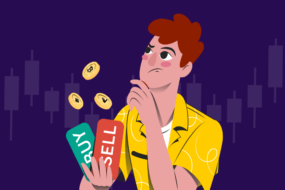

There is an interesting story behind the terms ‘bear’ and ‘bull’ from an investment perspective. Both words are believed to refer to the respective animals’ fighting styles.

A bear starts high, attacks its prey with claws facing downward, and puts all its weight down. Whereas a bull attacks with its horns in the upward direction. Similarly, a downward market is called a bear market, while an upward market is called a bull market.
This article will focus specifically on the crypto bear market, how to stay safe while involved in the market and how to take advantage of it.
Technically, a crypto bear market (or a ‘crypto winter‘) occurs when the value of the cryptocurrencies has fallen by at least 20% from previous highs and continues to decline.
The latest example would be the Bitcoin crash in late 2021, when the BTC price fell from around $68,000 to less than $50,000 over a few days. The BTC price hovers around $19,000 in September 2022, owing to a continuous drop. Before this instance, Bitcoin fell from $20,000 to $3,200 due to the crash in December 2017.
This kind of downward movement destroys investors’ confidence in the market. It negatively impacts their outlook, leading to a further dip in the crypto price and creating a vicious cycle.
Typically, during a bear market, the economy tends to be slow with high unemployment rates. The downtrend could occur due to geopolitical issues, market bubbles, poor economic policies, or unexpected global crises (like a pandemic).
You can expect two different reactions from investors during a bear market. Most act cautiously and hold off on investments as they expect more bad news to come. In contrast, the remaining folks try to purchase assets at rock bottom. However, it can be hard to accurately pinpoint the lowest price, whether of stock or cryptocurrency. Prices might drop further from the supposedly lowest point and not recover.
Despite these hurdles, a bear market eventually calms down, and investors regain their confidence, starting a new bull cycle.
A bear market can be triggered by war, pandemics, government interventions, economic crises, or political instability. It leads to a continuous price drop, making investors lose confidence in the recovery, resulting in a further downward trend.
The stock market has decades of data points for investors to rely upon. Hence, you can have a fair idea about when a bear market will start. However, the crypto market began in 2009 only, making it younger. Thus, predicting a bear market won’t be an easy task.
Though there might be multiple causes for a bear market, investors can look for some evident signals that suggest an upcoming downward trend.
The Fed hikes the rate to ease inflation by slowing the economy. The goal is to slow down the increasing prices, but a slower economy eats into corporate profits and investor confidence. Thus, investors end up selling their assets, starting a downward trend.
China is a notable example of restrictive interventions over crypto mining operations.
One example would be Jamie Dimon, CEO of JPMorgan. He is known for his blatant remarks against Bitcoin.
This is the first symptom of investors’ negative sentiments and uncertainty in the market.
The asset’s price in the current market is higher than in the futures market.
Crossing of 50-day moving average and 200-day moving average is a standard technical indicator denoting trend reversal.
Below are the typical attributes of a bear market.
A bull market refers to a rising asset demand due to positive investor sentiments. A favorable economic condition, high employment levels, and sustained increases in asset prices are some clear indicators of a bull market.
The intensity of price appreciation varies depending on the type of asset. In the case of cryptocurrencies, it exhibits more robust and consistent bull-run phases than stocks — typically a 40% increase in crypto prices over a few days. This volatility is due to the smaller market cap of the cryptocurrencies compared to other asset classes. The global equity market cap is more than 100 Trillion USD. But the crypto market cap is a measly 938 Billion USD.
The bull market lasts until the public confidence wears out. After a while, it turns into a bear market, and the cycle repeats.
The bear market can be a blood bath, especially for new crypto investors without sufficient experience. They tend to commit mistakes, damaging their financial and emotional well-being.
Hence, there are some critical mistakes to avoid during bearish movement.
Panic is a universal response to a crisis or a danger. It happens when one experiences intense fear and anxiety. In the context of investing and trading, panic selling is the action of overselling cryptocurrency due to fear. Panic selling is likely the most common mistake committed by investors. As cryptos are a risky asset class, it has a higher chance of panic selling than other assets.
It’s important to remember that no asset follows a linear path. Selling an investment must be a well-thought-out move rather than a reactionary decision devoid of logic.
This is another prevalent mistake new crypto investors make. In the pursuit of timing the market, investors delay the purchase as they believe there is still room for more dips. Eventually, one of the two things occurs,
In the crypto world, things can quickly change. The bear market can suddenly shift into a bull market, rapidly increasing the asset price and leading to missed opportunities.
Dollar-cost averaging (DCA).
While panic selling indicates shutting down everything at once, excessive or overtrading refers to frequently correcting the mistakes and ending up doing more harm than good. Investors, in an attempt to earn back their earlier losses or missed trades, make emotional decisions and incur more losses and additional trading fees.
The market doesn’t care about your emotions. Hence, it’s advisable to keep it aside while making investment decisions.
You can make the most out of the crypto bear market through the below strategies.
Your investment journey will always be filled with ups and downs. Hence, you should spread your investment into smaller amounts and invest periodically despite the existing trend (whether bullish or bearish). This strategy is called Dollar-Cost Averaging (DCA). Averaging the market is a better strategy to maximize your return potential instead of investing all at once or waiting for the right moment.
There is a famous adage, “Don’t put all your eggs in one basket.” It is true when it comes to investment. Investors should diversify their portfolios with different asset classes (like stocks, bonds, crypto, gold, real estate, etc.) instead of relying on just one or two. The proportion of the asset must be designed based on the investor’s risk profile, financial goals, and so on.
Even if one of the assets in a well-diversified portfolio fails, the remaining could cover the loss and give additional profits.
Staking refers to crypto holders locking their cryptos in a blockchain network to become a validator. They earn rewards for validating the transactions in the network. It is applicable in PoS-based blockchains like Ethereum (ETH), Cardano (ADA), and Solana (SOL).
Yield Farming refers to crypto holders offering their cryptos to Decentralized Finance (DeFi) platforms. They are called liquidity providers as they increase the liquidity of these platforms and earn rewards in the process.
How to identify if we are in a bull or bear market? The simple answer could be to watch the direction of the overall asset prices. Yet, there are a few things to be taken note of.
Markets are the reflection of investors’ reactions. However, these reactions affect stock and cryptocurrency differently. In crypto, the volatility quotient is much higher, and the price movements tend to be faster as soon as bullish or bearish trends emerge. Moreover, the timeline of the trend can be short-lived, sometimes only lasting between a few days to months. On the other hand, it’s the opposite in the case of stocks.
Below are the notable differences between bull and bear markets, irrespective of the asset classes.
| Parameters | Bull Market | Bear Market |
| Economic Scenario | Strong economic activity | Declining economy |
| Trade Volume | High | Low |
| Asset Price | High | Low |
| Supply & Demand dynamics | Low supply, high demand | Low demand, high supply |
| Liquidity | High | Low |
| Unemployment Rate | Low | High |
| Investor Sentiments | Positive | Negative |
Ideally, investors can purchase cryptos at a lower price and sell them at the peak of the next bull market. Another approach is selling the existing investments after detecting bearish signals and then buying back these holdings at a much lower price as the market declines.
Regardless, both strategies are risky and challenging to implement as no one can accurately predict how long a bear market will last or which is the lowest bottom. As a result, there is a higher chance of making a wrongly timed trade or missing out on a good investment.
For these reasons, the bull market seems favorable to everyone. But the bear market has the possibility of higher returns as even good assets are available at a discounted price. Unfortunately, people lose out on the opportunity as they lack knowledge of doing research and have low confidence to invest in a bear market.
Therefore, we suggest you check out Coin Sets by Mudrex. The portfolio designed in the Coin Set is research-backed by investment experts. Also, the proportion of each crypto is such that investors get a better return by taking the optimum level of risk.
Many factors drive the crypto bull and bear markets. Whether you’re investing during a bull or bear market, it’s important to remember that risks are associated with both strategies.
Thus, it’s advisable to do your research to ensure that you’re making the best possible decision given the circumstances.
It’s better to invest during both bull and bear markets to capture the benefits of the whole cycle. During a bear market, the investors get the opportunity to buy the asset at a lower price, and they can sell it during the bull run.
In crypto, considering its volatile nature, you are likely to run through multiple bullish and bearish trends.
No one can tell how long a bear market will last, especially if it’s driven by recession or similar circumstances. It applies to any asset class, whether crypto or stock.
Currently, we are, in fact, in a crypto bear market (or a ‘crypto winter’). Since hitting an all-time high in market capitalization in November 2021, the crypto market has seen an extended drop of more than 70%.