
Ever wanted to own a piece of Apple or Tesla but balked at the price tag? Fractional shares solve exactly that problem. Instead of needing the full price of one share, fractional shares let you buy a slice of it, sometimes for as little as Rs.100!
So a $200 stock is no longer out of reach just because you only have ₹500 to invest.

This guide covers what are fractional shares, how they work, and exactly how Indians can start fractional investing today.
Fractional shares are exactly what the name suggests: less than one full share of a company’s stock. If a single share of a company trades at $1,000 and you invest $100, you own 0.1 of a share, per FINRA’s own definition of the concept. This partial stock ownership works the same way whether you’re buying $10 or $10,000 worth: the dollar amount you commit gets converted into however many shares (whole or fractional) that buys.
Fractional investing exists because some of the world’s most valuable companies also carry some of the highest per-share prices, and fractional stock investing removes that barrier so smaller investors aren’t priced out of expensive stocks entirely.
Say a NASDAQ-listed stock trades at $500 a share. Instead of needing the full $500, you tell your platform you want to invest $50, and you receive 0.1 of a share. Your fractional ownership entitles you to a proportional slice of everything a full share gets: price movement, dividends (paid out based on your fraction), and in most cases, a stock split adjusts your fraction the same way it would a whole share.
Where fractional shares differ from full shares is mainly around control: voting rights on corporate matters aren’t always available to fractional holders, and some platforms restrict transferring a fractional position between brokers, per FINRA’s investor guidance.
Not directly on NSE or BSE. SEBI and India’s Ministry of Corporate Affairs don’t currently permit Indian companies to issue or trade fractional shares domestically; SEBI approved its first sandbox pilot for a fractional-shares startup only in mid-2025, and it hasn’t scaled to the broader market yet.
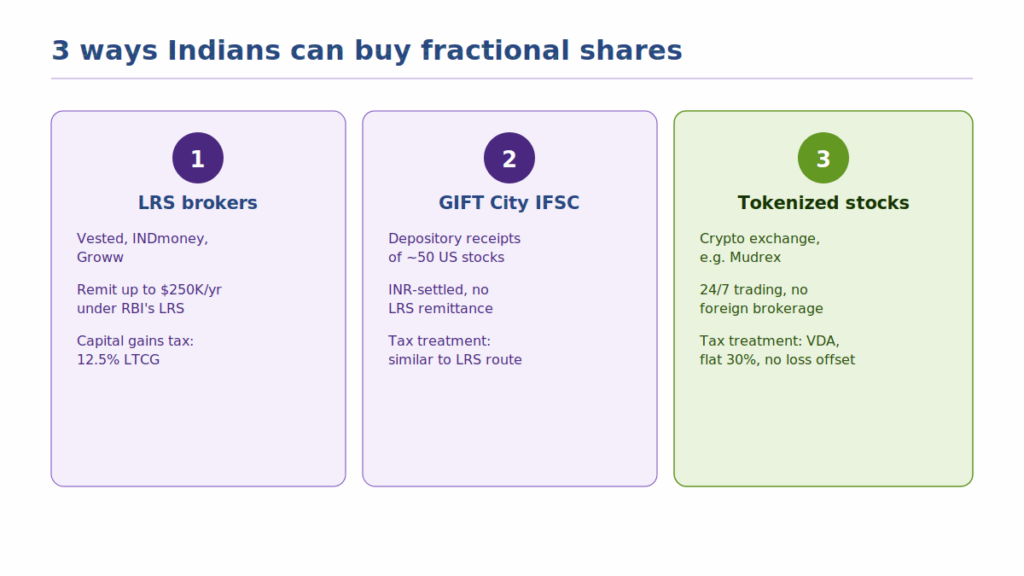
For US stocks specifically, though, Indians have three real ways to buy fractional shares:
| Route | Minimum Investment | Settlement | Tax Treatment |
| LRS brokers | ~$1 | T+1/T+2, US market hours | Capital gains (12.5% LTCG after 24 months) |
| GIFT City IFSC | INR-denominated | INR-settled | Capital gains, similar to LRS route |
| Tokenized stocks | Varies by platform | 24/7, instant | Taxed as a VDA: flat 30%, no loss offset |
If you’re curious how the crypto-native version works in practice, our guide on investing in US stocks from India walks through the tokenized route step by step, and you can also read tokenized vs traditional US stocks for a full tax and access comparison before you decide.
The underlying stock investing exposure is identical, fractional ownership and full ownership both move with the same share price. The practical differences show up around the edges: voting rights are sometimes limited for fractional holders, transferring a fractional position to another broker isn’t always possible “in kind,” and extended-hours trading may not be available on the fractional portion, per FINRA. For most buy-and-hold investors doing long-term investing rather than active trading, none of these gaps matter much day to day.
Yes to both, generally. You receive dividend yield proportional to your fraction, and most platforms let you sell fractional shares anytime during regular market hours, the same as a full share. The one caveat: if a stock’s fractional-trading eligibility changes, it’s technically possible (though rare) to end up holding a fractional position you can’t easily sell later, per FINRA’s investor notice.
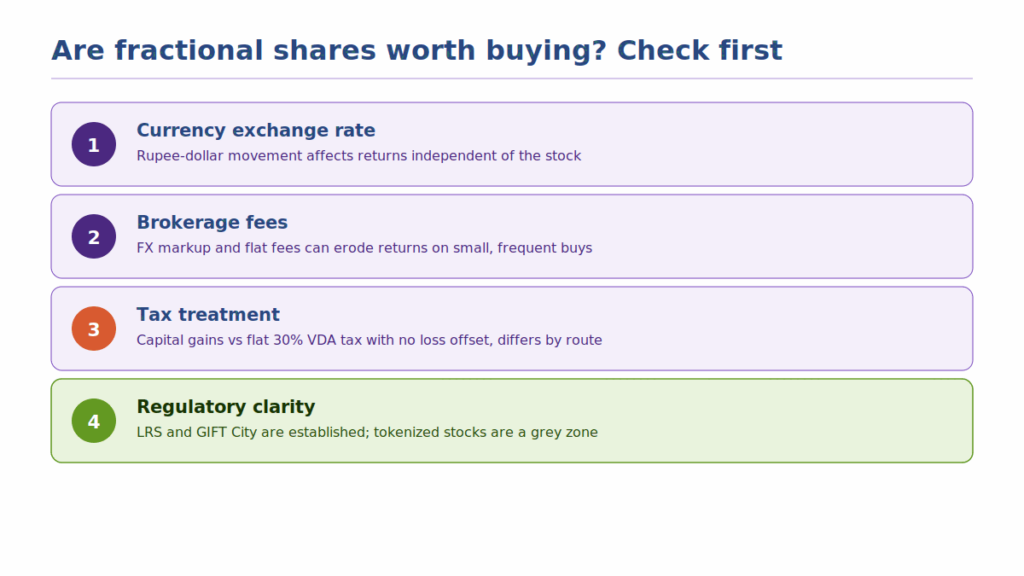
For most beginner and small-budget investors, yes, especially if the alternative is skipping international investing entirely because a single share felt out of reach. But weigh a few real factors before you buy fractional shares:
Fractional shares make it possible to own a piece of Apple, Tesla, Nvidia, or any other expensive stock without needing the full share price upfront.
Indians can’t yet do this on NSE or BSE directly, but LRS brokers, GIFT City IFSC platforms, and tokenized stocks all offer real ways to buy fractional shares of US companies today.
If you’re already comfortable with fractional ownership through crypto, whether that’s Bitcoin, Ethereum, or Solana, tokenized stocks extend that same idea to equities. Explore tokenized US stocks on Mudrex, download the Mudrex app to get started, or subscribe to the Mudrex YouTube channel for regular market updates.
A fractional share is less than one full share of a company’s stock, bought by dollar amount rather than share count.
You invest a dollar amount, and the platform converts it into a proportional fraction of a share based on the current share price.
Not on NSE or BSE directly, but yes for US stocks, through LRS brokers, GIFT City IFSC platforms, or tokenized stocks.
For most small-budget or beginner investors, yes, though currency risk, fees, and tax treatment vary by platform and route.
Yes, proportional to the fraction you hold.
Generally yes, during regular market hours, though eligibility for a specific stock can occasionally change.
Price exposure is identical; the differences are around voting rights, transferability between brokers, and extended-hours trading access.
This article is for informational purposes only and does not constitute investment, tax, or legal advice. Tax rates, LRS/TCS thresholds, and the regulatory status of tokenized assets in India are subject to change. Consult a SEBI-registered investment adviser and a qualified tax professional before making investment decisions.