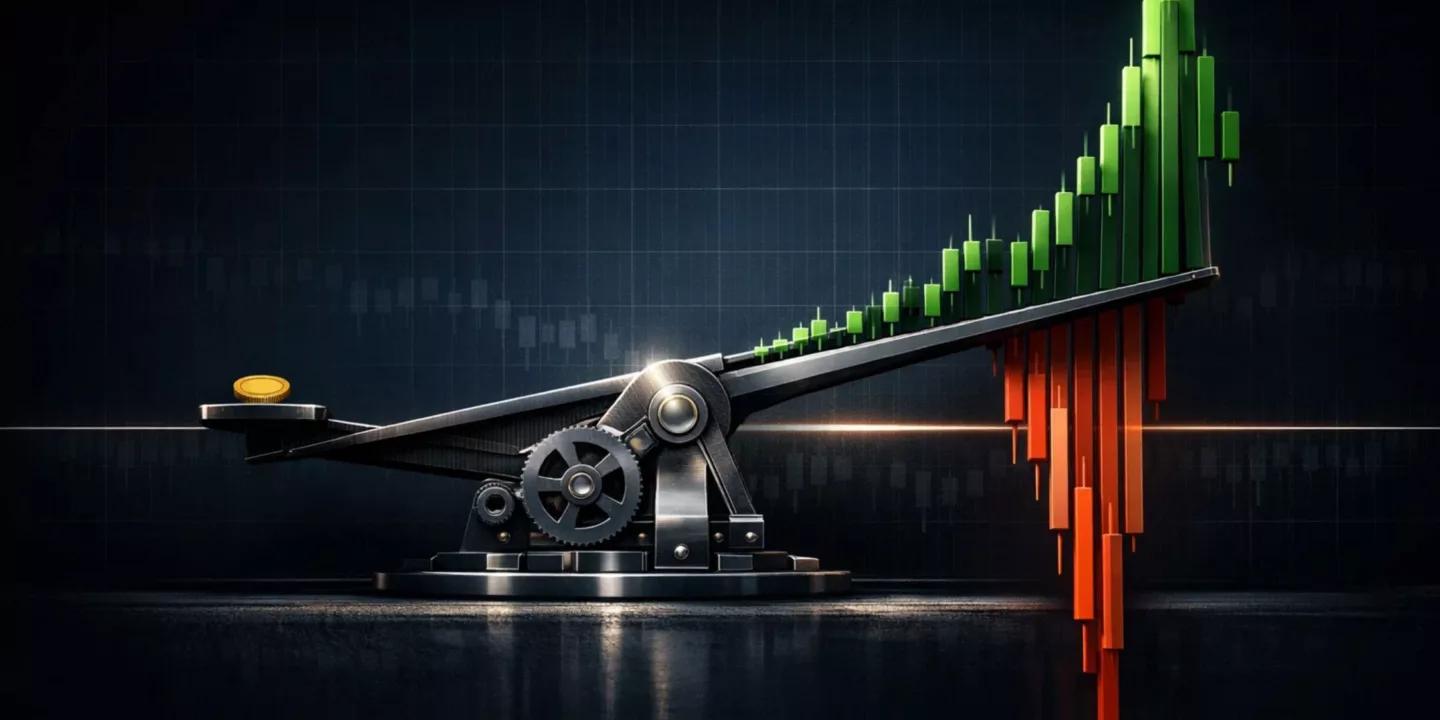

Margin trading allows traders to amplify their exposure to crypto markets using borrowed funds. While this can significantly boost profits, it also magnifies losses and liquidation risk. Understanding leverage, liquidation mechanics, volatility, and risk management strategies is essential for survival and long-term profitability in crypto futures trading.
Margin trading is borrowing capital from an exchange to increase your trading position beyond your own funds.
Traders must maintain a collateral deposit to cover potential losses. This setup allows controlling a larger position than your actual investment, increasing both profit potential and exposure to losses.
Leverage represents the ratio of borrowed funds to your own capital. For instance, 10x leverage allows a ₹10,000 investment to control ₹1,00,000 in crypto.
Notional value grows with leverage, but your risk and liquidation threshold become tighter. Understanding this distinction between nominal and effective leverage is key to risk management.
In spot trading, you can only invest your available capital, and profits or losses are directly proportional to price changes.
Margin trading amplifies both upside and downside, as even small price movements are multiplied by leverage. This creates a higher-risk environment that requires precise risk planning.
Leverage multiplies gains. For example, a ₹10,000 BTC trade at 10x leverage controls ₹1,00,000. A 5% price increase yields ₹5,000 profit instead of ₹500.
The higher the leverage, the greater the ROI for the same market movement. This demonstrates why traders are drawn to margin trading despite its risks.
Even a minor 2-3% price swing can result in substantial gains in leveraged positions. Traders can benefit from short-term fluctuations that would barely impact spot trading.
Precision in entry and exit points is critical, as errors are amplified by leverage.
Profits can be reinvested to compound account growth faster than spot trading. Leveraged gains increase capital for subsequent trades, accelerating growth.
However, this also increases risk, as leveraged losses compound in the same manner.
Losses are magnified in the same way as gains. A 5% adverse move in a 10x leveraged trade can wipe out 50% of capital.
Understanding the relationship between leverage and potential loss is essential to prevent catastrophic account drawdowns.
Recovering from losses becomes exponentially harder with leverage. For instance, a 50% loss requires a 100% gain to return to break-even.
This asymmetry highlights the importance of risk limits and capital preservation strategies.
Leverage creates a psychological imbalance: losses are felt more acutely than gains. Emotional reactions to adverse moves can lead to over-leveraging or revenge trading, accelerating potential liquidation. Awareness and discipline are key to surviving in leveraged markets.
Liquidation occurs when a position falls below the maintenance margin, prompting automatic closure by the exchange.
This protects both the trader and the exchange from negative balances. Awareness of liquidation thresholds is crucial for safe leverage usage.
The liquidation price depends on entry price, leverage, and margin ratio. Higher leverage reduces the price movement tolerance, making even small adverse market changes capable of triggering liquidation. Understanding the formula allows traders to plan buffer zones.
Example
A BTC trade with ₹10,000 capital at 10x leverage might be liquidated if the price drops by 10%. The exchange closes the position automatically, using the collateral to cover the loss. Traders must track margin requirements to avoid surprise liquidations.
Crypto markets regularly swing 5-10% intraday, which is multiplied by leverage. Position sizing must account for volatility; otherwise, trades risk liquidation even with small market moves.
Rapid price swings can trigger a domino effect: one liquidation can lead to stop-loss triggers for other traders. Understanding market structure and volatility patterns helps mitigate cascading losses.
Combining high leverage with volatile markets dramatically increases risk. Traders must reduce leverage or increase margin buffers to survive in highly volatile conditions.
Cross margin uses total account equity as collateral for all positions. This allows flexibility but exposes your entire portfolio to losses from a single position.
An isolated margin confines risk to a single position. Only the capital allocated to that trade is at risk, limiting potential portfolio-wide losses.
| Margin Type | Pros | Cons |
| Cross | Greater capital flexibility; can maintain larger positions | Single losing trade can impact entire portfolio |
| Isolated | Risk confined to one trade; safer for volatile assets | Limits potential capital efficiency for multiple trades |
Funding rates are periodic payments exchanged between long and short positions in perpetual futures to keep the contract price aligned with the spot market.
Ignoring these payments can slowly erode profits over time, especially if a trader holds a leveraged position for multiple days or weeks.
Understanding the schedule and amount of funding fees is crucial to accurately measure net returns on leveraged trades.
Leveraged positions amplify the effect of funding payments. Even a trade that appears profitable on price movement can turn into a net loss after accounting for funding costs.
Traders must monitor these rates and factor them into position sizing and duration, as high leverage can multiply both gains and the cost impact, potentially negating expected profits.
Holding leveraged trades long-term increases cumulative exposure to funding fees, slippage, and liquidity costs. Over time, these “hidden costs” can significantly reduce net gains or deepen losses.
Effective traders account for these costs in their strategy and often prefer short-term or hedged positions to minimize erosion of returns.
Nominal leverage, such as 10x, does not always reflect actual exposure. Effective leverage accounts for total equity versus position size.
Misjudging effective leverage can result in unexpected liquidation or larger-than-anticipated losses, even if nominal leverage seems manageable.
Monitoring effective leverage across all open positions is critical. Correlated trades in the same asset or sector can increase overall risk beyond individual position levels.
Understanding portfolio-level exposure helps prevent cascading losses that could wipe out multiple positions simultaneously.
Regular reviews of drawdowns, margin usage, and overall equity ensure that positions remain within acceptable risk thresholds.
This proactive monitoring allows traders to adjust leverage, take profits, or reduce exposure before a significant market move causes forced liquidation.
Big wins can inflate confidence, prompting traders to increase leverage or overtrade without strategic planning. This emotional response increases exposure to potential losses and can quickly undo prior gains if risk limits are ignored.
After suffering losses, traders often take impulsive, high-risk trades to recover quickly. Using leverage during these moments amplifies potential losses and increases the probability of account blow-ups, highlighting the importance of emotional discipline.
Leveraged trading intensifies emotional responses. Even minor market swings can trigger anxiety, overtrading, or premature stop-outs. Maintaining a disciplined trading plan and following pre-defined risk rules is essential to mitigate the psychological impact of amplified gains and losses.
Risk of ruin refers to the probability of losing so much capital that recovery is impossible. Leverage increases this probability dramatically, as small adverse moves are magnified. Traders must understand their capital at risk to avoid catastrophic account losses.
High leverage accelerates loss potential. A minor unfavorable market move can wipe out the entire account if not managed with strict risk limits. Calculating risk per trade and maintaining proper stop-loss strategies are essential practices to reduce the likelihood of failure.
Professional traders prioritize capital preservation above all. Surviving through losing streaks and volatile market periods is essential before considering aggressive profit strategies. Consistently managing risk is the foundation for long-term trading success.
Leverage can enhance returns in short-term trending markets. Traders need precise entry and exit points and a strong understanding of momentum indicators to capture amplified gains safely without overexposure.
Margin trades can hedge against potential losses in spot holdings. Using short positions or offsetting trades protects a portfolio during downturns, allowing traders to maintain exposure without liquidating core assets.
Experienced traders use leverage to deploy smaller amounts of capital across multiple trades, increasing overall portfolio efficiency. Proper risk management ensures that amplified positions do not compromise account safety.
In non-trending markets, leverage magnifies losses from minor price fluctuations. Funding fees and stop-outs can further erode equity, making margin trading counterproductive.
High leverage during sudden news announcements or market shocks can trigger cascading liquidations. Traders should avoid entering positions during high-impact events unless well-prepared with hedging and stop-loss measures.
Unprepared or inexperienced traders should avoid margin trading. Without pre-defined stop-loss, position sizing, and risk management plans, beginners are highly susceptible to rapid account liquidation.
Using moderate leverage (2x–5x) allows trades to withstand normal volatility. Professional traders rarely exceed 5x–10x leverage, ensuring positions survive minor adverse price movements.
Limiting risk to a small percentage of capital preserves account longevity. Even a series of losing trades will not destroy the account, allowing traders to recover and capitalize on future opportunities.
Predetermined stop-loss orders prevent small losses from compounding into catastrophic losses. This disciplined approach keeps traders aligned with risk limits and prevents emotional decision-making.
Keeping a buffer between the entry price and liquidation price reduces forced liquidations. A safe distance allows the trade to fluctuate within normal volatility without triggering automatic closures.
Monitoring P&L, funding fees, and drawdowns allows traders to adjust leverage, position sizing, and trading strategy dynamically. Regular evaluation ensures sustainable growth while minimizing risk exposure.
Margin Trading Pros and Cons
Margin trading provides higher capital efficiency, shorting capability, and amplified ROI potential. It enables traders to deploy capital efficiently, hedge spot positions, and capitalize on short-term market opportunities with limited initial capital.
Liquidation, accelerated losses, emotional stress, and hidden funding fees are the main risks. Mismanagement of leverage or ignoring market volatility can quickly wipe out account balances, emphasizing the need for structured risk management.
| -Pros | Cons |
| Higher capital efficiency | Risk of liquidation |
| Shorting capability | Emotional stress |
| Amplified ROI potential | Accelerated losses |
| Hedging flexibility | Funding fees and slippage |
Margin trading magnifies both profits and losses in crypto. Traders must understand leverage, funding costs, volatility, and psychological biases to survive and thrive. Structured risk management, stop-loss discipline, and awareness of effective leverage are crucial for long-term success.
Learn structured margin trading strategies and risk management with Mudrex Learn or the Mudrex YouTube channel, designed for both beginners and professional crypto traders.
2x–5x leverage is typically safe, allowing trades to absorb normal market volatility without risking rapid liquidation.
Typically, no, but extreme slippage or sudden price gaps can cause small additional losses beyond initial margin.
The exchange automatically closes your position once it hits the maintenance margin threshold to prevent further losses.
No, it is primarily designed for short-term trades, hedging, and speculative opportunities. Long-term holding increases funding and liquidation risks.
No. Leverage amplifies both gains and losses, and poor risk management can lead to rapid account depletion.