How to Read Crypto Futures Charts: A Complete Guide for Perps & Dated Futures
Perpetual futures (“perps”) trade 24/7 without expiry, while dated futures have set settlement dates. To confirm moves, look beyond price: check Open Interest (OI) and funding rates—they reveal whether a trend is genuinely supported or just a temporary squeeze.
Why this matters for beginners: Most “how to read crypto futures chart” guides stop at price action. Futures add leverage, funding, OI, liquidations, order-flow—these explain who is pushing price and how long the move can last. If you learn to glance at these alongside price, your read improves instantly.
Quick checklist (every time you open a chart):
What’s the trend? (Up, down, or sideways.)
Are OI and funding supporting it? (Rising OI with trending price = stronger trend. Extreme funding = crowded side.)
Where are the obvious levels? (Prior day high/low, session highs/lows, VWAP, round numbers.)
What could trigger a sharp move? (Liquidation clusters above/below, news times, session overlaps.)
The goal: pick the chart type that makes the move easiest to see. Don’t overcomplicate it.
Chart Type
What you see
When it helps
Candlestick
Open/High/Low/Close (with colored bodies and wicks)
Best all-rounder; learn patterns and wick behavior
Heikin Ashi
Smoothed candles (averaged); trends look cleaner
When noise is high and you want to “see the trend” clearly
Bars
Thin bar with left tick = open, right tick = close
If you like less color, more minimal OHLC data
Line
Closes connected by a line
Quick big-picture direction; hides intrabar noise
Chart reading reading tips
How to read candlestick charts (the basics):
Green body = close above open (buyers won). Red body = close below open (sellers won).
Long upper wick = buyers pushed up but sellers pushed back. Long lower wick = sellers pushed down but buyers pushed back.
Tiny body + long wicks (doji-like) = indecision; wait for follow-through.
Bar vs candlestick: same information (OHLC); candlesticks just make direction obvious with color.
Heikin Ashi note: smoother look = easier trend view, but the candle may not match the exact current price—use it for trend context, not precision entries.
Timeframes & Session Logic for 24/7 Markets
Pick a timeframe that matches your lifestyle and risk.
Higher TF (macro):1D / 1W — big trend and key levels; great for context.
A simple multi-TF routine (works for most beginners):
Start at 1D or 4H: mark major trend and obvious levels (weekly opens, prior highs/lows).
Drop to 1H: find the directional bias and fresh levels (today’s VWAP, session highs/lows).
Drop to 15m or 5m: plan the entry, stop, and target.
Sessions (even in 24/7):
Many traders box Asia / Europe / US hours on their charts. Volatility often clusters near session opens or overlaps (EU→US).
If you day trade, note your local time vs. high-volume windows you want to be active in.
Perpetuals vs Dated Futures
Perpetual futures (perps) are contracts with no expiration date. Traders can hold them indefinitely, subject to periodic funding payments that tether the contract’s price to the spot market. The funding mechanism works like this: if the perp price is above the spot price, longs pay shorts; if the perp is below spot, shorts pay longs. This incentivizes arbitrage (e.g. buying spot and selling perp when it’s at a premium) and keeps prices in line. Perps dominate crypto volumes (often 80–90%) because they allow constant 24/7 trading without rollovers.
Dated futures, by contrast, have fixed settlement dates (weekly, quarterly, etc.). Before expiry, their price can be above or below spot. This price difference is called the basis (futures price minus spot price). A positive basis (futures > spot) is called contango (a premium), while a negative basis (futures < spot) is backwardation. In theory, as a dated future approaches its expiry, its price converges to the spot price (so basis → 0). Traders often exploit basis by doing cash-and-carry arbitrage: buy the cheaper leg (spot) and sell the richer (futures or perp), locking in the spread. In perps, the “carry” is realized via funding: consistently positive funding (perp above spot) effectively means longs are paying to hold, so one could short the perp and hold spot to earn that rate.
In summary, the key differences are:
Perpetual futures: Trade 24/7, no expiry, use funding to align with spot.
Dated futures: Expire on a set date, basis closes at zero by expiry.
Basis/Premium: Futures price minus spot price, indicating contango/backwardation.
The Core Read: Price + Volume + Volatility
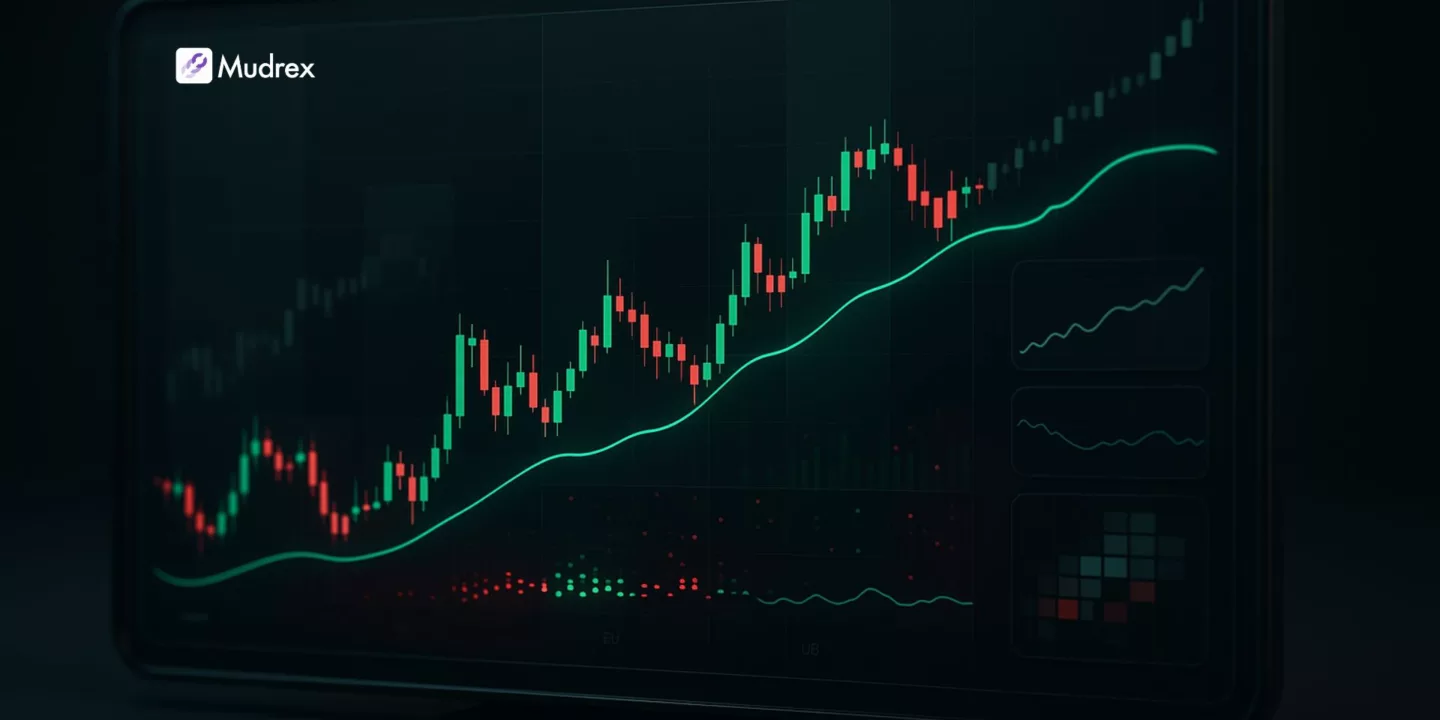
Reading any crypto futures chart starts with the price action itself. A candlestick shows four key values: open, high, low, and close. The candle’s body (colored green for up, red for down by convention) tells you open vs close, and the wicks (lines) show the period’s highest and lowest prices. For example, a long green body with little upper wick means buyers dominated. A red candle with a long lower wick (hammer) indicates sellers pushed price down but buyers regained it before the close. In general, alternating green/red candles mark indecision, while clusters of one color show momentum direction. Learning to interpret wick lengths, body size, and color gives instant insight into intra-bar sentiment.
Below the price pane, volume bars indicate how much trading occurred each period. A sudden spike in volume often precedes a breakout or reversal. High volume suggests strong conviction (e.g. many traders piling in), whereas low volume may signal a weak move. A volume spike can indicate strong interest and potential price movement For instance, a break of resistance on high volume is more credible than one on thin volume. Always check if price moves are backed by volume – strong trend moves usually have expanding volume, while dry moves on little volume can be suspect.
Traders also overlay value-area metrics. A popular tool is the VWAP (Volume-Weighted Average Price). VWAP plots the average price of the asset, weighted by volume, over the trading session. In intraday trading, prices above the VWAP line are often seen as bullish (buyers in control) and below as bearish. VWAP can act like dynamic support/resistance: price often gravitates back to it after strong moves. For example, a rally that becomes overextended may pause or reverse around the VWAP as profit-taking ensues. Many traders will scale out of or enter positions near VWAP.
Finally, assess volatility using measures like the ATR (Average True Range). The ATR quantifies the average range of price swings, adapting to current volatility. You can use ATR to size stops and position size. For instance, if BTC’s ATR (14) is $500, placing a stop 1×ATR or 1.5×ATR ($500–$750 away) gives the trade some breathing room against normal volatility. As AVATrade explains, “if the ATR is 150 pips, a stop of more than 150 pips will give your trade enough breathing room”. In practice, larger ATR means wider stops (and smaller positions), while a quiet market (low ATR) allows tighter stops. Using ATR for stops helps avoid getting whipsawed by ordinary noise, ensuring stops are proportional to volatility.
Open Interest (OI): OI measures how many crypto futures contracts are currently open. Read it alongside price: when price and OI rise together, new money is joining the move and the trend is likely strengthening; when price falls while OI rises, shorts are building and bearish pressure is increasing. If OI drops during a move, positions are being closed, so momentum may fade.
Funding Rate (perps): Perpetuals use funding—periodic payments between longs and shorts—to keep prices near spot. Positive funding means longs pay shorts (crowded long bias); negative means shorts pay longs (crowded short bias). Extreme readings often act as contrarian signals: very high positive funding after a rally warns of overheated longs and potential mean reversion, while very negative funding signals crowded shorts that can be squeezed.
Liquidation Heatmaps: Heatmaps highlight price zones where many leveraged positions would be liquidated. Price is frequently attracted to these clusters like a magnet, and once tagged, forced liquidations can create sharp “sweep-and-reverse” moves. Treat major clusters as potential support/resistance and avoid chasing right into them—wait for the sweep and then judge the reaction.
Order Book & Footprint (Delta): Footprint charts show executed buy vs. sell aggression (delta = buys − sells). Breakouts that print weak or negative delta—or show absorption, where heavy volume fails to move price—often stall or fail. Likewise, delta divergences (e.g., price makes a new low but delta is less negative) hint that selling pressure is waning and a reversal toward the mean or prior balance may be brewing.
Support/Resistance That Actually Matters in Futures
Key S/R levels in crypto futures often come from recent and psychological levels, as well as data-driven zones:
Session Highs/Lows & Prior Day High/Low (PDH/PDL): The previous trading day’s top/bottom are natural barriers. Price often reacts to these old highs/lows as support or resistance. Similarly, the high/low of the current or recent 24h session can be marked.
VWAP Bands: The VWAP line and its standard-deviation bands act like dynamic support/resistance. Altrady notes VWAP can form “barriers that separate supply and demand zones,” serving as moving S/R. For example, in an uptrend the VWAP may provide a temporary support floor; in a downtrend, price may stall at VWAP overhead.
Weekly and Monthly Opens: The open price on a new week or month is a psychological pivot. Traders watch if price holds above or below these anchors. A decisive break below the weekly open, for instance, can trigger bearish continuations (as often seen in crypto futures news commentary).
Round Numbers: Even in crypto, round numbers like $10,000, $50,000, $100 are watched by many. These whole levels can act like magnets (people set stops/limits there). A long wick to a round figure and quick reversal is common – it’s a self-fulfilling S/R.
Fair Value Gaps (FVG): A Fair Value Gap is an imbalance left on the chart after a rapid move: a range where no trades occurred (often between three consecutive candles). Traders mark FVG zones as latent supply/demand. As TradingView analysis points out, when a strong candle creates an FVG, “the price often returns later to retest that gap before continuing”. Think of it as “delayed demand” – the unfilled orders in that range often get filled on a retrace. Watch for price pausing or bouncing near a known FVG.
Supply & Demand Zones: These are horizontal zones where price has repeatedly stalled or flipped. TrendSpider defines them as areas of significant selling (supply) or buying (demand) pressure. For example, if price once dropped sharply from $30K (strong supply), traders will later label $30K as a supply zone – price may hesitate or reverse there in the future. The flip side applies to demand zones (excess buying). Marking these zones (usually by shading a price range rather than a line) highlights where institutions or whales likely placed big orders.
In practice, combine these: if multiple cues align (e.g. PDH = round number = VWAP band = supply zone), that level is very likely to produce a reaction. Always zoom out and consider higher timeframe pivots too (weekly high/low, long-term trendlines). The more “tags” a level has, the stronger its support/resistance is likely to be.
Top Patterns for Crypto Futures
Certain price patterns recur frequently in crypto futures trading:
Breakout + Retest: A classic continuation setup. Price decisively breaks a horizontal resistance (or downtrend line), then pulls back to retest that level, which has become support. A successful retest often leads to the next leg up. Watch volume/flow on the retest: firm bids there increase confidence to go long.
Higher Highs & Higher Lows (HH/HL): A series of higher highs and higher lows defines a strong uptrend. Each new dip stops above the last low, and each rally tops above the last high. Identifying an HH/HL structure helps traders stay aligned long. Conversely, Lower Lows & Lower Highs mark a downtrend.
Wedge/Fakeout: Wedge patterns (ascending or descending) often precede reversals. However, a common trap is the false break: price appears to break out of the wedge only to snap back. Traders look for a breakout that holds, otherwise a quick reverse is likely (a “fakeout”). In crypto, sharp wedge breaks can produce big whipsaws. It pays to be cautious – confirmation (e.g. a close beyond the wedge or follow-through volume) is key.
Sweep of Equal Highs/Lows: Price often “sweeps” above recent highs (or below recent lows) briefly to trigger stops (liquidity grab) and then reverses. For example, BTC might spike to an all-time high for a minute, taking out stops, then plunge back. Recognizing this liquidity sweep pattern (especially on small timeframes) can signal a counter-trend move. If you see an obvious level get taken out with a quick fill and then significant opposite flow, that’s a likely sweep-and-reverse.
Change of Character (CHOCH): A term from market structure analysis. A CHoCH is formed when the trend’s sequence of highs/lows breaks. FluxCharts defines it as a sign that “the current trend is likely to reverse or lose momentum”. For example, in a bearish structure you might see lower highs and lower lows; a bullish CHoCH occurs when price finally makes a higher high after a lower low, signaling the bears have lost control. It literally means the “character” of the market changed. Traders treat a CHoCH as an early clue that a trend flip is happening, and may switch sides accordingly.
In addition to these, classic candlestick reversal patterns (hammer, doji, bullish/bearish engulfing) also appear in crypto and can provide entry signals, especially when they coincide with the above pattern contexts.
Putting It Together: 3 Ready-to-Use Playbooks
1) Trend-Follow Pullback (4H → 15m): Define uptrend on 4H (HH/HL, above MA/VWAP) with OI rising. On 15m, buy a pullback into VWAP or an FVG that holds; enter on a strong bullish candle. Stop: below swing or ~1–1.5× ATR. Targets: prior high, VWAP band; trail remainder.
2) Funding-Skew Reversion (1H): If price is stretched from VWAP, funding is extreme positive, and OI high (crowded longs), look for a failure at resistance or fakeout. Short the reclaim/loss of level. Stop: above the swing. Targets: VWAP or nearest liquidation cluster. Take partials if funding cools and OI rolls over.
3) Liquidity Sweep Reversal (5–15m): Identify equal highs/lows near a heatmap cluster. Wait for a sweep and quick reclaim with supportive delta/absorption. Entry: after the reclaim candle. Stop: beyond the sweep wick. Targets: VWAP first, then range opposite/balance.
Risk & Position Sizing for Leveraged Products
Use leverage sparingly; your edge is risk control. Risk 0.5–1% of account per trade, size positions so a full stop equals that amount. Place stops just beyond structure or ~1–1.5× ATR to avoid normal noise. Know your liquidation price and keep a buffer above maintenance margin—don’t trade at the edge. Example: on a $10k account risking 1% ($100), if your ATR-based stop is $50, size so $50 move equals $100 loss. Remember: 10× leverage means a 10% adverse move can nuke the position; 20× needs only ~5%. Combine volatility (ATR), clear invalidation, and disciplined sizing—leverage is a tool, not the goal.
FAQs
What is a crypto futures chart?
It plots time (X-axis) vs price (Y-axis) using candles/bars, but adds derivatives context: leverage, funding, open interest, and liquidations. Perpetuals (“perps”) trade 24/7 with no expiry, so traders also watch funding rates to gauge crowd bias.
How do I choose the right timeframe for crypto futures?
Match horizon to style: 1–5m scalps, 5–30m day trades, 1–4h swings, 1D/1W macro context. Start top-down (1D/4H for bias) → refine entries on 15m/5m.
How do funding rates affect price?
Funding aligns perps with spot: positive = longs pay shorts (crowded long), negative = shorts pay longs (crowded short). Example: after a sharp rally with spiking positive funding, expect mean-reversion risk as longs get stretched.
What does rising open interest mean?
Rising OI = new positions opening (more participation/leverage). Combos: Price↑ + OI↑ = trend build; Price↓ + OI↑ = shorts adding; Big move ± + OI↓ = exits/short-covering → move may fade.
How do I spot a bullish trend on futures?
Look for Higher Highs/Higher Lows (HH/HL) plus a VWAP reclaim/hold on dips. Bonus confirms: OI rising on pushes, neutral/cooling funding, and pullbacks holding FVG/supply-turned-demand.
What is a liquidation heatmap and how do I use it?
It visualizes clusters where levered positions would liquidate (stop/liq pools). These levels attract price, often get swept, then price may reverse—avoid chasing into clusters; trade the sweep & reaction.
Which indicators are best for crypto futures?
VWAP for intraday fair value/S-R, ATR for volatility-based stops/sizing, OI to confirm participation, Funding to spot crowd skew. They’re decision aids, not guarantees—combine with structure and risk rules.
When is the best time to trade crypto futures?
Typically EU open → US session brings the most volatility; US–EU overlap is peak activity, Asia is often quieter (varies by asset/news). Higher vol = more opportunity and risk—size down and widen stops accordingly.
Can AI analyze crypto charts?
Yes, as an assistant: scan patterns, test rules, and set alerts/backtests; it’s not a crystal ball. Use AI to systematize your plan, but keep discretion, risk caps, and post-trade reviews.
Anush is a crypto researcher dedicated to making blockchain insights clear and accessible. A proud Solana maxi who still appreciates a good Layer 2 debate, he dives deep into market trends so others don’t have to (but really should). Passionate about simplifying crypto, he strives to make the space less intimidating and a lot more relatable, one report at a time.