Ichimoku Cloud for Crypto Trading: A Practical Guide
Ichimoku Cloud is a multi-line momentum and trend-following system that gives a full market picture at a glance. In crypto trading, where volatility and noisy price action are normal, Ichimoku helps identify trend strength, support and resistance, and entry and exit signals across timeframes. This guide explains how to adapt Ichimoku to spot and derivatives markets with seven practical, testable strategies.
Ichimoku Cloud is one of the most complete trading indicators ever built. Because it shows
Trend
Momentum and
support–resistance at once.
Created in Japan in the late 1930s by Goichi Hosoda, the full method was published in 1969 under the name Ichimoku Kinko Hyo, which translates to “one glance equilibrium chart.”
The system, as you will come to see, was originally built and optimised for the Japanese Equities Market, i.e. it was calibrated for daily stock charts with a five-day trading week, so its default settings don’t perfectly fit crypto’s nonstop cycle.
However many have adapted this for Crypto trading decisions.
The Ichimoku indicators confirm it—Bitcoin's momentum is solid. The bull market is alive and well. Time to strategize your next move. https://t.co/c6BiHXejom
Ichimoku is best suited for higher timeframes like daily and weekly charts, where its signals are cleaner and less distorted by noise. But this doesnt mean that it is not suited for crypto trading, and this will be clear when you understand the logic and underlying principles of this indicator.
The Ichimoku Cloud is built on five calculated lines, each designed to balance past, present, and future price action:
Line
Technical Japanese Name
Formula
Purpose
Placement
Conversion Line
Tenkan-sen (転換線)
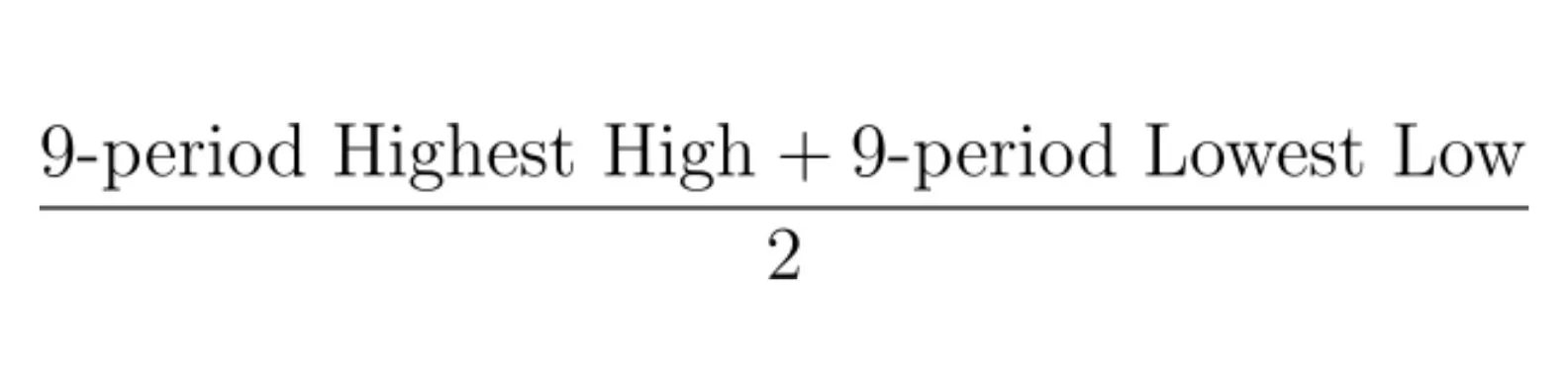
(9-period high + 9-period low) ÷ 2
Measures short-term momentum and minor trend shifts
Plotted on current period
Base Line
Kijun-sen (基準線)
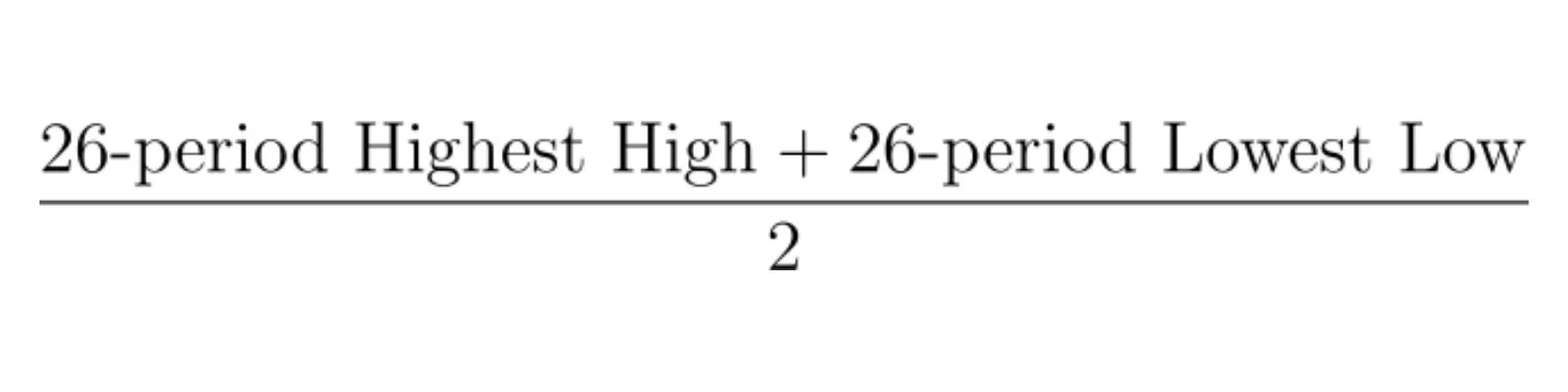
(26-period high + 26-period low) ÷ 2
Medium-term trend anchor, signals equilibrium
Plotted on current period
Leading Span A
Senkou Span A (先行スパンA)
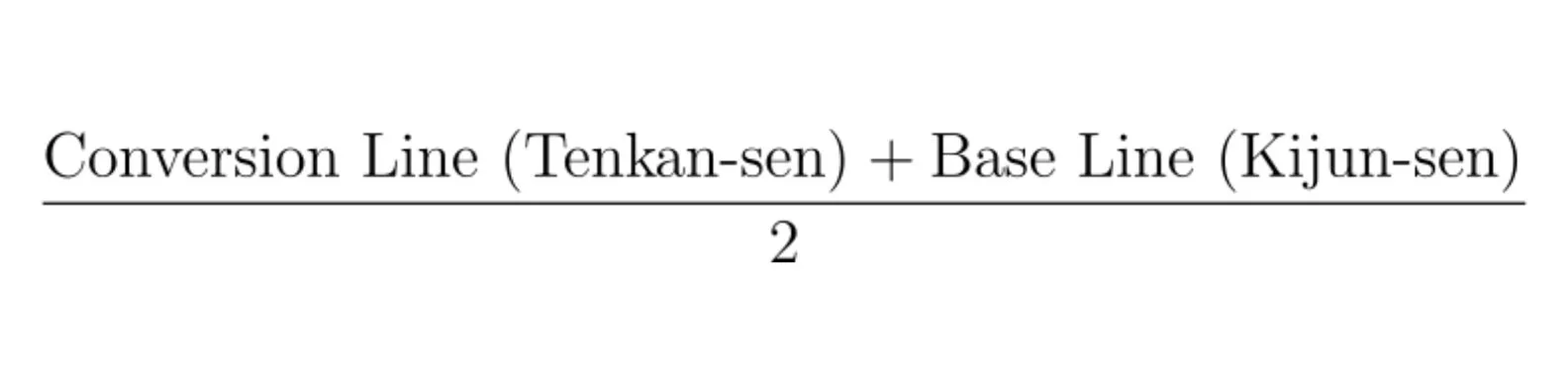
(Tenkan-sen + Kijun-sen) ÷ 2
Faster edge of the cloud, forward support/resistance
Plotted 26 periods ahead
Leading Span B
Senkou Span B (先行スパンB)
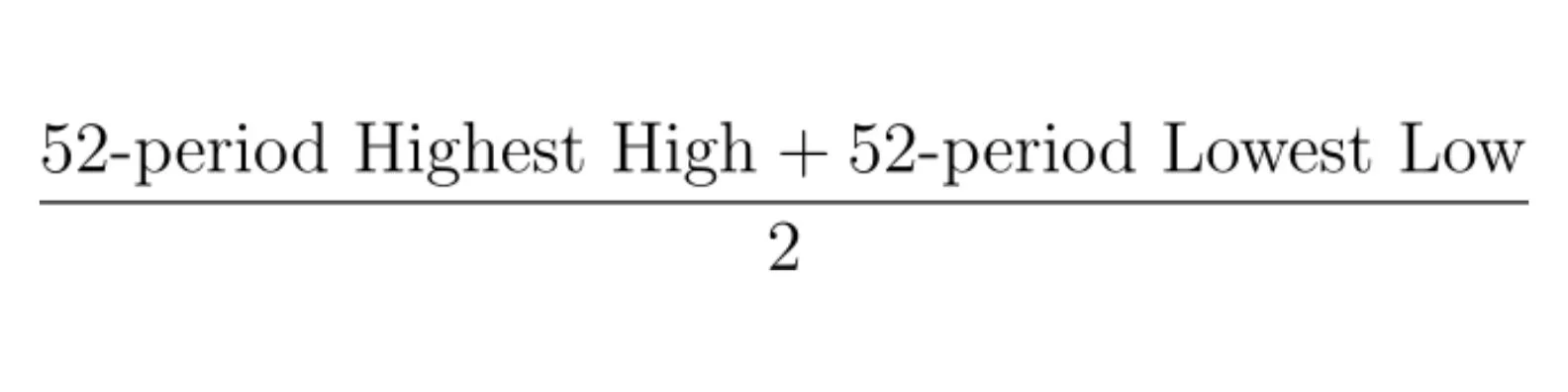
(52-period high + 52-period low) ÷ 2
Slower, more stable cloud edge; long-term equilibrium
Plotted 26 periods ahead
Lagging Line
Chikou Span (遅行スパン)
Current closing price shifted back 26 periods
Confirms strength of current trend vs. past price
Plotted 26 periods behind
Here’s how the Ichimoku cloud indicator works in Crypto
Component
Default Use (Traditional)
Adaptation in Crypto
Practical Role in Crypto
Conversion Line (Tenkan-sen)
9 periods (≈ 1.5 weeks of trading)
Often adjusted to 10 or 20 periods
Tracks short-term momentum in volatile moves; helps time entries/exits.
Base Line (Kijun-sen)
26 periods (≈ 1 trading month)
Adjusted to 30 or 60 periods
Medium-term trend anchor; acts as dynamic support/resistance in Bitcoin & ETH.
Leading Span A (Senkou Span A)
Avg of Tenkan & Kijun, projected 26 ahead
Same, but projection sometimes stretched to 30
Faster edge of the cloud; projects near-term support/resistance zones in 24/7 markets.
Leading Span B (Senkou Span B)
52 periods (≈ 2 months)
Adjusted to 60 or 120 periods
Long-term equilibrium line; strong crypto support/resistance where whales often defend levels.
Lagging Line (Chikou Span)
Current close shifted 26 back
Same, sometimes 30 back
Confirms breakout reliability; filters out fake pumps common in altcoins.
Timeframes
Daily/weekly stock charts
Daily + 4H (trend + setup), weekly for bias
Multi-timeframe approach needed due to crypto’s 24/7 flow and higher noise on intraday charts.
1. Conversion Line (Tenkan-sen)
Ichimoku Cloud crypto trading: 5 Steps to Deploy and Proven Strategies
In crypto, this captures short-term momentum across the last nine candles (on a 4H chart, that’s ~36 hours; daily, over a week). Because crypto moves fast, the Conversion Line reacts quickly to volatility, showing immediate shifts in momentum. A steep slope often flags breakout energy; a flat line signals sideways chop.
Ichimoku Cloud crypto trading: 5 Steps to Deploy and Proven Strategies
This smooths out crypto’s noise by focusing on a longer window—26 candles. On daily charts, it acts as a medium-term equilibrium level and is often defended by Bitcoin whales. When price pulls back to the Base Line and holds, it signals continuation; when it breaks, it warns of reversal.
Ichimoku Cloud crypto trading: 5 Steps to Deploy and Proven Strategies
Plotted 26 periods ahead, this forms the faster edge of the Kumo. In crypto, it projects near-term support/resistance into the future, helping traders anticipate zones where altcoins might stall or bounce. Its responsiveness makes it useful for identifying breakout strength.
Ichimoku Cloud crypto trading: 5 Steps to Deploy and Proven Strategies
Also projected 26 periods ahead, this is the slower edge of the cloud. In Bitcoin and ETH, it marks long-term equilibrium, creating “memory levels” where price often retests. A flat Senkou Span B is especially significant in crypto—it highlights price zones where liquidity clusters.
By plotting today’s close 26 candles behind, it shows whether current momentum has historical support. In crypto, where fake breakouts are common, traders check if the Lagging Line clears prior resistance. If it does, the move is more trustworthy; if not, it’s often a trap.
To summarise, the Ichimoku indicator consists of five different lines, with each line being a mathematical midpoint of price over a set time horizon and giving you a picture of trend, momentum, support/resistance, and confirmation—all in one glance.
Conversion Line → short-term momentum
Base Line → medium-term equilibrium
Leading Spans A & B → forward-projected cloud (support/resistance & trend bias)
Lagging Line → historical confirmation of strength
The grand idea behind the ichimoku cloud indicator is to function as a self-contained market map that balances past, present, and future price action.
Identify whether price is above(bullish), below(bearish), or inside the cloud to set your directional bias.
The cloud, formed by Senkou Span A and B, is the backbone of Ichimoku.
Its placement relative to price gives you the dominant market bias. If price sits above the cloud, the path of least resistance is upward; bulls are in control.
If the price is below, sellers dominate and bearish trades have higher probability. When price is inside the cloud, it reflects indecision and congestion—trend signals here are weaker and prone to false starts.
For crypto, which thrives on momentum, this step prevents you from trading against the broader tide. Always define whether you’re in bullish, bearish, or neutral territory before considering entries.
2. Read Momentum (Conversion Line vs. Base Line)
Watch for Conversion (Tenkan) and Base (Kijun) line crosses to spot momentum shifts.
The Tenkan-sen (Conversion Line) is fast, reacting to short-term price ranges, while the Kijun-sen (Base Line) is slower, showing medium-term equilibrium.
Their crossover is a momentum trigger. A bullish cross (Tenkan above Kijun) signals rising speed in the trend, while a bearish cross (Tenkan below Kijun) shows weakening.
Where the cross occurs matters: above the cloud is a strong confirmation, below the cloud is a bearish confirmation, and inside the cloud is ambiguous.
In crypto, where sudden volatility is common, using these crosses in tandem with cloud position filters out noise. This step tells you when to act, aligning entries with directional momentum.
3. Confirm with History (Lagging Line)
Use the Lagging Line (Chikou) to check if today’s price action aligns with past structure.
The Chikou Span, or Lagging Line, is today’s closing price shifted back 26 periods. It acts as a sanity check: does current momentum align with past price action? If the Chikou is above past candles, it confirms bullish strength; if it’s below, it confirms bearish pressure. If it weaves through price, the signal is weak and prone to whipsaws.
Fakeouts are common in crypto, especially around key psychological levels (like $100K or $150K in BTC).
The Chikou filter helps avoid chasing traps by ensuring that a breakout is supported by historical price structure. In short, it keeps you disciplined, entering only when present momentum has historical backing.
4. Project the Future (Cloud Edges)
Use Senkou Span A and B to identify future support and resistance zones.
Unlike most indicators, Ichimoku projects forward. Senkou Span A and B are plotted 26 periods ahead, forming the cloud that extends into the future.
These edges mark dynamic support and resistance zones—price tends to bounce, stall, or reverse here. A thick cloud signals strong defense: trends are less likely to reverse easily. A thin cloud suggests fragility, where price can slice through with little resistance.
For crypto traders, this forward projection is invaluable. It gives you a map of future battle zones, letting you plan entries, exits, or stop-losses in advance rather than reacting in panic. The cloud edges are not guesses—they’re mathematically derived equilibrium levels.
5. Manage Risk (Stops & Sizing)
Place stops beyond the opposite edge of the cloud and size positions based on cloud thickness.
Ichimoku isn’t just about entries—it’s about discipline. Risk management revolves around the cloud. Place stops outside the opposite edge of the cloud: if you’re long, your stop should sit below the lower edge; if short, above the upper edge. This ensures you exit only if the overall structure breaks, not from minor volatility.
In crypto, where candles can swing 5–10% in hours, position sizing is critical. A thick cloud means larger risk exposure, so reduce your size. A thinner cloud allows tighter risk and bigger position sizing. This framework gives you structure in an otherwise chaotic market, ensuring your trades are backed by logic rather than emotion.
Common Pitfalls to Avoid When Using Ichimoku in Crypto
Even though Ichimoku is one of the most complete trading systems, many traders misuse it, especially in crypto’s 24/7, high-volatility environment. Avoid these common mistakes to get cleaner, more reliable signals.
For the Ichimoku cloud indicator, you have to abide by its rules and logic:
1. Treating Default Settings as Universal
Don’t assume 9-26-52 works for crypto. Ichimoku was designed for Japanese stock markets with a five-day trading week. Crypto never sleeps. You must re-optimize your settings. Many traders use 10-30-60 or 20-60-120 for Bitcoin and ETH to better reflect longer cycles and 24/7 activity.
Reason: Default values compress too much price data, leading to misleading “flat” cloud areas and late signals.
2. Trading Signals Inside the Cloud
Avoid trades when the price is inside the cloud. Inside the cloud = indecision zone. The cloud itself is in equilibrium—price is fighting for direction.
Reason: Most fake breakouts and choppy losses come from trading mid-cloud moves. Wait for clear breaks above or below with Lagging Line confirmation.
3. Ignoring the Multi-Timeframe Context
Never rely on one chart alone. Crypto trends cascade across timeframes: a bullish 4-hour setup can fail if the daily trend is bearish. Always align smaller-timeframe signals (like 1H or 4H) with the higher timeframe cloud (daily/weekly).
Reason: Multi-timeframe alignment filters out low-probability trades and prevents counter-trend bias.
4. Using Crossovers as Stand-Alone Triggers
Don’t trade every Tenkan-Kijun cross. Not all crosses are equal. A bullish cross below the cloud is weak, while the same cross above the cloud is powerful.
Reason: Context matters. Crossovers without cloud confirmation often result in false starts—especially during sideways consolidation or news-driven volatility.
5. Ignoring the Lagging Line (Chikou Span)
Never skip the Chikou check. Many traders ignore it because it’s “behind,” but it’s a filter for false momentum. Before entering, confirm that the Lagging Line is clear of past candles.
Reason: In crypto, where manipulation and fake pumps are frequent, Chikou confirmation distinguishes sustainable moves from traps.
6. Over-trading on Lower Timeframes
Avoid 1-minute or 5-minute Ichimoku setups. The indicator’s equilibrium logic requires context; small timeframes distort it with noise. Instead, stick to 4H and above for meaningful trend signals; use 1H only for entries in already-confirmed setups.
Reason: Crypto volatility on low timeframes triggers constant false crosses and unreadable clouds.
7. Ignoring Volume and Market Context
Ichimoku isn’t a crystal ball—it needs context. Combine it with volume or volatility measures (e.g., VWAP, ADX, or funding rate data). If price breaks the cloud on low volume or during thin liquidity hours, treat it as suspect.
Reason: Ichimoku shows structure, not conviction. Without volume confirmation, breakouts lack fuel and often reverse.
Where Ichimoku Cloud Falls Short
1. Struggles in Ranging or Sideways Markets
Ichimoku performs best in trending environments. When price chops sideways, its lines (especially Tenkan and Kijun) overlap and produce false crosses. The fix is to add a trend filter like ADX (>25 = valid trend) or volume confirmation before acting on signals.
2. Lagging Nature in Fast Moves
While the system projects forward (Senkou Spans), its calculations are based on historical midpoints—making it inherently lagging. Sudden pumps or liquidations can outrun Ichimoku’s confirmation speed, causing traders to enter late. It is best to use Ichimoku for structure, but complement entries with faster indicators like EMA crossovers or momentum oscillators.
3. Default Settings Don’t Fit 24/7 Markets
The 9-26-52 default setting in the Ichimoku cloud was designed for the five-day Japanese stock markets. In crypto, Continuous trading and high volatility make those cycles meaningless. Without adjustment, Ichimoku clouds can appear flat and misleading.
Don’t forget to recalibrate the configuration for crypto’s rhythm—common alternatives: 10-30-60 or 20-60-120.
Conclusion
The Ichimoku cloud is a complete trading framework. In a market as volatile and continuous as crypto, it helps you see balance, momentum, and future structure at one glance. When adapted with the right settings and paired with disciplined risk management, Ichimoku can transform noisy price action into a clear, actionable roadmap.
Respect its logic, filter its signals with context, and let the chart speak in equilibrium. In the long run, traders who use Ichimoku as a system—not a shortcut—build consistency, clarity, and confidence across every crypto cycle.
Ready to put the Ichimoku Cloud to work? Apply what you’ve learned directly on live crypto charts with Mudrex.
Mudrex offers you a secure, FIU-IND–compliant platform offering 600+ coins, 350+ trading pairs combined in easy-to-use app and web platforms. Download the Mudrex app now and start your crypto trading journey today.
FAQs
Does Ichimoku Cloud work on crypto?
Yes. The Ichimoku Cloud works effectively in crypto markets due to their high volatility and round-the-clock trading. It helps traders identify momentum, trend direction, and potential reversals across assets like BTC, ETH, and altcoins.
What is the Ichimoku setting for crypto?
While the traditional setting (9, 26, 52) still works, many crypto traders adjust it to 10, 30, 60 to better fit 24/7 market conditions. Always back-test before applying to live trades.
Do professional traders use Ichimoku?
Yes. Many professional traders and quantitative analysts use Ichimoku for its all-in-one structure—combining trend, momentum, and support-resistance in one view. It’s common in both discretionary and algorithmic setups.
Is Ichimoku Cloud good for day trading?
Absolutely. Ichimoku is highly effective for day trading because it provides fast, visual cues for entry and exit. When paired with volume or confirmation indicators, it helps manage risk and improve trade timing.
Krishnan is a Bangalore-based crypto writer dedicated to simplifying complex crypto concepts. He covers blockchain, DeFi, and NFTs, with a focus on real-world asset tokenization and digital trust. Previously he has written on Real Estate related assets for NoBroker. Krishnan holds a B.Tech degree from the College of Engineering Trivandrum.