A year ago, the tokenized US stocks trend looked like hype dressed up as infrastructure. Global exchanges, top securities regulators, and a well-known digital asset bank all pointed to the same gaps: no institutional money, no shareholder rights, no real regulatory backing.
That case was fair then. It isn’t anymore.
In the twelve months since, the crypto-native platforms this criticism was actually about have built exactly what was missing. A U.S. regulator, the CFTC, cleared tokenized assets for use as collateral. A crypto exchange, Kraken, won direct access to the Federal Reserve’s payment system. Tokenized equities platform xStocks scaled past $25 billion in volume.
This happened specifically on the crypto-native side, the side the skeptics were writing about.
Key Takeaways
2025 skepticism was widespread: global exchanges, IOSCO, ESMA, and analysts like Sygnum Bank flagged the same gaps in crypto-native tokenized stocks.
The CFTC now lets tokenized assets serve as collateral, a legitimacy signal for the category.
Kraken Financial became the first digital asset bank with direct Federal Reserve payment access.
Independent on-chain trackers, not just company self-reporting, show real usage: Dune Analytics puts combined trading volume at $20B+ since June 2025, and RWA.xyz shows the category’s largest platform holds 68% of the top 25 tokenized US stocks by unique holders.
Full shareholder rights and India’s regulatory clarity remain unresolved, though “institutions aren’t coming” no longer holds.
Was the Skepticism About Tokenized US Stocks Justified a Year Ago?
Largely, yes. It’s worth stating the critics’ case fairly, because it came from serious institutions, not just one bank’s blog, and it was specifically about the crypto-native products this piece covers.
In August 2025, the World Federation of Exchanges wrote to the Crypto Task Force at the U.S. Securities and Exchange Commission (SEC), the European Securities and Markets Authority (ESMA), and the International Organization of Securities Commissions (IOSCO)’s Fintech Task Force. According to Reuters’ reporting on the letter, it argued that tokenized equities “mimic” traditional stocks without providing equivalent investor protections, a direct warning shot at crypto platforms like Coinbase and Robinhood.
Regulators echoed the concern from there. ESMA’s Executive Director, Natasha Cazenave, raised the possibility of “fake equity.” SEC Commissioner Hester Peirce warned some tokens could be classified as security-based swaps. IOSCO’s own November 2025 review called adoption “incipient and incremental.”
Sygnum Bank’s widely-read analysis tied it together: no shareholder rights, no protection under safeguards like the Securities Investor Protection Corporation (SIPC), and no institutional flows to take the category from a crypto-native experiment to real capital markets infrastructure. Its structural argument was that without legally enforceable rights at scale, institutions with fiduciary obligations couldn’t participate, no matter how efficient the technology was.
Between a global exchange body, three securities regulators, and a well-regarded digital asset bank, that was close to institutional consensus on where crypto-native tokenized US stocks genuinely stood in the second half of 2025.
What Actually Changed in the Twelve Months Since?
Almost exactly what the skeptics said was needed, and it happened on the crypto-native rail, not a parallel Wall Street one. Much of the clearest evidence below happens to come from the largest platform in that category, currently run by Kraken, simply because it publishes the most data and has hit the most milestones first, the same underlying model our own tokenized US stocks run on, not a pointer toward any one platform.
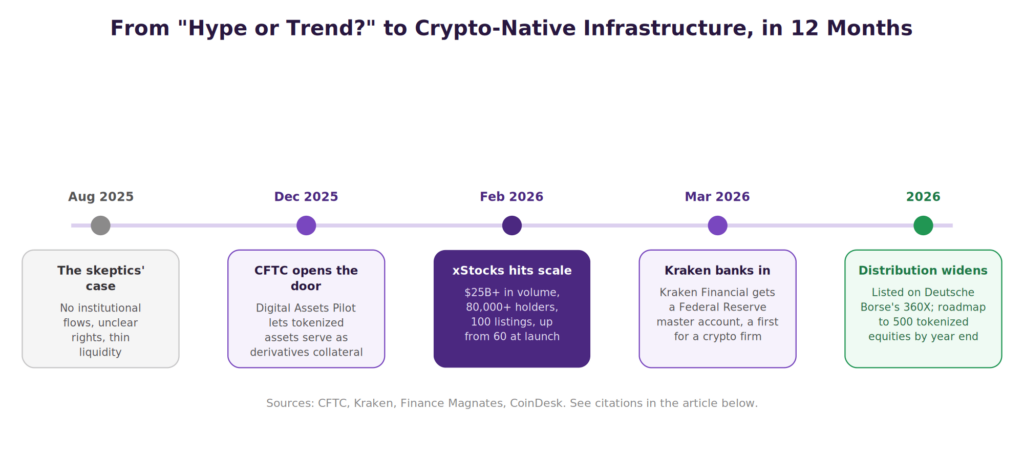
December 2025: The U.S. Commodity Futures Trading Commission (CFTC) launched its Digital Assets Pilot Program, allowing certain digital assets, including tokenized real-world assets like U.S. Treasury securities, to serve as collateral in regulated derivatives markets. It’s a narrower move than tokenizing equities directly, but it’s the first time a major U.S. derivatives regulator built a standardized pathway for tokenized assets to sit inside the same collateral workflows as cash, a meaningful regulatory legitimacy signal for the whole category.
February 2026: According to Kraken’s own reporting, xStocks, the tokenized equities platform originally issued by Backed Finance and now under Kraken’s ownership, crossed $25 billion in total transaction volume and over 80,000 unique holders, expanding from 60 listed stocks to 100. Each xStock is backed 1:1 by the underlying share, held with a licensed custodian in a bankruptcy-remote structure, according to Kraken.
March 2026: Kraken Financial, Kraken’s Wyoming-chartered banking arm, was granted a Federal Reserve master account, making it the first digital asset bank in U.S. history with direct access to the Federal Reserve’s core payment system. This isn’t a tokenized-stock-specific approval, it’s about Kraken’s banking infrastructure broadly, but it matters here because it’s the clearest institutional-legitimacy signal yet for the company issuing the largest tokenized equities product on the market.
Through 2026: That same platform went live on Deutsche Börse’s 360X, a regulated European trading venue, giving crypto-native tokenized equities distribution through infrastructure outside crypto exchanges entirely.
This is not a pilot program stuck in committee. It’s a live build-out, on a public timeline, inside the same crypto-native model the skeptics were writing about.
Is Institutional Money Actually Showing Up Now?
Yes, in the ways that matter for a crypto-native product’s credibility: regulatory legitimacy for the model, institutional-grade banking access for issuers, and distribution through regulated venues beyond crypto exchanges.
A Federal Reserve master account and a listing on a Deutsche Börse-operated venue aren’t things any company can self-report into existence. Regulators and exchange operators had to sign off on both. That’s a materially stronger picture for the category than “institutions aren’t coming.”
Aug 2025 (peak skepticism)
Mid-2026
U.S. regulatory posture on tokenized assets
No standardized pathway
CFTC pilot allows tokenized assets as derivatives collateral (Dec 2025)
Issuer’s institutional banking access
None disclosed
Kraken Financial holds a Federal Reserve master account (Mar 2026)
Distribution beyond crypto exchanges
None
Live on Deutsche Börse’s 360X
What Do the On-Chain Numbers Actually Show?
Company announcements are one thing. On-chain data is harder to spin, since it comes from independent platforms reading the blockchain directly, not a company’s own press release.
According to Dune Analytics, an independent on-chain analytics platform, xStocks has processed more than $20 billion in combined centralized and decentralized exchange trading volume since its June 2025 launch. That’s a narrower measure than the $25 billion “total transaction volume” figure cited earlier, which likely includes minting and redemption activity alongside trading, so the two numbers aren’t directly comparable, but both point the same direction. The $20 billion figure also shows a “U-shaped” recovery pattern: a slowdown after initial hype, then a rebound in September 2025 that tracked alongside genuine strength in US stock indices, the kind of pattern that suggests people trading based on real market conditions, not a one-time speculative spike.
Two other independent trackers back this up. CoinMarketCap data shows xStocks account for 7 to 8 of the top 10 tokenized US stocks by 24-hour trading volume. RWA.xyz, a research platform that tracks real-world asset tokenization, found xStocks hold 8 of the top 11 tokenized equities by unique holder count, and 68% of the top 25 tokenized US stocks by unique holders overall.
Metric
Source
Figure
Combined CEX + DEX trading volume since June 2025
Dune Analytics
$20B+
Unique on-chain holders
Dune Analytics
80,000+
Share of top 10 tokenized stocks by 24h volume
CoinMarketCap
7-8 of 10
Share of top 25 tokenized stocks by unique holders
RWA.xyz
68%
Worth being precise about sourcing here: these figures are cited by Kraken from third-party platforms, not independently pulled and verified by us directly from Dune, CoinMarketCap, or RWA.xyz. That’s a meaningfully stronger evidence category than a company’s self-reported number alone, since it comes from platforms with no commercial stake in the figures, but it’s still one step removed from primary verification.
Distribution has widened too. Tokenized equities under this model are now tradable 24/7 across multiple exchanges, including Kraken, Bybit, Gate.io, and Bitget, rather than being locked to a single platform.
Does This Actually Solve the Ownership and Voting Rights Problem?
Not yet, and it’s worth being direct about that rather than overselling the progress.
Every piece of evidence above is about the infrastructure and legitimacy around crypto-native tokenized US stocks getting stronger: better custody standards, regulated banking access, distribution through established European venues. None of it changes the underlying custodial-entitlement model this blog has covered before.
A licensed custodian holding a real share in a bankruptcy-remote structure, the standard the largest platform in this category describes for its own product, is a genuinely stronger disclosure practice than a year ago. But it still isn’t the same as being the shareholder of record. Voting rights and direct dividends generally still aren’t part of the deal.
What has shifted is the regulatory posture toward taking that distinction seriously. The CFTC’s own December 2025 guidance explicitly noted that different tokenization methods can carry different rights or protections, and encouraged case-by-case evaluation rather than treating all tokenized assets as equivalent.
That’s a regulator formally acknowledging the exact nuance skeptics were raising, a meaningfully different posture than silence or a blanket crackdown. The direction is toward more scrutiny and better disclosure, not toward full shareholder rights arriving anytime soon.
Why Does This Matter for Indian Investors Specifically?
Because the infrastructure being built- Federal Reserve-level banking access, regulated European distribution, formal collateral pathways- isn’t being built for the US market alone. It sets the template that crypto-native platforms everywhere, including the ones Indian traders already use, build toward next.
Indian traders have historically waited on the sidelines for this kind of shift. Investing in US stocks through the Reserve Bank of India’s Liberalised Remittance Scheme (LRS) has existed for years, but it’s slow and capital-intensive relative to what a maturing crypto-native model is now demonstrating is possible.
As custody standards, banking access, and regulated distribution improve across the category, the tokenized US stocks available on Indian-accessible platforms, including Mudrex’s own offering, run on this same underlying custodial model. They’re likely to keep moving in the same direction: better disclosed, better custodied, even if full ownership rights remain the next frontier rather than a solved problem.
Getting comfortable with how tokenized US stocks work now, including the custodial model’s real limits, means being ready to use the better version of this product as it arrives, instead of starting from zero when it does.
What Could Still Go Wrong?
A fair piece doesn’t skip this. Voting rights and direct dividends still generally aren’t part of the crypto-native tokenized US stock model, no matter how much the surrounding infrastructure matures. Liquidity outside the biggest names is still thin.
India-specific regulatory clarity, covered in our earlier deep dive on tokenized US stocks, hasn’t moved at the same pace as the infrastructure described here. India’s securities regulator, the Securities and Exchange Board of India (SEBI), still has no dedicated framework for tokenized assets on crypto platforms, and gains remain taxed as virtual digital assets.
A bigger, better-capitalized issuer succeeding doesn’t automatically mean every crypto-platform tokenized US stock product available today carries the same custody standards. The direction of travel is clear. The pace and shape of it, especially outside the US, is still being written.
The Trend Isn’t Slowing Down, It’s Getting Built
A year ago, the honest answer to “emerging trend or hype?” was “too early to tell,” and that view had real institutional backing: a global exchange body, three securities regulators, and a respected digital asset bank all pointing the same direction.
Today, with a U.S. derivatives regulator formally recognizing tokenized collateral, a crypto exchange holding direct Federal Reserve payment access, and independent on-chain data showing tens of billions in real trading volume across multiple exchanges, that’s no longer the honest answer. The infrastructure the skeptics said was missing is being built, in public, verifiable by third parties, not just company press releases, by crypto-native platforms operating on the same custodial model this entire category runs on.
That’s the model our own tokenized US stocks are built on too. If you want to understand this shift well enough to act on it early rather than catch up to it later, Mudrex’s tokenized US stocks offering is a place to start, alongside your existing crypto portfolio.
Which regulators and institutions were skeptical of tokenized US stocks in 2025?
The World Federation of Exchanges wrote to the SEC, ESMA, and IOSCO, warning tokenized equities lacked real investor protections. ESMA’s Natasha Cazenave raised “fake equity” concerns, SEC Commissioner Hester Peirce warned some tokens could be classified as security-based swaps, and IOSCO’s own report called adoption “incipient.”
Is the tokenized US stocks trend actually growing, or is it slowing down?
On the crypto-native side, it’s growing, and not just by the industry’s own account. Independent on-chain trackers like Dune Analytics show over $20 billion in combined trading volume since June 2025, and RWA.xyz shows the category’s largest platform holds 68% of the top 25 tokenized US stocks by unique holders.
Do tokenized US stocks now come with full shareholder rights?
Generally, no. Custody and disclosure standards have improved, and U.S. regulators like the CFTC are now formally distinguishing between tokenization models with different rights, but most crypto-platform tokenized US stocks still don’t carry voting rights or direct dividends.
What is Kraken Financial’s Federal Reserve master account, and why does it matter for tokenized stocks?
It’s direct access to the Federal Reserve’s core payment system, granted to Kraken’s banking arm in March 2026, the first such approval for a digital asset company. It isn’t specific to tokenized US stocks, but it’s a strong signal that the institutions behind crypto-native tokenization are being taken seriously at the highest levels of US financial infrastructure, a legitimacy signal for the category, not any single platform.
Has India’s regulatory stance on tokenized US stocks changed?
Not materially. The Securities and Exchange Board of India (SEBI) still has no dedicated framework for tokenized assets on crypto platforms, and gains are taxed under India’s virtual digital asset rules.
RiskDisclaimer
Trading tokenized US stocks and other virtual digital assets carries risk of capital loss. Tokenized products may involve leverage exposure that can amplify both gains and losses. Any examples, figures, or third-party volume data cited in this article are illustrative and not independently audited, and should not be treated as financial advice. Tokenized US stocks currently sit outside SEBI’s regulatory framework in India, and regulations may change. Please consult a qualified financial advisor before making investment decisions.
Siri is a writer venturing into the exciting realms of blockchain technology, cryptocurrency, and decentralized finance (DeFi), eager to explore the transformative potential of these innovations. She brings a unique perspective that bridges traditional industries and cutting-edge technology, often infused with a touch of humor through memes. She has a rich background in real estate and interior design, having previously contributed to NoBroker, where she crafted blogs and assets on these topics.