When trading cryptocurrencies, timing your entry can make all the difference. Two useful tools for improving entry timing are the long/short ratio and price action analysis. The long/short ratio gives insight into market sentiment by comparing how many traders are bullish (long) versus bearish (short) on an asset.
Price action analysis involves reading charts, looking at support and resistance levels, candlestick patterns, and key price levels, to understand what price movement is telling us. In this beginner-friendly guide, we’ll explain what the long/short ratio is, why it matters, and how to interpret it. Then we’ll cover the basics of price action and show how combining these insights can help you better time your trade entries.
Long vs. Short Positions: In trading, a long position means you bet the price will go up (you buy now hoping to sell higher later), while a short position means you bet the price will go down (for example, borrowing an asset to sell now and buy back lower later). The long/short ratio is simply the ratio of the number of long positions to the number of short positions in the market. In other words:
If there are 80 longs and 40 shorts, the long/short ratio = 80/40 = 2.0. This means there are twice as many bullish bets as bearish bets.
A ratio above 1 means there are more longs than shorts (more bullish sentiment overall). A ratio below 1 means more shorts than longs (more bearish sentiment).
For example, a ratio of 1.5 would indicate 1.5 times more long positions than short positions (bullish leaning), whereas a ratio of 0.8 means more shorts than longs (bearish leaning).
Why It Matters – Sentiment Gauge: The long/short ratio is essentially a gauge of market sentiment or the market’s “mood.” A high ratio suggests that the majority of traders are optimistic and betting on prices to rise (bullish sentiment), while a low ratio suggests most are pessimistic, betting on prices to fall (bearish sentiment). In this way, the ratio acts like a market thermometer, converting the crowd’s emotions into a number. Traders often check this metric on platforms like CoinGlass, which provides real-time long/short ratio data for major cryptocurrencies, to see the balance between bullish and bearish positions.
Interpreting the Long/Short Ratio: For beginners, here’s a simple way to interpret the ratio values:
Ratio > 1: More longs than shorts. The crowd is leaning bullish (optimistic) For instance, if the ratio is 2.0, there are twice as many long positions as shorts – a sign of strong optimism.
Ratio = 1: Longs equal shorts. Market sentiment is neutral, with an even balance of opinion.
Ratio < 1: More shorts than longs. The crowd is leaning bearish (pessimistic). For example, a ratio of 0.5 means shorts double the longs – a strongly bearish crowd sentiment.
Typically, extreme values can signal strong sentiment extremes. If the ratio gets very high (lots of longs), it means most traders are bullish, whereas a very low ratio means most are bearish. These situations are interesting because markets can be contrarian: when everyone is on one side of the trade, it sometimes precedes a reversal.
As the famous saying goes, “Be fearful when others are greedy, and greedy when others are fearful.” In crypto, if the long/short ratio becomes excessively high (overwhelming longs), it may indicate greed is rampant and a price drop (“long squeeze”) could occur, as large players might take the opposite side and “trap” overexposed long traders. Likewise, an extremely low ratio (too many shorts) could precede a short squeeze where prices jump up, catching bearish traders off guard.
Long/Short Ratio as a Sentiment Tool: The value of the long/short ratio lies in quantifying bullish vs. bearish forces in the market. It provides an objective number to read the crowd’s bias. On its own, the ratio cannot predict exact price moves, but it gives context. Think of it as a background indicator: it tells you whether optimism or pessimism is high. This helps in making trading decisions – for example, whether to be cautious or confident about a potential trade. The key is to not use it in isolation. Always combine sentiment data with other analysis (like price action), which we’ll discuss next, to get a fuller picture
Understanding Price Action Basics
Price action means reading the chart using raw price movement. You focus on where price has been and how it reacts at important areas. You do not rely on heavy indicators. You let the candles and levels tell the story of buyers and sellers.
Support and Resistance
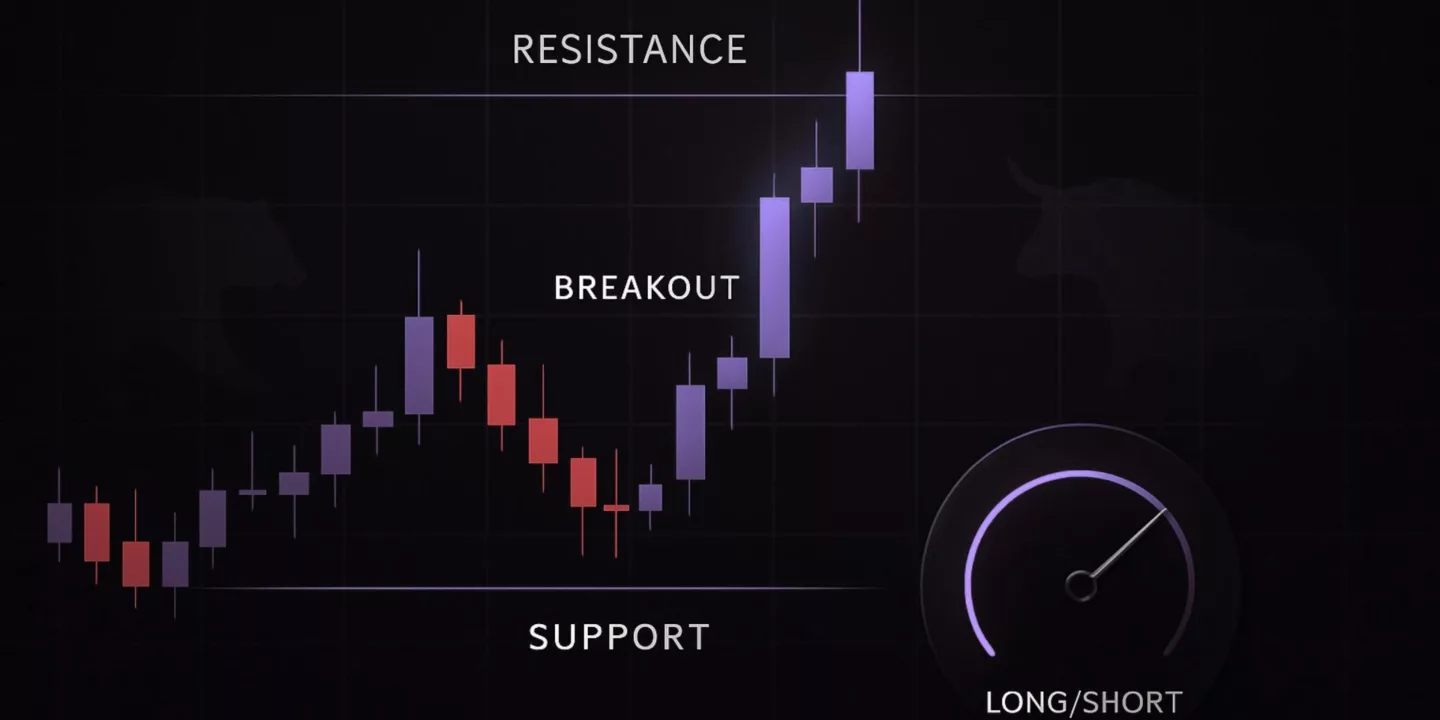
Support is a price “floor” where declines often pause or bounce. It forms because buyers see value at that level and step in. You can find support by looking left on the chart for repeated lows where price turned higher.
Resistance is a price “ceiling” where rallies often stall or reverse. It forms because sellers take profits or see price as too high. You can find resistance by looking left for repeated highs where price turned lower.
Traders use these levels to plan entries and exits. Buying near support or selling near resistance can make sense if the level holds. When price breaks cleanly through a level and closes beyond it, the balance of supply and demand may have shifted. That shift can start a trend move known as a breakout.
Candlestick charts show who is in control during each period. The size of the body, the length of the wicks, and the closing position all matter. At support, a bullish reversal pattern such as a hammer or a bullish engulfing candle can signal buyers taking back control. At resistance, a bearish reversal pattern such as a shooting star or a bearish engulfing candle can signal sellers stepping in. A doji shows indecision, which can be a warning to wait for the next candle to confirm direction.
You do not need to memorize many patterns. Focus on a few clear ones and where they appear. A strong bullish candle that closes above resistance shows conviction. A small candle with long upper wicks at resistance can show fading momentum. Candlestick signals are more reliable when they align with strong levels and the broader trend.
Key Price Levels and Market Structure
Trendlines connect higher lows in an uptrend or lower highs in a downtrend. A break of a well-respected trendline can hint at a shift in momentum. Prior swing highs and lows act as reference points where price often reacts. If price breaks a prior high and then retests it successfully, that old resistance can turn into new support. Round numbers, such as $1, $100, or $10,000, often attract orders and can behave like soft levels. Consolidation ranges show balance between buyers and sellers. When price leaves a tight range with a strong close, the move that follows can be powerful.
Understanding where price stalls, where it accelerates, and how candles behave at those areas gives you context. With this context, you can combine price action with sentiment from the long/short ratio to time entries with more confidence.
Combining Long/Short Ratios With Price Action for Better Entries
Price action tells you what price is doing and where the key decision points are. The long/short ratio tells you how traders are positioned and how confident they feel. Using both together helps you judge whether a move is likely to continue, reverse, or trap the crowd. You can check the long/short ratio on Coinglass for a quick view of positioning.
1) Contrarian Signals at Overbought or Oversold Areas
When price is stretched into resistance, the market can be overbought. If the long/short ratio is also very high, it means many traders are already long. A small drop can trigger profit-taking and stop losses, which can turn into a deeper pullback. In this case, it is often better to wait for a bearish candle to confirm weakness before considering a short or a patient long after a pullback.
When price is stretched into support, the market can be oversold. If the long/short ratio is very low, it means many traders are short. A small bounce can force them to cover, which can power a larger rally. If you see a clear bullish reversal at support, the bearish crowding can add fuel to the upside. You still want confirmation from the candles or from a reclaim of the level before you enter.
The key idea is that extremes in sentiment often align with turning points. Let the ratio alert you to crowding, and let the candles confirm the turn.
2) Timing Breakouts With Sentiment
A genuine breakout usually pushes against the majority. If price breaks above resistance while the long/short ratio is low, many traders are short and wrong. As they exit, their buying can strengthen the breakout. In such a case, you can enter on the close above the level or on a clean retest that holds.
If price breaks above resistance while the ratio is already very high, the move may be crowded. With so many longs already in, there may be fewer new buyers to drive the next leg. In that case, wait to see if price can hold above the level. If you get an immediate reversal candle back below the level, treat it as a warning for a potential bull trap.
The same logic works for breakdowns. If price breaks below support and the ratio had been high, trapped longs can accelerate the drop. If price breaks below support but the ratio was already very low, a quick reclaim can become a bear trap because shorts are crowded and vulnerable.
3) Spotting Fakeouts and Traps
A bull trap occurs when price pokes above resistance but closes back below it. If the long/short ratio was high at the time, many longs are now stuck. That pressure can drive price lower as they exit. A bear trap occurs when price dips below support but quickly reclaims it. If the ratio was low, many shorts are stuck and a sharp bounce can follow. In both cases, the close relative to the level matters. A level break without a strong close is a red flag. Waiting for the close or the retest helps you avoid chasing the trap.
4) A Simple Entry Checklist
First, mark the level you care about, such as a strong support, resistance, range boundary, or trendline.
Second, read the candles at that level and decide whether buyers or sellers are taking control.
Third, check the long/short ratio on Coinglass to see whether the crowd is already leaning hard in one direction.
Fourth, align your plan with both signals. A long near support is stronger when the ratio is low, and a short near resistance is stronger when the ratio is high. A breakout has more follow-through when it squeezes the majority.
Finally, manage risk with a logical stop beyond the level. No setup is guaranteed, so protect your capital.
Conclusion
Price action gives you the map, and the long/short ratio tells you where the crowd is standing on that map. When levels, candles, and sentiment all point in the same direction, your odds improve. When they clash, you slow down, wait for confirmation, or stand aside. Use Coinglass for positioning, use your chart for context, and let the close and the retest confirm the move. This simple blend helps you avoid traps, chase fewer bad breakouts, and enter with more conviction.
Anush is a crypto researcher dedicated to making blockchain insights clear and accessible. A proud Solana maxi who still appreciates a good Layer 2 debate, he dives deep into market trends so others don’t have to (but really should). Passionate about simplifying crypto, he strives to make the space less intimidating and a lot more relatable, one report at a time.