On September 9, at the Global Fintech Fest 2026 in Mumbai, Maharashtra Chief Minister Devendra Fadnavis made an announcement that should make anyone tracking Indian capital markets sit up. He confirmed the state is building the DELTA Act, a legal framework to tokenise land and other immovable property, aimed at unlocking roughly ₹50 lakh crore in dormant land value. If it passes, Maharashtra becomes the first Indian state with a dedicated statute for tokenised real-world assets.
The line that mattered most was not about land at all. It was about intent. Fadnavis said tokenization is not about speculation; it is about unlocking productive capital. That is the same idea, almost the same words, that anchors a report we published in partnership with e-Sutra, A Builder’s Guide to Bond Tokenization in India (read the full report here). Fadnavis appears in that report too, making the same point about a different asset class.
Two announcements, one summit, one Chief Minister, two asset classes: land and bonds, pointing at the same thesis. Our report does the unpacking in detail. The DELTA Act is proof that the pattern it describes is already repeating in real time.
A ₹59 Lakh Crore Market That Barely Trades
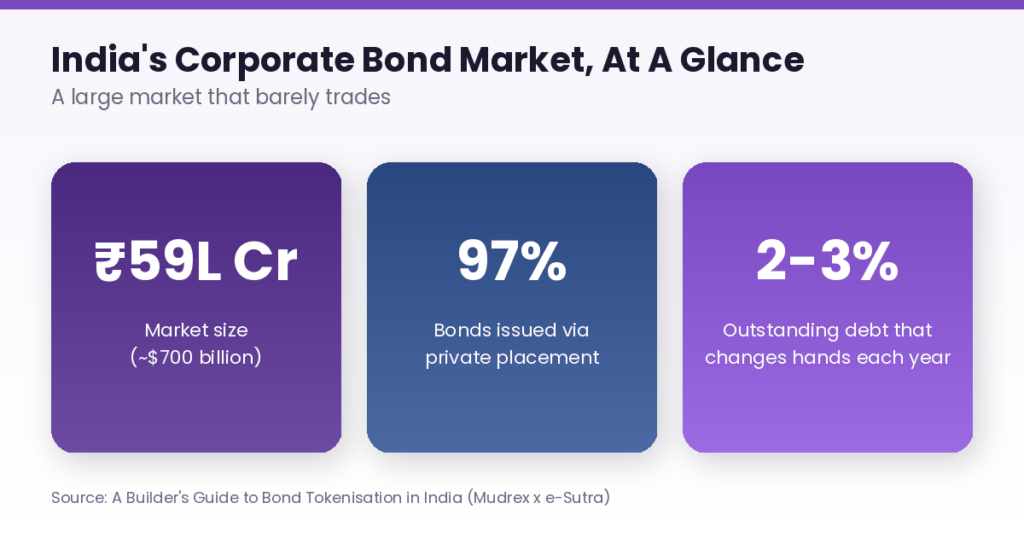
Start with why bonds were where our report chose to dig in. India’s corporate bond market is large, but it moves very little.
Metric
Figure
Market size
₹59 lakh crore (about $700 billion)
Bonds issued through private placement
97%
Outstanding debt that changes hands each year
2-3%
A large market that barely trades: India’s ₹59 lakh crore corporate bond market by the numbers.
A market this size, moving this little, is not short of participants. It is short of infrastructure that makes trading easy. That is the exact gap tokenization is being pitched to close, by representing bonds digitally and dividing them into smaller, more accessible units.
To be clear about what would and would not change, the report breaks a bond’s life into four stages: issued, transferred, settled, and serviced. Tokenization’s effect concentrates in the middle two. Transfer could move from re-registration through intermediaries, which takes a day or more, to near instant token movement. Settlement and servicing could shift to smart contracts handling coupon payments and covenant checks. Who is allowed to hold the bond, the KYC behind it, and the risk that the issuer defaults all stay exactly the same. Tokenization changes the plumbing, not the underlying credit risk.
This is not happening in isolation. India added government securities to JPMorgan’s GBI-EM index in 2024, opening the market to passive foreign capital. SEBI reduced friction for foreign investors trading government securities in June 2025. SEBI then approved net settlement for foreign portfolio flows in March 2026. The report reads tokenization as the next lever in that same sequence, another attempt to make a large, illiquid market easier to actually transact in.
The Coverage Gap Nobody Has Reconciled
Since April 2022, India has run a government-mandated distributed ledger to record security creation and monitor covenant compliance in the corporate bond market, jointly operated by NSDL and CDSL. Four years in, you would expect a settled answer to a basic question: how much of the market does it actually cover?
It does not have one.
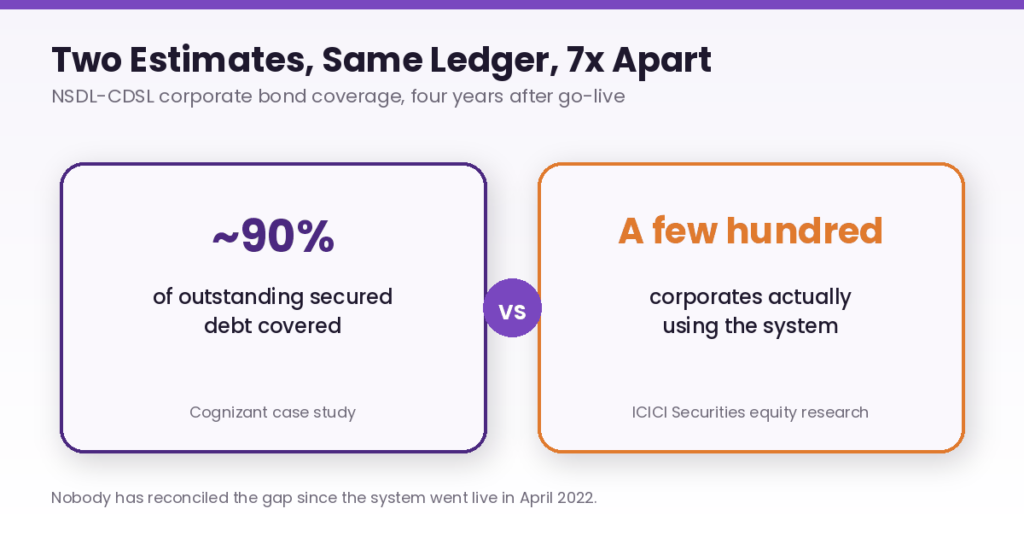
Source
Coverage estimate
Cognizant case study
Roughly 90% of outstanding secured debt
ICICI Securities equity research
Only a few hundred corporates using the system
Two credible sources, one government-mandated ledger, and a sevenfold gap nobody has closed.
The two most credible estimates differ by a factor of seven. Rather than pick a side, the report puts both numbers on the table and treats the disagreement itself as a finding. Nobody has produced a reconciled figure four years after go-live, and that gap says more about where India actually stands than either headline number would alone.
Regulation Was Never the Real Constraint on Bond Tokenization
It is tempting to read India’s slow bond tokenization progress as a regulatory story, one where everything waits for the right law. The report tests that assumption against five other markets, and it does not hold up.
Market
Regulatory approach
What actually happened
United States
No dedicated tokenization statute
Produces the largest tokenized fixed income products in the world; BlackRock’s BUIDL fund has traded the lead for the largest tokenized Treasury fund through 2026
Singapore
Detailed framework via Project Guardian
Widely called the closest thing to a global regulatory benchmark, yet no account discloses comparable transaction volume
UAE
Finalised rulebook
30+ tokenized real estate deals closed, almost none in bonds
Hong Kong
Wrote no new rules; applied existing securities law directly
Government-backed issuances scaled from HK$800 million in 2023 to roughly HK$12 billion by 2026
Switzerland
Built full regulatory infrastructure for the world’s first regulated digital bond settlement in 2021
Folded its standalone exchange back into the main Swiss bourse in October 2025
Luxembourg
Law arrived in January 2025, years after the first issuance
The European Investment Bank issued digital bonds there from 2021, before the law existed
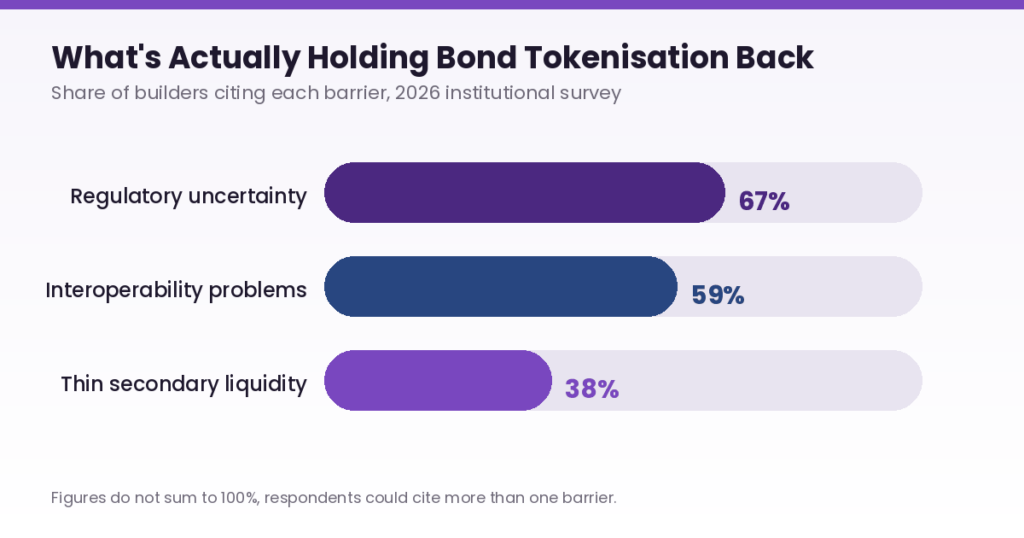
Global DLT-based fixed income issuance reached €4.8 billion (about $5.5 billion) in 2025, up 48% year on year. TheEY-Parthenon and Coinbase 2026 Institutional Digital Assets Survey, polling more than 350 institutional investors globally, backs up the same conclusion with real numbers.
Regulatory uncertainty led the list, but interoperability and liquidity were close behind.
These numbers sit close enough together that no single friction explains the whole picture. Regulatory clarity helped wherever it existed, but across five very different regulatory philosophies, it was never what separated the markets that moved from the ones that did not. What every success story shared instead was a specific, executed use case and a credible first issuer willing to go first.
India Has Already Run This Exact Playbook, Twice
This is the part of the report that makes the DELTA Act news land differently. India does not need a global case study to understand how new infrastructure gets adopted without waiting for a bespoke law. It has already done it domestically, twice.
Since 2018, India’s warehouse receipt system has let farmers pledge stored commodities as collateral, mostly disconnected from any digital ledger. Two companies changed that without a new statute arriving first.
Arya.ag built a blockchain layer on the existing system, specifically to stop the same commodity being pledged against two different loans.
Whrrl built a lending business the same way. It now operates across fourteen hundred warehouses in five states, with roughly $500 million tokenized through it.
The government’s response, a ₹1,000 crore credit guarantee scheme, arrived in December 2024, after the model had already proven itself.
The same sequence played out again in energy, on a faster timeline. In February 2026, Delhi’s electricity regulator approved a six-month pilot for blockchain-based peer-to-peer solar trading across two distribution utilities and a state boundary, within months of a company proposing the specific mechanism. Neither case waited for permission to exist first. Both found existing government infrastructure, solved one narrow, concrete problem with it, and let regulatory support follow the proof.
As Kanhaiya Singh, Co-founder of e-Sutra, puts it in the report, technology is a small part of the equation. The bulk of the work is regulatory, and once the rules are set, adoption tends to follow on its own. REC Ltd’s Executive Director Mohan Lal Kumawat frames the shift in terms of speed. Activities that once took two to three days under the old process were completed within about two hours once the tokenized system was actually used.
The Stack Is Already Connecting
Where does that leave bonds specifically? The report traces a five-year build-out that is now converging fast.
Aug 2021: SEBI mandates a DLT-based system for corporate debt
Apr 2022: NSDL and CDSL go live with it
Oct 2025: RBI launches the Unified Market Interface (UMI) to standardise settlement, including for tokenized assets
May 2026: SEBI proposes a pilot specifically for tokenized debt securities
Sept 2026: REC Limited is reportedly preparing India’s first tokenized bond, a sub-₹5 billion (about $57 million) issuance settled through RBI’s wholesale CBDC
That last one is still reported, not completed. If it closes as described in the report, it connects four years of separately built infrastructure, the ledger, the settlement rail, and the regulatory pilot, into a single live transaction for the first time.
The Gap That Is Actually Holding Builders Back
The report argues the constraint is not infrastructure or intent. Both are real. The constraint is translation.
A builder today has no clear picture of what NSDL and CDSL’s system actually covers, no technical specification to design against for RBI’s settlement layer, and no visible path from “SEBI announced a pilot” to “here is how I participate in it.”
For anyone building toward foreign capital specifically, the report identifies GIFT City’s IFSCA sandbox as the one path that is usable today. It has published consultation guidance since February 2025 and has already been tested end-to-end with real investors, just not yet in bonds. The mainland SEBI pathway has an active pilot but no disclosed participant list or timeline yet, worth revisiting the moment either shows up. UMI itself has no published specification, so the pragmatic move is to build on conventional depository-based settlement now, architected modularly enough to plug into UMI once RBI opens it up.
Tokenization will not fix everything on its own, either. Thin secondary liquidity does not disappear because a bond is tokenized. Buyers and sellers still have to show up on both sides, and even sophisticated investors sometimes prefer the settlement delay tokenization is meant to eliminate, because it preserves netting efficiencies they rely on elsewhere.
As Blockmaze CEO Tejinder Virk describes it in the report, India’s tokenization moment resembles a bamboo tree, years of underlying growth that are not visible from outside, until the moment it all shoots up at once. The digital identity layer, KYC and e-KYC infrastructure, UPI, and wholesale CBDC are all already in place. What is missing is not more plumbing. It is someone connecting the plumbing into a working product.
Nobody Has To Build The Whole Stack Alone
The fastest route to a viable tokenized market is not every participant building the entire stack independently. It is issuers, regulated intermediaries, technology providers, and distribution platforms each contributing the pieces they already know how to operate.
A partner that has already worked through KYC, AML, and regulatory engagement for tokenized products can save a first-time builder from rebuilding those processes from scratch. An established distribution platform can connect a new product to an audience already familiar with tokenized assets, which the report flags as possibly the harder problem than the technology itself.
Three Things Worth Watching More Than The Next Announcement
The report closes with a short, specific list of signals that would tell the market more than another speech at another summit.
Whether NSDL and CDSL ever reconcile the 90%-versus-few-hundred-corporates gap.
Whether UMI’s next public mention comes with an actual technical specification, rather than the same one-paragraph description it has had for a year.
Whether the REC transaction reportedly closes in September as described, or gets confirmed, revised, or quietly dropped.
Why The DELTA Act Is The Clearest Confirmation Yet
Put the two announcements side by side, and the pattern our report describes stops being theoretical. Fadnavis is not only talking about bonds or only about land. He is describing the same infrastructure thesis in both cases. India already has the digital identity layer, the KYC and e-KYC rails, UPI for payments, and now a wholesale CBDC issued by the central bank. What has been missing is not more plumbing. It is someone connecting the plumbing that already exists into a specific, narrow, executable product, and a regulator willing to move once that product proves itself.
That is the exact sequence Arya.ag and Whrrl ran in agricultural credit, that Delhi’s solar pilot ran in energy, and that REC’s reported issuance is now attempting in bonds. Land tokenization under DELTA, still in its architecture phase, is the same formula applied to what Fadnavis has called Maharashtra’s most illiquid asset class: real estate. Different asset, same underlying constraint. These are assets that are valuable, illiquid, and locked behind access barriers that have nothing to do with investor interest and everything to do with market structure.
The question our report keeps coming back to is no longer whether the technology works. It is what gets built on top of the infrastructure that already exists, and who is willing to stand next to the builders doing it. With REC’s tokenized bond reportedly weeks away and Maharashtra now formally drafting a legal framework for tokenized land, that question just became a lot less hypothetical, for bonds, for land, and quite possibly for whatever asset class India tokenises next.
If you want the full comparative analysis, the methodology notes, and the builder roadmap behind everything above, our complete report is available here: A Builder’s Guide to Bond Tokenization in India.
This piece draws on our report “A Builder’s Guide to Bond Tokenization in India,” produced in partnership with e-Sutra for the India Bond Tokenization Summit, September 2026. Every factual claim in it was checked against the most primary source available. Government circulars and regulator statements are treated as confirmed, named journalist reporting as credible but unconfirmed, and single-source vendor estimates as directional rather than definitive. This article is for informational purposes only and does not constitute financial or investment advice.
Siri is a writer venturing into the exciting realms of blockchain technology, cryptocurrency, and decentralized finance (DeFi), eager to explore the transformative potential of these innovations. She brings a unique perspective that bridges traditional industries and cutting-edge technology, often infused with a touch of humor through memes. She has a rich background in real estate and interior design, having previously contributed to NoBroker, where she crafted blogs and assets on these topics.