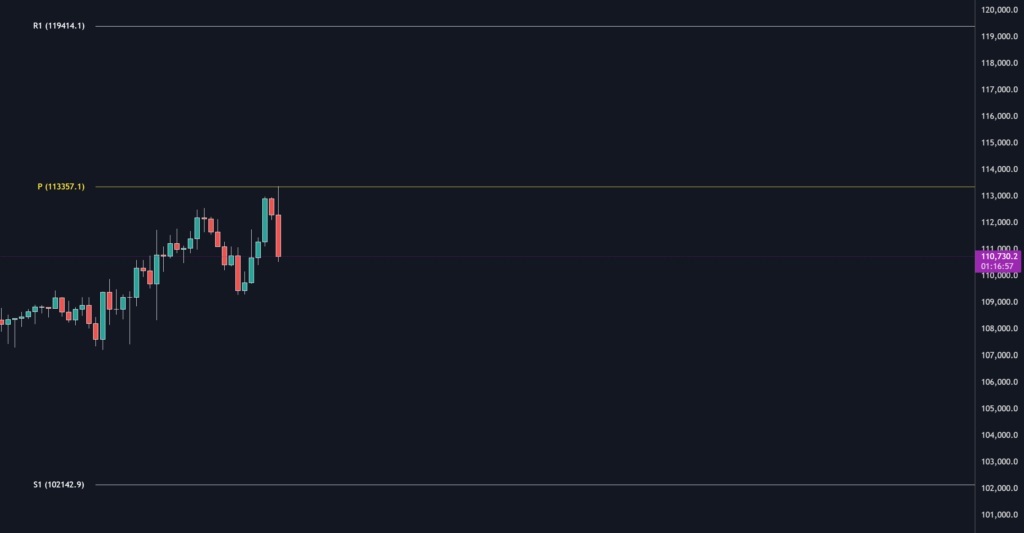
Pivot points are a simple way to turn yesterday’s trading into an objective roadmap for today. The central pivot, usually written as PP, is the average of the prior period’s high, low, and close, so PP = (High + Low + Close) ÷ 3. From that anchor, a set of support and resistance lines is projected above and below the market for the new session. Because the levels come straight from yesterday’s data and do not change during the day, they give beginners a clean, unbiased map of where price may pause, reverse, or accelerate. Traders often treat trading above the pivot as a bullish sign and trading below it as a bearish sign, which keeps intraday decision-making grounded and consistent.
Why traders use them (bias, levels, planning entries/exits)
Traders use pivot points because they deliver three benefits at once. First, they define a daily bias in one glance: if the market is holding above the pivot, it suggests strength; if it is struggling below the pivot, it suggests weakness. Second, they provide predetermined support and resistance levels that help you plan potential entries, stops, and profit targets without guesswork. Third, they are fixed for the whole session, which makes it easier to prepare a trading plan before the open and then execute it with discipline as the day unfolds.
Standard pivots are the basic version most traders start with. You take yesterday’s high, low, and close to get the central pivot (PP), then place support and resistance lines using the size of yesterday’s move. R1 and S1 are the first lines price often tests during a normal day, while R2, S2 and the outer levels matter more when the market trends strongly. This set is popular because it is simple, consistent, and widely watched.
If you want to plot these on TradingView, open your chart, click the Indicators button, search for “Pivot Points Standard,” and add it. In the indicator’s settings, choose “Classic” under Type to use the standard/floor method. Set the Timeframe to Daily if you are trading intraday or to Weekly if you want a swing bias. In the Style tab, keep PP, R1–R3 and S1–S3 visible and hide anything that makes the chart feel cluttered. It can also help to enable labels and extend the lines so the levels are easy to read across the session. If the lines do not look right, make sure you selected “Pivot Points Standard” and not “Pivot Points High/Low,” and confirm your chart time zone and session. For crypto, many traders use UTC so the “daily” pivot resets at 00:00 UTC, while for NSE instruments you should use the official session close at 3:30 PM IST so the prior day’s OHLC is correct.
Fibonacci pivots use the same central pivot as Standard, but the distance to each level follows common Fibonacci ratios such as 0.382 and 0.618 of yesterday’s range. Traders like these when markets trend because swings often react near Fibonacci areas. The idea is that crowd behavior makes these ratios show up often, so reactions around the levels can be more pronounced.
Camarilla Pivot Points — L1–L8, H1–H8, mean reversion focus
Camarilla pivots pack several levels close to the prior close and are handy for range days. The most watched lines are H3 and L3. When price drifts up to H3 and momentum fades, traders often expect a slip back toward the middle. When price drifts down to L3 and selling slows, they look for a bounce. If price pushes beyond H4 or L4 with energy, the day may be shifting from range to breakout, and traders adjust accordingly.
Woodie Pivot Points — open-weighted variant
Woodie pivots are almost the same as Standard, but they give extra weight to the prior close when calculating the central pivot. Support and resistance are then built in a similar way. Some intraday traders prefer this because the close often reflects the market’s final view of the previous session, so the new pivot can feel more responsive.
DeMark Pivots — conditional formulas
DeMark pivots change slightly depending on whether yesterday closed above the open, below it, or about the same. Instead of many lines, you get one key support and one key resistance. Traders who like a cleaner chart use DeMark to focus on the next likely turning point without a busy grid.
Central Pivot Range (CPR) — TC, Pivot, BC + width interpretation
The Central Pivot Range replaces one center line with a small band made of three lines: the Bottom Central (BC), the Pivot, and the Top Central (TC). The gap between BC and TC matters. A narrow CPR suggests the market has tightened and could break out; a wide CPR suggests a day that may chop around inside the band. CPR is widely used for planning opening-range trades because it quickly shows whether the market looks coiled or already stretched at the start of the session.
Variant
Central Idea
Minimal Equations
Typical Use Case
Standard (Floor)
Average last session, space levels by prior range
PP = (H+L+C)/3; levels spaced by (H−L)
All-purpose intraday map
Fibonacci
Same PP, Fib spacing
PP as above; levels use 0.382, 0.618, 1.000 of (H−L)
Trend and continuation days
Camarilla
Close-centric inner bands
Levels cluster near prior close
Range and mean-reversion
Woodie
Close-weighted center
PP gives extra weight to Close
Day bias via prior close
DeMark
Direction-aware anchor
Conditional anchor, one S and one R
Minimalist high/low focus
CPR
Three-line band around PP
BC, Pivot, TC; width = TC−BC
ORB and volatility read
Step-by-Step Example (worked numbers)
Consider a set of realistic values such as a high of 19,850, a low of 19,600, and a close of 19,740 from the prior session. The Standard central pivot would sit close to 19,730, since it is the average of those three numbers. From there, the first resistance, R1, would sit roughly one step above the pivot and the first support, S1, would sit one step below, with the size of each step based on the difference between the high and the low. In practice, that would put R1 near 19,860 and S1 near 19,610, with R2 and S2 another step out, and R3 and S3 further still. If you also compute the CPR from the same session, you would find the bottom and top of the band hugging the pivot very closely, which is what traders describe as a narrow CPR. A narrow CPR often warns that the market has compressed and can break out quickly once volume comes in.
This example shows how you can go from three numbers to a complete daily plan. If price opens and holds above the pivot, many traders adopt a bullish bias and watch for a move toward R1. If momentum breaks R1 and then price retests it from above and holds, the move toward R2 becomes more credible. If price opens below the pivot and cannot reclaim it on the first attempts, the tone is bearish and traders start thinking in terms of moves toward S1 and, on strong days, S2. The clarity comes from having these levels written down before the session starts so that your entries, stops, and targets are already mapped out.
How to Use Pivot Points (with tactics)
Trend bias — price vs PP; daily open vs PP
A practical way to set your bias is to compare both the current price and the day’s open to the pivot. When price and the open are above PP and the market keeps holding there, the path of least resistance is usually higher, and you can look for long setups into the first resistance. When both sit below PP and attempts to reclaim the pivot fail, the path of least resistance is lower, and you can plan short setups into the first support. If price whipsaws around the pivot, stay patient and wait for a clear break and hold before committing.
Bounce setups — buy near S1 in uptrend; sell near R1 in downtrend
A straightforward bounce plan is to align the direction of your trade with the prevailing bias and use the nearest pivot level as your entry area. In an uptrend day, if price pulls back toward S1 and the tape shows buyers defending it, you can enter near S1 with a stop just beyond that level and aim first for the pivot and then for R1. In a downtrend day, if price rallies toward R1 and stalls, you can sell near R1 with a stop just beyond it and look for the pivot and then S1 as targets. Keeping stops just beyond the level you are trading respects the idea that levels should hold; if they do not, you exit quickly and reassess.
Breakout setups — PP/R1/S1 breaks with volume; retest entries
A classic breakout plan looks for decisive pushes through PP, R1, or S1 that happen with expanding volume or obvious momentum. Rather than chasing the very first tick through the line, many traders prefer to wait for a retest, where the broken level flips role and acts as support if it was resistance or as resistance if it was support. If the retest holds and the tape continues to show strength, the trade has a clearer risk point at the reclaimed level and a logical target at the next pivot line.
Range trading — Camarilla L3/H3 reversion
When the market is quiet and rotating within a band, Camarilla levels are effective reference points. If price drifts up to H3 and momentum fades, range traders often look for it to revert back toward the center of the day. If price drifts down to L3 and sellers tire, they look for a rebound toward the middle. If the market breaks beyond H4 or L4 with real energy, it is a signal to shift away from fading and toward breakout tactics, because the day is no longer behaving like a range.
Stop-loss & targets — behind next level (e.g., long above R1 → SL below R1, TP at R2)
A simple, mechanical approach keeps the process calm. If you buy a break and hold above R1, you can place your stop just below R1 and target R2. If you sell a break and hold below S1, you can place your stop just above S1 and target S2. The point is not to guess what the market might do, but to let the structure tell you when the idea is no longer valid and where the next logical destination lies.
Position sizing by level distance (risk per trade ÷ (entry–SL))
Position sizing becomes easier when your entry and stop are tied to fixed levels. You decide your cash risk per trade first, measure the distance between your planned entry and your stop in points or ticks, and then calculate the position size so that a full stop equals that fixed cash amount. When every trade uses the same risk and the same level-based logic, your results become more consistent and easier to evaluate.
Best Settings & Timeframes (intraday & swing)
Intraday (Nifty/Bank Nifty/MCX) — Daily pivots on 5–15m charts; CPR for ORB; India market caveat on session times.
Intraday traders in Indian markets commonly plot daily pivots on five-minute or fifteen-minute charts and pay special attention to the CPR at the open. A narrow CPR before the bell often precedes an opening-range breakout, so traders prepare both a long and a short plan and then follow whichever direction triggers first with confirmation. It is important to compute the pivots from the official prior session close, so for NSE instruments you should use the previous day that ended at 3:30 PM IST rather than any aftermarket data.
Forex — Use New York close data; weekly pivots for swing bias.
Forex technically trades around the clock, but the market treats the New York 5 PM close as the daily cutoff. If you trade intraday, you compute your daily pivots from that close and then apply them to your preferred chart timeframe. If you trade multi-day swings, you may find weekly pivots more useful because they filter noise and help you hold a bias for several sessions without reacting to every small wiggle.
Crypto — 24/7: fix day to 00:00 UTC; weekly pivots to reduce noise.
Crypto never closes, so you first need to define when your “day” ends. The simplest convention is midnight UTC, which keeps your pivots aligned across exchanges and time zones. Because crypto can be very volatile, weekly pivots are also popular. They reduce the temptation to over-trade and provide a cleaner directional read for the week ahead.
Which pivot points are best for intraday? (Camarilla/CPR for mean reversion; Standard/Fibo for breakouts)
No single method is best in all conditions, but there is a helpful way to choose. If you like range and mean-reversion tactics, Camarilla and CPR tend to serve you better because they concentrate several actionable levels near the middle of the day’s trading. If you prefer momentum and continuation, Standard and Fibonacci pivots tend to serve you better because their outer levels line up well with trend drives and measured moves. Many traders keep both styles on hand and switch tools based on the day’s behavior.
Combining Pivot Points with Other Indicators
Moving Averages (20/50/200) — direction confirmation
It is easier to trade in sync with the market when pivots and moving averages agree. If price is above the pivot and above a rising 50-period average, the long side usually offers better odds. If price is below the pivot and below a falling average, the short side usually offers better odds. When they disagree, patience helps.
RSI/Stoch — timing at S/R
Oscillators are helpful for timing entries at the levels. If price tests a support pivot and RSI is already oversold, the bounce idea gains credibility. If price tests a resistance pivot and RSI is already overbought, the fade idea gains credibility. You still want confirmation from price and volume, but the oscillator can keep you from fighting a strong momentum push.
Volume/OBV — breakout validation
Breakouts through pivots work best when participation expands. If price pushes through R1 or S1 on rising volume or a strengthening OBV line, the follow-through tends to be better. If the break happens on thin activity, it is more likely to fail. Waiting for clear participation can save you from many traps.
VWAP — intraday confluence
VWAP acts like an intraday gravity line, and when it lines up with a pivot, the level strengthens. A market trading above both the pivot and VWAP has broad support from both price structure and volume-weighted positioning, and the opposite is true below both lines. That simple alignment check adds useful context to every setup.
Fibs vs Pivots — confluence heat = higher probability
Confluence is just a fancy word for multiple tools pointing to the same place. If a Fibonacci retracement, a prior swing high, and a pivot level all overlap within a tight price band, that band often attracts reactions. When you see overlapping evidence like that, you can lean more confidently on the setup and justify taking the trade with a normal or even slightly larger size, provided your risk rules allow it.
A practical approach for Nifty and Bank Nifty is to mark CPR before the open, identify whether it is narrow or wide, and prepare an opening-range breakout plan accordingly. When CPR is narrow and the market quickly pushes through the pivot or the first resistance/support with volume, following that direction and using the broken level as your risk line is often effective. For swing bias, weekly pivots give you a higher-level read that keeps you from flipping opinions every hour.
Gold/Crude (MCX) — volatility filter; widen stops to next level
Commodities can move sharply, so it helps to widen stops slightly beyond the next pivot level rather than the nearest tick. That extra cushion respects the instrument’s natural volatility while still honoring the idea that the level should hold. Once in profit, stepping targets up from one pivot to the next allows you to scale out methodically instead of trying to pick the exact top or bottom.
US Equities/Indices — Globex vs RTH data note
If you trade during regular US hours, it is best to compute your pivots from the prior regular session rather than the overnight Globex session, because most volume and price discovery occurs during RTH. If the market gaps at the open and the gap places price well above or below the pivot, that gap itself becomes part of the bias and often leads to “gap-and-go” or “gap-and-fill” dynamics around the first pivot lines.
For Bitcoin and Ethereum futures, combining weekly pivots with funding rates and open interest gives you a fuller picture. If price is above the weekly pivot and open interest is rising into strength, continuation becomes more likely. If price is below the weekly pivot and funding tilts heavily one way, be careful with crowded positions near pivot lines because squeeze moves can be violent.
Common Mistakes (and fixes)
The most common mistake is to treat a single level as magic and ignore the overall environment. Pivot points work best when you respect the trend and confirm with volume or momentum. Another frequent mistake is using the wrong session data, such as computing crypto pivots from a non-UTC day or computing Nifty pivots from aftermarket values. A third mistake is failing to put the stop just beyond the level you are trading, which defeats the whole point of using objective lines. Finally, many beginners chase the very first touch after a sharp move; waiting for a retest or clear confirmation usually produces better trades.
Backtesting & Journaling Template
The simplest way to build confidence is to test one clear setup for a month and write down every trade. Pick something basic, like “buy the retest above R1 with rising volume” or “fade near L3 when CPR is wide.” For each trade, note the date, market, setup, entry, stop, target, and result. After 30–50 trades, check your expectancy by comparing your average win and average loss with your win rate. If the result isn’t positive, tighten the rules: add confluence, place better stops, or skip the conditions that keep losing. With a written plan and a clean log, pivot points stop being lines on a chart and become a simple, repeatable system.
How to calculate daily pivot points?
Take yesterday’s high, low, and close, compute PP, then derive S/R levels from the prior range. For crypto, fix the “day” at 00:00 UTC; for equities/FX, use the market’s official daily close.
What is S1, S2, R1, R2 in trading?
They are the first and second Support (S1, S2) and Resistance (R1, R2) levels around the pivot. Price often reacts at these “first touch” zones; outer levels (S3/R3) matter more on strong trend days.
Which pivot points are best for intraday?
Use Camarilla or CPR for range/mean-reversion days and Standard or Fibonacci for momentum/breakout days. Many traders keep both and adapt to the day’s behavior.
Best timeframe for pivot points?
For intraday trading, plot daily pivots on 5–15 minute charts; for swings, use weekly pivots on higher timeframes. In crypto, be consistent with a 00:00 UTC rollover.
Do professional traders use pivot points?
Yes—because they’re widely watched, simple, and objective. Even if pros don’t trade them alone, the levels often act as self-fulfilling S/R where liquidity clusters.
How to use pivot points in forex/TradingView/Excel?
In FX, compute from the New York 5pm close. On TradingView, add Pivot Points Standard, choose Classic, set Daily/Weekly, and plot PP with S/R. In Excel/Sheets, enter H/L/C, compute PP, then formulas for S/R.
Difference between pivot points and support/resistance?
Pivot points are calculated levels from prior data—objective and fixed for the session. Support/resistance can be discretionary (drawn from price structure like swing highs/lows) and may shift as new data comes in.
What is CPR and how to calculate it?
The Central Pivot Range is a three-line band: BC = (H+L)/2, Pivot = (H+L+C)/3, TC = 2×Pivot − BC. The width (TC−BC) hints at volatility: narrow often precedes breakouts; wide often implies rotation.
What is the Fibonacci pivot point strategy?
It uses the same PP but spaces S/R with Fib ratios (0.382/0.618/1.000) of the prior range. Traders look for bounces or breakouts at these levels, ideally with confluence (trend, volume, VWAP).
Pivot points vs Camarilla vs Woodie vs DeMark — when to use?
Use Standard/Fib for trend and continuation, Camarilla/CPR for range and opening-range plans, Woodie when you want the close weighted more, and DeMark for a minimalist, direction-aware read with one main S and R.
Anush is a crypto researcher dedicated to making blockchain insights clear and accessible. A proud Solana maxi who still appreciates a good Layer 2 debate, he dives deep into market trends so others don’t have to (but really should). Passionate about simplifying crypto, he strives to make the space less intimidating and a lot more relatable, one report at a time.