SEI Network is a Layer-1 blockchain designed to optimize decentralized finance (DeFi) applications, particularly in trading environments. Known for its high-performance consensus mechanism, SEI aims to combine scalability with speed, creating a platform tailored for applications that require high throughput and low latency.
As of June 24, 2025, Sei (SEI) is trading at approximately $0.2863 (~₹24.66). The eagerly awaited Giga upgrade aims to deliver 50× improvements in throughput, consensus, and storage—bringing performance to Web 2 levels.
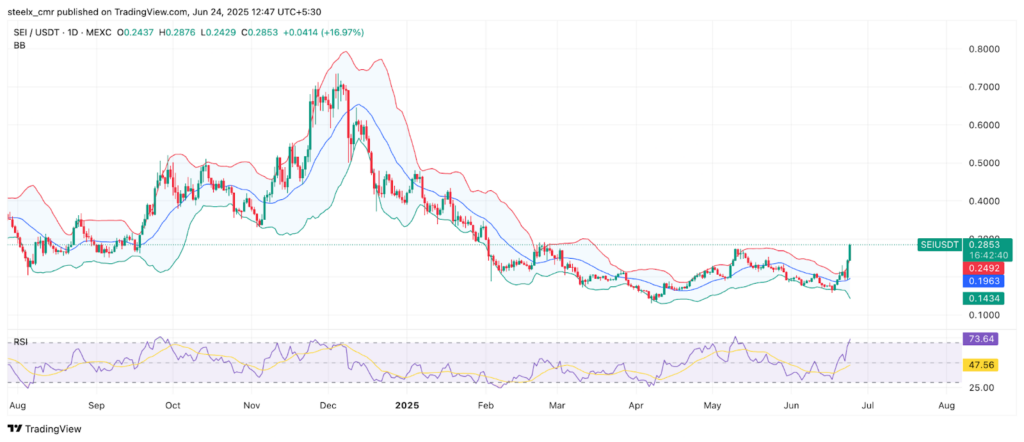
SEI recently broke out of two key patterns—a downward-sloping channel and a symmetrical triangle—showing signs of a possible trend reversal. It also moved above both its 50-day (at $0.212) and 200-day (at $0.275) moving averages, which is generally a positive signal. The MACD indicator has turned bullish, with the histogram rising to +0.00805, and the lines crossing over in a way that suggests upward momentum. Meanwhile, the 14-day RSI is at 66.35, which means the token is gaining strength but hasn’t entered the overbought zone yet.
| Aspect | Details | Evaluation |
|---|---|---|
| Founders | Developed by a team with expertise in blockchain and DeFi | Strong foundation with a DeFi-centric approach |
| Tokenomics | Total supply is capped at 10 billion, but without a fixed max supply, more tokens could still be issued in the future. | Potential inflationary pressures could reduce token value and impact long-term investor confidence. |
| Whitepaper | Vision focused on high-performance DeFi applications | Clear mission supporting high-throughput transactions |
| Team | Experienced in high-performance tech and finance | Well-suited team to advance scalable blockchain goals |
| Project | High-speed Layer-1 for DeFi | Uniquely positioned for trading and DeFi applications |
| Blockchain Use Case | Optimized for DeFi and trading applications | Addresses a critical need within on-chain trading |
| Price | Gradual growth with increasing DeFi interest | Market-driven with resilience and growth potential |
| Volume | Growing, indicative of demand in trading environments | Increasing liquidity underscores market engagement |
| Year | Low Estimate | High Estimate | Remarks |
| 2025 | $0.14 | $0.60 | Bullish Giga upgrade—intended to deliver up to 50× faster throughput and sub‑400 ms finality—could drive wider use and lift price toward $0.60 |
| 2026 | $0.18 | $0.75 | Steady growth expected as SEI’s ecosystem adds more dApps and liquidity |
| 2027 | $0.34 | $0.64 | Higher usage and developer activity could bring price stability |
| 2028 | $0.59 | $0.91 | Scaling improvements and cross-chain traction may drive further gains |
| 2029 | $1.13 | $1.37 | Rising demand from DeFi platforms and institutional use could support this level |
| 2030 | $1.18 | $1.45 | Strong fundamentals and mainstream presence may push SEI into this range |
2025: The base case places SEI between $0.14 and $0.38, reflecting its current positioning in the market and overall crypto sentiment. However, the Giga upgrade—a major technical leap promising up to 50x faster throughput and sub-400 ms finality—has the potential to be a game-changer. If it delivers and drives user and developer adoption, SEI could break out toward the higher end of this range, touching $0.60 in a strong bull market.
2026: In 2026, SEI’s ecosystem is expected to expand further, with more dApps, integrations, and partnerships forming. This year could see more users interacting with SEI-based apps and DeFi platforms. A lack of strong catalysts could keep the token closer to $0.18–0.30, but sustained momentum from 2025 and broader ecosystem development could help SEI climb toward the $0.75 mark if crypto markets are supportive.
2027: By 2027, SEI is likely to have a more mature network. Developer activity, on-chain volumes, and user retention could all play a role in price stabilization. If the network continues to grow steadily without much volatility, SEI could remain in a stable range. In a more optimistic scenario—where SEI captures a share of niche DeFi or GameFi markets—the price could climb above $0.60.
2028: This year could mark SEI’s scaling phase, where performance improvements and cross-chain interoperability help attract a wider audience. If SEI manages to establish itself as a high-speed hub for decentralized applications, especially in Asia-based markets or sectors needing low-latency infrastructure, the token may rally into the $0.80–$0.91 range. A quieter market cycle, however, may keep it closer to $0.60.
2029: As institutional interest in DeFi rises, SEI could benefit from integration with broader DeFi platforms and enterprise solutions. If it secures real-world use cases and stronger liquidity across exchanges, it might solidify its position above the $1 mark. However, competition from other Layer-1s and macroeconomic headwinds may cap gains below $1.20.
2030: SEI’s long-term bullish case relies on mainstream presence, strong fundamentals, and its ability to hold a competitive edge in the Layer-1 space. By this point, if SEI is used regularly for payments, gaming, or scalable DeFi products, its valuation could climb higher. The lower end of the range accounts for stagnation or market-wide downturns, while the top reflects broad adoption and strong tokenomics.
SEI stands out as a high-performance Layer-1 blockchain designed specifically for trading and decentralized applications, offering lightning-fast throughput and low finality times. With technical upgrades like the Giga upgrade and increasing ecosystem development, SEI is positioning itself as a strong contender in the modular blockchain space. Its focus on improving user experience and network efficiency could unlock meaningful upside, especially if it attracts more developers and liquidity over time.
However, investors should stay mindful of the intense competition in the DeFi and Layer-1 landscape, with platforms like Solana, Sui, and Aptos also racing to dominate similar niches. SEI’s long-term success will depend not just on its speed, but on real-world adoption, community engagement, and sustained innovation. While the upside potential is promising, a cautious, well-researched approach is key—especially in a space where market leadership can shift quickly.