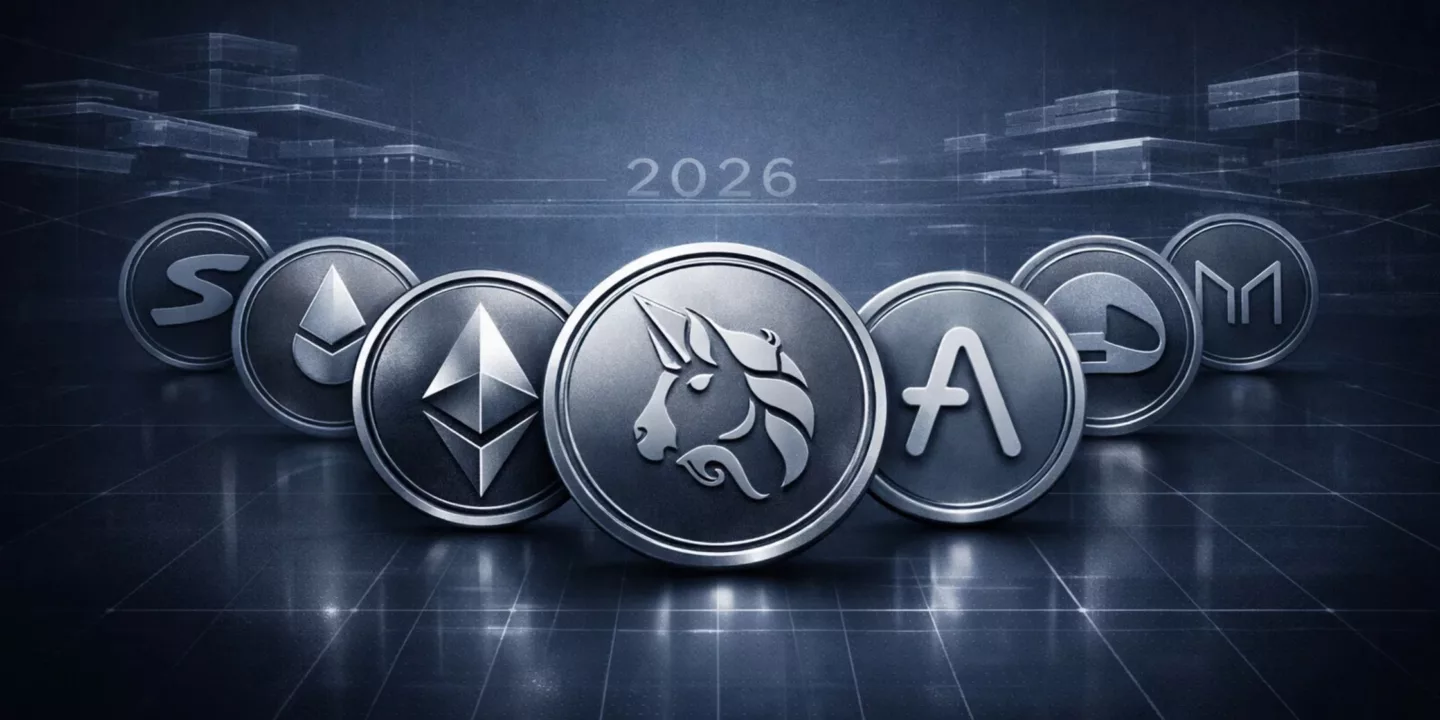
Decentralized finance has evolved from experimental yield farming to serious on-chain financial infrastructure. In 2026, DeFi is no longer about hype cycles. It is about protocol revenue, security, and sustainable token models. This guide explains the top DeFi coins in 2026, how they generate value, what risks they carry, and how to evaluate them using a clear, educational framework.
Why DeFi Coins Still Matter in 2026
DeFi coins represent ownership, governance, or economic participation in decentralized financial protocols. These protocols replace traditional intermediaries such as banks, brokers, and clearinghouses with smart contracts.
In earlier cycles, speculation drove most demand. In 2026, the market is more selective. Protocols are evaluated based on:
Total Value Locked (TVL)
Active users
Fee revenue
Security track record
The focus has shifted from “Which coin will pump?” to “Which protocol creates real economic activity?”
This shift makes understanding fundamentals more important than ever.
What Are DeFi Coins and How Do They Capture Value?
A DeFi coin is a cryptocurrency that powers a decentralized finance application. These applications operate on blockchain networks and execute transactions automatically through smart contracts.
DeFi coins typically fall into three categories.
Protocol Governance Tokens
These allow holders to vote on changes such as fee structures, risk parameters, and upgrades. Examples include tokens powering decentralized exchanges or lending platforms.
Revenue or Fee-Capture Tokens
Some protocols distribute a portion of transaction fees to token holders or use revenue for token buybacks.
Stablecoin Governance Tokens
These tokens help manage decentralized stablecoin systems and maintain peg stability.
The key concept is value capture. A token becomes valuable when:
The protocol generates fees
The token has real utility
Supply inflation is controlled
Without these factors, price appreciation is difficult to sustain.
Uniswap is one of the largest decentralized exchanges, allowing users to trade crypto assets directly from their wallets using automated liquidity pools instead of traditional order books. The UNI token governs protocol upgrades and treasury decisions, and its long-term value depends on whether trading fees are directed toward token holders.
In 2026, Uniswap remains important because decentralized trading continues to expand globally, although competition from newer exchange models remains a key risk.
Aave is a decentralized lending protocol that enables users to deposit crypto assets to earn interest or borrow against collateral without relying on banks. The AAVE token supports governance and plays a role in shaping risk parameters such as collateral ratios and liquidation thresholds.
Its relevance in 2026 comes from growing demand for on-chain credit markets, but sudden market downturns can reduce borrowing activity and increase liquidation events.
Chainlink provides decentralized oracle services that deliver real-world data, such as asset prices, to blockchain applications. The LINK token incentivizes node operators to provide reliable and tamper-resistant data that secures lending, derivatives, and trading protocols.
Because most DeFi applications depend on accurate external data, Chainlink serves as critical infrastructure, though it must continue innovating to maintain its leadership position.
4. Maker (MKR)
Maker governs the decentralized stablecoin DAI, which is issued when users lock crypto assets as collateral in smart contracts. MKR token holders vote on system parameters such as stability fees and acceptable collateral types to ensure the stablecoin maintains its peg. Its economic model is supported by borrowing demand, but severe collateral volatility can stress the system during extreme market conditions.
Lido offers liquid staking services that allow users to stake proof-of-stake assets while receiving tradable tokens representing their staked positions. The LDO token governs protocol decisions, including validator management and fee distribution policies.
As staking participation increases across major blockchain networks, liquid staking becomes more essential, although regulatory scrutiny around staking services may influence future growth.
Top 10 DeFi Coins 2026: Ranked by Category
DeFi tokens play different roles in the ecosystem, so evaluating them by category gives a clearer picture of their strengths.
DEX and Liquidity Leaders
1. Uniswap (UNI)
Uniswap is one of the most widely used decentralized exchanges, operating through automated liquidity pools instead of traditional order books. It introduced concentrated liquidity, which improves capital efficiency and allows liquidity providers to allocate funds within specific price ranges. The UNI token governs protocol upgrades and fee structures, and its long-term value depends on sustained trading volume and competitive positioning among DEX platforms.
2. Curve Finance (CRV)
Curve specializes in low-slippage swaps between similar assets, particularly stablecoins and pegged tokens. Its design maximizes capital efficiency for assets that trade at near-identical prices, making it a backbone of stablecoin liquidity in DeFi. The CRV token governs emissions and liquidity incentives, though high token inflation can create persistent sell pressure.
Lending and Collateral Protocols
3. Aave (AAVE)
Aave enables users to lend crypto assets to earn interest or borrow against collateral using overcollateralized smart contracts. Interest rates adjust automatically based on supply and demand within each lending pool. The AAVE token supports governance and risk parameter management, and its stability depends on effective liquidation systems during volatile market conditions.
4. Compound (COMP)
Compound is an algorithmic lending protocol where interest rates are determined programmatically without manual intervention. Users supply assets to liquidity pools and earn yield, while borrowers provide collateral to access loans. The COMP token grants governance rights, and its relevance depends on maintaining competitive yields and sufficient liquidity.
Oracle and Data Infrastructure
5. Chainlink (LINK)
Chainlink provides decentralized oracle services that deliver accurate price feeds and external data to smart contracts. Without reliable oracles, lending platforms, derivatives markets, and stablecoins cannot function securely. The LINK token incentivizes node operators to supply trustworthy data, and its importance grows as DeFi applications become more complex.
6. The Graph (GRT)
The Graph indexes blockchain data, allowing decentralized applications to retrieve and display information efficiently. It acts as a search and query layer for on-chain data, which improves usability across DeFi platforms. The GRT token rewards indexers and curators, though competition from alternative data solutions remains a factor.
Stablecoins and Synthetic Dollar Systems
7. Maker (MKR)
Maker governs the decentralized stablecoin DAI, which is created when users lock crypto assets as collateral. The protocol earns revenue from stability fees paid by borrowers, linking MKR’s value to system usage. MKR holders manage collateral types and risk parameters, but severe market downturns can test the resilience of the system.
8. Ethena (ENA)
Ethena focuses on synthetic dollar mechanisms designed to maintain price stability while generating yield. Its model often relies on hedging strategies to balance long and short exposures in derivatives markets. The ENA token participates in governance decisions, and the protocol’s success depends on disciplined risk management during volatile periods.
Derivatives and Perpetual Trading
9. Hyperliquid (HYPE)
Hyperliquid supports decentralized perpetual futures trading, enabling users to take leveraged positions without centralized intermediaries. Revenue depends largely on trading activity and derivatives volume within the platform. The HYPE token is tied to ecosystem growth, but derivatives markets are inherently sensitive to volatility and liquidity cycles.
Loopring is a layer-2 protocol that uses zk-rollup technology to enable faster and lower-cost decentralized trading. It improves scalability by batching transactions off-chain while maintaining security guarantees from the base layer. The LRC token supports staking and protocol participation, and its adoption depends on continued demand for scalable DEX infrastructure.
Each of these tokens captures value differently. Some depend on trading fees, others on lending demand, and others on infrastructure usage that supports the broader DeFi ecosystem.
Top DeFi Coins 2026 Price Snapshot
When reviewing the top DeFi coins in 2026, price should always be interpreted alongside supply and valuation metrics. A token priced at $5 is not automatically more expensive than one priced at $0.50. What matters is how much the entire network is valued and how many tokens exist.
The table below shows the key metrics you should compare before investing:
Token
Category
Current Price
Market Cap
Circulating Supply
Fully Diluted Valuation
UNI
DEX & Liquidity
$3.57
$2.26 B
634.11 M
$3.21 B
CRV
DEX & Stablecoin Swaps
$0.25
$372.76 M
1.46 B
$770.57 M
AAVE
Lending & Borrowing
$127.68
$1.96 B
15.32 M
$2.05 B
COMP
Lending Protocol
$18.79
$187.28 M
9.96 M
$187.93 M
LINK
Oracle Infrastructure
$8.94
$6.33 B
708.09 M
$8.96 B
GRT
Data Indexing
$0.027
$299.94 M
10.72 B
$320.89 M
MKR
Stablecoin Governance
$1531.6
$1.29 B
847.22 k
$1.53 B
ENA
Synthetic Dollar System
$0.121
$1 B
8.22 B
$1.82 B
HYPE
Perpetual Derivatives
$29.72
$7.7 B
259.11 M
$28.56 B
LRC
Layer-2 DEX
$0.034
$47.45 M
1.36 B
$47.65 M
Values as of 18 Feb, 2026 (01:00 PM IST)
Top DeFi Coins 2026 Price Prediction: Scenario-Based Analysis
Price prediction should not be framed as a guarantee. Instead, it is more responsible to evaluate how different economic conditions could influence token performance.
Base Case Scenario
Adoption continues steadily, and DeFi remains integrated within the broader crypto ecosystem. Protocol revenues grow gradually as trading and lending activity expand. In this environment, leading DeFi tokens tend to move in line with overall market growth rather than dramatically outperform.
Bull Case Scenario
Institutional participation increases, regulatory clarity improves, and more capital flows into on-chain finance. Protocols generate higher fee revenue and strengthen token value capture through buybacks or staking incentives. Under these conditions, high-quality DeFi tokens could outperform the broader crypto market.
Bear Case Scenario
Liquidity contracts and speculative activity declines. Regulatory tightening creates friction at exchange access points, slowing capital inflows. Reduced Total Value Locked weakens protocol revenue, placing sustained pressure on token valuations.
Can a DeFi Coin Reach $1? Understanding Market Capitalization
A token reaching $1 depends entirely on its circulating supply and overall market capitalization. The fundamental formula is:
If a token has 10 billion units in circulation, reaching $1 would require a $10 billion valuation. For established protocols with strong revenue and adoption, this may be feasible. For smaller or inflation-heavy tokens, it may require unrealistic capital inflows.
Low nominal price does not mean undervalued. High nominal price does not mean expensive. Market structure determines sustainability.
How to Choose the Best DeFi Coins in 2026
Selecting DeFi coins requires evaluating both the protocol and the token that powers it. A disciplined framework helps reduce emotion-driven decisions.
Product-Market Fit
Does the protocol show consistent usage?
Strong trading volume, active lending markets, and recurring fee generation signal real demand.
Revenue and Value Capture
Does the token benefit when the protocol earns fees?
Some tokens only grant governance rights, while others participate directly in revenue distribution or buyback models.
Tokenomics and Supply Discipline
Review inflation rates, emission schedules, and upcoming unlocks. Even strong protocols can struggle if supply expands too quickly.
Security and Track Record
Examine audits, exploit history, and how the team responded to past incidents. Resilience during volatile markets often separates durable projects from short-lived ones.
Competitive Position
Consider integrations, ecosystem depth, and network effects. Protocols embedded across multiple DeFi applications tend to maintain stronger long-term relevance.
This structured evaluation shifts the focus from speculation to fundamentals.
Risks of Investing in DeFi Coins
DeFi carries distinct risks beyond normal market volatility. Understanding these risks strengthens long-term decision-making.
Smart Contract Risk
Smart contracts execute automatically, and coding flaws can lead to loss of funds. Even audited protocols are not immune to vulnerabilities.
Oracle Risk
Many DeFi applications rely on external price feeds. Incorrect or manipulated data can trigger cascading liquidations.
Liquidation Risk
In lending systems, borrowers must maintain sufficient collateral. Sharp price declines can result in automatic liquidation of assets.
Governance Risk
Large token holders may influence protocol decisions in ways that favor their interests. Active governance participation is often necessary to protect decentralization.
Regulatory Risk
Global regulatory frameworks for digital assets continue to evolve. Policy changes can affect exchange access, stablecoin structures, and institutional participation.
How to Invest in DeFi Coins in India
Investors in India can access leading DeFi tokens through compliant cryptocurrency exchanges that support domestic regulations. The first step is completing KYC verification and understanding applicable tax obligations.
A disciplined approach includes:
Starting with modest allocations
Avoiding excessive leverage
Diversifying across different DeFi categories
Using secure wallets and strong authentication practices
Long-term participation benefits from steady accumulation and risk management rather than short-term speculation.
Conclusion
The top DeFi coins in 2026 represent financial infrastructure, not temporary trends. Decentralized exchanges, lending markets, oracle networks, and stablecoin systems collectively form the foundation of on-chain finance. Investors who understand valuation, tokenomics, and risk dynamics are better positioned to navigate volatility. Sustainable growth in DeFi will likely reward utility, disciplined governance, and consistent revenue generation.
If you want to go beyond surface-level token lists and truly understand how DeFi works, explore the structured guides on Mudrex Learn. From tokenomics breakdowns to market cycle analysis, the platform helps you build conviction through clarity.
For regular market updates, educational explainers, and practical investing insights, subscribe to the Mudrex YouTube channel. Staying informed is the first step toward making disciplined, long-term crypto decisions.
FAQs
1. What are the top DeFi coins in 2026?
The top DeFi coins in 2026 generally include leading decentralized exchange, lending, oracle, and stablecoin governance tokens. They are evaluated based on utility, adoption, and protocol revenue rather than short-term price changes.
2. What are DeFi coins?
DeFi coins are cryptocurrencies that power decentralized financial applications such as exchanges and lending platforms. They often provide governance rights, staking rewards, or fee participation within their ecosystems.
3. Can a DeFi coin reach $1?
A DeFi coin can reach $1 if its market capitalization supports that valuation relative to its circulating supply. The feasibility depends on the supply structure and sustained demand.
4. How do I choose the best DeFi coins?
Evaluate user adoption, revenue generation, tokenomics, security audits, and competitive positioning. A structured framework reduces speculation-driven decisions.
5. Are DeFi coins safe?
DeFi coins carry market and technical risks, including smart contract vulnerabilities and volatility. Careful research and disciplined allocation are essential before investing.
Siri is a writer venturing into the exciting realms of blockchain technology, cryptocurrency, and decentralized finance (DeFi), eager to explore the transformative potential of these innovations. She brings a unique perspective that bridges traditional industries and cutting-edge technology, often infused with a touch of humor through memes. She has a rich background in real estate and interior design, having previously contributed to NoBroker, where she crafted blogs and assets on these topics.