Kaspa is a proof-of-work cryptocurrency that solves a problem Bitcoin has lived with since 2009: when two miners find a valid block at nearly the same time, one of those blocks normally gets thrown away. Kaspa’s BlockDAG design keeps both blocks instead, letting the network confirm far more of them per second without giving up the security that makes proof-of-work mining trustworthy.
This guide explains what Kaspa actually is, how its GHOSTDAG consensus mechanism works, and what to know before buying or holding KAS today.
Key Takeaways
Kaspa is a proof-of-work Layer 1 cryptocurrency that replaces the traditional single-chain blockchain with a BlockDAG.
Its GHOSTDAG consensus protocol currently processes 10 blocks per second, following the 2025 Crescendo upgrade.
KAS has a fixed maximum supply of 28.7 billion tokens, with no premine, no ICO, and no allocation to founders.
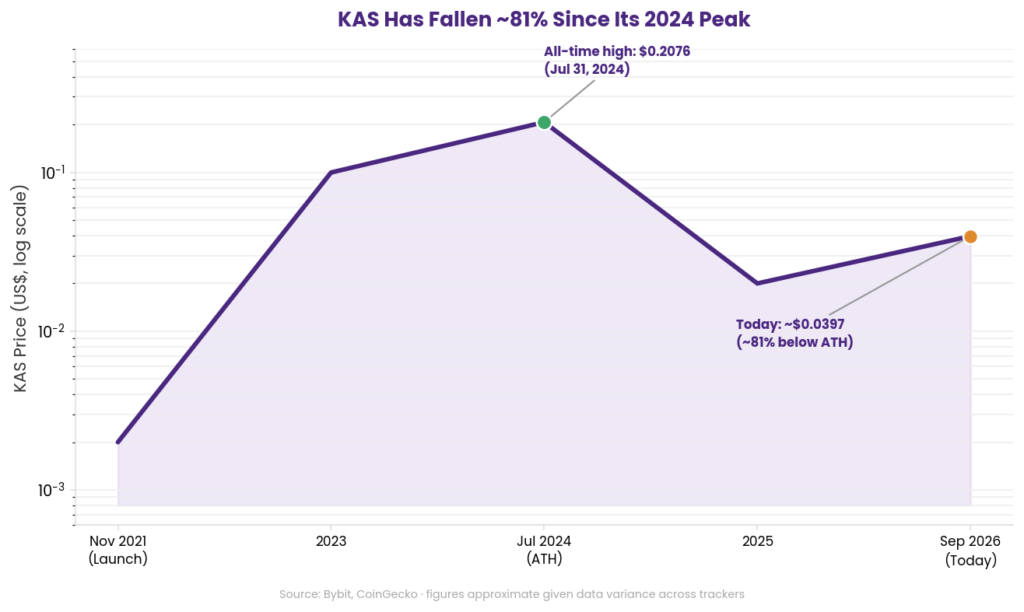
KAS trades around $0.0397 today, down roughly 81% from its all-time high of $0.2076, reached in July 2024.
KAS is available to buy and store in India, including through platforms like Mudrex, starting from as little as ₹100.
What Is Kaspa (KAS)?
Kaspa is a proof-of-work cryptocurrency built around a BlockDAG (Block Directed Acyclic Graph) architecture, designed to confirm transactions far faster than traditional single-chain blockchains like Bitcoin. Instead of discarding blocks that get mined around the same time, Kaspa’s GHOSTDAG protocol keeps all of them and orders them into one agreed history, currently at a rate of 10 blocks per second.
Kaspa is a cryptocurrency and blockchain network, and KAS is its native coin.
It uses proof-of-work mining, the same security model as Bitcoin, rather than proof-of-stake.
Its core innovation is the BlockDAG structure, which processes multiple blocks in parallel.
The network launched with no premine, ICO, or venture funding, following a fair-launch model.
Definition: BlockDAG A ledger structure where multiple blocks can be created and confirmed at the same time, rather than being forced into a single chain, so that no valid block ever has to be discarded as an “orphan.”
How Does Kaspa Work?
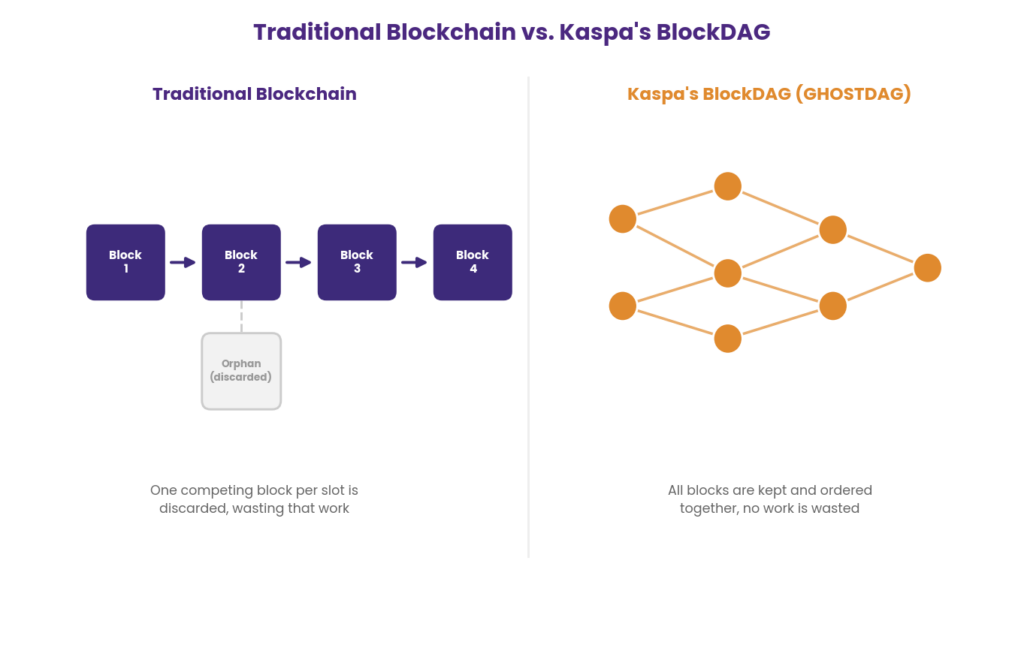
Kaspa works by replacing the single-chain structure most blockchains use with a directed acyclic graph, a network of blocks that can branch and reconnect rather than following one straight line. When multiple miners find valid blocks around the same time, all of those blocks get added to the graph instead of only one winning and the rest being discarded.
Traditional blockchains discard competing blocks. Kaspa keeps them all.
The GHOSTDAG protocol is what makes this possible. It looks at the full graph of blocks and calculates a consistent order for all of them, even ones created almost simultaneously, so every bit of mining work counts toward network security instead of some of it going to waste. This is what lets Kaspa run at 10 blocks per second today, following its 2025 Crescendo upgrade, with a roadmap targeting 100 blocks per second through a planned upgrade called DAGKnight.
What Are KAS’s Main Use Cases?
KAS functions primarily as a fast, low-fee medium for peer-to-peer payments, taking advantage of the near-instant confirmations its BlockDAG structure allows. Because blocks are produced and ordered so quickly, transactions can reach a reasonable level of confirmation confidence in a fraction of the time a traditional proof-of-work chain would need.
Beyond payments, Kaspa is building out a broader application layer. Projects like Kasplex add token-layer functionality on top of the base network, while Igra focuses on smart-contract-style applications, positioning Kaspa as infrastructure for developers who want proof-of-work-level security with far higher throughput than Bitcoin offers.
What Blockchain Does KAS Use?
KAS runs on Kaspa’s own Layer 1 blockchain rather than being issued on top of another network like Ethereum. It has no token contract in the traditional sense, since KAS is the base-layer coin miners earn directly through proof-of-work, using an algorithm called kHeavyHash designed to support efficient, parallelized mining.
The network’s performance has advanced through a series of upgrades since its 2021 launch. The most significant recent one, called Crescendo, rewrote the software in Rust and pushed block production to 10 blocks per second in 2025. A further upgrade named Toccata shipped in June 2026, with the long-term roadmap aimed at reaching 100 blocks per second through a consensus mechanism called DAGKnight.
Kaspa Tokenomics Explained
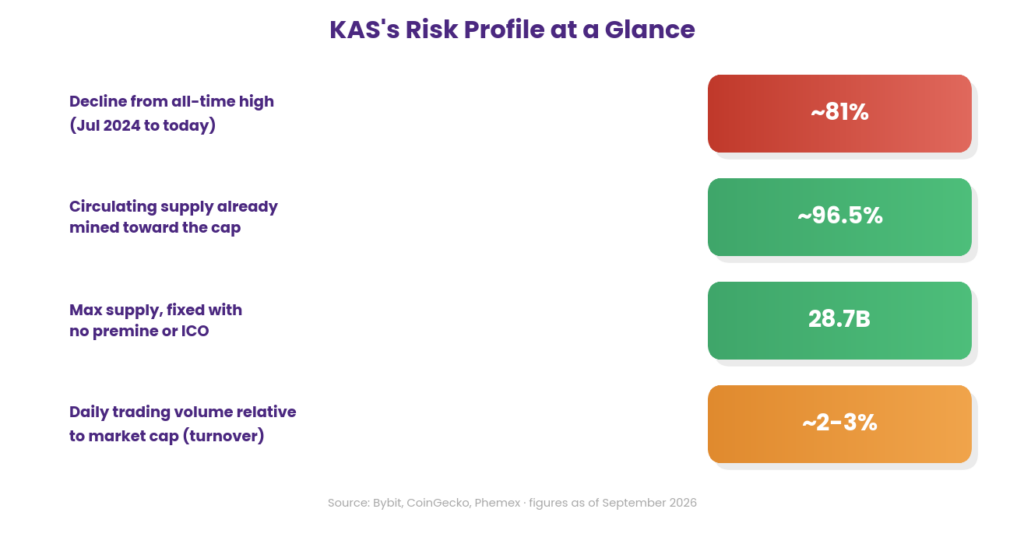
Kaspa has a fixed maximum supply of 28.7 billion KAS, with no mechanism to increase that cap. As of September 2026, roughly 27.7 billion tokens are in circulation, about 96.5% of total supply, following years of continuous proof-of-work mining since the network’s 2021 launch.
KAS’s price since its 2021 launch.
Metric
Value
All-time high
$0.2076 (Jul 31, 2024)
Recent price levels
~$0.0397
Approximate decline from ATH
~81%
Circulating supply
~27.7 billion KAS
Max supply
28.7 billion (fixed)
Launch model
Fair launch, no premine or ICO
Because there was no premine, ICO, or founder allocation at launch, every KAS token in circulation was mined through proof-of-work, the same distribution model Bitcoin uses. With circulating supply already near 96.5% of the hard cap, future dilution from new issuance is limited compared to many newer proof-of-work projects.
Who Created Kaspa?
Kaspa was created by Yonatan Sompolinsky, a researcher whose earlier academic work on the PHANTOM protocol influenced later blockchain scaling research, including some ideas that fed into Ethereum’s own scaling discussions. Kaspa’s whitepaper, titled “Application of the GHOSTDAG Protocol in Proof-of-Work Cryptocurrencies,” was published on November 10, 2021, alongside co-authors Shai Wyborski and Aviv Zohar.
The network launched shortly after, in November 2021, using a fair-launch model with no premine, no ICO, and no early allocation to the founding team. Development has continued since through the Kaspa community and contributors working on upgrades like Crescendo and the planned DAGKnight consensus mechanism.
What Makes KAS Different From Other Cryptocurrencies?
KAS’s core differentiator is its BlockDAG architecture, which lets it keep the proof-of-work security model that has secured Bitcoin for over a decade while processing blocks at a dramatically faster rate. Most high-throughput blockchains achieve their speed by moving to proof-of-stake or other consensus mechanisms; Kaspa instead tries to scale proof-of-work itself.
Compared most directly to Bitcoin, the difference in block time is stark. Kaspa currently produces a block roughly every 100 milliseconds, versus Bitcoin’s roughly 10-minute average, while both remain fixed-supply, no-premine proof-of-work networks at their core. That combination of Bitcoin-style security assumptions with far higher throughput is what Kaspa is most known for within the broader crypto market.
What Are the Risks of Using or Investing in KAS?
The core numbers behind KAS’s risk profile.
Severe historical decline: KAS trades roughly 81% below its all-time high, reflecting a broad, sustained pullback since mid-2024 rather than a brief dip.
Proof-of-work mining risk: like any PoW network, Kaspa’s security depends on sustained mining participation; a significant drop in hash rate could weaken network security.
Execution risk on the roadmap: reaching 100 blocks per second via DAGKnight and expanding the Kasplex and Igra application layers are still in progress, not guaranteed outcomes.
Thin liquidity relative to major coins: KAS’s daily trading volume runs a small fraction of larger cryptocurrencies, which can mean wider price swings on comparatively modest trading activity.
General crypto market risk: as a mid-cap token outside the very largest cryptocurrencies, KAS tends to move more sharply with broader crypto market sentiment.
Is Kaspa Secure?
Kaspa’s core security model rests on proof-of-work mining, the same fundamental approach that has protected Bitcoin since 2009: attacking the network would require controlling a majority of its mining power, which becomes more expensive as more miners participate. The GHOSTDAG protocol was specifically designed to preserve this security guarantee even while processing many more blocks per second than a traditional chain.
The main practical security consideration for KAS holders is standard crypto wallet hygiene rather than anything unique to Kaspa’s design: using reputable wallets, never sharing seed phrases, and verifying addresses carefully before sending funds. As with any proof-of-work network, security scales with the amount of honest mining power actively securing it.
How to Buy and Store KAS in India
KAS can be bought directly with INR on regulated Indian platforms such as Mudrex, which supports UPI and bank transfers, starting from as little as ₹100. Our step-by-step guide to buying Kaspa coin in India walks you through the full process, including KYC and storage options.
For readers weighing KAS specifically against Bitcoin’s more established, larger network, our Kaspa vs Bitcoin comparison covers the trade-offs between the two in more depth, from block times to liquidity.
Conclusion
What is Kaspa (KAS), in the simplest terms? It is a proof-of-work cryptocurrency that uses a BlockDAG structure and the GHOSTDAG protocol to process far more blocks per second than a traditional blockchain, without giving up the security assumptions that make proof-of-work mining trustworthy. Its tokenomics are about as straightforward as proof-of-work gets: a fixed 28.7 billion supply, no premine, and nearly all of it already mined.
The real open questions are whether its planned DAGKnight upgrade delivers the promised 100 blocks per second and whether its Kasplex and Igra application layers attract genuine developer activity, both worth watching before treating KAS as more than a speculative, high-throughput bet on proof-of-work’s future.
Ready to explore KAS? Download the Mudrex app for Android or iOS, or subscribe to our YouTube channel for more explainers like this one.
FAQs
What is Kaspa?
Kaspa is a proof-of-work cryptocurrency that uses a BlockDAG structure to process multiple blocks in parallel, rather than the single-chain design most blockchains rely on.
How does Kaspa work?
Kaspa’s GHOSTDAG protocol orders all blocks mined around the same time into one agreed history, instead of discarding competing blocks, currently achieving 10 blocks per second.
What is KAS used for?
KAS functions primarily as a fast, low-fee token for peer-to-peer payments, with an emerging application layer through projects like Kasplex and Igra.
Who created Kaspa?
Kaspa was created by researcher Yonatan Sompolinsky, alongside co-authors Shai Wyborski and Aviv Zohar, with the network launching in November 2021 through a fair-launch model.
What blockchain does KAS use?
KAS runs on Kaspa’s own Layer 1 proof-of-work blockchain, mined using the kHeavyHash algorithm, rather than being issued on another network.
How many KAS tokens are in circulation?
Roughly 27.7 billion KAS tokens are in circulation as of September 2026, out of a fixed maximum supply of 28.7 billion.
Where can I buy KAS in India?
Regulated Indian platforms such as Mudrex support buying KAS with INR, starting from as little as ₹100.
Is Kaspa secure?
Kaspa relies on proof-of-work mining for security, the same model Bitcoin uses, with the GHOSTDAG protocol designed to preserve that security while processing significantly more blocks per second.
Risk Disclaimer
Cryptocurrency investments carry a high risk of loss and are highly volatile, and proof-of-work tokens outside the largest few by market cap have historically shown sharp price declines during broader crypto downturns. The figures, comparisons, and scenarios in this article are illustrative and for educational purposes only; they are not financial advice or a guarantee of future performance. Please consult a qualified financial advisor before making any investment decisions.
Siri is a writer venturing into the exciting realms of blockchain technology, cryptocurrency, and decentralized finance (DeFi), eager to explore the transformative potential of these innovations. She brings a unique perspective that bridges traditional industries and cutting-edge technology, often infused with a touch of humor through memes. She has a rich background in real estate and interior design, having previously contributed to NoBroker, where she crafted blogs and assets on these topics.