What Is a Silver ETF? How It Works, How to Buy It in India, and Why It Falls
Silver delivered 144% returns on MCX in 2025. Silver ETF inflows in January 2026 alone rose 139% month-on-month to Rs. 9,463 crore. AUM across silver ETFs crossed Rs. 1.16 lakh crore.
It is quite evident that Indian retail investors are paying attention to silver in a way they never have before. And the most accessible way most of them are getting exposure is through a silver ETF.
This guide covers everything you need to know: what a silver ETF is, how it works, how to buy one in India step by step, which ones are available, how they are taxed, and why they sometimes fall sharply even when the silver story looks intact.
TL;DR: Key Takeaways
A silver ETF is a SEBI-regulated fund that tracks the domestic price of silver. You buy and sell units like stocks through a demat account.
Silver ETFs in India hold 99.9% pure physical silver in audited vaults. You get silver exposure without storage, purity, or theft risk.
You need a demat and trading account to buy a silver ETF in India. You can start with as little as one unit.
Silver ETFs fall when the US dollar strengthens, rate expectations rise, industrial demand weakens, or when overcrowded positioning unwinds — all separate from silver’s long-term story.
A silver ETF, or silver exchange-traded fund, is a SEBI-regulated mutual fund scheme that invests in physical silver or silver-related instruments and trades on stock exchanges like a stock.
When you buy a silver ETF, you are not buying physical silver. You are buying units of a fund that holds physical silver on your behalf, in SEBI-mandated vaults, at 99.9% purity. The price of each unit moves in line with the domestic silver price. When silver prices rise, your silver ETF units go up in value. When silver falls, they fall.
Silver ETFs trade on the NSE and BSE during market hours, just like equity shares. You can buy one unit, ten units, or a thousand. You can sell at any point during market hours. No storage costs, no purity concerns, no insurance required on your end.
SEBI first permitted silver ETFs in India in 2021. Since then, most major AMCs have launched their own versions and the category has grown rapidly, with the global silver supply deficit and industrial demand from solar panels, EVs, and AI infrastructure driving investor interest.
How Does a Silver ETF Work?
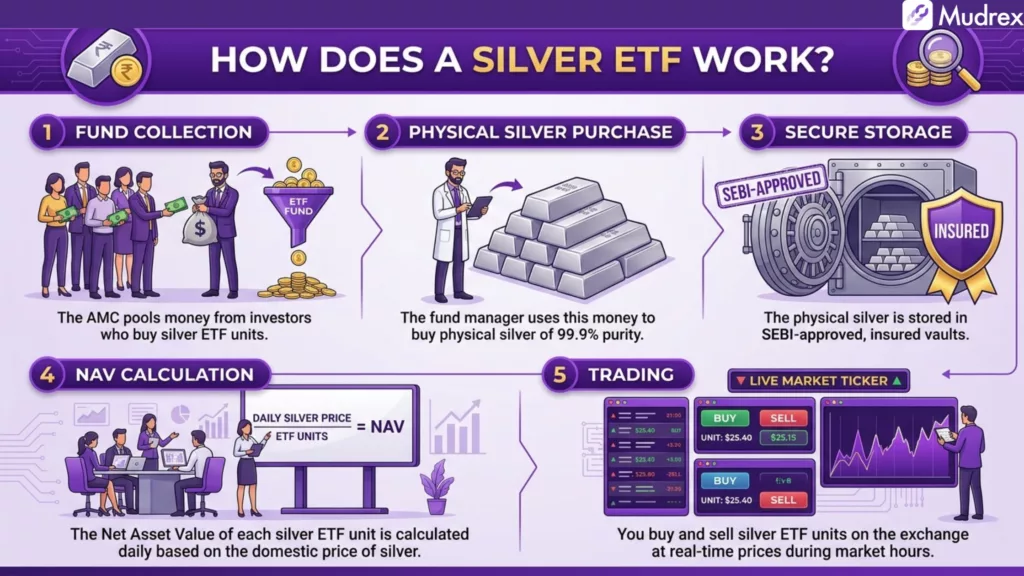
How does a silver ETF work?
Here are the mechanics of a silver ETF in simple terms:
Step 1: Fund collection. The AMC pools money from investors who buy silver ETF units.
Step 2: Physical silver purchase. The fund manager uses this money to buy physical silver of 99.9% purity, as mandated by SEBI and the London Bullion Market Association (LBMA) standards.
Step 3: Secure storage. The physical silver is stored in SEBI-approved, insured vaults. Fund houses must commission regular auditor reports to verify physical holdings.
Step 4: NAV calculation. The Net Asset Value of each silver ETF unit is calculated daily based on the domestic price of silver. From April 1, 2026, SEBI has mandated that silver ETF NAV be calculated using pooled spot prices published by recognised Indian exchanges like MCX, rather than LBMA-based international benchmarks. This means the NAV now more accurately reflects what silver actually costs in India.
Step 5: Trading. You buy and sell silver ETF units on the exchange at real-time prices during market hours (9:15 AM to 3:30 PM IST). Unlike mutual funds priced at end-of-day NAV, silver ETF prices change throughout the day.
Silver ETF vs Physical Silver vs Silver Mutual Fund: What Is the Difference?
Feature
Silver ETF
Physical Silver
Silver Mutual Fund (FoF)
Storage required
No
Yes
No
Purity guarantee
99.9% (SEBI mandated)
Depends on source
99.9% (through underlying ETF)
Demat account needed
Yes
No
No
Buy/sell timing
Real-time (market hours)
When you find a buyer
End-of-day NAV
Entry amount
1 unit (approx. Rs. 70-100+)
Varies (physical bar/coin)
Rs. 500 SIP minimum
Expense ratio
0.20-0.60% per year
Nil (but storage/making charges)
Slightly higher (double fee layer)
SEBI regulated
Yes
No
Yes
Liquidity
High (exchange traded)
Low for large amounts
Moderate
GST applicable
No on purchase
3% GST on purchase
No
The silver mutual fund (technically a silver ETF Fund of Fund) is worth noting for investors who do not have a demat account. You can buy a silver FoF directly through an AMC website or app, start a SIP from Rs. 500 per month, and get silver exposure without needing a demat account. The trade-off is a slightly higher expense ratio since you are paying two layers of fees.
Is There a Silver ETF in India? Top Silver ETFs Available in 2026
Yes. Multiple SEBI-approved silver ETFs are available in India as of 2026. Here are the major ones:
Silver ETF
AMC
Key Feature
Nippon India Silver ETF
Nippon India Mutual Fund
Highest AUM and liquidity in the category, preferred by traders
ICICI Prudential Silver ETF
ICICI Prudential Mutual Fund
AUM crossed Rs. 10,000 crore in 2026, cost-efficient
HDFC Silver ETF
HDFC Mutual Fund
Strong brand, robust physical silver holding
Aditya Birla Sun Life Silver ETF
Aditya Birla Sun Life Mutual Fund
Large AMC, widely accessible
UTI Silver ETF
UTI Mutual Fund
PSU-backed, suited to conservative investors
SBI Silver ETF
SBI Mutual Fund
PSU trust factor, widely distributed
Kotak Silver ETF
Kotak Mahindra Mutual Fund
Clean tracking, stock-like trading experience
Groww Silver ETF
Groww Mutual Fund
Platform-native, beginner-friendly access
All of the above hold 99.9% pure physical silver in SEBI-approved vaults. When comparing silver ETFs, the key metrics to look at are expense ratio (lower is better), tracking error (closer to zero is better), and daily trading volume on NSE and BSE (higher volume means easier entry and exit).
Things to Consider Before Investing in a Silver ETF
Expense ratio
The expense ratio is the annual fee charged by the fund. SEBI has capped silver ETF expense ratios at 1% of AUM. In practice, most silver ETFs charge between 0.20% and 0.60%. Lower is better, especially for long-term holders.
Tracking error
Tracking error measures how closely the silver ETF’s returns match the actual silver price movement. SEBI mandates that fund houses keep tracking error within 2%. Choose a silver ETF with the lowest tracking error for the most accurate silver exposure.
Liquidity and trading volume
A silver ETF with higher daily trading volume on the exchange is easier to buy and sell at fair prices. Nippon India Silver ETF consistently has the highest trading volumes in the category.
Risk appetite
Silver is significantly more volatile than gold. It can deliver 100%+ returns in a bull year and fall 40%+ from peak in a matter of weeks. Silver ETFs are appropriate for investors who understand and can handle that volatility.
How to Buy a Silver ETF in India: Step by Step
Buying a silver ETF in India requires a demat account and a trading account.
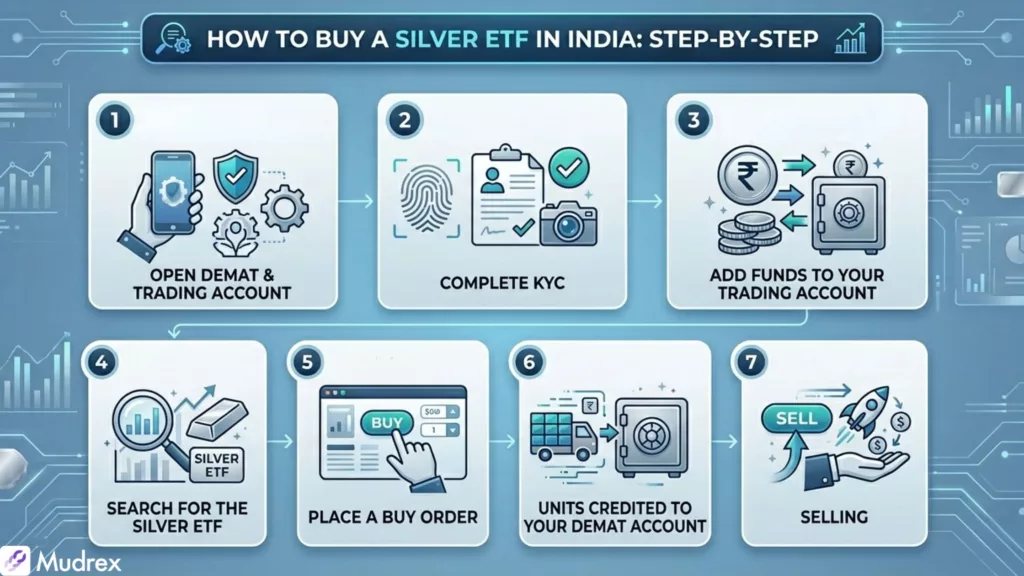
Step by step process to invest in a silver ETF in India
Here is the exact process:
Step 1: Open a demat and trading account
If you do not already have one, open a demat and trading account with any SEBI-registered broker. Popular options include Zerodha, Groww, Angel One, Upstox, and HDFC Securities. The process is fully online with e-KYC verification and typically takes 15-30 minutes. You will need your PAN card, Aadhaar, and bank account details.
Step 2: Complete KYC
KYC is a one-time process across all SEBI-regulated platforms. Once done with one registered broker, it applies across all others.
Step 3: Add funds to your trading account
Transfer funds from your bank account to your trading account using UPI, NEFT, or IMPS. You need enough to cover the cost of at least one unit of the silver ETF you want to buy, plus brokerage charges.
Step 4: Search for the silver ETF
Log in to your broker’s app or platform. Search for the silver ETF by name or NSE/BSE ticker. For example, Nippon India Silver ETF trades on NSE as “SILVERETF”.
Step 5: Place a buy order
Select the number of units you want to buy. Choose between a market order (executes immediately at the current price) or a limit order (executes only at your specified price). Click buy. The transaction happens during market hours (9:15 AM to 3:30 PM IST, Monday to Friday).
Step 6: Units credited to your demat account
Once the order is executed, the silver ETF units are credited to your demat account within T+1 settlement. You can track your holdings through your broker’s app.
Step 7: Selling
When you want to exit, place a sell order the same way. Proceeds are credited to your trading account after settlement.
One important note: Check the silver ETF’s iNAV (indicative NAV) on the fund house website before buying, especially for less liquid ETFs. Some silver ETFs trade at a slight premium or discount to their actual NAV during the day. Buying at a significant premium to NAV means you are overpaying for silver exposure.
Taxation of Silver ETFs in India (2026)
Silver ETFs are treated as capital assets for tax purposes in India.
Holding period
Tax treatment
Less than 24 months
Short-term capital gains (STCG) — taxed at your applicable income tax slab rate
More than 24 months
Long-term capital gains (LTCG) — taxed at 12.5% without indexation
Note: Tax rules are subject to change. Consult a qualified tax advisor or CA for your specific situation and for the most current applicable rates under the Finance Act.
There is no GST on the purchase of silver ETF units (unlike physical silver, which attracts 3% GST at purchase). This is one of the cost advantages of ETFs over physical silver for investment purposes.
Why Is Silver ETF Falling Today?
This is the question investors type into Google on days when their silver ETF drops sharply. It is worth understanding in detail because silver ETF declines can feel alarming if you do not know what is driving them.
Here are the six main reasons silver ETFs fall — and the context behind each in 2026:
1. US dollar strengthening
Silver is priced globally in US dollars. When the dollar strengthens, silver becomes more expensive for buyers using other currencies, which reduces international demand and pushes prices down. In India, a stronger dollar also means a weaker rupee, which can partially offset the fall for domestic silver ETF investors — but not always enough to prevent a net decline in INR terms.
2. Rising interest rate expectations
Silver pays no interest and no dividends. When interest rate expectations rise, bonds and fixed-income products become relatively more attractive. Investors rotate out of non-yielding assets like silver, reducing demand and pushing prices lower. In May 2026, the Fed’s June dot plot split the committee on rate hikes, the dollar surged, and silver posted one of its sharpest single-day drops of the year.
3. Weakening industrial demand signals
About 55% of silver demand is industrial — solar panels, EVs, AI semiconductors, medical devices, and electronics. When industrial output data weakens, particularly from China, which is a major silver consumer, demand projections are revised lower and silver prices fall. Silver ETFs follow immediately since they track spot prices closely.
4. Overcrowded positioning and profit-booking
When too many investors hold the same long position in silver — as happened in late 2025 when speculative long positions on COMEX silver were near five-year highs — even a modest change in market conditions can trigger a sharp unwind. When the CME raised margin requirements on silver futures by over 15% in January 2026, it forced leveraged traders to sell positions quickly, creating a feedback loop that pushed prices down faster than fundamentals justified.
5. Tracking discount — ETF price vs NAV
Sometimes a silver ETF unit trades at a slight discount to its actual NAV during periods of low liquidity or high selling pressure. This means the ETF can fall more than silver itself on a given day, not because silver fell more, but because of ETF-specific selling pressure. This is temporary and typically corrects itself.
6. Broad risk-off market sentiment
During broad market sell-offs — when equities, commodities, and risk assets all fall together — silver is often sold by investors who need liquidity. In March 2026, silver and gold both sold off despite strong underlying fundamentals as global investors sold perceived safe-haven assets to cover losses elsewhere.
What should you do when silver ETF is falling?
For long-term investors, silver’s structural drivers — six consecutive years of global supply deficit, growing industrial demand from energy transition and AI infrastructure, and monetary debasement — have not changed because of short-term corrections. The 2026 fall from the January all-time high was driven by overcrowded positioning and margin hikes, not by a collapse in silver’s fundamental demand story.
For short-term traders, risk management and defined stop-losses are essential. Silver’s volatility means it can fall 10-15% in a matter of days. Sizing positions correctly is more important than predicting direction.
Silver ETF vs XAG on Mudrex: An Alternative for Active Traders
Silver ETFs are excellent for investors who want regulated, demat-based silver exposure in India. But they come with one significant limitation for active traders: they only trade during NSE and BSE market hours, 9:15 AM to 3:30 PM IST, Monday to Friday.
Silver is a global market that moves 24 hours a day. In 2026, some of the most significant silver price moves have happened outside Indian market hours — weekend developments in the US-Iran geopolitical situation, Sunday announcements from the Fed, and Asian session industrial demand data that moved silver before Indian markets opened on Monday.
For traders who want 24/7 access to silver price movements, Mudrex offers XAG — a silver futures token that tracks silver futures price movements around the clock.
XAG is a crypto asset, not a SEBI-regulated silver ETF. It is not backed by physical silver. It is a digital token that tracks silver futures prices and is available for futures trading only on Mudrex. No spot silver trading is available through XAG.
Feature
Silver ETF (India)
XAG on Mudrex
What it tracks
Domestic silver spot price
Silver futures price
SEBI regulated
Yes
No (crypto asset)
Physically backed
Yes (99.9% pure silver in vaults)
No
Trading hours
9:15 AM to 3:30 PM IST (weekdays)
24/7 including weekends
Demat account needed
Yes
No (Mudrex account)
Spot trading
Yes
No
Futures trading
No (ETF holds physical)
Yes
Minimum investment
1 ETF unit (Rs. 70-100+)
Fractional sizing available
Rollover complexity
None
Handled automatically
The right choice depends on your purpose. For long-term investment with SEBI-regulated, physically-backed silver exposure, a silver ETF is the appropriate route. For active trading around the clock with silver futures price movements, XAG on Mudrex is worth exploring.
A silver ETF is one of the simplest, most cost-effective ways for Indian investors to get exposure to silver without the storage costs, purity concerns, or liquidity problems of physical metal. It is SEBI-regulated, demat-based, and trades like a stock. You can start with one unit.
Understanding why a silver ETF sometimes falls sharply is as important as knowing how to buy one. Short-term corrections driven by dollar strength, rate expectations, or positioning unwinds do not change the structural case for silver — six consecutive years of global supply deficit, growing industrial demand from solar, EVs, and AI infrastructure, and accessible entry points for retail Indian investors.
Understanding why a silver ETF sometimes falls sharply is as important as knowing how to buy one. For more guides on silver, gold, and commodity investing, explore Mudrex Learn and watch beginner-friendly explainers on the Mudrex YouTube channel.
FAQ
What is a silver ETF in simple terms?
A silver ETF is a fund that holds physical silver and trades on the stock exchange like a share. When you buy a silver ETF unit, you get silver price exposure without owning or storing physical metal.
Is there a silver ETF in India?
Yes. Multiple SEBI-approved silver ETFs are available in India, including those from Nippon India, ICICI Prudential, HDFC, Aditya Birla, UTI, SBI, Kotak, and Groww Mutual Fund. All hold 99.9% pure physical silver in audited vaults.
How can I buy a silver ETF online in India?
Open a demat and trading account with any SEBI-registered broker, search for the silver ETF by name or ticker on the exchange, and place a buy order during market hours. You can start with one unit.
Why is silver ETF falling today?
The most common reasons are a strengthening US dollar, rising interest rate expectations, weak industrial demand signals (especially from China), overcrowded speculative positioning unwinding, or broad market risk-off sentiment. These are short-term drivers and typically do not change silver’s long-term supply-deficit story.
Is investing in silver ETF safe?
Silver ETFs are SEBI-regulated and hold 99.9% pure physical silver in audited vaults, making them safer than buying physical silver from unverified sources. However, silver ETFs are subject to significant price volatility since silver prices can fall 20-40% in sharp corrections. They carry market risk, not counterparty or fraud risk.
Siri is a writer venturing into the exciting realms of blockchain technology, cryptocurrency, and decentralized finance (DeFi), eager to explore the transformative potential of these innovations. She brings a unique perspective that bridges traditional industries and cutting-edge technology, often infused with a touch of humor through memes. She has a rich background in real estate and interior design, having previously contributed to NoBroker, where she crafted blogs and assets on these topics.