Aarav is 27. He earns well, spends carefully, and last year he did what most of us call “being responsible.” He let ₹200,000 (about $2,100) sit in his savings account. Safe. Untouched. Waiting for the right moment.
That moment never came. And the money got smaller anyway.
Here’s the short answer to the question you came here with: if you’re asking where should I invest right now, the riskiest thing you can do in 2026 is nothing. Idle cash loses value every month to inflation, and the two assets most people turn to when they finally act are gold and Bitcoin. This guide compares both, with real 2026 numbers, so you can decide where to invest your money with confidence.
Key Takeaways
Idle savings are the real enemy. India’s retail inflation was 3.93% year-on-year in May 2026, and a Reuters poll expected June to rise to 4.3%, above the central bank’s comfort line.
Gold had a historic run, returning over 60% in 2025 and hitting fresh record highs in early 2026.
Bitcoin is down heavily year-over-year (around $64,000 in July 2026 versus roughly $116,000 a year earlier) but sits closer to the start of its next cycle than the top.
The best place to put your money depends on your risk appetite and time horizon, not on which asset is loudest.
You can buy both gold and Bitcoin on Mudrex, starting small.
Where Should I Invest Right Now? Bitcoin vs Gold 2026
Let’s do Aarav’s math. He kept ₹200,000 (~$2,100) in a savings account earning about 3% interest. Over the year, that added roughly ₹6,000 (~$63).
But prices didn’t stay still. With inflation running near 4%, the things his money could buy got more expensive faster than his money grew. In real terms, his “safe” savings lost purchasing power. He earned a little on paper and went backward in reality.
This is the quiet tax nobody sends you a bill for.
Here’s the uncomfortable part. Savings account rates in most banks sit well below inflation. So the longer money sits idle, the more it shrinks in what it can actually buy. Doing nothing feels safe. It isn’t.
That’s why the question isn’t really “should I invest?” It’s where.
When people finally decide to protect their money, two names come up again and again.
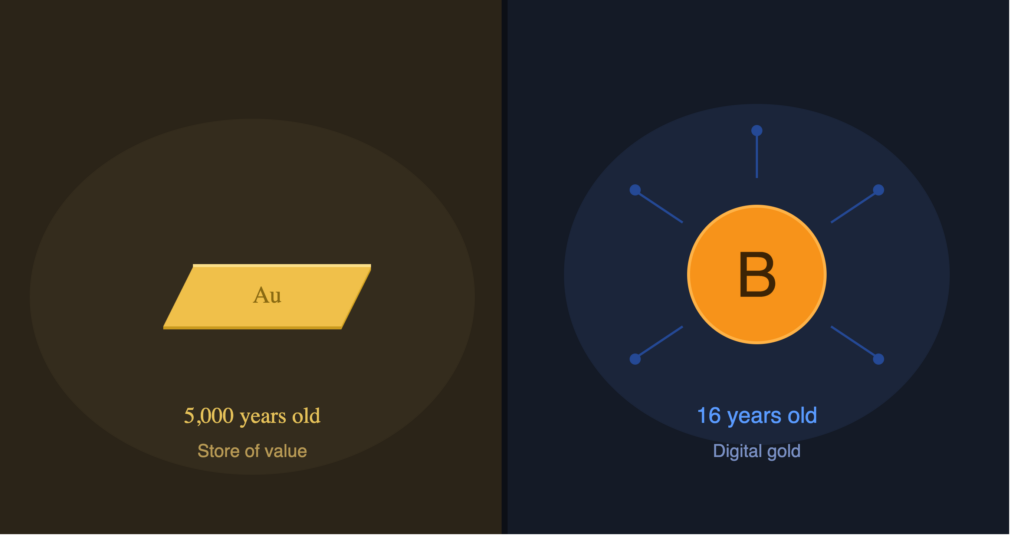
One is 5,000 years old. The other is 16.
Gold has been humanity’s store of value since before written history. Bitcoin was created in 2009 and is often called “digital gold.” Both promise the same core thing: a way to hold value outside the banking system, especially when currencies weaken and prices rise. They just go about it very differently.
Gold just had one of the best runs in living memory. It returned over 60% in 2025, notching more than 50 all-time highs. By early 2026 it kept climbing, touching an all-time high of ₹169,349 (about $1,780) per 10 grams on March 2, 2026.
Gold is entering a historically favorable period of the year:
Gold prices have gained +1.5% in July on average over the last 20 years, making it the 2nd-strongest month of the year.
Gold prices have also recorded positive returns in 65% of July months, the 2nd-best win rate of… pic.twitter.com/lkbaRa5MAa
— The Kobeissi Letter (@KobeissiLetter) July 8, 2026
As of July 13, 2026, 24K gold trades around ₹14,054 (about $147) per gram in India, with global spot gold near $4,100 an ounce.
Why gold works
It holds up when everything else feels shaky. War, weak currencies, and market panic tend to push gold higher.
It’s a genuine inflation hedge over long periods.
It carries deep, universal trust. It’s not just an asset, it’s history.
Where gold falls short
After a 60%-plus year, a lot of the easy upside may already be behind it. The World Gold Council projects gold could rise 5% to 15% in 2026, solid but far from explosive.
Physical gold means storage, making charges, and purity worries.
It grows slowly. Gold protects wealth. It rarely multiplies it fast.
Gold is the anchor. It keeps your portfolio steady. But an anchor is not an engine.
The Case for Bitcoin
Now the other contender.
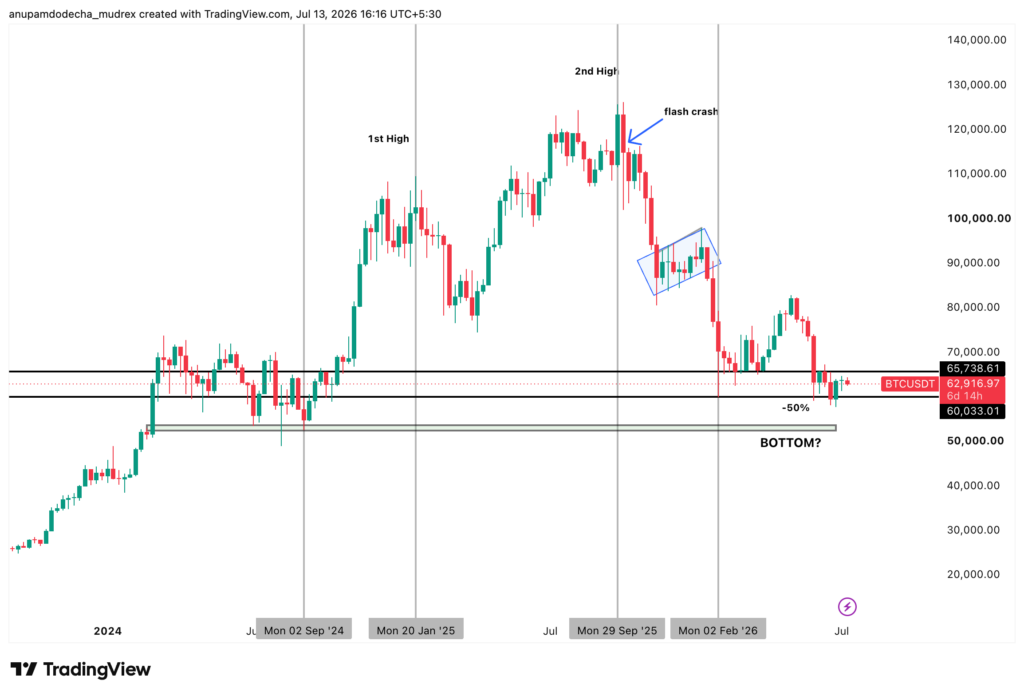
Bitcoin has had a rough year on the scoreboard. It’s trading around $64,000 in mid-July 2026, roughly $51,700 lower than a year earlier, after peaking near $126,000 in October 2025. If you’d bought at the top, you’d be hurting.
Bitcoin Price Chart
But zoom out, and a different picture appears.
Over roughly the last decade, Bitcoin’s price has climbed more than 15,000%. It moves in four-year cycles tied to its “halving,” and a down year has historically come before the next big move up, not after it. Bitcoin’s supply is capped forever at 21 million coins. That hard scarcity is the whole point.
Here’s the honest framing for someone chasing higher upside: gold protects, but Bitcoin is where the asymmetric growth has historically lived. A down year is closer to a discount than a disaster, if you have the stomach and the time horizon for it.
The risk you must accept
Volatility is brutal. Bitcoin can lose tens of thousands of dollars in months, then rally just as hard.
It’s still young, and regulation is evolving.
It demands patience. This is a multi-year bet, not a next-month one.
Bitcoin is the engine. It can power real growth. It can also stall violently along the way. Never put in money you’d need next quarter.
Bitcoin vs Gold: The Head-to-Head
Factor
Gold
Bitcoin
Age as an asset
~5,000 years
16 years (since 2009)
2025 return
Over 60%
Peaked at $126K, then corrected
Price (Jul 2026)
~$147/gram 24K (₹14,054); ~$4,100/oz
~$64,000 (₹6,100,000) per BTC
Volatility
Low to moderate
High
Growth potential
Steady, slow
High, with high risk
Inflation hedge
Proven over centuries
Emerging, cycle-driven
Storage
Physical or digital gold
Fully digital
Best for
Stability, capital protection
Long-term upside seekers
BTC vs Gold Comparison
So Where Should I Invest Right Now, Gold or Bitcoin?
Back to Aarav. And back to you.
There’s no single “best” answer, because the right choice depends on who you are. Here’s a simple way to figure out where to invest your money.
If you want stability above all: lean gold. Protect what you have. Sleep easy. Accept slower growth.
If you’re young, earning, and can leave money untouched for years: this is where leaning toward Bitcoin makes sense. You have the one thing Bitcoin rewards most, which is time. A year like 2026, with prices well below the peak, is historically when patient buyers have accumulated, not when they’ve run away.
If you’re honest that you don’t know: hold both. Let gold be the anchor and Bitcoin be the engine. A common approach is a larger, steady base in gold and a smaller, growth-oriented position in Bitcoin that you’re fully prepared to see swing hard.
The one choice that has consistently lost is Aarav’s original one: leaving it all in the bank while inflation nibbles away.
Important: This is educational information, not financial advice. All investments carry risk, Bitcoin especially. A qualified financial advisor and your own research should drive your final decision.
How to Start (Even With Small Money)
You don’t need lakhs to begin. You need a habit.
The simplest approach is a SIP-style plan, sometimes called dollar-cost averaging. You invest a fixed small amount at regular intervals, say weekly or monthly, regardless of price. This smooths out the ups and downs so you’re not trying to guess the perfect day to buy.
Buy Bitcoin in rupees, starting with a small amount, no need to buy a whole coin.
Get exposure to gold alongside crypto, so you can hold your anchor and your engine in one place.
Set up recurring buys so investing becomes automatic instead of a decision you keep postponing.
Start small. Stay consistent. Give it time. That’s the whole game.
The Bottom Line
If you’ve been asking where should I invest right now, the real answer is to stop letting your money sit idle while inflation shrinks it. Gold offers proven, steady protection after a stellar run. Bitcoin offers higher long-term upside for those who can handle the swings and wait out the cycles.
For a young investor with time on their side, leaning toward Bitcoin, while keeping gold as a stabilising anchor, is a reasonable way to chase growth without abandoning safety. But the best place to invest is the one that matches your risk appetite and lets you sleep at night.
Aarav finally started a small monthly SIP into both. Not a fortune. Just a start. And a start beats a shrinking savings account every single time.
Disclaimer: This content is for educational purposes only and is not financial advice. Cryptocurrency and gold prices are volatile and can fall as well as rise. Past performance does not guarantee future results. Always do your own research and consider consulting a licensed financial advisor before investing.
FAQs
Where should I invest right now for the long term?
For long-term investors, a mix of gold and Bitcoin covers both stability and growth. Gold protects your capital and hedges inflation, while Bitcoin offers higher upside over multi-year cycles. Younger investors with time to ride out volatility often lean more toward Bitcoin, using gold as a steadying anchor.
Is Bitcoin a good investment in 2026?
Bitcoin is trading around $64,000 in July 2026, well below its October 2025 peak of about $126,000. Historically, down years have come before Bitcoin’s next major upward cycle rather than after it. It carries high risk and sharp volatility, so it suits patient investors who won’t need the money soon and can tolerate large swings.
Is gold still a good investment after its 2025 rally?
Gold returned over 60% in 2025 and hit record highs in early 2026, so the easiest gains may be behind it. The World Gold Council projects a more moderate 5% to 15% rise in 2026. It remains an excellent stabiliser and inflation hedge, but expect slower growth than the previous year.
Bitcoin vs gold: which is the better place to invest?
Neither is universally “better.” Gold offers steady, low-volatility protection, while Bitcoin offers higher potential returns with much higher risk. Gold suits capital preservation; Bitcoin suits long-term growth seekers. Many investors hold both to balance safety and upside.
How much money do I need to start investing in Bitcoin or gold?
You can start with a small amount. On platforms like Mudrex, you can buy a fraction of a Bitcoin in your local currency and set up recurring purchases, so you don’t need to buy a whole coin or invest a large sum upfront.
Why is leaving money in a savings account risky?
With inflation near 4% in many markets in mid-2026 and most savings accounts paying around 3%, idle cash loses purchasing power over time. Your balance may grow slightly on paper while buying less in real terms, which is why simply “waiting” is often the costliest choice.
Anupam has over 3 years of experience in the crypto industry, having worked with top indian crypto exchanges. He writes about Bitcoin, altcoins, AI, and emerging tech, helping readers understand what’s driving markets and where the digital asset ecosystem is headed.