
Why is Solana falling in 2026? For most of the year, the answer was straightforward: Bitcoin correlation, a cooling meme coin cycle, and a relative dip in confidence pulled SOL roughly 60% below its January 2025 peak.
But things have just changed. Between August 19 and 21, SOL rallied from around $74 to above $92, driven by two Washington-linked catalysts rather than anything specific to Solana.

This guide covers the reasons behind Solana price decline 2026, what changed in the last few days, and the levels traders are watching now.
Yes, largely. Solana behaves as a high-beta asset: when Bitcoin falls, SOL historically falls harder, and when Bitcoin rallies, SOL tends to outperform, which is also why Solana price is decreasing faster than Bitcoin in most sell-offs.
Early August saw a broader crypto sell-off with Bitcoin down over 2%, and SOL fell further on a technical break below support amid ecosystem outflows and weak network demand signals, per Finbold. Leveraged positions unwinding can add a liquidation cascade on top of ordinary selling, and bearish momentum tends to feed on itself once support breaks. This risk-off sentiment pattern isn’t unique to 2026.
Substantially, yes. Solana became the dominant chain for meme coin speculation via Pump.fun, driving real fee revenue during 2024’s boom. By 2025, rug pulls and volatility made traders cautious and volumes cooled: Solidus Labs found 98.6% of Pump.fun tokens showed rug-pull behavior, and about 93% of Raydium pools showed manipulation.
Activity has since partially rebounded though, alongside broader DeFi growth.
Less than you might expect. Unlike altcoins with large scheduled unlocks, Solana’s supply pressure mostly comes from ongoing staking-reward issuance, not cliff-based token dilution. Its inflation schedule disinflates toward a low long-term rate, a steady, shrinking supply source rather than a sudden shock.
No. Daily active addresses have regularly reached 4-5 million, non-vote transactions run 80-100 million per day, and weekly DEX volume overtook Ethereum’s in April 2026, per CoinGecko. Stablecoin supply hit an all-time high above 14.6 billion in early 2026. DeFi TVL fell 56% from $11.7 billion to $5.5 billion, but has since partially recovered.
Price and fundamentals simply diverged for a stretch.
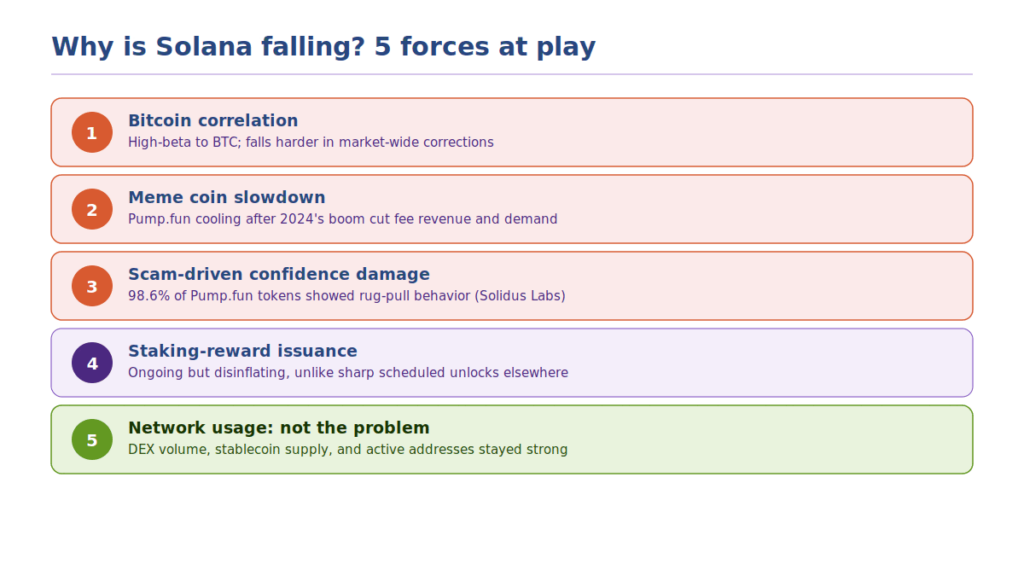
Yes, meaningfully. Beyond the rug-pull statistics, incidents like the LIBRA token scandal (a meme coin endorsed by a sitting head of state that collapsed shortly after launch) fed a narrative that Solana’s permissionless token-launch culture invites fraud.
A lawsuit alleging coordinated manipulation on Pump.fun, plus increased SEC and DOJ scrutiny, adds regulatory uncertainty on top of reputational damage. Confidence and price both respond to headlines, not just fundamentals. See our guide on spotting common crypto scams if researching any specific token.
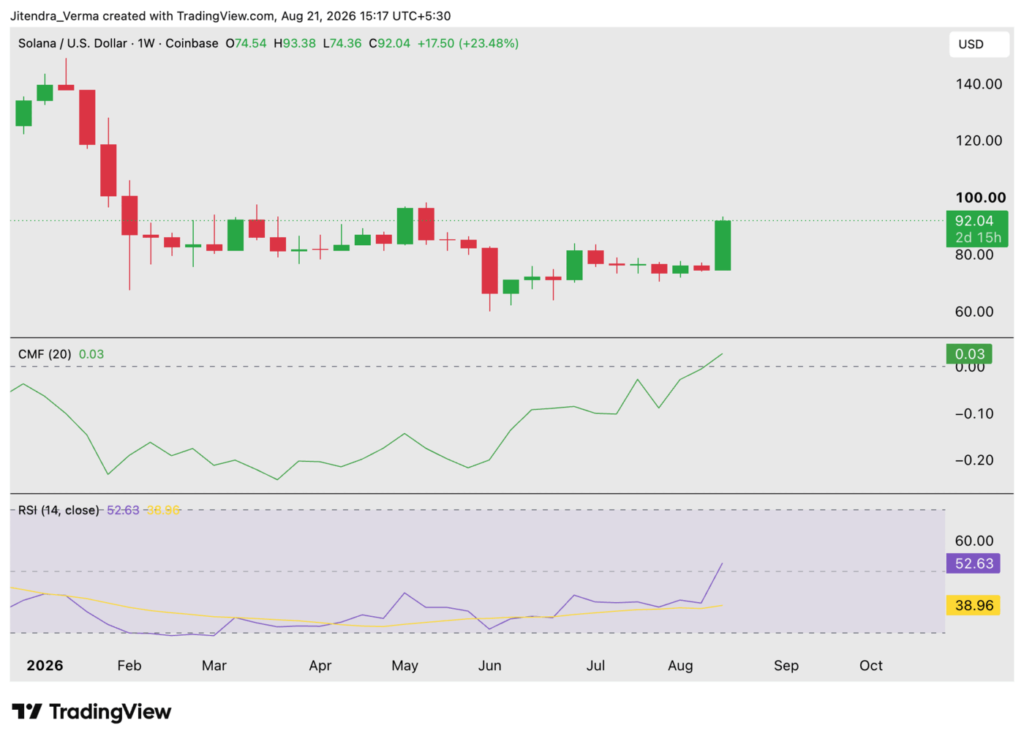
The weekly chart tells the story: after months of lower highs, SOL printed a strong green candle, opening at $74.54 and closing at $92.04, a +23.48% weekly gain. RSI(14) climbed from deeply oversold to 52.63, back in neutral range, while Chaikin Money Flow turned positive (0.03) for the first time in months, signaling real buying volume behind the move.
The hourly chart shows how fast it happened: SOL climbed from ~$74 late on August 18 to an intraday high of $93.31 by August 21, before pulling back to $91.91. Hourly RSI pushed above 70 and CMF spiked well above zero, signs of a genuine momentum surge rather than thin drift.
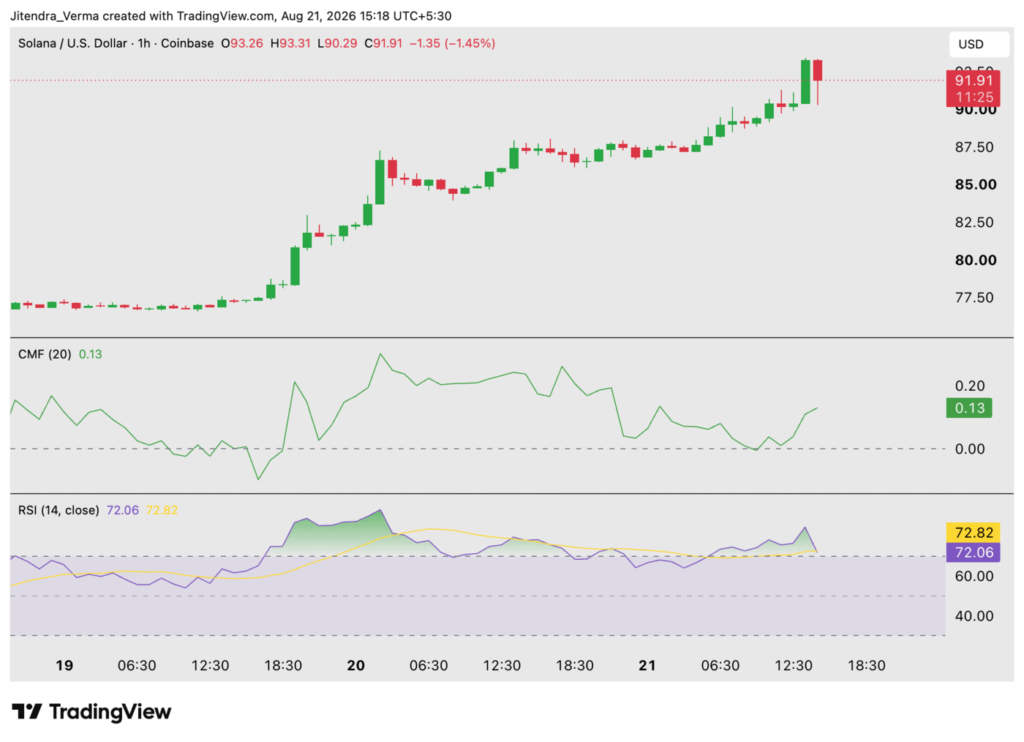
SOL has reclaimed the $70-75 zone that had capped it for most of August. A support breakdown back below ~$80-85 would suggest the rally is fading; holding above it supports the case that sentiment has genuinely turned.
Two developments out of Washington, not Solana-specific news, explain the bounce:
A Treasury bond buyback eased a macro headwind. The 30-year Treasury yield hit 5.337% on August 18, its highest since 2007; higher long-term yields make risk-free debt more attractive relative to Bitcoin and SOL. The US Treasury announced it would at least double liquidity-support buybacks for longer-dated bonds, from $2 billion to $4 billion per operation, running September 9 to November 4. The yield fell nearly 10 basis points afterward, and Reuters reported the move weakened the dollar and lifted stocks, gold, Bitcoin, and Ether alongside SOL. This is a liquidity-support program, not Fed quantitative easing, though both ease conditions.
Trump revived the CLARITY Act, and the SEC moved separately. On August 19, Trump hosted crypto executives from Coinbase, Ripple, Robinhood, Kraken, and ICE at the White House and pushed Congress to pass the CLARITY Act, clarifying SEC versus CFTC oversight of digital assets. Its Senate path remains difficult, but the push gave traders a reason to price in friendlier regulation. Separately, the SEC proposed new crypto rules on August 18, including exemptions for some token offerings and a conditional safe harbor for qualifying assets.
Recovery is possible, but not guaranteed to last.
The bull case: this week’s rally came on real volume, fundamentals that never matched the earlier decline, and a macro backdrop that could keep improving.
The bear case: the move was driven by catalysts external to Solana, RSI is now overbought short-term, and SOL remains highly correlated to Bitcoin, so a reversal in those same catalysts could pull it back down just as fast.
This is a map of what’s driving price now versus what drove the decline before it, not a signal to buy or avoid SOL.
The last few days flipped the script with a sharp, catalyst-driven rally back toward $92. Buy Solana on Mudrex from ₹100, check the live SOL/INR rate, or read our Solana price prediction for a longer-term view. Download the Mudrex app to get started, or subscribe to the Mudrex YouTube channel for regular market updates.
Bitcoin correlation, a cooling meme coin cycle, and relative reputation lack to BTC and ETH due to memecoin activity, even as core network usage stayed strong.
Yes. Solana is high-beta to Bitcoin, falling harder during corrections and outperforming during rallies.
Yes, trading cooled sharply after a wave of rug pulls, though Pump.fun activity has since partially rebounded.
Not in the traditional sense. New supply mostly comes from disinflating staking rewards, not large scheduled unlocks.
No. Active addresses, transaction counts, and DEX volume stayed strong or grew even while price fell.
Yes. High rug-pull rates on Pump.fun and Raydium, plus incidents like the LIBRA scandal, damaged sentiment beyond what fundamentals alone would suggest.
This article is a market analysis for educational purposes only and is not financial advice. Cryptocurrency prices are highly volatile, and past performance does not guarantee future results. Do your own research and consult a qualified financial advisor before making investment decisions.