The Wyckoff Method is a structured framework for understanding market movements by analyzing supply, demand, and the actions of large investors, often referred to as smart money. In cryptocurrency markets, where volatility is pronounced and institutional activity is visible, the method provides clear insight into market cycles. By observing price action and volume patterns, traders can predict potential accumulation, distribution, and trend reversals.

This guide explains the Wyckoff Method; you will learn how to read market phases, recognize key events, apply Wyckoff’s laws, and use them for informed trade entries and exits.
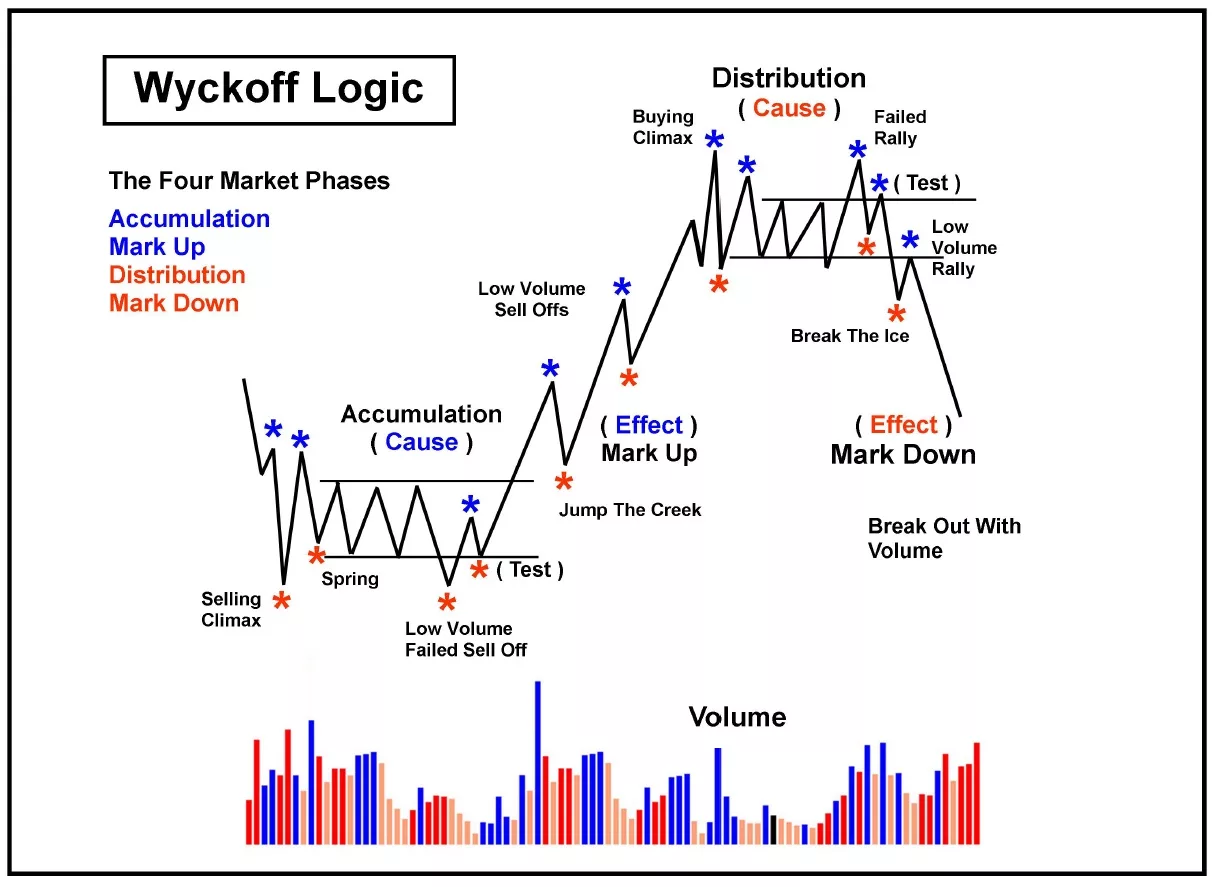
Developed in the early 1900s by Richard D. Wyckoff, the Wyckoff Method is a technical framework for understanding market behavior and institutional activity. It helps determine the phases of accumulation and distribution, enabling traders to anticipate potential price moves. By reading price action alongside trading volume, one can identify when smart money is entering or exiting the market.

The Wyckoff Method emphasizes observation over reliance on complex indicators. Its principles focus on price, volume, and trading ranges, making patterns easier to spot over time. While it requires patience and practice to recognize nuances, following the structured approach provides clarity in volatile markets and helps reduce impulsive trades.
The Composite Man represents institutional or large-scale traders who accumulate or distribute assets strategically. Observing market movements as the actions of a composite entity makes it easier to understand why prices behave a certain way. Large investors often control liquidity, so analyzing volume and price together reveals when they are accumulating (buying) or distributing (selling) assets.
Price rises when demand exceeds supply and falls when supply exceeds demand.
For example, during sideways Bitcoin accumulation, reduced selling pressure and steady buying indicate rising demand, hinting at a potential upward move.
The duration and intensity of accumulation or distribution (cause) determine the magnitude of the next price move (effect).
For example, a multi-month accumulation in Ethereum often precedes a substantial price rally once the breakout occurs.
Volume represents effort, and price movement represents result. A divergence between effort and result can indicate exhaustion or upcoming reversals. For example, Bitcoin trading at high volume with minimal price change during sideways consolidation suggests absorption and a potential trend reversal.
This phase occurs when smart money starts buying assets quietly, keeping the price within a trading range. Consolidation occurs with occasional small dips and low volatility.
This range has a ‘high,’ which acts as resistance (difficult to surpass that price), and a ‘low,’ which acts as support (it’s hard for the price to go below that). The lows, also known as the failure point, mark a selling climax.
Wyckoff created a fictional entity called the ‘composite man’ in the stock market. He suggests that we view the stock market as run by a single person or operator. In essence, this composite man refers to the whales or wealthy investors/institutions. It is in their best interest to steer the market so that they can always buy low and sell high. If observed closely, one can predict the movement of the composite man.
A composite man always accumulates or takes positions before others in the market. This is done strategically to ensure that the ‘buy’ is not reflected in the prices. Markets show a sideways movement during the accumulation phase.
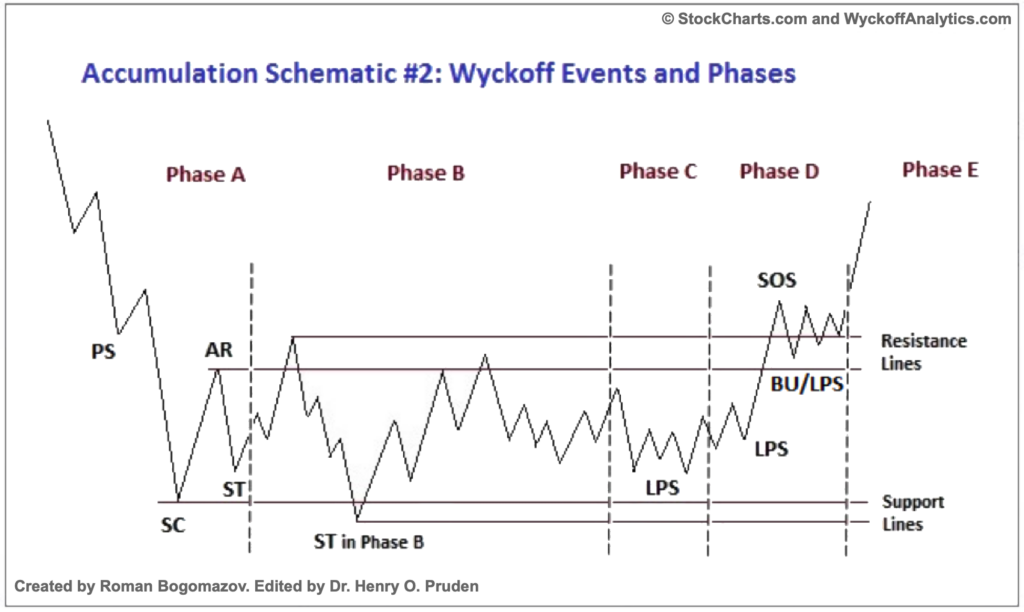
Here, the price begins to rise as demand outweighs supply. Pullbacks or throwbacks offer additional buying opportunities.
Markup is defined by the slope of the upward trend. Each markup will have the following characteristics:
In this phase, large players gradually sell positions to late entrants.
A composite man would sell his positions to the people entering late into the market. This is again denoted by a sideways movement until the demand is exhausted. A characteristic marking the start of the distribution phase is the failure to form higher highs or each subsequent local peak being less than the previous one.
To understand the distribution phase better, think of it as the exact opposite of the accumulation phase. Just like the former, distribution is also range-bound. There are often pullbacks to the previous resistance, which can be used to short the commodity for profit.
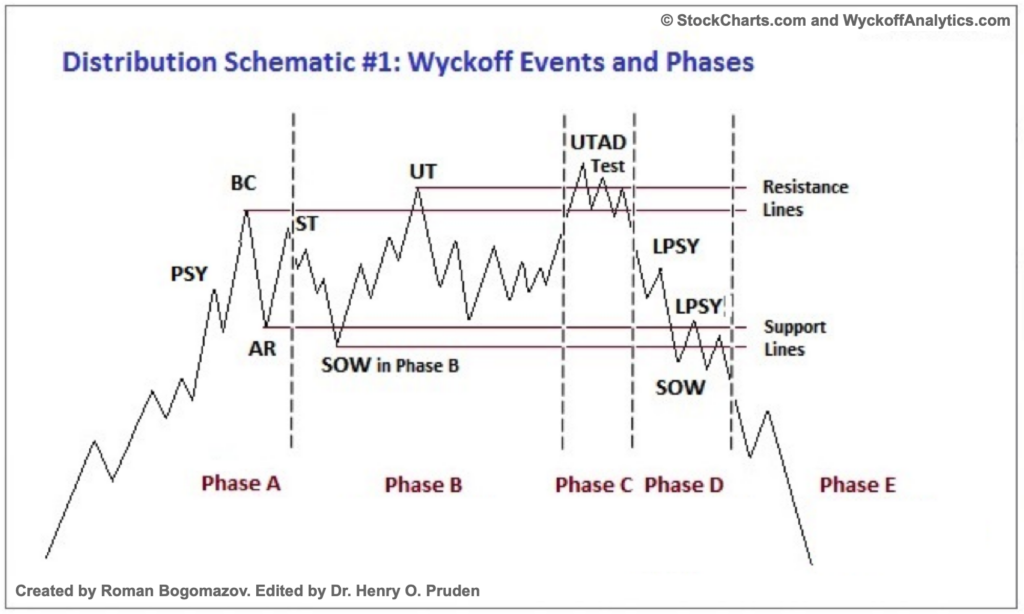
In this phase, prices decline as supply exceeds demand. Temporary rallies may occur, but are often followed by lower lows, leading to a sustained downtrend.
The exact opposite of markup, markdown is measured by the slope of the downward trend. Similar to an uptrend, a downtrend also has re-distribution phases where the market tends sideways.
Another key feature of a markdown is a bull-trap or dead cat bounce. It is the moment of a short jump in the prices, where traders mistake it for a reversal and hence get trapped.
Key signals include liquidity hunts, open interest spikes, and sudden funding changes. Observing volume patterns helps distinguish real trend reversals from temporary manipulations.
| Signal | Chart Appearance | Action | Invalidations |
| Spring | Wick below support | Buy on low-volume test | Break below spring low |
| UTAD | Wick above resistance | Short after confirmation | Close above UTAD |
| SOS | Breakout with volume | Add to position | Fails breakout retest |
Position sizing, clear invalidations, and avoiding excessive trades improve long-term performance. Monitoring the relationship between volume and price ensures decisions are data-driven rather than emotional.
While Support & Resistance simply mark price levels where buyers or sellers reacted in the past, the Wyckoff Method goes deeper. It explains why these levels matter by revealing the underlying smart-money actions—absorption, accumulation, distribution, and manipulation happening around those zones. This adds more context and helps traders avoid blindly relying on horizontal lines.
Both Wyckoff and ICT focus on liquidity, market structure, and institutional activity. But Wyckoff offers a more organised, phase-driven framework. Instead of just identifying liquidity pools or imbalances, Wyckoff guides you through stages of accumulation and distribution, helping you understand the full lifecycle of a move, not just entry points.
Indicator-based strategies rely on tools that lag behind actual price movement. Wyckoff, on the other hand, uses pure price and volume to interpret what institutions are doing in real time. This allows traders to anticipate major shifts earlier, instead of reacting after an indicator triggers a signal.
Accumulation → Markup → Distribution → Markdown
SC, ST, Spring, SOS, LPS, UTAD, SOW
The Wyckoff Method provides a clear framework to observe market phases, understand institutional behavior, and make data-driven trading decisions. By recognizing accumulation, distribution, springs, UTADs, and volume-confirmed trends, traders gain an edge in crypto markets. Applying this method improves timing, reduces impulsive trades, and helps navigate volatile markets confidently.
Take the next step in applying structured trading strategies with Mudrex. Explore Coin Sets, crypto SIPs, and leveraged futures trades to optimize your exposure to Bitcoin, Ethereum, and altcoins while saving time and managing risk efficiently. Start leveraging the power of disciplined market analysis with Mudrex today.
The method is built on three core laws: Supply and Demand, Cause and Effect, and Effort vs. Result, each explaining how price moves based on institutional activity.
Yes. It simplifies complex market behavior into clear phases and events, making it easier for beginners to understand price action without relying on in
The market moves through Accumulation, Markup, Distribution, and Markdown; a repeating cycle driven by smart-money positioning.
Use the daily timeframe to identify overall structure, and lower timeframes for precise entries, confirmations, and stop-loss placements.
It can be highly effective when applied with discipline. The method produces high-probability setups when paired with volume analysis, market structure, and clear invalidation levels.
Yes. Intraday ranges often form mini accumulation and distribution zones, allowing day traders to apply Wyckoff principles for quick, structured trade setups.