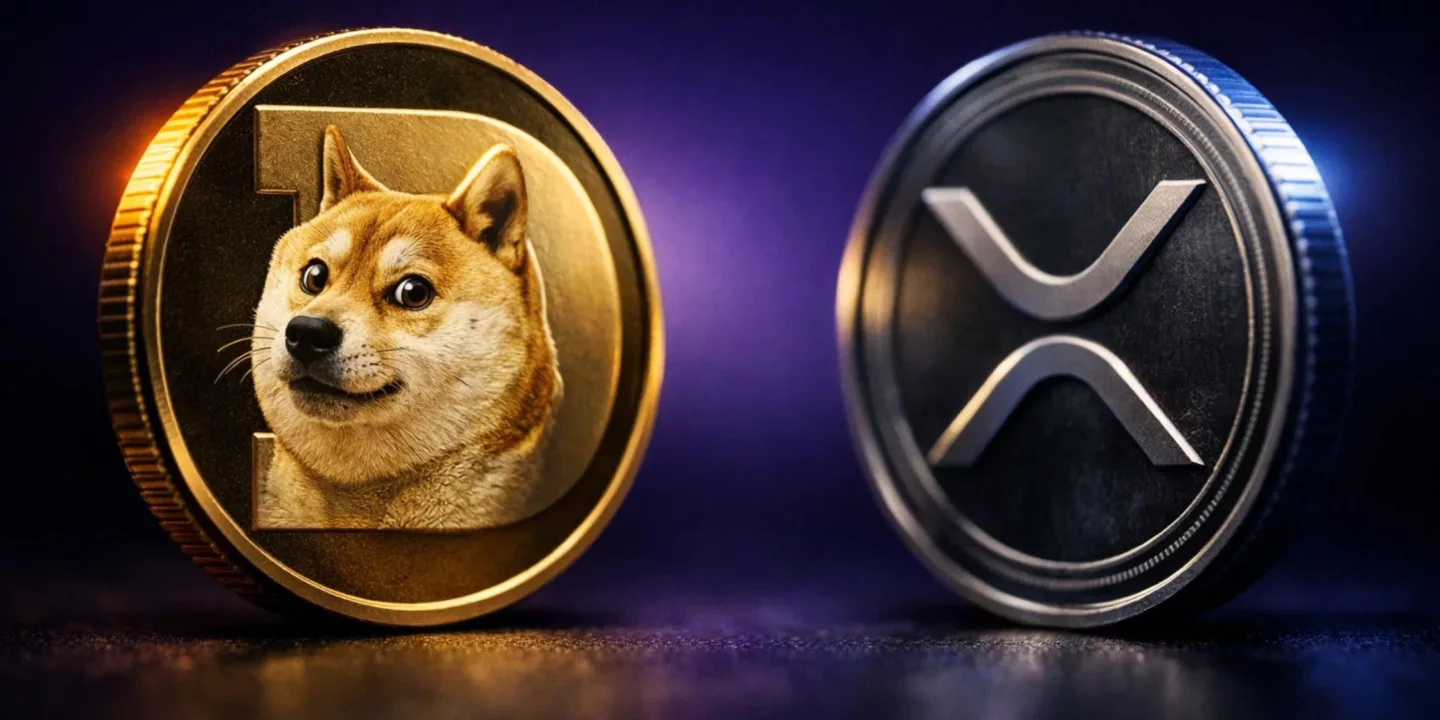

The debate around xrp vs dogecoin continues in 2026 as both tokens remain popular but for very different reasons. This guide explains their purpose, supply models, volatility, realistic price targets, and which type of investor each one fits best.
Quick rule:
If you want real-world financial use, lean XRP.
If you want meme-cycle momentum, DOGE is the bet.
| Feature | XRP | Dogecoin (DOGE) |
| Purpose | Cross-border payments, liquidity bridge | Meme coin turned retail payment asset |
| Network Type | XRP Ledger | Proof-of-Work blockchain |
| Supply | Fixed (100B max) | Inflationary (new coins yearly) |
| Inflation | No | Yes (~5B DOGE/year) |
| Speed | Very fast (seconds) | Slower (minutes) |
| Fees | Low and stable | Low but demand-dependent |
| Adoption Drivers | Banks, fintech, tokenization | Social media, community hype |
| Volatility Style | Catalyst-driven moves | Meme-cycle sentiment spikes |
At first glance, XRP and Dogecoin may seem similar because both are large-cap cryptocurrencies that have survived multiple market cycles. They are widely traded, heavily discussed online, and often included in retail investor portfolios.

However, these two coins represent completely different corners of the crypto market.
XRP is positioned as a financial infrastructure token designed for payments and settlement. Dogecoin remains closely tied to meme culture, internet momentum, and speculative retail cycles.
That is why the XRP vs Dogecoin: debate is not about which coin is better overall. It is about what role you want each asset to play in your portfolio.
Note: Ripple is the company; XRP is the token. Dogecoin is unrelated.
By 2026, investors will be asking smarter questions. Instead of only chasing hype, many people now compare assets based on fundamentals like transaction efficiency, supply mechanics, and adoption potential.
That is where XRP and DOGE differ sharply.
XRP focuses on building financial utility, especially for settlement and tokenization. DOGE remains a culture-driven asset that thrives when the market mood becomes speculative.
| Metric | XRP | DOGE |
| Consensus Mechanism | Validator-based consensus | Proof-of-Work mining |
| Confirmation Speed | ~3–5 seconds typical | ~1 minute+ per block |
| Fees Behavior | Extremely low and predictable | Low but varies with activity |
| Supply Model | Fixed supply (100B max) | Inflationary supply (new DOGE yearly) |
| Primary Use Case | Payments + tokenization rails | Meme speculation + community payments |
| Key Catalysts | Regulation clarity, fintech adoption | Meme hype, social media cycles |
| Key Risks | Legal uncertainty, adoption pace | Inflation, attention decay |
| Factor | XRP | DOGE |
| Token Release Structure | Fixed supply already issued | New coins minted every year |
| Inflation Impact | No ongoing dilution | Continuous dilution over time |
| Main Growth Narrative | Institutional payments + tokenization | Community + meme-driven adoption |
| Biggest Bull Catalyst | Regulatory clarity + partnerships | Viral hype + retail mania |
| Biggest Bear Risk | Adoption not scaling fast enough | Meme interest fading sharply |
One of the biggest mistakes new investors make is assuming all crypto moves for the same reason. In reality, XRP and DOGE respond to completely different kinds of market triggers.
Before breaking down the drivers, it helps to understand why these tokens became widely known.
XRP’s market identity has been shaped by its long legal battle with the U.S. SEC. Beginning in 2020, the case became one of the most closely watched regulatory fights in crypto history. Even after appeals were dismissed in 2025, regulatory clarity remains a major factor in how investors view XRP.
In contrast, Dogecoin’s identity is strongly tied to social momentum and Elon Musk’s influence. DOGE rallies have often followed viral mentions, memes, and cultural hype, making sentiment one of its biggest price catalysts.
This difference explains why XRP and DOGE behave so differently in markets.
XRP often reacts sharply to regulatory developments. Institutional confidence depends heavily on legal certainty.
XRP’s upside depends on whether fintech firms and payment networks expand real-world usage.
As tokenized finance grows, XRP could benefit as a bridge asset for settlement.
DOGE rallies when meme coins trend again. Prices can spike quickly even without major network upgrades.
Elon Musk’s mentions and online hype remain key short-term catalysts for DOGE.
DOGE performs best when speculative capital flows into high-volatility assets.
If you study the xrp vs dogecoin chart, volatility patterns look very different.
DOGE typically experiences explosive rallies followed by deep corrections. XRP moves more steadily but can jump sharply when regulatory or adoption catalysts appear.
Key takeaway:
Both may follow Bitcoin, but XRP can decouple when major institutional news breaks.
Price targets sound exciting, but smart investors always check the math first.
Formula:
Price = Market Cap ÷ Circulating Supply
| Token Target | Required Market Cap (Approx.) | Realistic? |
| XRP at $10 | ~$500B+ | Possible with strong adoption |
| XRP at $100 | ~$5T+ | Extremely unlikely near-term |
| DOGE at $1 | ~$140B+ | Possible in meme bull cycle |
| DOGE at $10 | ~$1.4T+ | Very unrealistic today |
Biggest mistake investors make: ignoring supply dynamics. DOGE adds new coins yearly, meaning demand must continuously rise just to sustain higher prices.
Instead of asking which coin is better, the smarter question is:
Which coin fits your goal and risk tolerance?
| Goal | Better Fit | Why | Main Risk |
| Long-term investing | XRP | Utility + adoption narrative | Regulation uncertainty |
| Meme-cycle trading | DOGE | Retail momentum upside | Sharp drawdowns |
| Fundamentals holding | XRP | Payment infrastructure focus | Adoption pace |
| High-risk speculation | DOGE | Viral rallies possible | Inflation + hype decay |
So, what is the takeaway from the xrp vs dogecoin comparison in 2026?
XRP is built around payments, institutional adoption, and long-term financial utility. Dogecoin remains one of crypto’s strongest meme assets, thriving mostly during speculative bull cycles.
Both can deliver returns, but only if you understand what truly drives them and what risks come with each.
For deeper educational resources on cryptocurrency investing, explore Mudrex Learn and subscribe to the Mudrex YouTube Channel to build knowledge step by step before making financial decisions.
XRP is stronger for utility-driven adoption, while DOGE is more speculative and sentiment-based.
The key difference is that XRP focuses on payment infrastructure and institutional adoption, while Dogecoin is mainly driven by meme culture and retail sentiment.
It would require a multi-trillion-dollar market cap, making it highly unlikely in the near future.
DOGE hitting $10 would require over a trillion-dollar valuation, which is unrealistic today.
It is possible if institutional adoption expands significantly, but depends heavily on regulation and usage.
In a strong bull cycle with positive catalysts, XRP reaching $4 is possible.
Ripple is the company, XRP is the token on the XRP Ledger, while Dogecoin is a separate meme-based Proof-of-Work cryptocurrency.