
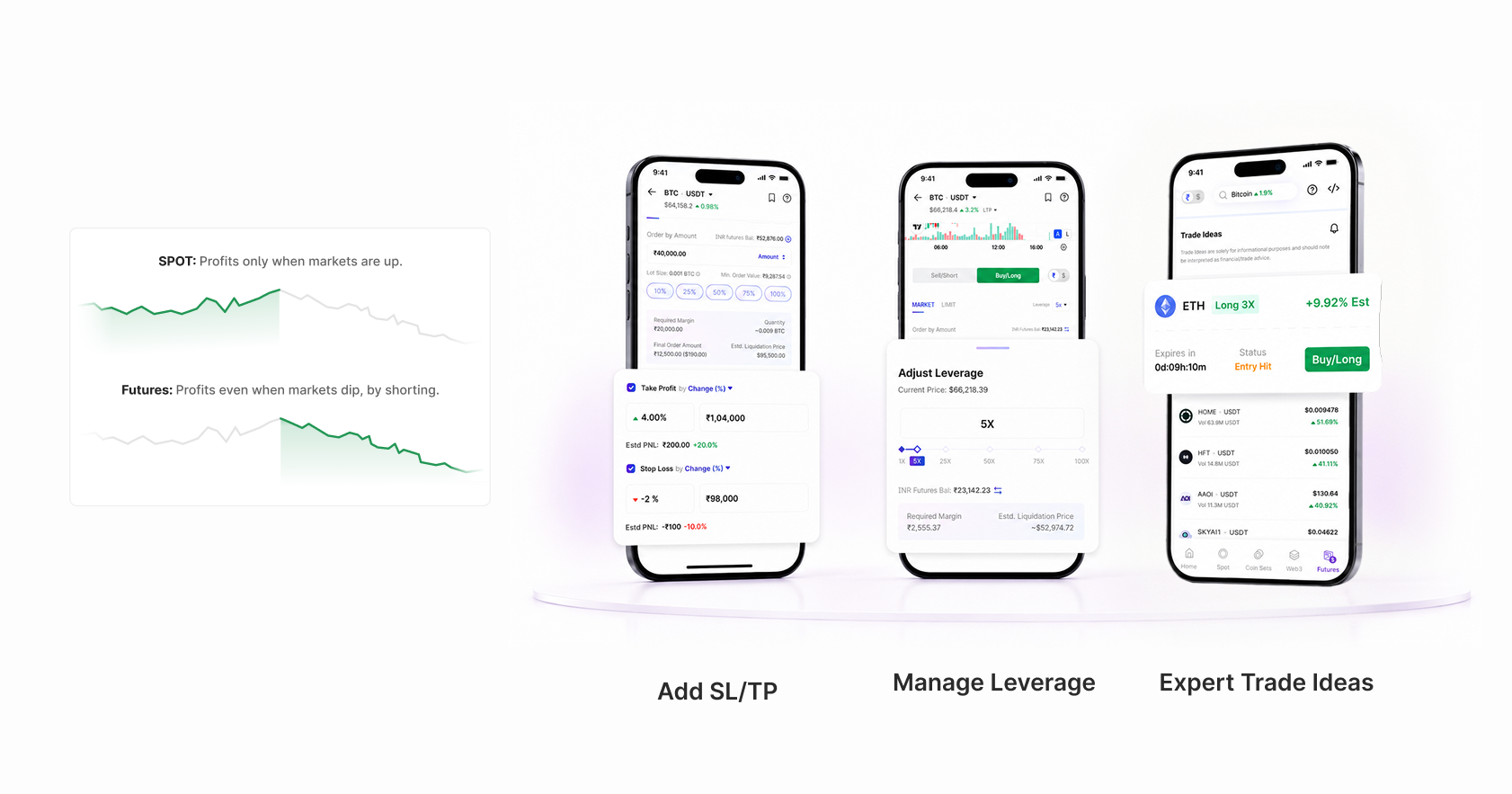
You’ve traded and invested with us, but futures is one corner of Mudrex you haven’t gotten to yet. Before you go, it’s worth knowing what that corner actually offers: a way to profit even when prices fall, and a way to protect crypto you already hold, without selling it. Here’s the short version.
Why futures trading, in plain terms
A futures position is a wager on direction, not a purchase. Pick long if you expect the price to climb, or short if you expect it to fall, and your profit or loss comes down to how far price travels from your entry before you close the trade. It’s also the only way to make money when a price is falling, which spot trading simply can’t offer.
Read more: A Complete Beginner’s Guide to Crypto Futures: Guide to Bitcoin & Crypto Futures
What leverage actually does
Leverage lets a relatively small deposit control a much bigger position than it would on its own. It’s worth treating that carefully rather than pushing it to the limit: losses scale up exactly as fast as gains do, so lower leverage, in the 2x to 5x range, is the sensible place to start as a first-time futures trader.
Read more: Crypto Leverage Trading for Beginners: What It Is & How It Works
Why futures trading uses a separate wallet
Futures trading runs through its own dedicated wallet on Mudrex, separate from any other crypto you hold. You can fund it directly in INR or USDT with just enough to place a single trade, so trying it out doesn’t require any large commitment.
Read more: USDT to Trade Futures: Do You Still Need It?
Set your SL/TP before your first trade
Stop-loss and take-profit orders fix your exit before the trade begins, so the decision is made ahead of time instead of in the moment. The stop-loss closes the position automatically once price moves against you past a chosen level, and the take-profit closes it once your target is reached, locking in the gain either way. Both attach directly to your futures order on Mudrex, so nothing is left to chance.
Read more: Stop Loss and Take Profit (SL & TP): What They Are and How to Use Them in Futures Trading
What liquidation is, and how it’s avoided
When a position’s losses fully use up the margin behind it, the exchange force-closes it automatically. That’s liquidation, and it’s the thing that probably makes futures sound riskier than it needs to be. It’s also mostly preventable: lower leverage and a stop-loss on every trade keep you well clear of it.
Read more: What is Liquidation and How to Manage Liquidation Risk in Futures Trading
Why emotions matter more than the market does
The biggest risk to a new trader usually isn’t a wrong call on price, it’s what happens after a loss. Chasing a loss with a bigger, hastier trade is how one setback turns into several. Deciding your size and rules before you place a trade, and keeping them the same regardless of how it goes, is what actually makes futures sustainable.
Read more: Crypto Futures Trading Psychology: 7 Useful Insights On Greed, Fear & Overtrading
You don’t have to find setups on your own
Reading charts and spotting a good setup takes practice most people haven’t built yet, and there’s no need to have it before you start. Mudrex’s in-app signals give you data-backed trade ideas with the entry, exit, and risk level already worked out.
Read more: Crypto Signal Guide: How to Use Them
When it’s actually worth trading
Crypto trades all day, every day, but it doesn’t move the same way every hour. Volatility and liquidity pick up during the Asia-Europe and Europe-US session overlaps, which tend to produce cleaner price action than the quiet stretches in between. A first trade placed in one of these windows gives you a fairer shot than one placed at a random hour.
Read more: Best Time to Trade Crypto Futures: 7 Proven Timing Windows
Whatever’s taking you away from Mudrex, futures is one thing you haven’t had a chance to weigh in on yet. A small position and a clear stop-loss is all it takes to see if it changes that.