
Siacoin (SC) is the native token of Sia, a decentralised cloud storage network where people rent out spare disk space and are paid in SC by renters who store files. It has run on its own proof-of-work blockchain since June 2015. This guide explains SC, how the Sia network works, its use cases, wallets and mining.
| Siacoin at a glance | |
|---|---|
| Ticker | SC (also written Sia coin or SC coin) |
| Network | Sia, its own proof-of-work blockchain |
| Launched | Announced May 2014, mainnet June 2015 |
| Role | Pays for storage; providers post SC as collateral |
| Supply | No fixed maximum; block reward floor of 30,000 SC |
| Price, October 2026 | About $0.001 (₹0.10 on Mudrex, 7 October) |
| Market cap | About $50 to $57 million |
Sia is decentralised cloud storage secured by a blockchain, and SC is the utility token that pays for it. Storage prices are denominated in SC, and you need SC to form storage contracts, per Sia’s docs.

Sia was created at HackMIT in 2013 by David Vorick and Luke Champine. Their company, Nebulous Inc. (also called Nebulous Labs), later became Skynet Labs, which has since shut down. Since a 2021 hardfork, the non-profit Sia Foundation has led development, funded by a protocol subsidy, according to Messari.
Siacoin, Sia coin, SC coin, SC cryptocurrency, Sia crypto and the $SC cashtag all mean one token with the ticker SC. “Sia” is the network; Siacoin is its currency.
If you wanted a Siacoin wiki or a plain Siacoin guide, this page covers the basics. Sia also has a second token, Siafunds (SF), which earns a share of contract fees and is a separate asset.
How does Siacoin work? It moves between renters and providers as storage payments and collateral. Three parties make Sia run. Renters store data. Storage providers, also called hosts, rent out disk space and earn SC. The Sia blockchain records the storage contracts between them.
Since the v2 hardfork on 6 June 2025, the software is split into renterd, hostd and walletd. For most people, the easiest way in is the Sia Storage app, which offers 50 GB free with no crypto knowledge needed.
Here is a simple example of how Siacoin works in practice:
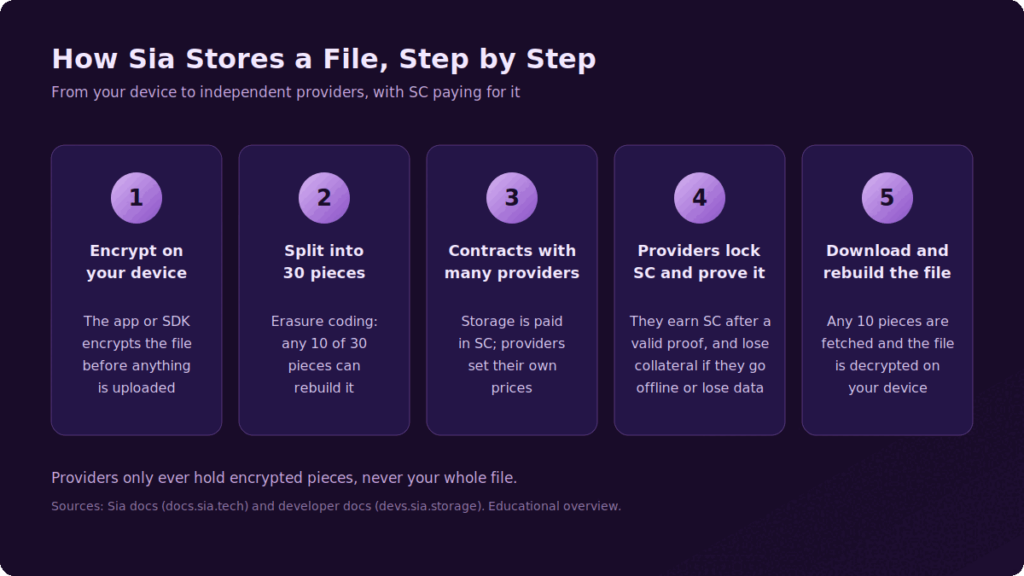
So SC does three jobs: it pays providers, funds contracts and acts as their collateral.
What is Siacoin used for? SC pays for storage and bandwidth, and providers need it to post collateral. The main Siacoin use cases are backups and archives, app data stored through the Sia Storage SDKs, and file sharing.
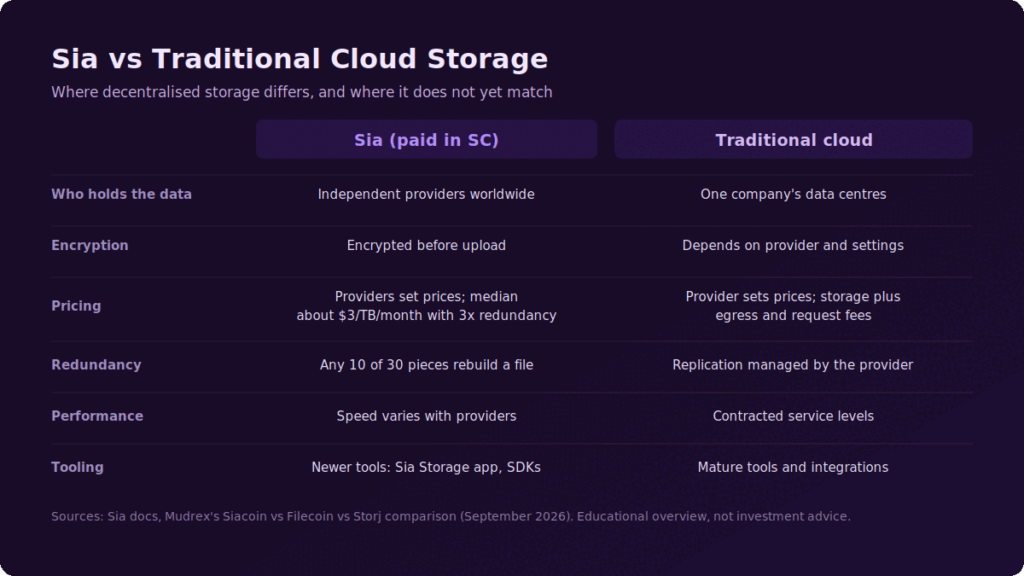
Factom (FCT) is a data-integrity protocol that anchors record hashes to Bitcoin. It proves a record existed but does not store the files. Sia stores the encrypted files themselves, so the two solve different problems.
| Possible drivers | Key risks |
|---|---|
| Paid storage demand, not just capacity | Competition from large clouds, Filecoin and Storj |
| Sia Storage app and S3-style access | No maximum supply; new SC keeps entering circulation |
| v2 upgrade, SDKs and Foundation grants | Small market cap and thin liquidity |
| Strong crypto-market cycles for small caps | About 99% below its January 2018 high of roughly $0.1117 |
Instead of a Siacoin price prediction, use market-cap maths. With about 56 billion SC circulating, $0.01 per coin would mean roughly $560 million, around ten times today’s valuation.
Mudrex’s analysis of whether Siacoin is a good investment weighs both sides. SC is volatile, so only commit what you can afford to lose.
For Siacoin storage, you can keep SC in an exchange account, which is simplest, or in a wallet you control. Sia’s walletd is the Foundation’s standalone wallet for SC and Siafunds and supports Ledger hardware wallets; the SiaCentral web wallet is another option.
Two cautions. walletd accepts only the new 12-word seed, not legacy 28 or 29-word seeds, and Sia-UI and siad are deprecated, so older guides may point you to dead software. SC also lives on Sia’s own blockchain, so send it only to Sia addresses.
Is Siacoin mineable? Yes. It uses proof of work with the Blake2b-Sia algorithm and ten-minute blocks, and the block reward fell from 300,000 SC to a permanent floor of 30,000 SC. Mining is ASIC-only, so GPUs cannot compete, and miners join a Siacoin pool to smooth payouts.
At average residential electricity prices, mining SC usually loses money in fiat terms. Be wary of cloud mining Siacoin offers, which ask for money upfront.
Bittrex, once a major SC venue, stopped trading on 4 December 2023. SC now trades on other exchanges, including Mudrex against INR.
You can buy SC with INR on Mudrex from ₹100 after KYC with Aadhaar and PAN; see the Siacoin buy page for steps and the live SC/INR converter for the current rate. Mudrex is FIU-IND registered.
What is Siacoin?
Siacoin (SC) is the native token of the Sia decentralised storage network. Renters pay it to providers for storing files, and providers post it as collateral.
What is SC coin?
SC coin is another name for Siacoin. Sia coin, SC crypto and Siacoin all refer to the same token.
Where can Siacoin be stored?
In an exchange account, or in a wallet you control such as Sia’s walletd, which supports Ledger. Use Sia addresses only.
How is Siacoin mined?
How to mine Siacoin: use an ASIC miner running the Blake2b-Sia proof-of-work algorithm, usually through a pool. GPUs cannot mine it, and home mining often loses money.
How can Siacoin be bought?
Complete KYC on an FIU-IND registered exchange, add INR and place an order. On Mudrex, buy SC from ₹100.
Is Siacoin a good investment?
That depends on your risk tolerance. SC has a real use, but also no maximum supply, a small market cap and strong competition. It is not advice either way.
Cryptocurrency investments are subject to high market volatility and risk of loss. Small-cap tokens such as Siacoin can lose most of their value quickly. This article is for educational purposes only and is not financial advice. Please consult a qualified financial advisor before making investment decisions.