
ApeCoin (APE) is an ERC-20 token on Ethereum built for the Bored Ape Yacht Club (BAYC) ecosystem. It launched on 17 March 2022 with an airdrop to BAYC and MAYC holders, and it now works mainly as the gas token of ApeChain and as a payment and access token across Yuga Labs’ projects.
| ApeCoin at a glance | |
|---|---|
| Ticker | APE |
| Standard | ERC-20 on Ethereum |
| Launched | 17 March 2022 |
| Launched by | Yuga Labs, with the ApeCoin DAO and APE Foundation |
| Supply | 1 billion, fixed; all unlocked |
| Price, October 2026 | About $0.15 to $0.16 (₹14.94 on Mudrex, at press time) |
APE is a fungible token: every APE is identical and interchangeable, unlike the Bored Ape NFTs it grew out of. It was announced on 16 March 2022 as a token for culture, gaming and commerce, and Yuga Labs said it would use APE as the primary token for its new products, per BeInCrypto.

APE is the token of the Bored Ape ecosystem, not a Bored Ape. The ape coin meaning is simple: a tradable asset tied to Yuga Labs’ projects. Ape token explained in one line: APE crypto is a currency-style token, not an NFT.
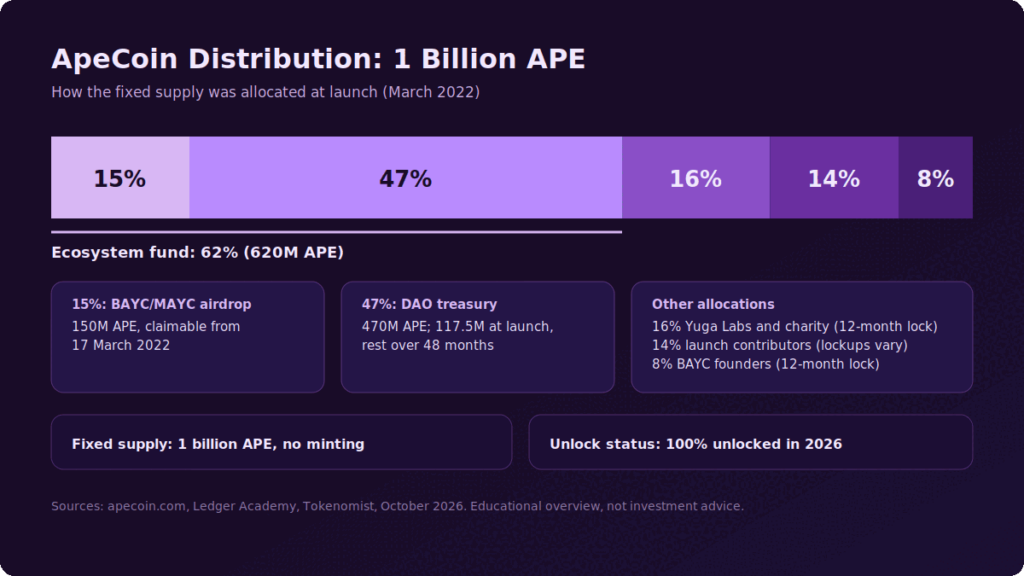
ApeCoin tokenomics start with a fixed supply of 1 billion tokens, all created at launch. Vesting began on 17 March 2022 and ran for 48 months, so every APE is now unlocked, according to Tokenomist. CoinGecko, CoinMarketCap and Coinbase list about 1 billion as circulating, so APE tokenomics no longer include a scheduled unlock overhang.
| Allocation | Share | Tokens | Terms |
|---|---|---|---|
| Ecosystem fund: BAYC/MAYC airdrop | 15% | 150M | Claimable from 17 March 2022 |
| Ecosystem fund: DAO treasury | 47% | 470M | 117.5M at launch, rest over 48 months |
| Yuga Labs and charity | 16% | 160M | 12-month lock, then monthly for 36 months |
| Launch contributors | 14% | 140M | Lockups vary; some staged over 18 months, others 12 months then monthly |
| BAYC founders | 8% | 80M | 12-month lock, then over 36 months |
The 1 billion cap has not changed, but one old assumption has: APE is no longer burn-free. It is ApeChain’s gas token, and apecoin.com says every ApeChain transaction burns the gas, with ApeCo matching the amount burned.
At about $0.15 to $0.16, APE has a market cap of roughly $150 to $161 million, per CoinGecko and CoinMarketCap.
How does ApeCoin work? APE moves on Ethereum like any ERC-20 token, then does a second job as gas on ApeChain.
ApeChain is an Arbitrum Orbit Layer 3 chain that went live in October 2024 and uses APE as its native gas token, as Arbitrum’s own write-up describes. Every transaction on it needs APE, which ties the token to network activity.
According to apecoin.com, APE pays for events such as ApeFest, member merchandise drops and community-made goods. Third-party developers can also pay rewards in APE. These ApeCoin use cases are narrower than the original pitch, and adoption is still the open question.
At launch, any APE holder could join the ApeCoin DAO and vote on Ape Improvement Proposals (AIPs) about the DAO treasury, with the APE Foundation carrying out the result.
That ended in June 2025. AIP-596, proposed by Yuga Labs CEO Greg Solano, dissolved the DAO and moved its assets and duties to ApeCo, a Yuga Labs entity. It passed with 99.66% of votes, per Messari.
By June 2026, CoinEdition reports, Yuga Labs had removed the ApeCo layer and held control directly. Holding APE no longer carries governance votes.
No. One APE equals any other APE, while each BAYC, MAYC and BAKC is a unique NFT. If you searched “what is APE NFT”, an ape NFT is a Bored Ape, Mutant Ape or Kennel Club dog; APE is the separate token.
Owning APE does not give you a Bored Ape, and owning an ape no longer earns you APE, because the airdrop was a one-time event.
ApeCoin fundamentals come down to three things: what APE does (ApeChain gas, access and payments), who controls it (Yuga Labs, since 2025 and 2026), and how much supply is still locked (none). The ApeCoin ecosystem is the set of Yuga Labs projects and partners that use the token. The main pieces:
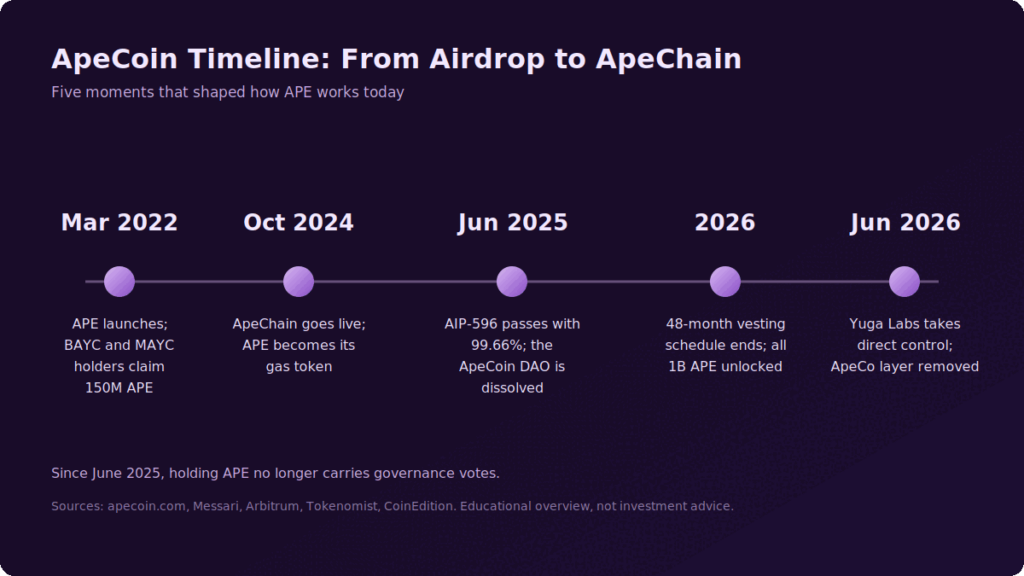
Claims opened on 17 March 2022, and 15% of supply (150 million APE) was set aside for NFT holders. Each BAYC could claim 10,094 APE and each MAYC 2,042, with 856 more for a paired BAKC (10,950 and 2,898 in total), per Ledger.
Recent changes include Michael Figge becoming Yuga Labs CEO around BAYC’s fifth anniversary in April 2026 and ApeChain switching its stablecoin from apeUSD to USDC on 31 July 2026. APE is volatile and closely tied to NFT sentiment, so read Mudrex’s analysis of whether ApeCoin is a good investment before deciding.
You can buy APE with INR from ₹100 on Mudrex, an FIU-IND registered platform; KYC needs Aadhaar and PAN. Check the live APE/INR converter first, or try Coin Sets for a basket instead of one token.
Gains are taxed at a flat 30% plus 4% cess, with 1% TDS above the thresholds and no loss set-off; Mudrex’s crypto tax filing guide explains the rest.
What is ApeCoin? ApeCoin (APE) is an ERC-20 token on Ethereum made for the Bored Ape Yacht Club ecosystem. It is now mainly ApeChain’s gas token and a payment and access token for Yuga Labs’ projects. You can buy APE on Mudrex.
What is APE crypto? APE crypto is another name for ApeCoin. It is a fungible token with a fixed supply of 1 billion, launched in March 2022.
Is ApeCoin an NFT? No. APE is fungible, so every token is identical. BAYC, MAYC and BAKC are the NFTs.
Can ApeCoin be mined? No. There is no way to mine ApeCoin: all 1 billion APE were created at launch on Ethereum, which has no mining, so you can only buy APE or earn it as a reward.
Who created ApeCoin? Yuga Labs, the company behind BAYC, launched it in March 2022 with the ApeCoin DAO and APE Foundation. Yuga described itself as a contributor, not the DAO’s owner.
Cryptocurrency investments are subject to high market volatility and risk of loss. ApeCoin’s price has fallen sharply since its 2022 launch. This article is for educational purposes only and is not financial advice. Please consult a qualified financial advisor before making investment decisions.