What Are Crypto Signals and How to Read Them Effectively?
The crypto market moves fast. Prices can swing more than 10% in minutes, with thousands of updates flooding traders every day. Without clear guidance, many end up making rushed, emotional, and costly decisions.
This is where crypto signals come in, curated trade ideas backed by technical and on-chain analysis that help you cut through the noise and make smarter trading moves.
In this guide, you’ll learn what crypto signals are, how they’re created, how to use them step-by-step, risk rules to follow, common mistakes to avoid, and how Mudrex makes it easier for you to access expert-curated trade ideas.
How to Use Crypto Signals Safely (A Quick Checklist)
✅ Use signals only from trusted sources/platforms
✅ Risk only 1–2% of your capital per trade
✅ Always set Stop Loss (SL) and Take Profit (TP)
✅ Check risk-reward ratio ≥ 2:1
✅ Avoid over-leverage (stick to 2x–3x if using futures)
✅ Don’t chase FOMO trades or average down losers
✅ Treat signals as guidance, not guarantees
What is a Crypto Signal?
A crypto signal is a clear trading recommendation based on technical analysis and on-chain data that tells you when to buy, sell, or hold a cryptocurrency. It’s designed to help traders act quickly and confidently in a fast-moving market.
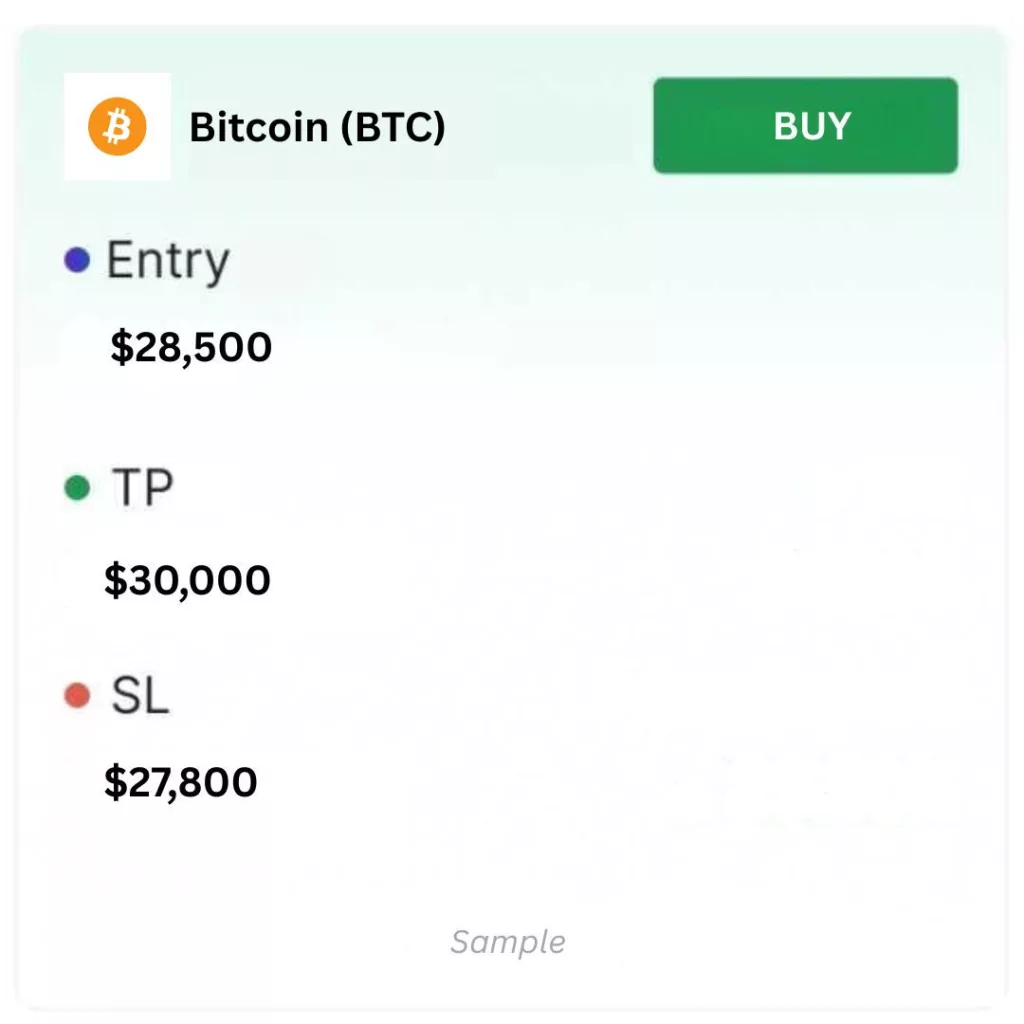
Example Spot Trading Signal (BTC):
Action: Buy
Entry Price: $28,500
Take Profit (TP): $30,000
Stop Loss (SL): $27,800
This means buy Bitcoin at around $28,500, aim to sell near $30,000 for profit, and cut losses if the price drops below $27,800.
Crypto Signal Guide: Powerful Insights on How To Use Them in 2025
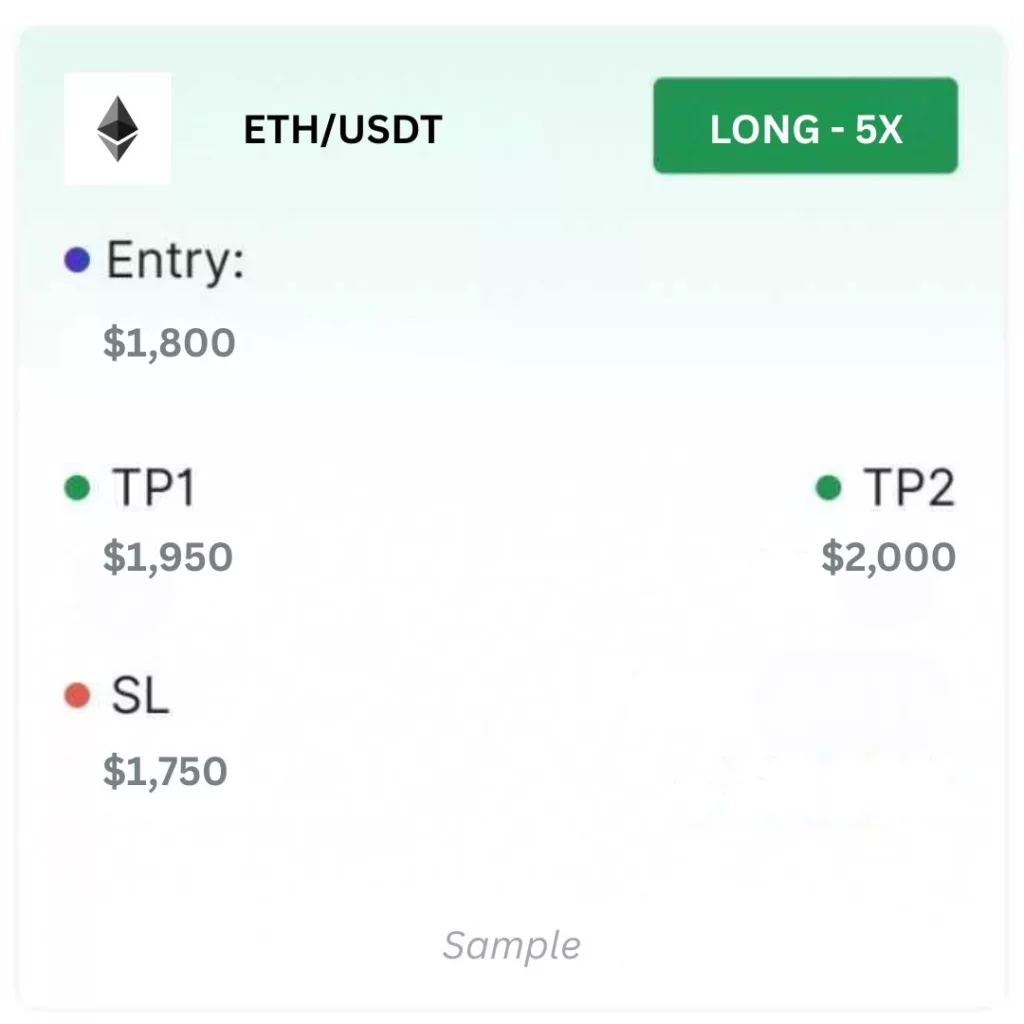
Example Futures Trading Signal (ETH):
Action: Long (Buy)
Entry Price: $1,800
Leverage: 5x
Take Profit (TP): $1,950
Stop Loss (SL): $1,750
Crypto Signal Guide: Powerful Insights on How To Use Them in 2025
This suggests opening a leveraged long position on Ethereum futures at $1,800, target $1,950, with a stop loss at $1,750 to manage risk.
Note: Crypto signals are not financial advice. Always do your own research and understand the risks involved before trading.
Types of Crypto Signals
Crypto signals come in different forms depending on the market, strategy, and provider:
On-Chain Data: Active addresses, transaction volume, whale activity.
Market Sentiment: News flow, funding rates, social chatter, volatility indexes.
First, the analyst selects a token based on its market activity and potential. They look for cryptocurrencies that have strong trading volumes, active user communities, and recent developments that could affect price. Let’s assume that the analyst has chosen Solana(SOL).
Solana is chosen because it has a large network, growing adoption, and enough market data to analyze trends reliably.
In many cases, both types of signals(futures and spot signals) can be created depending on market conditions and trader preferences.
Next, analysts study Solana’s price movements using tools like moving averages and the Relative Strength Index (RSI).
Solana (SOL) is currently priced around $185, showing steady movement between approximately $182 and $194 over the past 24 hours.
Analysts look for signs like
price crossing above key moving averages,
an RSI below overbought levels,
increasing trading volume, and
rising on-chain activity, such as more active addresses and transactions.
These indicators help the analyst form an educated and calculated conclusion that the upward trend is likely to continue.
Next, the analyst decides on the exit points, leverage, stop loss (SL), take profit (TP), and expected profit percentage based on detailed analysis of price behavior and risk management.
For exit points, the analyst identifies resistance levels or previous price highs where the upward momentum might slow or reverse.
The take profit (TP) is set near these levels to secure gains before a potential pullback.
The stop loss (SL) is placed just below a recent support level to limit losses if the price moves against the trade, ensuring risk is controlled.
Leverage value, especially for futures signals, is chosen by balancing the trader’s risk tolerance with market volatility.
Moderate leverage (e.g., 3x) is often preferred to amplify returns while keeping risks manageable.
The analyst calculates the risk-reward ratio by comparing the distance between entry and SL against entry and TP, aiming for a ratio of at least 2:1, meaning potential profit is twice the potential loss.
For Solana, the entry price is $185, the stop loss (SL) is at $180, and the take profit (TP) is at $200. The potential loss per unit is $185 − $180 = $5. The potential gain per unit is $200 − $185 = $15.
The risk-reward ratio is calculated as potential gain divided by potential loss: 15 ÷ 5 = 3.
Finally, the expected profit percentage is estimated based on the difference between entry and TP prices relative to the entry price. This helps traders understand the potential return if the trade reaches the target, aiding in decision-making and portfolio management.
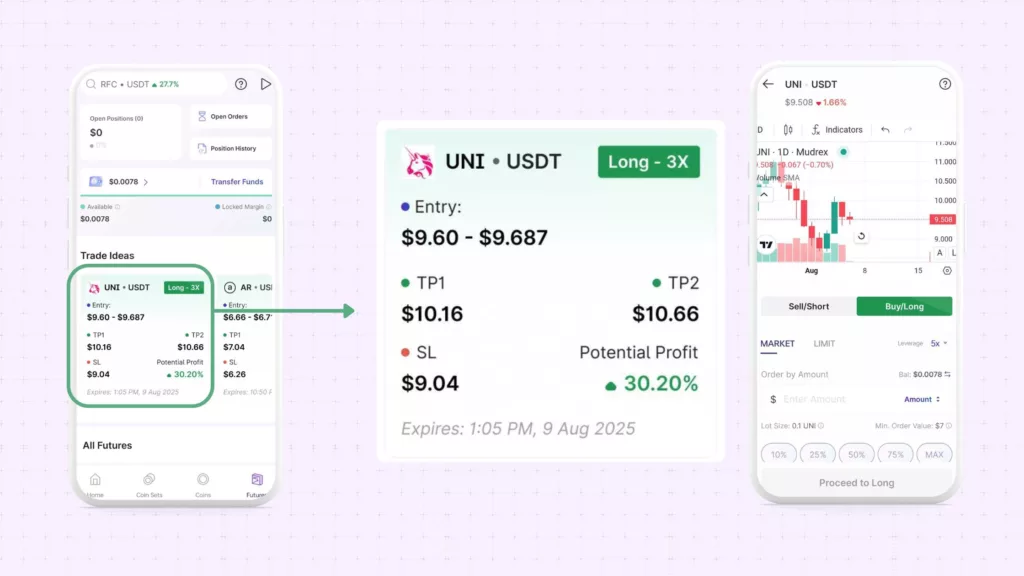
Expert Curated Trade Ideas Right Inside the Mudrex App
Mudrex brings you expertly researched trade ideas directly within the app, making it easier than ever to act on high-quality opportunities.
You can see live trade suggestions for popular pairs, complete with
clear entry ranges
multiple take profit (TP) targets, and
well-defined stop loss (SL) levels.
Each trade idea also shows the estimated profit percentage, helping you quickly assess potential rewards.
How to Use Mudrex Trade Ideas?
Crypto Signal Guide: Powerful Insights on How To Use Them in 2025
Open the Mudrex app.
Tap on the Futures section in the bottom navigation bar.
Browse the expert-curated trade ideas available.
Select a trade idea that suits your strategy.
Choose to place a limit order and enter your preferred entry price within the suggested range.
Based on your risk appetite, select either Take Profit 1 (TP1) or Take Profit 2 (TP2) as your target price.
Enter your desired Stop Loss (SL) value to manage potential losses.
Review and confirm your order.
You can turn on notifications in the Mudrex app settings to receive real-time alerts for new trade ideas and signals.
Remember, crypto signals are valuable tools designed to assist you in making informed trading decisions, but they should never replace your own analysis and due diligence.
Markets are unpredictable, and relying solely on signals without understanding the underlying factors can lead to costly mistakes.
Always take the time to research the asset, assess market conditions, and evaluate the signal’s relevance to your personal trading strategy. Combining signals with your own judgment helps you trade smarter and manage risks more effectively.
How to Use Signals Step-by-Step
STEP 1
Choose a reliable provider/platform
STEP 2
Check if the signal suits your trading style (spot vs futures)
STEP 3
Note down Entry, TP, SL clearly
STEP 4
Calculate position size so loss = max 1–2% of portfolio
STEP 5
Place limit order near entry range
STEP 6
Set SL and TP in advance (no manual guesswork)
STEP 7
Track trade, but avoid emotional changes
STEP 8
Log results to improve over time
Risk Management Rules
1. The 1–2% Rule A fundamental principle of trading is to never risk more than 1–2% of your total capital on a single trade. This prevents any one trade from wiping out a large portion of your portfolio. For example, if your trading account has $10,000, the maximum amount you should risk on one trade is $100–$200.
2. Position Sizing Formula Calculating the correct position size ensures your risk stays within safe limits. The formula is: Position size = (Account size × % risk) ÷ (Entry price – Stop Loss price). This tells you how much of an asset to buy or sell, based on your chosen risk tolerance and the difference between your entry and stop loss levels.
3. Risk-Reward Ratio (RR) Every trade should have a clearly defined risk-reward ratio. A minimum ratio of 2:1 means your potential profit is at least twice your potential loss. For instance, if you risk $50 (difference between entry and stop loss), your take-profit target should be at least $100 above the entry level. This ensures that even with a 50% success rate, you can remain profitable over time.
4. Maximum Daily Loss Rule Set a limit on how much you are willing to lose in a single trading day. A common guideline is to stop trading if you lose 5% of your total account balance in one day. This prevents “revenge trading,” where traders try to recover losses quickly and often make impulsive, high-risk decisions that lead to even bigger losses.
Spot vs Futures Signals: A Comparison
Feature
Spot Signals
Futures Signals
Complexity
Simple (buy/sell)
Advanced (long/short + leverage)
Risk
Lower (no liquidation)
Higher (liquidation possible)
Fees
Standard trading fees
Trading + funding fees
Profit Potential
Limited (no leverage)
Higher (with leverage)
How to Vet a Crypto Signals Provider
1. Track Record A reliable signal provider should have a verifiable history of performance. Look for platforms or analysts who publish past trades with entry, stop loss, and take profit levels clearly documented. Independent verification or third-party auditing of results adds credibility. Avoid providers who only highlight successful trades and ignore their losses.
2. Transparency Good providers explain how their signals are created. This could include references to technical indicators, on-chain data, or sentiment analysis. Vague calls like “Bitcoin will pump soon” should be avoided. Instead, look for structured signals that state exact entry ranges, targets, and risk management rules.
3. Win Rate Reporting Check whether the provider shares their success rate over a reasonable period of time. A consistent win rate matters more than one or two lucky calls. For example, a provider with a 60% win rate and a 2:1 risk-reward ratio is generally sustainable, while someone boasting of 90% wins with no proof is likely misleading.
4. Slippage Control Signals should be practical to execute in real trading conditions. If prices have already moved by the time the signal reaches you, the setup becomes less reliable. A good provider ensures that entry ranges are realistic and considers market liquidity to minimize slippage.
5. Pump-and-Dump Red Flags Be cautious of providers promoting obscure or low-liquidity tokens. Many such signals are designed to artificially inflate prices so insiders can sell at a profit, leaving followers with losses. A credible provider avoids these tactics and focuses on established assets or well-researched opportunities.
How to Identify Good Crypto Signals
Not all crypto signals are created equal. To trade smarter, it’s important to know how to spot reliable signals. Here are key factors to consider:
Source Credibility: Trust signals from experienced analysts or platforms with proven track records. Look for transparency about who creates the signals and their methodology.
Clear Entry and Exit Points: Good signals specify exact entry prices, take profit (TP), and stop loss (SL) levels to manage risk and reward effectively.
Use of Technical and On-Chain Analysis: Reliable signals combine technical chart patterns (like support/resistance, moving averages) with on-chain data (like volume, whale activity) for better accuracy.
Timeliness: Signals must be delivered promptly to capitalize on market moves. Late signals lose value quickly in volatile markets.
Risk Management: The best signals include well-defined stop loss levels to limit potential losses if the trade moves against you.
Consistency: Look for sources that provide signals regularly and with a good success rate over time, not just occasional hits.
Transparency About Limitations: Responsible signal providers clarify that signals are not guaranteed and recommend doing your own research before acting.
Benefits of using Crypto Trading Signals
1. Act Fast with Reliable Guidance
Trading crypto moves fast and can be overwhelming. Prices swing quickly, and information overload makes it hard to know what to trust. In-app signals give you timely, data-backed trade ideas right inside your platform. This means you can act fast without wasting time hunting for reliable guidance.
2. Trade with Clear Rules
Clear entry, exit, and risk levels are vital in volatile markets. Good signals provide exactly that—so you know when to enter, where to take profit, and when to cut losses. This helps you stick to your plan, avoid guesswork, and protect your capital.
3. Stay Focused and In Control
Having signals integrated in your app keeps you focused and in control. It helps you avoid emotional decisions that can hurt your trading. Plus, these signals cover both spot and futures markets, giving you a complete toolkit to manage risk across your trades.
Costs & Hidden Costs of Signals
1. Trading Fees Every buy/sell order incurs an exchange fee, which can eat into small profits.
2. Funding Rates If you hold leveraged futures overnight, you’ll pay (or receive) funding fees that affect returns.
3. Subscription Fees Most premium signal providers charge monthly or annual fees—factor these into your cost base.
4. Copy-Trading Commissions Auto-trading services often take a percentage of your profits or trades as commission.
Common Mistakes and How to Avoid Them
1. FOMO Entries Jumping in late usually means buying at the top. Instead, wait for price to return to your planned entry zone.
2. Over-Leverage High leverage magnifies both profits and losses. Stay within 2x–3x unless you are highly skilled.
3. Skipping Stop Losses Trading without a stop loss risks wiping out your capital. Always set it before entering a position.
4. Averaging Down Losing Trades Adding more to a bad trade only deepens losses. Cut your loss and move to the next opportunity.
Conclusion
Crypto signals are more than just alerts; they’re a powerful tool to cut through the noise, reduce guesswork, and make confident trading decisions backed by data and expert analysis. Whether you’re just starting out or looking to enhance your current strategy, integrating high-quality signals into your routine can help you stay ahead in the fast-paced world of crypto.
Ready to take your trading to the next level? Download the Mudrex app today to access expert-curated crypto signals, live trade ideas, and real-time alerts, all designed to help you trade smarter, manage risk better, and capture opportunities as they happen.
FAQ
How can I effectively integrate crypto signals into my existing trading strategy?
Use signals as clear entry and exit guides, but always combine them with your own market research and risk management rules.
How do I calculate and manage risk when following a crypto signal?
Determine your stop loss level first, then calculate your position size so that a loss won’t exceed your risk tolerance (e.g., 1-2% of your capital).
How do I decide between using spot trading signals versus futures trading signals?
Use spot signals for straightforward buy/sell decisions with lower risk; choose futures signals if you want to leverage positions and can handle higher volatility.
How can I set appropriate stop loss and take profit levels based on a signal?
Follow the signal’s suggested SL and TP levels, usually set near recent support/resistance zones, to protect capital and lock in profits.
How do I adjust leverage safely when trading futures with signals?
Start with low to moderate leverage (e.g., 2x-3x), increase only if confident in the signal and market conditions, and never risk more than you can afford to lose.
Can crypto signals guarantee profit?
No signal can guarantee profits since markets are unpredictable. Use them as guidance, not as financial certainty.
Which time frame is best for crypto trading?
It depends on your style: scalpers use 1m–15m charts, swing traders prefer 4h–1d. Choose based on your risk tolerance and availability.
How can I get free crypto signals?
You can access expert crypto signals on the Mudrex Telegram channel or even on the Mudrex app.
Krishnan is a Bangalore-based crypto writer dedicated to simplifying complex crypto concepts. He covers blockchain, DeFi, and NFTs, with a focus on real-world asset tokenization and digital trust. Previously he has written on Real Estate related assets for NoBroker. Krishnan holds a B.Tech degree from the College of Engineering Trivandrum.