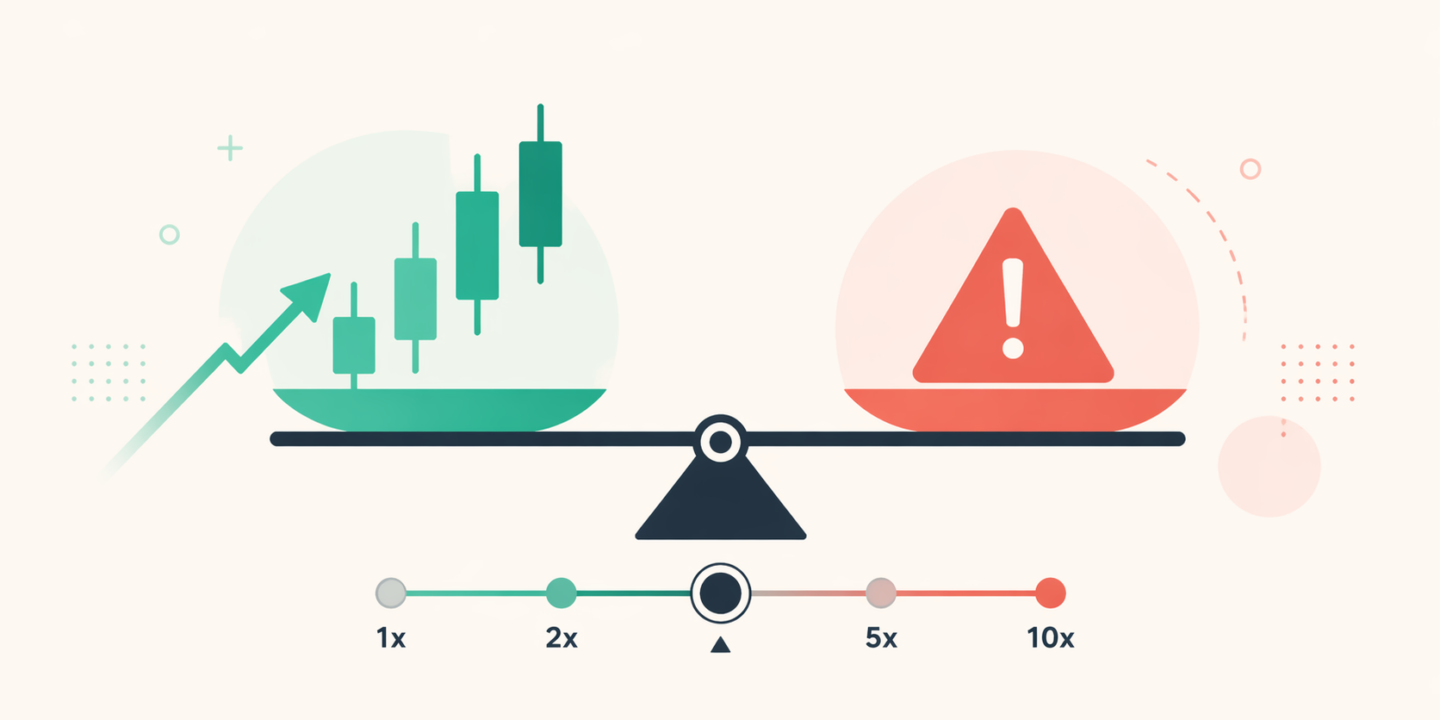

Crypto leverage can feel like a shortcut to bigger profits, but it’s also the fastest way to get liquidated if you don’t treat risk seriously. So, how much leverage should I use in crypto?
The safest answer isn’t a single number. It depends on your stop-loss, the coin’s volatility, and how much of your account you’re willing to lose on one trade. This guide gives you a practical framework and clear rules so you can use leverage without blowing up your account.

If you pick leverage first (“I’ll use 10x”), you’re doing it backwards. Professional-esque risk control starts with:
Only then do you see what leverage is required (if any).
A simple guideline many disciplined traders use is risking 0.5% to 2% of their account per trade.
Rule of thumb:
If your stop-loss must be wide (3%-8%), your leverage should usually be lower, not higher.
Here’s a practical range that works for most people:
The reality: most accounts don’t blow up from using too much leverage and getting forced out before the trade has time to work.
So if you’re still asking, “how much leverage should I use in crypto?” a safe default is…
1x-3x for most traders, most of the time and 5x+ only with a strong plan and strong discipline.
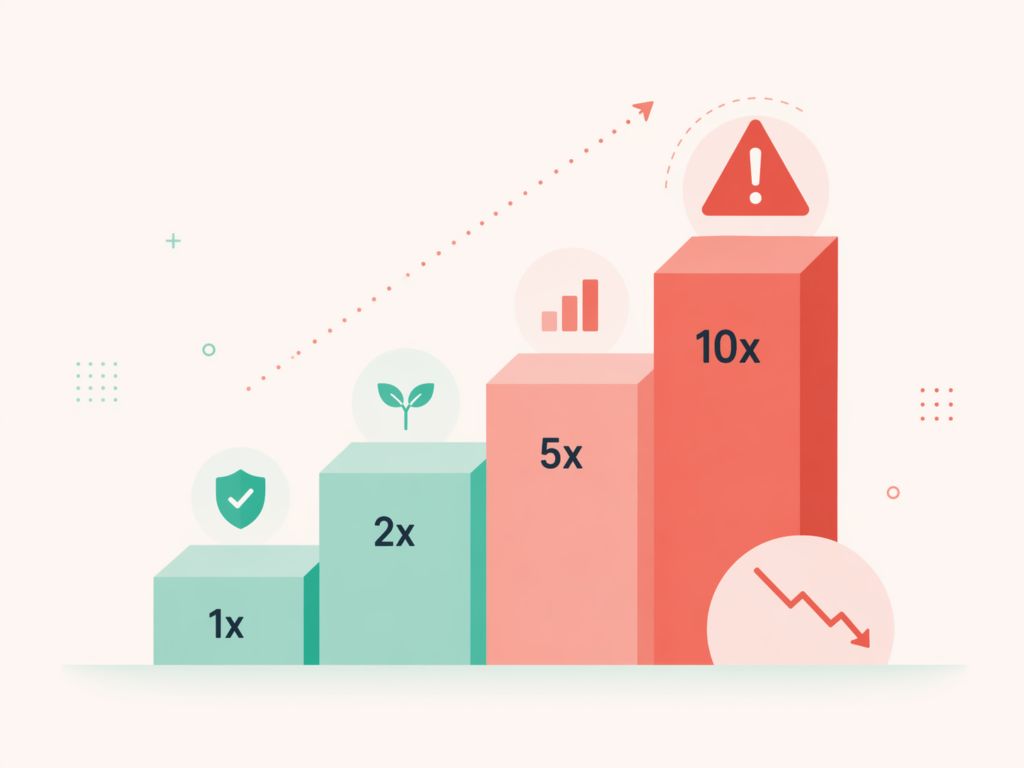
A stop-loss is a choice. Liquidation is the exchange choosing for you.
Why liquidation is dangerous:
Pro tip: Keep your stop-loss far enough from liquidation that you’re not relying on “hoping it doesn’t hit.”
If liquidation is close to your stop-loss, your leverage is probably too high.
Margin mode matters as much as leverage.
For most retail traders, isolated margin is the safer default because it prevents one bad trade from draining your whole account.
Use cross margin only if:
Crypto doesn’t move like traditional markets. A “normal” candle can be 2%-5%. On altcoins, even more. That’s why volatility should set your stop-loss, and your stop-loss should set your position size and leverage.
Here’s a practical way to think about it:
Be careful of the trap: tight stop + high leverage means getting chopped out repeatedly. If the market is choppy or news-driven, reduce leverage automatically.
On higher leverage, small costs become more impactful because:
If you want a “pro” habit that instantly improves your survival odds, use this checklist:
If you can’t answer those in 30 seconds, don’t take the trade.
When in doubt, lower leverage wins because it keeps you in the game. Surviving is what lets you improve. To make better crypto decisions, explore detailed guides on Mudrex Learn and subscribe to the Mudrex YouTube channel for practical explainers and strategy breakdowns.
For most traders, it’s risky. Normal volatility can liquidate you quickly, and one mistake can wipe out a large chunk of your margin. It’s generally better to use lower leverage with proper sizing.
Beginners are usually safest at 1x-2x with isolated margin and strict stop-losses. Focus on consistency first, not maximizing returns.
It can be reasonable if you have a defined stop-loss and you’re risking a small percentage of your account per trade. Without a plan, even 2x can be dangerous.
Not for most people. Isolated margin is typically safer because it caps losses to that position’s margin. Cross margin can expose more of your account if a trade goes wrong.
Use lower leverage, set stop-losses well before liquidation, trade liquid pairs, and keep risk per trade small (often 0.5%-2%). Avoid emotional averaging down on leveraged positions.