The BRISE token trades at a price with so many zeros that it is easy to dismiss as a joke coin. But Bitgert is a real, multi-product blockchain ecosystem that has been running since 2021, with its own Layer-1 chain, a working exchange, a DEX, and a staking program that pays real rewards.
This guide breaks down what BRISE actually does, how its 1 quadrillion token supply works, and what you are actually buying if you buy it.
Key Takeaways
Bitgert (BRISE) is a crypto engineering project that runs its own Layer-1 blockchain, Bitgert Chain, alongside a wider suite of products.
The BRISE token is used for staking (paid in BUSD), governance, and paying fees across the Bitgert ecosystem.
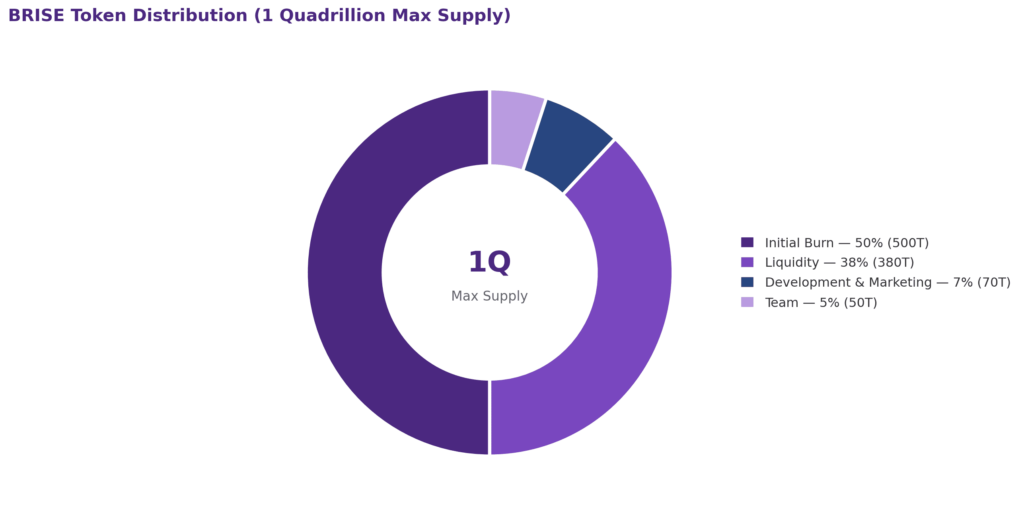
Total supply is a fixed 1 quadrillion tokens, with 50% burned at launch and 38% allocated to liquidity.
What Is Bitgert (BRISE)?
Bitgert is a crypto engineering organization that builds blockchain infrastructure and products. BRISE is its native token. The project launched in July 2021 under the name Bitrise, then rebranded to Bitgert in December 2021, without changing the token or its ticker.
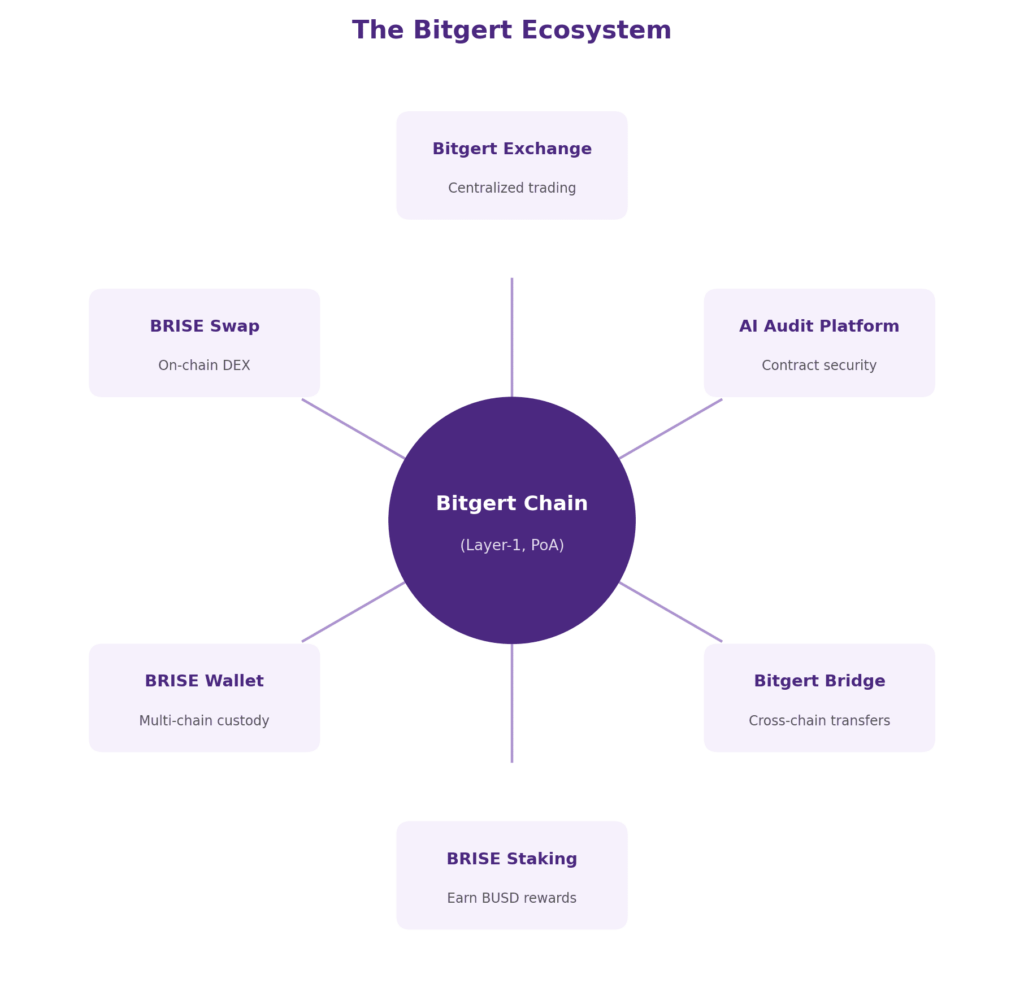
Bitgert’s flagship product is Bitgert Chain (also called Brise Chain), its own Layer-1 blockchain built for speed and low cost. Beyond the chain itself, Bitgert operates a centralized exchange, a decentralized swap platform, a multi-chain wallet, a staking program, and an AI-powered smart contract audit tool.
How Does BRISE Work?
BRISE works through two connected systems: the blockchain it powers, and a tax mechanism built into the token itself.
Bitgert Chain sits at the center. Every other product in the ecosystem either runs on it or supports it.
Bitgert Chain uses a Proof-of-Authority consensus mechanism, which lets it process transactions quickly with very low fees. The chain is EVM-compatible, meaning developers can bring over projects built for Ethereum or BNB Chain without rewriting their code.
The BRISE transfer tax applies to every transaction: 5% goes to an automatic buyback-and-burn (the contract buys BRISE from the liquidity pool and burns it), 4% is distributed to staking rewards, and 3% goes to marketing. That is a 12% total tax on transfers.
Definition: Buyback-and-Burn A mechanism where a portion of every transaction is used to automatically buy back tokens from the market and permanently destroy them, reducing total supply over time.
What Is the Utility of the BRISE Token?
BRISE has a few concrete uses within the Bitgert ecosystem:
Staking
Holders lock BRISE in the staking program and earn rewards paid out in BUSD, a stablecoin, rather than more BRISE. This matters because it means rewards hold their dollar value instead of being diluted by an ever-growing token supply. Reward rates depend on how much is staked and how much fee revenue the ecosystem is generating at the time.
Transaction fees
BRISE is the gas token on Bitgert Chain, so every smart contract call, swap, or transfer on the chain needs a small amount of it. This is the core of Bitgert’s low-fee pitch: because BRISE’s per-token price is so small, even a normal gas amount in BRISE terms costs a tiny fraction of a cent.
Governance
Token holders can weigh in on decisions about the ecosystem’s direction, such as new product priorities or parameter changes. This is closer to informal community input than a formal on-chain voting system with binding proposals.
Ecosystem access
BRISE is the base trading pair on BRISE Swap, the token merchants accept through PayBrise, and the asset staked to participate in various ecosystem programs. In practice, most activity across Bitgert’s products routes through BRISE at some point.
This utility case is one reason BRISE is treated differently from a pure meme coin, even though its price behaves like one. For a deeper look at whether that utility translates into a sound investment, see our full take on whether Bitgert is a good investment.
Which Blockchain Does BRISE Use?
This is truly multi-chain, and worth getting straight. BRISE launched on BNB Smart Chain (BSC) in 2021, and that deployment is still active today. It is the version with by far the most liquidity and exchange support. In February 2022, Bitgert launched its own chain, Bitgert Chain, where BRISE also functions as the native gas token. BRISE additionally has deployments on Ethereum and Solana, though trading volume on those is much smaller than on BSC.
If you are buying or checking BRISE anywhere, confirm which chain’s version you are looking at, since the contract address is different on each one.
What Are the Main Use Cases of BRISE?
Bitgert’s ecosystem spans several areas beyond simple trading:
DeFi BRISE Swap lets holders trade BEP-20 tokens directly from their wallets, and the staking platform lets them lock BRISE for BUSD rewards instead of parking it idle. Liquidity providers can also earn a share of swap fees by depositing token pairs into BRISE Swap’s pools.
Payments PayBrise is a payment gateway that lets merchants accept BRISE as payment for real goods and services, similar in concept to a crypto checkout button, aimed at giving the token use beyond speculation.
Real estate A Web3 real estate marketplace where property-linked assets are tokenized and traded on-chain, letting buyers get exposure to real estate deals without the usual paperwork-heavy process, though this remains one of the ecosystem’s newer and less-tested products.
Security tooling An AI-powered audit platform that scans smart contracts for common vulnerabilities. It’s built for any project to use, not just Bitgert’s own contracts, positioning it as a service business alongside the rest of the ecosystem.
Peer-to-peer trading A P2P marketplace and LocalBitgert connect buyers and sellers directly for local-currency trades, without a centralized order book in between, similar in spirit to how Binance’s P2P service works.
What Is the Total and Circulating Supply of BRISE?
Metric
Value
Max supply
1,000,000,000,000,000 BRISE (1 quadrillion)
Total supply
Approx. 427 trillion BRISE
Circulating supply
Approx. 395.7 trillion BRISE
Market cap
Approx. $6 million to $8 million
BRISE’s price carries many leading zeros because of this enormous supply, not because the project itself is unusually new or small in ecosystem terms. You can check the live BRISE price in INR anytime on the BRISE to INR converter.
What Is the BRISE Tokenomics Breakdown?
BRISE opened with a fixed supply of 1 quadrillion at launch. Its allocation was heavily weighted toward burning and liquidity rather than the team.
What Is Bitgert Coin (BRISE)? Utility, Tokenomics and Ecosystem
Allocation
Share
Tokens
Purpose
Initial Burn
50%
500T BRISE
Removed from supply at launch
Liquidity
38%
380T BRISE
Keeping trading pairs deep on exchanges
Development & Marketing
7%
70T BRISE
Funding ecosystem growth
Team
5%
50T BRISE
Contributor allocation
Half the total supply being burned before trading even began is a notably different structure from most new tokens, and it is one reason BRISE’s ongoing transfer tax adds further burn on top of that starting point.
What Is the Bitgert Roadmap and Ecosystem?
Bitgert’s ecosystem today includes Bitgert Chain, Bitgert Exchange (a centralized trading platform), BRISE Swap (its DEX), a multi-chain BRISE wallet, a staking platform, an AI audit tool, a P2P marketplace, PayBrise, and a Web3 real estate marketplace. The team publishes regular ecosystem updates and continues to ship bridge integrations to connect Bitgert Chain with other networks.
One thing worth knowing before you go further: Bitgert’s development team has operated anonymously since launch, with plans to reveal identities stated but no confirmed timeline. That is a governance detail worth weighing, not a reason to dismiss the ecosystem outright, since the products themselves are real and functioning.
Conclusion
Bitgert (BRISE) is a real, multi-product ecosystem built around its own Layer-1 blockchain, with a token whose main jobs are paying gas, staking for BUSD rewards, and settling transaction taxes. Its 1 quadrillion supply explains the tiny per-token price, not the size or activity of the project behind it. That utility case is genuine, and it sits alongside real risk: an anonymous team, a price down roughly 99% from its 2021-2022 peak, and a supply so large that meaningful scarcity requires serious adoption.
Ready to buy? Get BRISE directly with INR through the Mudrex app, or subscribe to the Mudrex YouTube channel for regular market updates.
FAQs
What is Bitgert (BRISE)?
Bitgert is a crypto engineering project that runs its own Layer-1 blockchain, called Bitgert Chain, along with a wider suite of DeFi and payment products. BRISE is the native token that powers that ecosystem.
How does BRISE work?
BRISE functions as the gas token on Bitgert Chain, so it’s needed for any transaction or smart contract call on that network. On top of that, every BRISE transfer carries a 12% tax that’s automatically split between buying back and burning tokens, funding staking rewards, and marketing.
What is the utility of the BRISE token?
BRISE has four concrete uses: staking for BUSD rewards, paying gas fees on Bitgert Chain, informal governance input on ecosystem decisions, and acting as the base currency across products like BRISE Swap and PayBrise. It’s built to be used within the ecosystem, not just held or traded.
Which blockchain does BRISE use?
BRISE is multi-chain. It launched on BNB Smart Chain in 2021 and still trades there with the most liquidity, then gained its own Layer-1 network, Bitgert Chain, in 2022. Smaller deployments also exist on Ethereum and Solana, each with its own separate contract address.
What are the main use cases of BRISE?
BRISE is used across five main areas: DeFi activity like staking and swaps on BRISE Swap, merchant payments through PayBrise, tokenized property trading on Bitgert’s real estate marketplace, third-party smart contract audits, and peer-to-peer trading through LocalBitgert. Adoption varies a lot across these, with staking and swaps seeing the most real usage.
What is the total supply of BRISE?
BRISE has a fixed maximum supply of 1 quadrillion tokens that will never increase. About 395.7 trillion of those are currently in circulation, with the rest either burned at launch or still locked.
Where can I check the official BRISE contract address?
Look it up directly on CoinMarketCap or BscScan rather than trusting a link from social media, and make sure you’re checking the right chain. Because BRISE exists on BNB Smart Chain, Bitgert Chain, Ethereum, and Solana, each version has its own distinct contract address.
What are the main risks associated with BRISE?
The three biggest are an anonymous development team with no confirmed timeline for revealing their identities, a token supply so large that meaningful price scarcity requires serious adoption growth, and a price that remains roughly 99% below its 2021 to 2022 peak with no confirmed recovery driver.
DISCLAIMER: BRISE is a highly volatile, micro-cap cryptocurrency. This article is for educational purposes only and is not financial advice. Crypto investments carry risk of loss, and past performance does not indicate future results. Do your own research before investing.
Siri is a writer venturing into the exciting realms of blockchain technology, cryptocurrency, and decentralized finance (DeFi), eager to explore the transformative potential of these innovations. She brings a unique perspective that bridges traditional industries and cutting-edge technology, often infused with a touch of humor through memes. She has a rich background in real estate and interior design, having previously contributed to NoBroker, where she crafted blogs and assets on these topics.