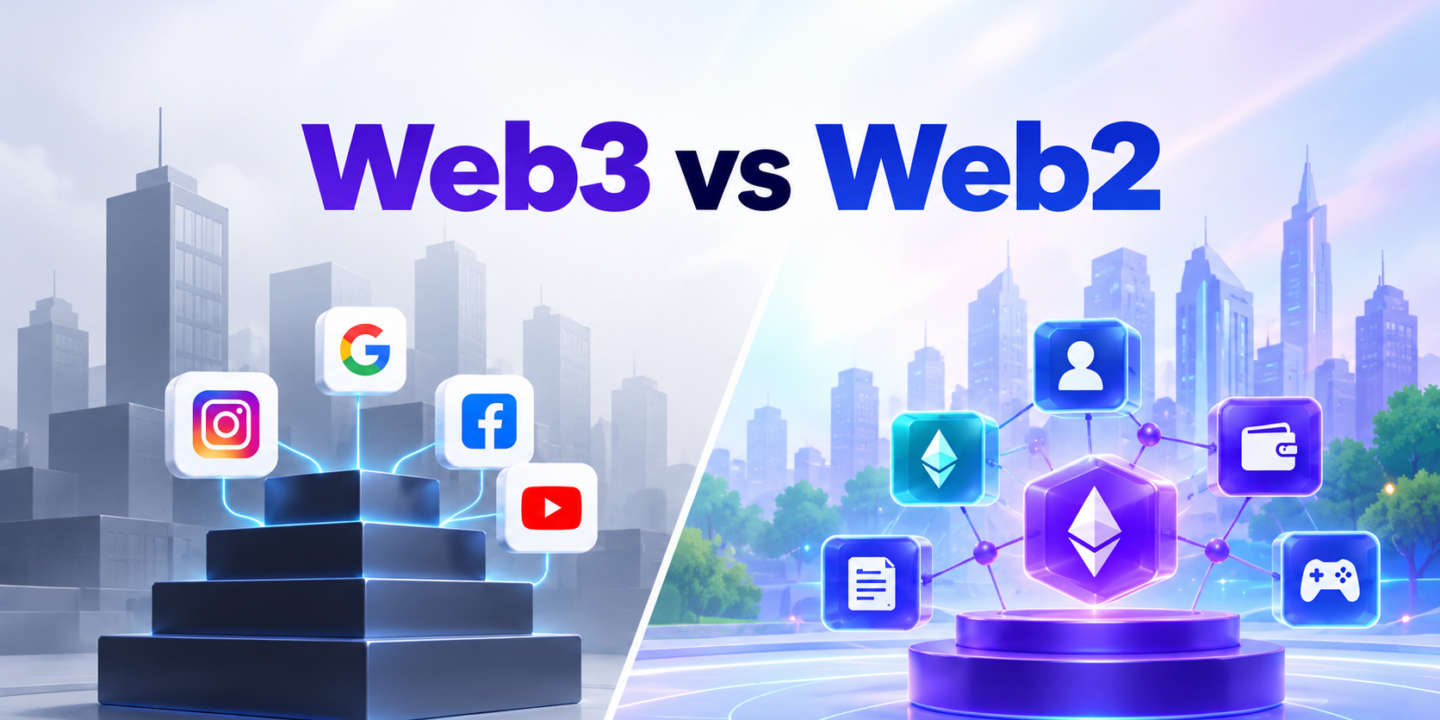

The main difference between Web2 and Web3 is how online services organise control and ownership. Web2 usually relies on companies to run platforms, manage accounts and store user data. Web3 uses blockchain networks, smart contracts and crypto wallets to make certain assets and activities independently verifiable or controlled by users.
That does not mean Web3 replaces Web2, or that one is always better. Both approaches involve trade-offs in convenience, privacy, cost and responsibility.

Web2 refers to the interactive internet used for social media, streaming, online shopping and cloud applications. Instead of only reading a webpage, people can post videos, comment, message friends, shop and collaborate.
Examples include YouTube, Instagram, Gmail and many online marketplaces. These companies manage their platforms and may control account access, content distribution, data storage and commercial rules. They also make services easy to use and provide customer support.
Web3 refers to online services that use decentralised technologies, especially public blockchains, to support programmable transactions and user-controlled digital assets. A person may connect a wallet to an application, sign a transaction and hold certain tokens without requiring the app operator to maintain the definitive ownership record.
Web3 remains an evolving model rather than a fully separate internet. Many applications depend on both blockchain networks and conventional web infrastructure.
For a closer look at the technologies used by blockchain applications, our Web3 and Web3 crypto coins explainer covers smart contracts, wallets and digital assets in straightforward terms.
| Feature | Web2 | Web3 |
| Main architecture | Usually company-operated services | Blockchain networks plus conventional infrastructure |
| Account access | Username, password or social login | Often a crypto wallet; hybrid logins are possible |
| Records | Typically controlled by service operators | Some transactions or ownership records stored on-chain |
| Payments | Banks, cards and payment providers | Cryptocurrencies and token-based payments, plus traditional options |
| Digital assets | Usually account- or platform-based | Some assets transferable between compatible wallets and apps |
| Governance | Company management and platform rules | Developers, foundations, token holders or mixed governance |
| Privacy | Depends on the provider and its policies | Depends on the design; public chains expose transaction history |
| Fees | Ads, subscriptions or transaction charges | Network fees, protocol fees and sometimes subscriptions |
| Customer support | Often centralised and familiar | Varies; self-custody transfers may be irreversible |
| Main challenge | Platform dependence and data concentration | Usability, scams, scalability and user responsibility |
On Web2, a platform typically decides the terms for holding and transferring items in its database. In Web3, ownership of some digital assets can be represented by tokens recorded on a blockchain. However, controlling a token does not automatically give you copyright, platform access or ownership of a business.
Web2 commonly uses email addresses, passwords and managed recovery. Web3 often allows wallet-based authentication. This can reduce reliance on a separate password for every application, but users must secure their keys and understand transaction permissions.
Web2 payments generally pass through banks or payment providers. Web3 can enable transfers using crypto networks and smart contracts. The trade-off is that fees vary, transfers can be irreversible and asset values may fluctuate.
Web2 companies can hold large private databases of personal information. Public blockchains let anyone examine many on-chain transactions, which supports verification but also creates privacy challenges. Web3 is not automatically anonymous or private.
Web2 policies are generally set by the service provider. Some Web3 protocols use voting systems or decentralised autonomous organisations (DAOs). In practice, token ownership may be concentrated and development teams can retain significant influence.
Consider a creator publishing content. On a Web2 platform, an account and most audience relationships are maintained inside a company’s systems. The platform provides discovery and moderation but can also change eligibility or revenue-sharing rules. A Web3-oriented publishing tool may use an independently controlled address or transferable membership token; however, discovery, storage and the user interface may still depend on services run by a company.
Now consider transferring value. A Web2 payment typically moves through banks, processors and app ledgers. A Web3 transfer can be authorised with a wallet and settled on a blockchain, but the sender must choose the correct network and pay any relevant fees. A mistaken address can be hard to recover. The choice is not between “good” and “bad” internet—it is between different systems of trust, control and recovery.
Also Read : What is Web3?
Web2 services commonly keep account records and decide what can be transferred between users. In Web3, compatible assets can be recorded in addresses controlled by users, making transfer and verification possible beyond one application. That can improve portability, but the ownership applies to the token or record—not automatically to every related legal right. An NFT of an artwork, for example, ordinarily does not grant copyright unless the applicable terms expressly say so.
Control also depends on custody. A Web3 user who holds assets through a centralised exchange depends on that provider’s policies and records. Conversely, a Web2 company may provide robust data export and interoperability features. A fair comparison should examine the actual product rather than assume an ownership model based only on the Web2 or Web3 label.
In Web2, common risks include password theft, data breaches, account takeovers and provider outages. The benefit is that service operators may be able to reverse fraudulent charges, reset passwords or restore access. In Web3, security shifts towards private keys, smart contracts, transaction approvals, network consensus and bridges. The user may gain control over the asset but also take on responsibility for protecting it.
Web3 is not inherently hack-proof. Smart contracts can contain defects, a wallet can be compromised, and a phishing page can trick a user into authorising a harmful transfer. The blockchain may continue operating while the application’s interface or data provider goes offline. Users should assess how support, upgrades, independent audits and recovery actually work in the product they intend to use.
Also Read: How to Invest in web3 Coins in India
Web2 companies often maintain user accounts, behaviour logs and personal information in private databases. Depending on policy and regulation, those records can be accessed, deleted or transferred by the service. Public Web3 networks may avoid requiring the same registration information for every application, but transparent ledgers can expose transaction histories and relationships between addresses.
A wallet address is usually pseudonymous, not automatically anonymous. When linked to identity verification, a purchase, or a public social profile, activity may become attributable to a person. Privacy-enhancing technologies exist, but protection varies. The right question is which information is public, who can correlate it and what the application collects off-chain.
Social platforms: A conventional social app stores posts and account relationships in its own systems. A Web3-style social protocol might let users carry an identity or social connections across compatible interfaces, but moderation and usability remain difficult challenges.
Gaming: In a Web2 game, purchased items generally remain inside the publisher’s ecosystem. A Web3 game may issue tradeable tokens or collectibles. Their resale value, utility and availability are not guaranteed.
Payments: A Web2 purchase may use a card network. A Web3 application may accept a token transfer from a wallet. Both options have fraud and operational risks; they simply manage them differently.
Cloud and storage: Web2 cloud storage relies on service providers’ infrastructure. Web3 projects such as Filecoin aim to coordinate storage through distributed participants and crypto incentives.
Web2 infrastructure offers mature hosting, scalable databases, predictable support contracts and familiar customer service tools. Developers can update products quickly, while users benefit from fast account recovery and established payment options. Businesses also carry responsibility for securing customer data, moderating content and complying with laws.
Web3 can offer transparent execution, shared infrastructure and assets that can be used across compatible applications. But builders must budget for smart-contract security, blockchain fees, wallet experience, transaction finality and potential governance complexity. Publishing code on a blockchain does not replace ordinary engineering, legal review, monitoring or customer support. Many teams select a hybrid design because they want some blockchain features without placing every operation on-chain.
A social post, streamed video or database query can typically be processed cheaply and quickly with Web2 cloud infrastructure. Writing every interaction to a public blockchain would be inefficient, so Web3 applications often store large files and transient data off-chain while recording selected transactions on-chain. Network fees may vary substantially with traffic, blockchain architecture and the operation being performed.
Web3 networks can introduce waiting time for confirmation and finality; some optimise for throughput, while others prioritise different decentralisation or security properties. Web2 providers also experience outages and fees, but their failure modes are different. Avoid claims that either approach is universally cheaper, faster or more secure: performance depends on the workload and system design.
A marketplace might use a Web2 front end and search engine but transfer a token on a blockchain. A game could keep real-time gameplay on conventional servers and use tokens only for selected items. An investment app could offer familiar KYC and INR funding while enabling access to blockchain-related assets. A decentralised finance interface may rely on ordinary websites, analytics tools and customer communications even though trades occur through smart contracts.
Hybrid products are common because decentralised settlement, distributed verification and user-controlled assets solve specific problems—not every problem. Describing these services as partly centralised is not a criticism; it is an important disclosure about where users must place trust.
It depends on what someone needs. Web2 is often easier for streaming a video, recovering an account or getting customer support. Web3 can be useful when independently verifiable transfers, open financial protocols or portable digital assets are important.
Web3 can also be less practical for everyday use when a service requires complex wallets, transaction fees or technical knowledge. A hybrid design can combine the strengths of both approaches.
Crypto coins and tokens can help pay transaction fees, reward network operators or govern specific protocols. For example, ETH is used for Ethereum network fees, LINK supports oracle services and FIL is used in the Filecoin storage economy.
Token utility does not guarantee price appreciation: adoption, supply, unlock schedules and competition all matter. Our comparison of leading Web3 crypto coins shows how tokens differ by their actual roles and risks.
Web2 is often preferable when the highest priorities are simple onboarding, low-friction collaboration, high-speed content delivery, customer support and recoverable accounts. Web3 can be useful when participants need to verify a shared record, transfer a digital asset without relying on one platform’s database, or interact with transparent programmable rules. Neither category guarantees a better outcome.
Ask five questions: Who controls the critical records? Can a user recover access? What information becomes public? What fees and delays will the user face? Who is accountable when something breaks? These reveal more about an application than its buzzwords. If you are weighing an exchange account against self-custody, the Web3 coin investing guide for India explains how those choices affect a real purchase.
Blockchain capacity and fees are only part of the challenge. Users need to understand signatures, permissions, recovery phrases and the difference between a token address and a website address. A scam can exploit that complexity without attacking the blockchain itself. Digital-asset rules also differ across jurisdictions, creating uncertainty for cross-border services and some token rights.
Governance is another challenge. Token voting can favour large holders, upgrades can be controversial and decentralised teams may struggle to respond quickly to emergencies. Finally, cross-chain bridges and middleware create extra dependencies. Web3 will become easier to use as infrastructure improves, but many applications will still need Web2-like customer support and risk controls.
Challenges include transaction fees, user onboarding, limited consumer protection, phishing, wallet-loss risk, smart-contract bugs and dependence on centralised infrastructure. Decentralised networks can also face concentrated governance and regulatory uncertainty.
The practical question is not whether an app calls itself Web3, but which functions genuinely benefit from a blockchain and which do not.
You can explore supported Web3 crypto coins on Mudrex to compare live market information and see which digital assets are available. First consider what each project does, how its token is used and what risks you would take.
A Web2 game generally stores purchases in the publisher’s database. A Web3 game may issue a token that a user can keep in a compatible wallet and transfer independently. The token does not guarantee that the game survives or that other games will recognise it.
Google’s major consumer services are generally examples of Web2: they operate through company-managed infrastructure and accounts. A company can research or offer blockchain features without turning every product into a decentralised Web3 service.
Yes. A product can combine a familiar Web2 website with blockchain settlement, wallet login or token-based features. Most mainstream Web3 services already depend on at least some conventional internet infrastructure.
Some components of a Web3 application can run on distributed networks, while its website, search features or customer support may use ordinary servers. The degree of decentralisation should be checked component by component.
Wallets can hold keys that authorise blockchain transactions and can act as identifiers for supported applications. They do not replace every login system, and they introduce important recovery and security responsibilities.
Web2 primarily uses company-managed accounts and databases, while Web3 can use blockchain networks to manage some assets and transactions independently of a single platform.
Web2 examples include traditional social media, streaming platforms and online marketplaces. Web3 examples include blockchain wallets, decentralised exchanges and token-based gaming or storage applications.
Not automatically. Blockchains provide particular verification and tamper-resistance properties, but Web3 apps can still suffer contract exploits, phishing, bridge attacks and user errors. Security depends on the implementation.
There is no evidence that Web3 will completely replace Web2. Most Web3 products still use conventional browsers, servers and services, and hybrid applications are likely to remain common.
No. Web3 also involves decentralised applications, digital identity, community governance and verifiable digital ownership. Cryptocurrency often supplies payment and incentive mechanisms.
Privacy varies. Public blockchains can reveal transaction histories, while some tools are designed to reduce information exposure. A wallet address should not be assumed to provide complete anonymity.
Web1 is commonly described as read-only, Web2 as read-and-write, and Web3 as read-write-and-own. These are simplifying labels, not formally separated internet systems.
It helps explain what a token is intended to do. Evaluating the service, token utility and risks is more useful than buying an asset simply because it has a Web3 label.
Disclaimer: This content is educational and is not investment advice. Digital assets and related technologies carry operational, cybersecurity and financial risks.