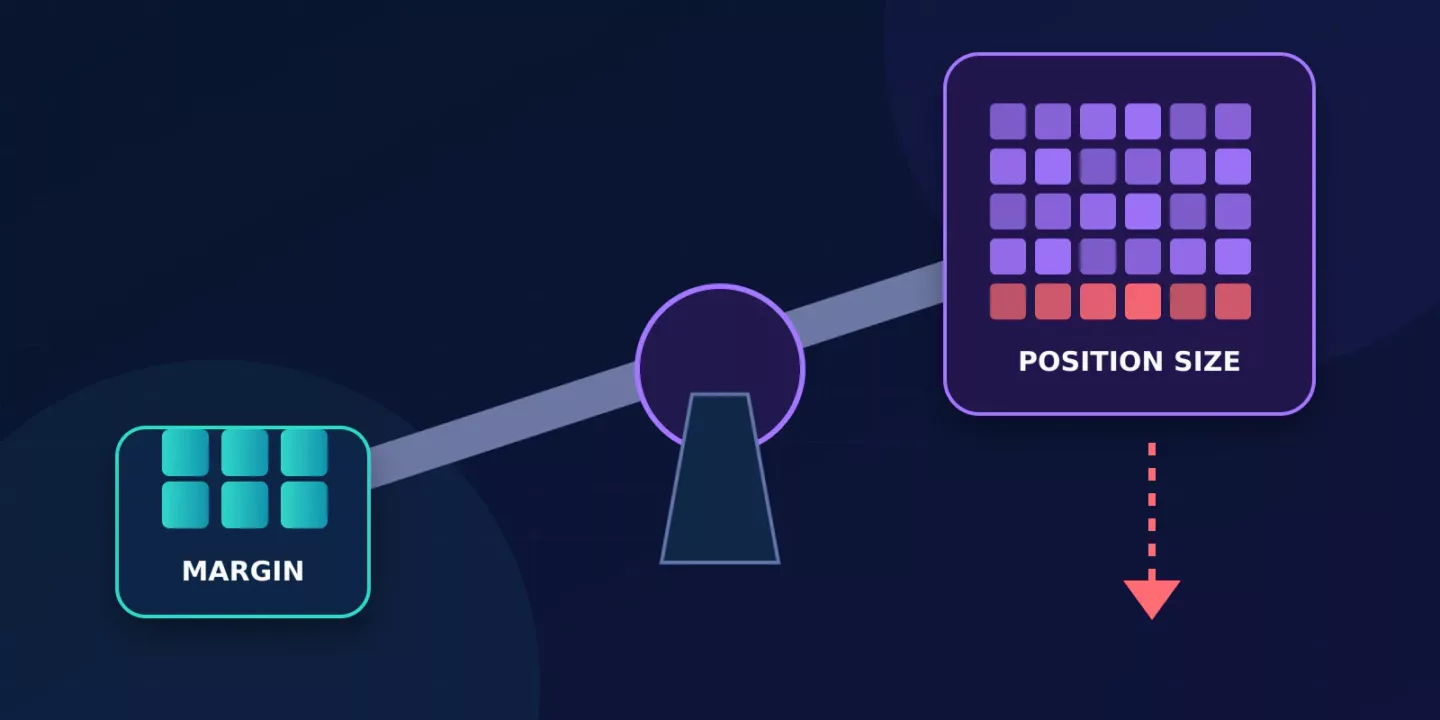

Leverage in crypto futures trading allows a trader to control a position larger than the margin deposited. It can improve capital efficiency, but it also magnifies losses and reduces the adverse price movement that the margin can absorb.
For example, ₹10,000 of margin at 10× leverage controls ₹1,00,000 of notional exposure. A 2% move changes the position by approximately ₹2,000 before fees and funding—about 20% of the original margin.

Understanding leverage requires more than knowing what 5× or 10× means. A trader must also understand position size, initial and maintenance margin, mark price, liquidation and the maximum loss planned for the trade.
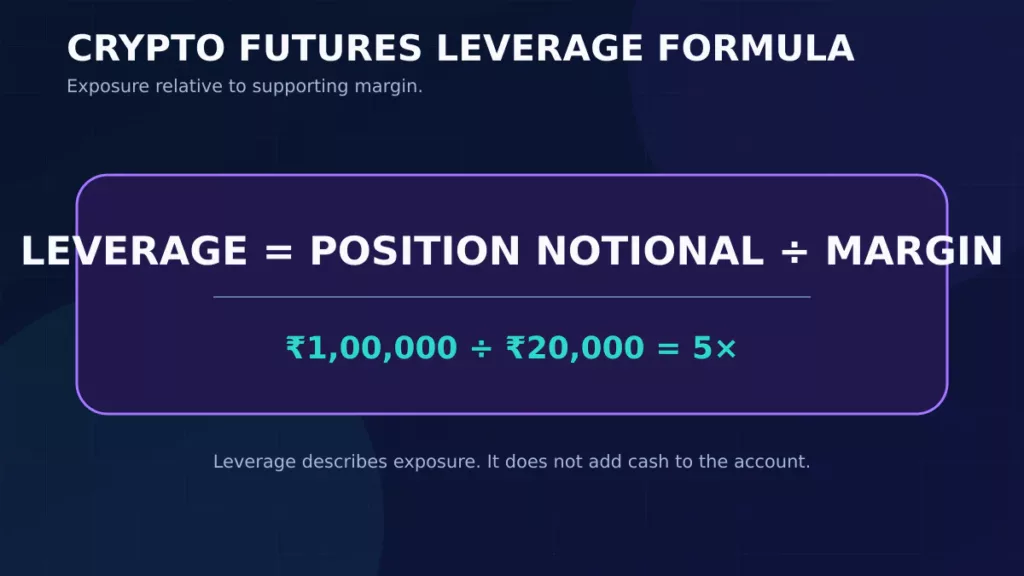
Leverage is the ratio between a futures position’s notional value and the margin supporting it.
The basic relationship is:
Leverage = Position notional value ÷ Margin
If a trader uses ₹20,000 of margin to control a ₹1,00,000 position, the effective leverage is 5×.
Leverage does not change the market price or increase the chance that a trade will be profitable. It changes how much exposure the margin controls and therefore how strongly a price move affects the trader’s capital.
The available leverage, initial-margin requirement and position limit vary by contract and venue. Maximum leverage may also change when volatility, liquidity or risk limits change.
The main use of leverage is capital efficiency. A trader can obtain a chosen amount of exposure without posting the position’s full notional value as margin.
This can leave other capital available, but “available” does not mean risk-free. In cross margin, eligible account funds may support losing positions. Opening several leveraged positions can also create more total exposure than the trader intended.
Leverage may support:
Each use creates its own basis, funding, execution and margin risks. Leverage is a contract tool, not a shortcut to higher-quality trades.
The ratio shows how much notional exposure each rupee of margin controls.
| Margin | Leverage | Position controlled |
|---|---|---|
| ₹10,000 | 1× | ₹10,000 |
| ₹10,000 | 5× | ₹50,000 |
| ₹10,000 | 10× | ₹1,00,000 |
| ₹10,000 | 20× | ₹2,00,000 |
At 10× leverage, every ₹1 of margin supports ₹10 of exposure. This does not mean that the trader has received ₹90 in cash or that the account balance has increased. It describes the size of the contract position relative to collateral.
As leverage rises for the same margin, the position grows. If the position size stays fixed, higher leverage instead reduces the initial margin required. Either approach can reduce the available margin buffer if the trader does not control total exposure.
These terms are related but not interchangeable.
A trader can reduce leverage by adding margin while keeping the position unchanged. A trader can also increase leverage by increasing position size without adding matching collateral.
Risk should be measured from the planned price move and position size, not from leverage alone.
Approximate planned loss = Position notional value × Adverse price move
Fees, funding, slippage and contract-specific multipliers must then be added where applicable.
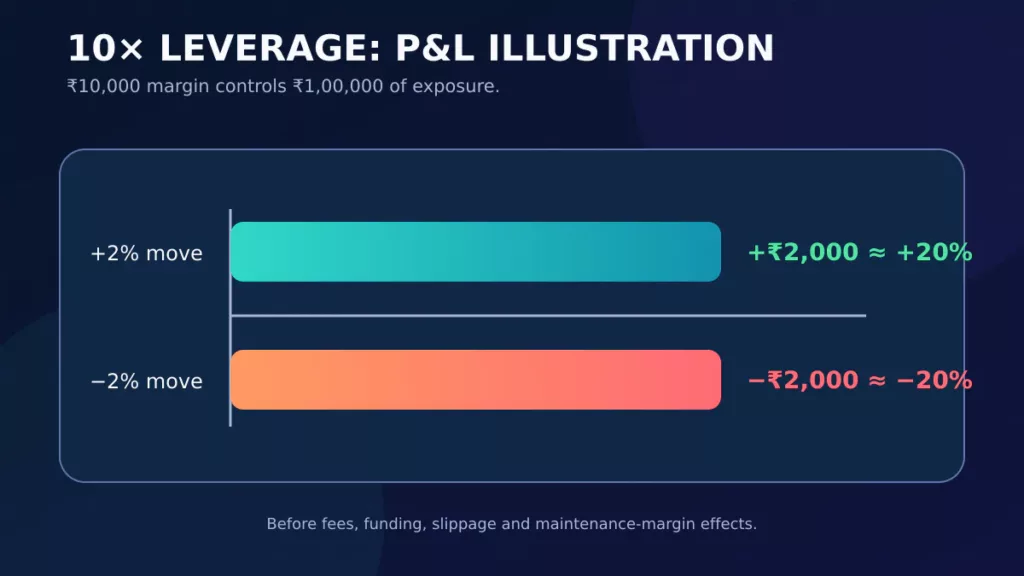
Assume a trader posts ₹10,000 of margin for a ₹1,00,000 long position at 10× leverage.
| Contract-price move | Approximate P&L | Approximate return on ₹10,000 margin* |
|---|---|---|
| +1% | +₹1,000 | +10% |
| +2% | +₹2,000 | +20% |
| −1% | −₹1,000 | −10% |
| −2% | −₹2,000 | −20% |
*Before fees, funding, slippage and maintenance-margin effects.
The market move remains 1% or 2%. The return on margin appears larger because the trader controls ten times the deposited amount.
This table is a profit-and-loss illustration, not a liquidation calculation. Actual liquidation may occur before the simple margin is fully exhausted.
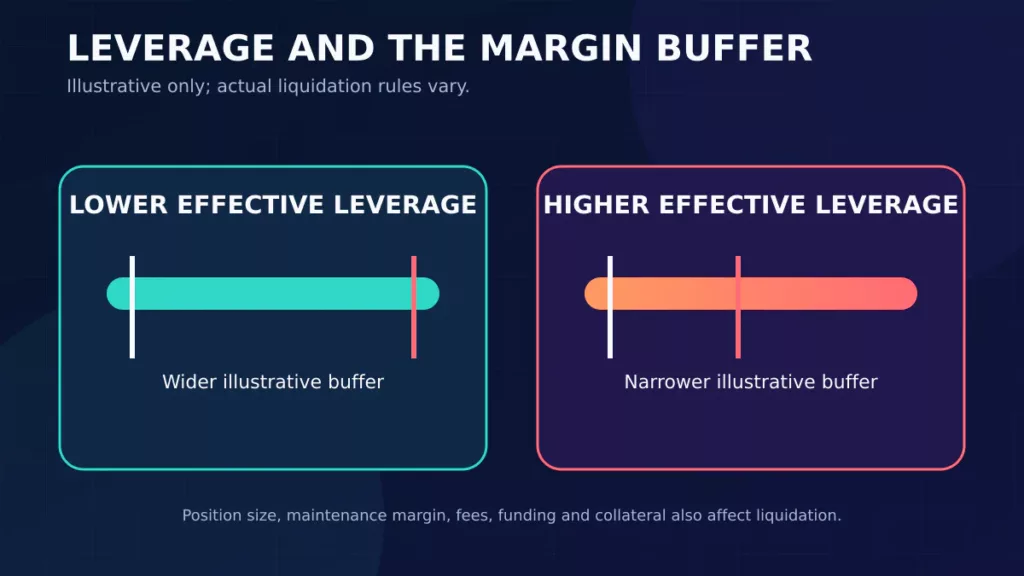
Initial margin opens a position. Maintenance margin is the minimum account equity required to keep it open.
If losses and costs reduce equity below the applicable requirement, the venue may liquidate part or all of the position. Many crypto venues use mark price rather than the last traded price for this calculation.
For the same position size, posting less margin creates higher effective leverage and a smaller buffer. For the same margin, selecting higher leverage creates a larger position and faster profit-and-loss changes.
Liquidation price depends on more than a simple leverage percentage. It can be affected by:
Use the live estimate shown for the exact contract and treat it as an estimate rather than a guaranteed execution price.
Lower leverage generally reduces the sensitivity of margin to a given price move when the trader also keeps position size controlled. It does not automatically make the trade safe.
A large 2× position can risk more rupees than a small 5× position. A wide stop, poor liquidity or correlated positions can also create substantial loss at a low leverage ratio.
The relevant questions are:
Leverage is only one part of the risk calculation.
There is no universally appropriate ratio. A beginner should not start with a target such as 2×, 5× or 10× and then build the trade around it.
A stronger process is:
If the position cannot tolerate ordinary volatility without approaching liquidation, the trader should reduce its size, add appropriate margin or skip the trade.
Paper trading can help practise the calculation, although simulated fills cannot reproduce every live fee, gap or emotional response.
Yes. A trader holding Bitcoin in the spot market could open a smaller short Bitcoin futures position to offset some downside during a defined risk period.
The hedge ratio determines how much exposure is offset. A full notional match may still be imperfect because the futures contract and spot holding can differ in price, basis, funding, liquidity or settlement.
The hedge itself may also face liquidation if it uses insufficient margin. A rising market can create losses on the short futures position even while the spot asset gains.
Hedging changes the portfolio’s exposure; it does not eliminate all risk.
Starting with “I want 20×” makes the platform setting drive the risk. Start with the maximum loss and stop distance instead.
Liquidation is the venue’s risk process, not a planned exit. A stop should be chosen from the trade thesis and should account for possible slippage.
Several modest-looking positions can create excessive combined notional exposure, especially when the underlying assets are correlated.
Adding collateral may move the liquidation estimate, but it also increases the capital exposed. It does not repair an invalid market thesis.
Confidence does not change volatility or contract mechanics. Every trade needs a loss limit, including one that appears unusually strong.
Before opening a leveraged position, confirm:
If any value is unclear, do not place the trade.
Leverage in crypto futures trading improves capital efficiency by allowing margin to control larger contract exposure. The same mechanism magnifies losses and can move liquidation closer to the entry price.
Do not choose leverage in isolation. Calculate the position size from the planned loss, review the contract’s maintenance-margin and liquidation rules, and include fees, funding and slippage.
Explore Mudrex Learn, visit the Mudrex YouTube channel or download the Mudrex app to continue learning about leverage and crypto futures risk management.
It is the ratio between a futures position’s notional value and the margin supporting it. It allows smaller collateral to control larger exposure.
At 10× leverage, ₹1 of margin supports ₹10 of notional exposure. A 1% move changes the position by roughly 10% of the margin before costs.
Leverage magnifies the result relative to margin because the profit or loss is calculated on the larger position. It does not change the underlying market move.
Margin is collateral. Leverage is the ratio between exposure and that collateral.
No ratio is universally safe. Risk depends on position size, stop distance, volatility, margin requirements, costs and available collateral.
It depends on margin mode and venue rules. Cross margin may expose additional eligible account funds, while gaps or deficits may be treated differently across platforms.