If you hold BTC or you’re thinking about buying it, 2026 has not been a straight line. Bitcoin risks in 2026 are stacking up from several directions at once: miners are shutting down machines at a pace not seen since China’s 2021 mining ban, US regulation is still stuck in the Senate, and Bitcoin now trades more like a tech stock than the uncorrelated hedge it was once sold as.
None of these pressures are new individually. What’s changed is how many are active together, right as BTC trades near $63,000, down sharply from last year’s highs. Here’s what’s actually driving Bitcoin risk, and what could offset it.
Key Takeaways
Miner capitulation is one of the most severe on record. Mining difficulty has dropped roughly 19-20% from its late-2025 peak, the steepest decline since China’s 2021 mining ban.
Bitcoin’s correlation with stocks has hit historic highs. Readings between 0.85 and 0.96 against the Nasdaq mean BTC increasingly moves with tech stocks, not against them.
Regulatory risk is easing but not resolved. Bitcoin has been informally classified as a digital commodity, but the CLARITY Act that would make it law keeps missing its Senate vote.
Quantum computing remains a distant, well-monitored risk. No existing quantum computer can break Bitcoin’s cryptography, and defensive proposals are already in development.
Custody and contagion risk hasn’t disappeared. Corporate treasuries lending out BTC for yield, and past exchange failures, remain a live reminder that not all Bitcoin risk sits at the protocol level.
What Are the Biggest Bitcoin Risks in 2026, Starting With Liquidity?
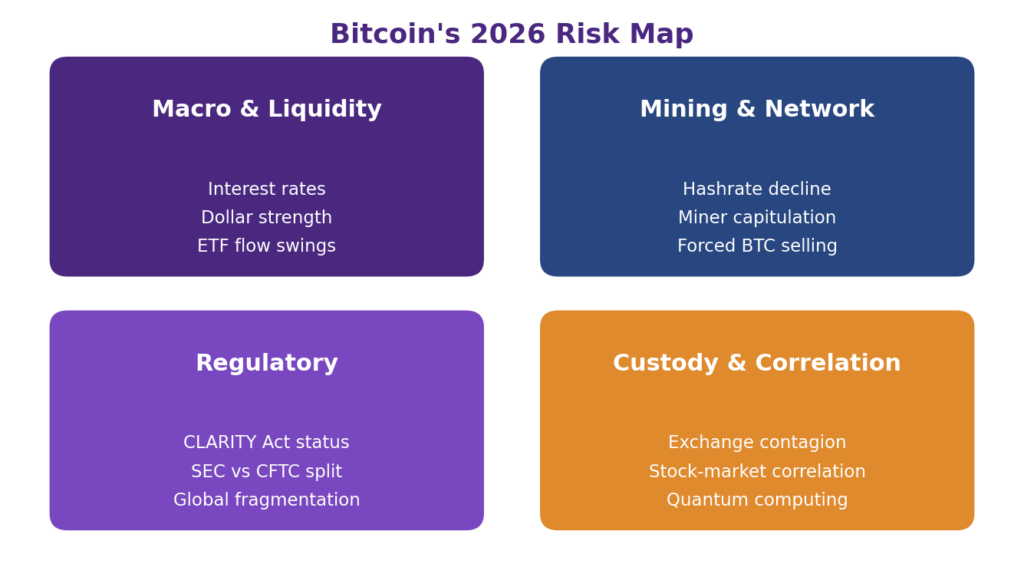
Bitcoin risks 2026 break down into four connected categories: macro and liquidity conditions, mining and network stress, regulation, and custody and correlation risk. Liquidity moves first and fastest, so it’s the natural place to start.
Bitcoin’s price has become tightly linked to the same liquidity conditions that drive the stock market. When the Federal Reserve holds rates high or signals fewer cuts, risk assets across the board tend to sell off together, and Bitcoin macro headwinds 2026 largely trace back to this single mechanism.
How Do Interest Rates and Liquidity Affect Bitcoin?
Definition: Liquidity This means how much money is circulating and available for investment in the financial system; more liquidity generally supports risk assets like Bitcoin, while less liquidity pressures them.
Higher rates make bonds and cash more attractive relative to a volatile asset like Bitcoin, pulling money away from it. The Fed has held rates through most of 2026, and hike-versus-cut odds have swung sharply within days of policy meetings, moving BTC price along with them even without any Bitcoin-specific news.
The Fed’s balance sheet matters too. Quantitative tightening drains liquidity from the system, while quantitative easing adds it back, and Bitcoin has historically tracked this cycle closely since institutional adoption deepened.
Can ETF Outflows Really Pressure Bitcoin’s Price?
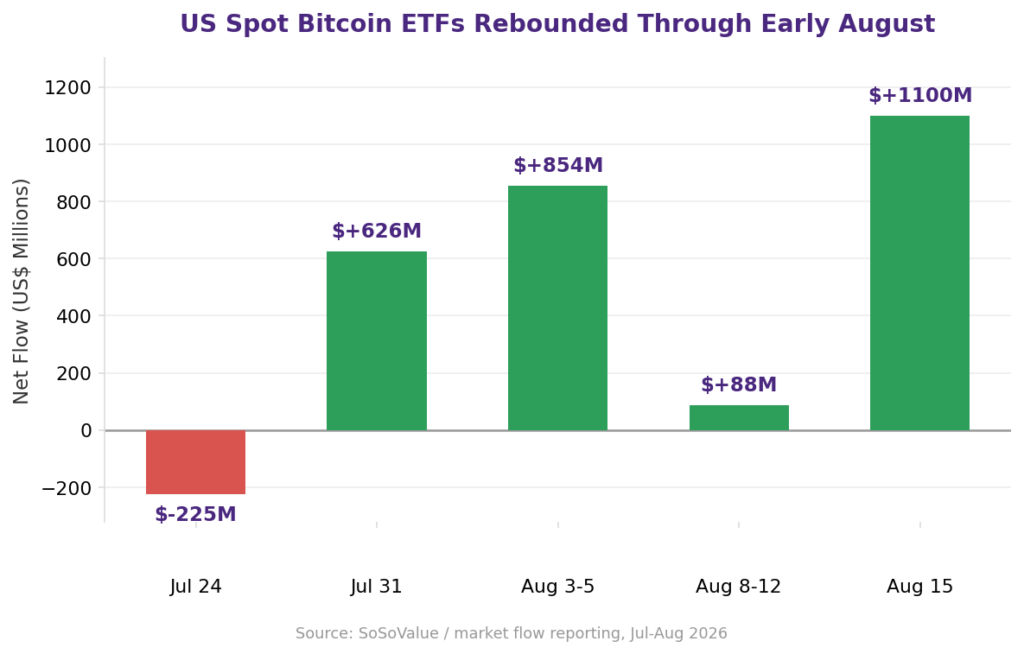
Bitcoin ETF outflow risk is real, but the 2026 data shows a market that swings hard in both directions rather than one in steady decline. Spot Bitcoin ETFs logged a record eight-week outflow streak earlier in the year, then reversed into some of the strongest inflow weeks since launch by mid-August.
Period
Bitcoin ETF Net Flow
Week of Jul 24
-$225M (single-day outflow)
Week of Jul 31
+$626M (3-day inflow run)
Aug 3-5
+$853.5M (strongest week since April)
Aug 8-12
+$88M
Aug 15
+$1.1B combined with ETH ETFs
BlackRock’s IBIT alone captured roughly 80% of recent inflow weeks, which means the rebound is heavily concentrated in a single product. Year-to-date, Bitcoin ETFs remain roughly $4.5 billion in net outflows despite the recent bounce, a reminder that one strong week doesn’t erase months of pressure.
For a deeper look at how these flows interact with Bitcoin’s broader 2026 setup, our Bitcoin 2026 price outlook breaks down the scenarios.
Is Miner Capitulation a Real Risk for Bitcoin in 2026?
Miner capitulation risk in 2026 is one of the most severe the network has seen since the 2021 China mining ban, and it’s playing out through the protocol’s own difficulty adjustment mechanism.
Definition: Miner Capitulation This describes the point where mining becomes unprofitable for a large share of operators, forcing them to power down equipment rather than mine at a loss.
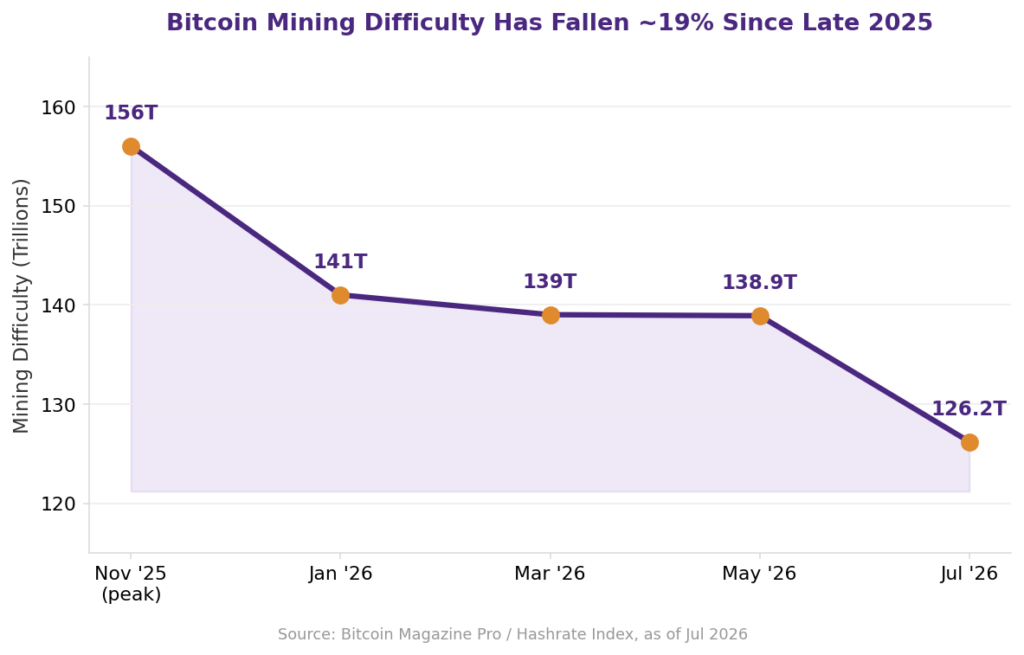
Mining difficulty has fallen roughly 19-20% from its November 2025 peak of about 156 trillion to around 126 trillion by late July 2026, according to Bitcoin Magazine Pro tracking. The network’s hash rate dropped a similar amount over the same window.
The economics behind this are stark. JPMorgan analysts placed the all-in production cost for publicly listed miners at roughly $78,000 per Bitcoin, well above BTC’s price through most of 2026, which means a large share of the industry has been mining at a loss. Publicly traded miners sold more than 32,000 BTC in the first quarter of 2026 alone, exceeding their combined sales for all of 2025 and surpassing the roughly 20,000 BTC sold during the Terra-Luna collapse in 2022.
This matters for investors beyond the mining sector itself. Forced miner selling adds direct sell pressure on BTC price, and because public miners increasingly carry debt obligations, a sharp price drop could force larger, more disruptive liquidations than in prior cycles when mining was more fragmented.
What Regulatory Risks Remain for Bitcoin Investors?
Bitcoin risks in terms of regulations have eased substantially since a joint SEC-CFTC classification named Bitcoin a digital commodity in March 2026, but “eased” isn’t the same as “settled.” The law that would make this permanent keeps missing its own deadlines.
The CLARITY Act, the main US bill governing crypto market structure, advanced through Senate Banking Committee markup in May 2026, but disagreements over stablecoin yield rules and ethics provisions have repeatedly delayed a full floor vote. The Senate left for recess on August 8, 2026, without voting, pushing the vote to September 15, 2026.
Definition: CLARITY Act This is the pending US bill that would formally divide crypto oversight between the SEC and CFTC and legally lock in which digital assets, including Bitcoin, count as commodities rather than securities.
Separately, the SEC postponed a scheduled vote on new capital-raising rules for crypto startups in mid-August, citing a scheduling issue. Together, these delays extend the uncertainty that has made institutional and ETF investors more cautious about pushing further into the asset. This is one of the regulatory risks for Bitcoin investors worth watching closely through the rest of the year, since a September vote outcome in either direction is likely to move price.
Can Stablecoin and Exchange Contagion Still Hurt Bitcoin Holders?
Stablecoin and exchange contagion risk hasn’t gone away just because Bitcoin itself has matured as an asset. The clearest 2026 reminder came from outside the crypto-native world entirely.
A Nasdaq-listed media company disclosed in an August 2026 SEC filing that it had pledged or lent out more than two-thirds of its roughly 9,477 BTC treasury to third parties to generate income, warning explicitly of “significant contagion risks” and naming FTX, Celsius, Voyager and BlockFi as cautionary examples. The filing noted these third parties may lack established credit ratings and could re-lend the coins elsewhere, with no government insurance protecting the company if a counterparty fails.
This illustrates a risk that applies well beyond one company: Bitcoin the protocol has never been hacked, but Bitcoin held by a third party is only as safe as that third party’s balance sheet. The 2022-2023 collapses of FTX, Celsius, Voyager, and BlockFi cost investors billions, and none of them were failures of Bitcoin itself; they were platform and counterparty failures. Anyone holding BTC on an exchange, in a yield product, or lent out for income should treat this as a distinct risk category from Bitcoin’s price risk.
What Technical and Market-Structure Risks Remain for Bitcoin?
Beyond price and regulation, two structural questions shape how Bitcoin risks and opportunities in 2026 are likely to evolve: how tightly BTC now trades with stocks, and how prepared it is for a threat that doesn’t exist yet.
Could Institutional Ownership Increase Bitcoin’s Correlation With Stocks?
It already has. Bitcoin’s correlation with the Nasdaq hit a record 0.96 in April 2026, up from an average of roughly 0.4 before recent volatility, and has run between 0.85 and 0.88 through much of the summer, according to multiple market data providers. That compares with a five-year average closer to 0.54.
Definition: Correlation This measures how closely two assets move together, on a scale from -1 (perfectly opposite) to +1 (perfectly in sync); a reading near 0.9 means the two assets are moving almost in lockstep.
The mechanism is straightforward: the same institutional desks that trade the Nasdaq now trade Bitcoin ETFs, using the same risk budgets and macro signals. When the Fed signals tighter policy, those desks cut exposure across both markets simultaneously. This is a meaningful shift from Bitcoin’s original pitch as an uncorrelated diversifier, and it’s a core part of BTC investment risks that longer-term holders need to price in.
Is Quantum Computing a Threat to Bitcoin?
Quantum computing risk to Bitcoin is real in principle but distant in practice. No quantum computer that exists today can break Bitcoin’s cryptography, and most credible estimates place a cryptographically relevant quantum computer at least 10 to 15 years away, though some recent research has narrowed that window.
Quantum Readiness Milestone
Status (as of August 2026)
Coins in theoretically vulnerable addresses
~35% of supply (Ark Invest/Unchained estimate)
BIP-360 (quantum-resistant address type)
Merged into Bitcoin’s code repository, Feb 2026
BIP-361 (legacy signature sunset proposal)
Drafted, community discussion ongoing
Estimated qubits needed to break Bitcoin’s cryptography
~6,000 logical qubits (current best estimate)
Logical qubits demonstrated to date
~24-28
Roughly 35% of Bitcoin’s supply sits in address types that would theoretically be exposed if a sufficiently powerful quantum computer existed, largely old addresses that have publicly revealed their keys. Bitcoin’s decentralized, no-central-authority structure makes coordinating a defensive upgrade slower than Ethereum’s more centralized roadmap, but the first building block, BIP-360, is already merged into the codebase years ahead of any realistic threat.
What Opportunities Could Offset These Bitcoin Risks in 2026?
Bitcoin risks and opportunities in 2026 sit side by side, and several developments could meaningfully offset the pressures above.
A September CLARITY Act vote, if it passes, would convert today’s favorable agency classification into durable law, removing years of jurisdictional overhang.
Miner capitulation historically precedes reversals. Sharply falling hashrate and difficulty have marked local bottoms in prior cycles, since the least efficient operators exit and the network becomes leaner.
ETF flows have proven they can reverse quickly. The move from an eight-week outflow streak to the strongest inflow week since April happened within a matter of weeks.
Post-halving supply dynamics remain structurally supportive. The 2024 halving continues to throttle new issuance, with the next halving not due until April 2028.
Quantum defenses are years ahead of any real threat. BIP-360 is already merged, giving the network a multi-year head start before a cryptographically relevant quantum computer could plausibly exist.
For investors thinking about how to manage this risk without exiting a position entirely, our guide on hedging Bitcoin with futures walks through when a hedge is worth its cost and when it isn’t. Dollar-cost averaging, covered in our guide to starting a Bitcoin SIP, is another structural way long-term holders manage timing risk through periods like this.
Conclusion
Bitcoin risks in 2026 span four connected fronts: macro liquidity and ETF flows, a historic wave of miner capitulation, an unfinished US regulatory rulebook, and structural shifts in custody, correlation and long-run technical resilience. None of these are fatal on their own, and several, including the regulatory classification and quantum-readiness work, are trending in Bitcoin’s favor.
The realistic takeaway is that BTC remains a volatile, increasingly macro-linked asset whose 2026 path depends heavily on decisions well outside crypto itself, from the Fed’s rate path to a Senate floor vote.
Ready to track BTC yourself? Download the Mudrex app for Android or iOS to follow live prices, or subscribe to the Mudrex YouTube channel for weekly market breakdowns.
FAQs
What are the main risks facing Bitcoin in 2026?
The biggest ones are macro and liquidity pressure, a severe wave of miner capitulation, unresolved US regulation, rising correlation with stocks, and custody or contagion risk from third parties holding BTC.
How do interest rates affect BTC?
Higher rates make bonds and cash more attractive than volatile assets, pulling money away from Bitcoin; rate cuts and added liquidity tend to have the opposite effect.
Can ETF outflows pressure Bitcoin?
Yes, but 2026 flows have swung sharply in both directions, moving from a record eight-week outflow streak to some of the strongest inflow weeks of the year within a short span.
Is quantum computing a threat to Bitcoin?
Not today. No existing quantum computer can break Bitcoin’s cryptography, and a defensive upgrade path (BIP-360) is already merged into the codebase years ahead of any realistic threat.
How does miner stress affect Bitcoin price?
Miners under financial pressure sell BTC to cover costs, adding sell pressure; historically, sharp capitulation phases like 2026’s have also marked points where the network became leaner ahead of a recovery.
Risk Disclaimer
Cryptocurrency investments, including Bitcoin, carry a risk of loss and volatility. Any use of leverage magnifies both potential gains and potential losses. The scenarios, figures, and examples in this article are illustrative and for educational purposes only; they are not financial advice or a guarantee of future performance. Please DYOR before making any investment decisions.
Siri is a writer venturing into the exciting realms of blockchain technology, cryptocurrency, and decentralized finance (DeFi), eager to explore the transformative potential of these innovations. She brings a unique perspective that bridges traditional industries and cutting-edge technology, often infused with a touch of humor through memes. She has a rich background in real estate and interior design, having previously contributed to NoBroker, where she crafted blogs and assets on these topics.