

Palantir Technologies (NASDAQ: PLTR) is an American software company that helps armies, governments and large companies turn scattered data into decisions. It has also become one of the most debated AI names on Wall Street, and more Indian investors are looking it up in 2026 than ever before.
This guide covers everything a beginner needs: what Palantir does, how it makes money, how its numbers have changed over the last three years, why the valuation divides analysts, and how you can invest from India.
| Item | Detail |
| Ticker | PLTR |
| Exchange | Nasdaq |
| Founded | 2003 |
| Went public | September 2020, through a direct listing |
| CEO | Alex Karp, co-founder |
| Employees | About 4,430 |
| Market value | About $461 billion |
| FY2025 revenue | $4.48 billion |
| Dividend | None |
| 52-week range | $106.37 to $207.52 |
Market data at the time of writing, from CNBC and TradingView.
Most large organisations run on dozens of systems that don’t talk to each other. A carmaker might keep supplier data in one tool, factory sensor readings in another and sales forecasts in a third. A defence ministry has the same problem at a much larger scale. And Palantir solves this.
Its software connects those systems into a single working model of the organisation, which it calls an ontology. Instead of rows in separate databases, the software represents real things, such as a part, a machine, a shipment or a soldier, and the relationships between them. When something changes in one place, everyone working on that model sees the effect.
Here is a simple illustrative example for how Palantir software makes companies highly functional.
A factory manager learns that a key supplier will deliver late. Once the systems are connected, the manager can see which production lines depend on that part, which customer orders are at risk and what switching to a second supplier would cost. Without that link, the same answer can take days of emails and spreadsheets.
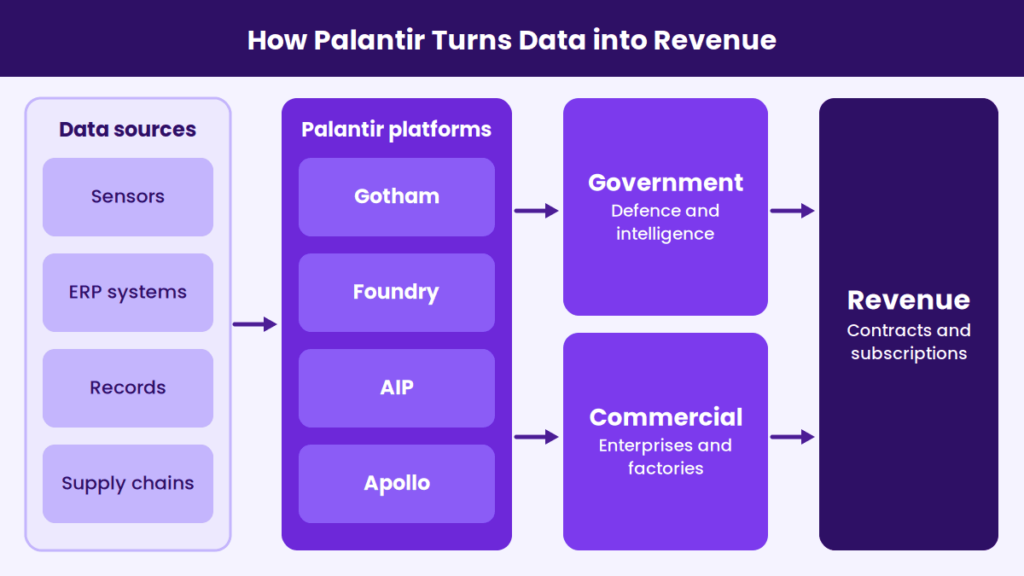
AIP is Palantir’s Artificial Intelligence Platform, launched in 2023 and the engine behind its current growth. AIP sits on top of the ontology, so the AI works with the organisation’s actual data, permissions and rules. It can suggest a decision, show the underlying numbers, and trigger an action, with a human able to check every step. It lets a customer plug large language models into the ontology, so the AI works with the organisation’s actual data and rules rather than generic information.
Palantir CEO Alex Karp describes the demand as a push for AI sovereignty. His argument is that customers want AI that works on their data without that data becoming training material for someone else’s model. You can read his full view in the quarterly shareholder letters.
| Year | Milestone |
| 2003 | Founded, with early work focused on US defence and intelligence |
| 2020 | Listed on the New York Stock Exchange through a direct listing |
| 2023 | Launched AIP, its platform for putting AI models to work |
| 2024 | Joined the S&P 500, moved to the Nasdaq and entered the Nasdaq-100 |
| 2025 | Revenue crossed $4.4 billion, up 56% |
| 2026 | Posted its fastest growth yet, with Q2 revenue up 93% |
A direct listing meant the company didn’t raise new money or use a traditional IPO. Existing shares simply started trading. The move to the Nasdaq followed in late 2024, and the stock joined the Nasdaq-100 on 23 December that year, which brought buying from index-tracking funds.
Alex Karp co-founded the business and has been its chief executive for most of its history. He is known for blunt shareholder letters and strong opinions on AI, defence and open-weight models, and his public comments often move the stock.
Peter Thiel, the PayPal co-founder, was an early backer and co-founder, at the time of the listing. Ryan Taylor serves as Chief Revenue Officer and Chief Legal Officer and often speaks on earnings calls about deal activity.
For investors, the key point is that founder-led companies can move fast, but they also carry key-person risk. If leadership changes, the strategy could too.
The business reports two segments: government and commercial. Customers pay for access to the software, usually under multi-year contracts, and spend more as they roll it out to more teams.
According to the FY2025 annual report:
That last figure matters. It shows the growth isn’t only from new logos. Existing customers are expanding how much they use.
US government revenue was $1.9 billion in 2025, up from $1.2 billion a year earlier. Clients include the Department of Defense, the Internal Revenue Service and the Department of Homeland Security. These contracts tend to be large and sticky, though they depend on budgets and politics.
Commercial revenue grew 60% in 2025 to $2.07 billion. The US commercial side is the fastest-growing part of the company by some distance, and it is the number most analysts watch each quarter.
The clearest way to understand why the stock gets so much attention is to look at how growth has sped up, not slowed down.
| Year | Revenue | Growth | Income from operations |
| 2023 | $2.23 billion | Not applicable | $120 million |
| 2024 | $2.87 billion | 29% | $310 million |
| 2025 | $4.48 billion | 56% | $1.41 billion |
| 2026 (guidance) | $8.150 to $8.158 billion | About 82% | Not applicable |
Source: FY2025 annual report and the Q2 2026 earnings release. 2024 growth calculated as ($2.87 billion minus $2.23 billion) divided by $2.23 billion.
Operating income rose more than tenfold between 2023 and 2025, while revenue roughly doubled. That tells you the business now keeps a much bigger share of each extra dollar it earns.
| Quarter | Revenue | Year-on-year growth |
| Q2 2025 | $1.004 billion | 48% |
| Q3 2025 | $1.181 billion | 63% |
| Q4 2025 | $1.41 billion | 70% |
| Q1 2026 | $1.633 billion | 85% |
| Q2 2026 | $1.94 billion | 93% |
Growth has accelerated for five quarters in a row. For a company this size, that is unusual.
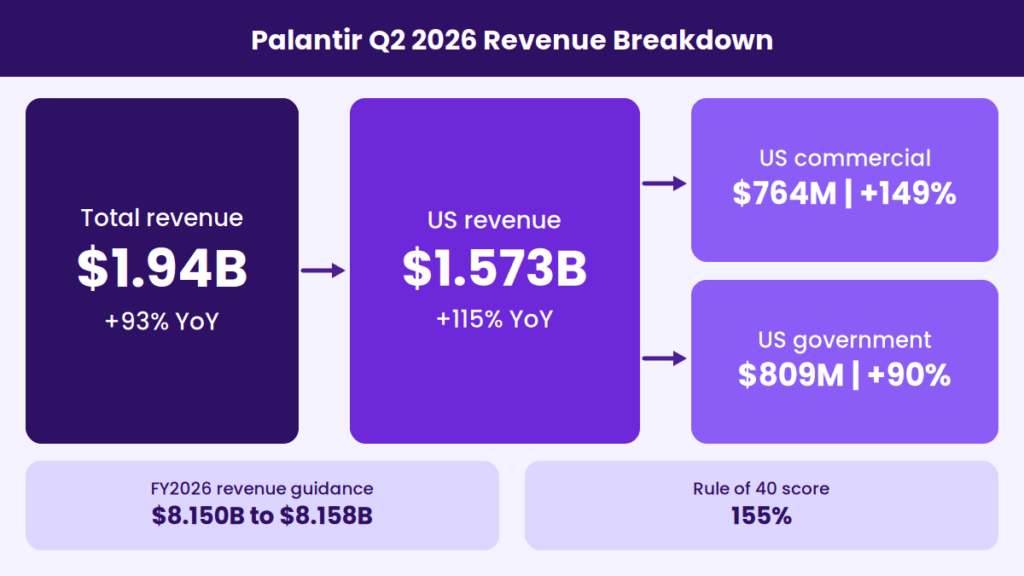
The company reported second-quarter results on 3 August 2026, the strongest in its history.
| Metric (Q2 2026) | Value | Year-on-year change |
| Total revenue | $1.94 billion | +93% |
| US revenue | $1.573 billion | +115% |
| US commercial revenue | $764 million | +149% |
| US government revenue | $809 million | +90% |
| GAAP net income | $1.06 billion | Up from $326.7 million |
| Total contract value closed | $3.37 billion | +49% |
| Rule of 40 score | 155% | Up from 94% |
The adjusted operating margin reached 62%, and gross margin was 84%, according to Investing.com’s earnings summary. Management raised full-year revenue guidance to between $8.150 billion and $8.158 billion, up from $7.65 billion to $7.66 billion a quarter earlier, and it expects a GAAP profit in every quarter of 2026.
The ride has been anything but smooth. Shares set an all-time closing high of $207.18 on 3 November 2025, then slid through much of 2026 on fears that the AI software trade was running out of steam. By the time Q2 results landed, the stock was down 29% for the year.
The results changed the mood. Shares rallied through August, and on 24 September 2026 they traded close to $192, near the top of a 52-week range of $106.37 to $207.52.
A few more facts matter for new investors:
At a market value of about $461 billion, investors are paying roughly 56 times the company’s own 2026 revenue forecast. That figure comes from $461 billion divided by $8.154 billion, the midpoint of guidance. Most established software companies trade at a small fraction of that multiple.
Bulls argue the premium is earned. Growth is accelerating, margins are rising and contracts already signed point to more revenue ahead. UBS raised its price target to $250 in mid-September.
Bears argue the price assumes near-perfect execution for years. Research firm Morningstar notes the stock trades at a premium to its estimate of fair value, and even a modest slowdown could hurt.
The spread of opinion is wide. The average 12-month analyst target is near $197, but individual targets range from $80 to $255.
| Bull case | Bear case |
| Growth has accelerated for five straight quarters | Valuation leaves little room for a miss |
| Operating margins above 60% on an adjusted basis | Most revenue comes from one country |
| Large, multi-year government contracts | Government budgets can shift with politics |
| Existing customers keep spending more | Only works with Western-aligned clients |
READ MORE: To see how analysts model these factors over the coming years, read our Palantir (PLTR) stock price prediction for 2026 to 2030.
The next big event is the Q3 2026 earnings report. The company usually confirms the date a few weeks ahead. Management has guided Q3 revenue to between $2.160 billion and $2.164 billion.
Two things will decide the reaction: whether revenue clears that range, and whether the full-year forecast goes up again. The company has raised guidance at each recent report, so the market now expects it.
The shares are listed only in the US, so how should Indian investors access them? There are three main options.
| Route | What you hold | Start from | Tax on gains |
| Tokenized spot | PLTRB token | ₹100 | Flat 30% plus 1% TDS |
| LRS broker | The actual share | Depends on broker | 12.5% after 24 months, slab rate before |
| GIFT City | Depository receipt | A fraction of a share | Generally foreign equity rules |
Our step-by-step guide to buying Palantir stock in India walks through the process.
Our comparison of tokenized spot, LRS brokers and GIFT City helps you pick one.
And if backing and custody worry you, read whether Palantir tokenized stock is safe.
You don’t need paid tools to follow this stock closely. The primary sources are free:
Read the guidance section first. For a stock priced on future growth, what management expects next matters more than what already happened.
It can be, if you go in with clear expectations. The business is growing faster than almost any large software company and is solidly profitable. The stock, though, fell nearly half from its peak to its low within the past 12 months.
A sensible approach for a first-time investor is to keep the position small relative to your overall portfolio, invest in instalments rather than all at once, and decide your holding period before you buy, since tax treatment depends on it.
The company trades on the Nasdaq as PLTR. On Mudrex, the tokenized version is listed as PLTRB.
Software platforms, mainly Gotham, Foundry, AIP and Apollo, that connect an organisation’s data and let teams, and AI models, make decisions on it.
No. The company reinvests its cash into the business and does not currently pay a dividend.
Yes. It reported GAAP net income of $1.06 billion in Q2 2026 and expects a GAAP profit in every quarter of the year.
Yes. Residents can buy US shares under LRS within the USD 250,000 annual limit, or buy tokenized exposure in rupees on platforms such as Mudrex.
PLTR is the theNasdaq listed share. PLTRB is a bStocks token issued by BTECH Holdings, a Binance group affiliate, and backed 1:1 by a share held with a regulated custodian. It tracks the price but does not give you direct ownership or voting rights.
For actual shares bought through LRS, gains on holdings over 24 months are taxed at 12.5%, and shorter holdings at your slab rate. Tokenized stocks are taxed as virtual digital assets at a flat 30%, with 1% TDS on transfers.
This article is for information only and is not investment, tax or legal advice. Figures are as of 24 September 2026.