

There are three practical ways for an Indian resident to invest in US stocks like Palantir (NASDAQ:PLTR), and they are not interchangeable. One gives you a token that tracks the share. One gives you the share itself. One gives you a depository receipt held in GIFT City.
The right pick depends on how much you are investing, how long you plan to hold and how much paperwork you are willing to handle. This comparison lays out the trade-offs so you can decide quickly. For background on the business, start with our complete guide to Palantir (PLTR) stock.
| Tokenized spot (Mudrex) | LRS broker | GIFT City (NSE IX) | |
| What you hold | PLTRB token, backed 1:1 | The actual share | Depository receipt (UDR) |
| Legal ownership of the share | No | Yes | Beneficial interest via custodian |
| Minimum to start | ₹100 | Depends on broker | A fraction of a share |
| Pay in | INR | USD | USD |
| Funded through | INR deposit | LRS remittance | LRS remittance |
| TCS above ₹10 lakh a year | Not applicable | 20% on the excess | 20% on the excess |
| Tax on gains | Flat 30% plus 1% TDS | 12.5% after 24 months, slab rate before | Treated as foreign equity (confirm with a CA) |
| PLTR available? | Yes, as PLTRB | Yes | Check the current NSE IX list |
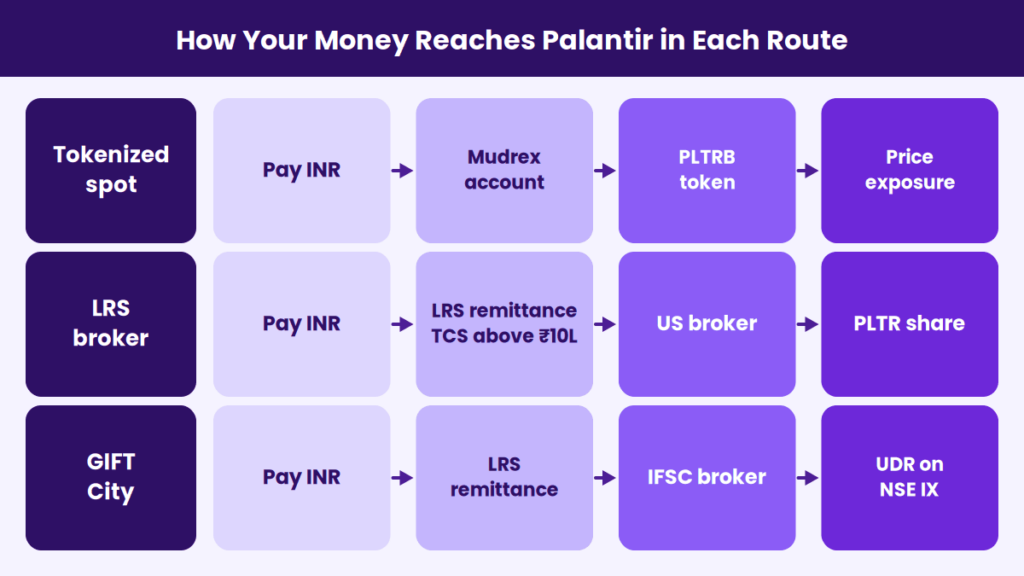
You deposit rupees, buy PLTRB and hold it in your Mudrex account. The token is issued by BTECH Holdings Ltd. and is backed by a real share held with a regulated US broker-custodian.
Where it wins
Where it falls short
You open an account with a broker, remit dollars through your bank under the RBI’s Liberalised Remittance Scheme and buy the share on the Nasdaq.
Where it wins
Where it falls short
Example: If you remit ₹15 lakh in one financial year, TCS applies to ₹5 lakh (₹15 lakh minus ₹10 lakh). At 20%, that is ₹1 lakh collected upfront.
GIFT City is treated as offshore under FEMA, so you still remit under LRS. You open a trading and demat account with an IFSC broker and trade NSE IFSC Receipts, which are unsponsored depository receipts on US shares.
HDFC Bank’s IFSC Banking Unit acts as custodian, with Deutsche Bank in New York holding the underlying shares. Trades settle on a T+3 basis, and there is no STT or stamp duty.
That said, GIFT City isn’t free of costs. Bank forex conversion on the LRS leg, wire fees and the IFSC broker’s own charges still apply, so the savings on STT and stamp duty rarely cancel out the full cost of moving money.
The catch: the receipt list covers roughly 50 large US companies. Confirm PLTR is available before you open an account. India INX’s Global Access platform offers a wider universe through partner brokers if it isn’t.
When you can trade matters if you react to news such as earnings.
For a long-term investor, this rarely decides the route. For someone who wants to act on quarterly results the moment they land, it can.
The holding period does impact decision making. Take a ₹1 lakh gain in each scenario, before surcharge:
| Scenario | LRS broker | Tokenized spot |
| Held more than 24 months | 12.5% of ₹1 lakh = ₹12,500, plus 4% cess = ₹13,000 | 30% of ₹1 lakh = ₹30,000, plus 4% cess = ₹31,200 |
| Held less than 24 months, 30% slab | 30% of ₹1 lakh = ₹30,000, plus 4% cess = ₹31,200 | ₹31,200 |
For short holds by someone in the top slab, the tax cost is similar. For long holds, actual shares come out well ahead.
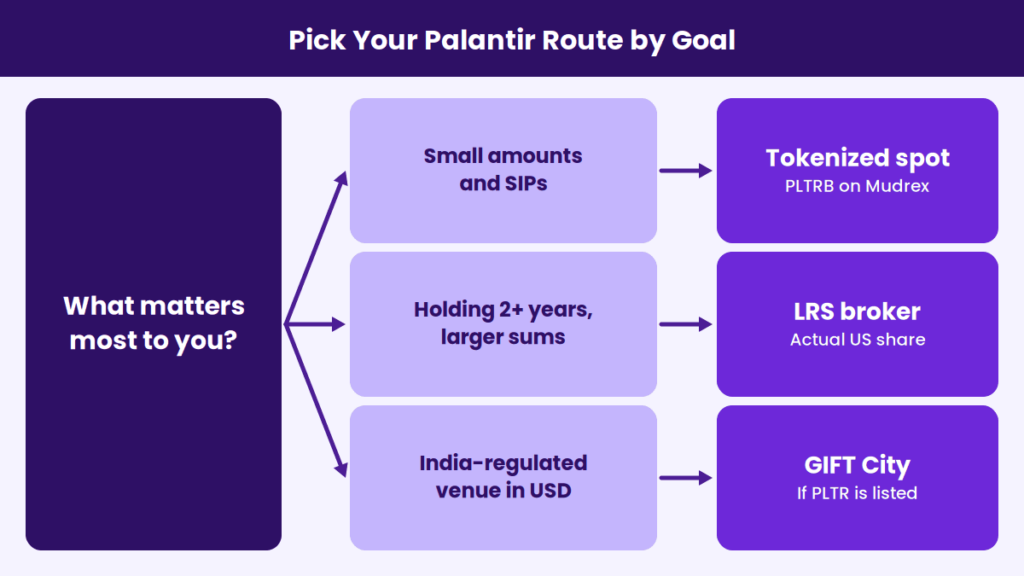
Many investors combine routes: an SIP in PLTRB for regular exposure, and actual shares for a long-term core holding.
READ MORE: For the exact steps on each route, see our guide to buying Palantir stock in India.
To weigh the upside against the risks, read our Palantir (PLTR) stock price prediction for 2026 to 2030.
For small amounts and short holds, tokenized spot usually costs less because there are no forex or wire charges. For large sums held beyond 24 months, actual shares through LRS win on tax.
No. You pay in rupees on an Indian platform, so no foreign remittance takes place.
Not exactly. You hold a depository receipt, and the custodian holds the underlying share on your behalf. Voting rights generally don’t pass through.
Switching usually means selling on one route and buying on the other, with tax due on any gain.
Tokenized spot. Mudrex supports SIPs in PLTRB from ₹100, while LRS routes usually need a fresh remittance to top up.
This article is for information only and is not investment, tax or legal advice. Figures are as of 24 September 2026.