

Palantir tokenized stock (PLTRB on Mudrex) is backed one-for-one by a real Palantir share (NASDAQ:PLTR) held with a regulated custodian, and you can check that backing yourself every single day. That puts it in a different league from synthetic tokens that have nothing behind them.
But “safe” is never just about the backing. A tokenized share adds a chain of companies between you and the stock, an issuer, a custodian, a platform, that owning the share directly does not.
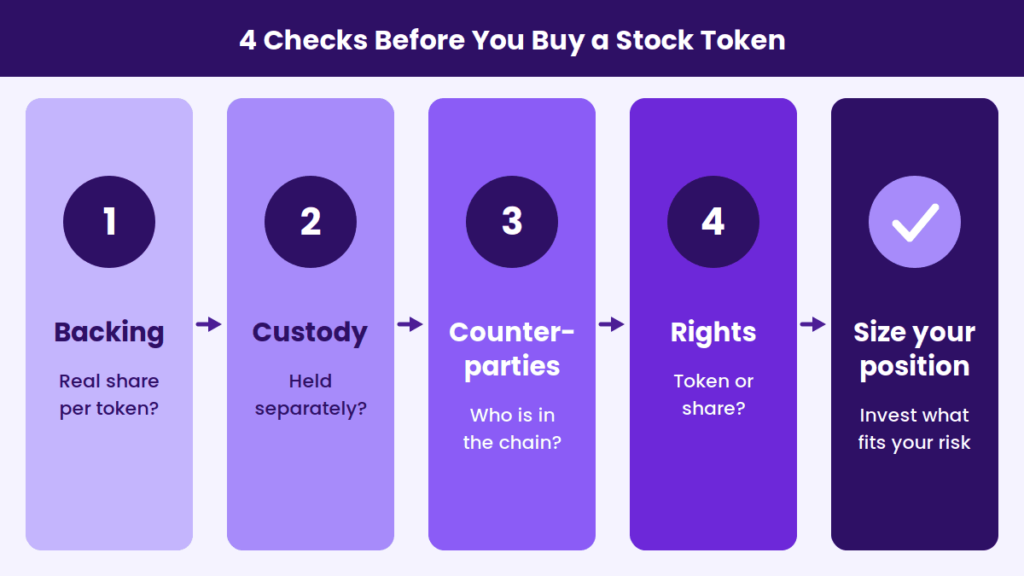
This guide breaks it into four checks so you know exactly what protects you and where the gaps are. If you’re new to the company, our complete guide to Palantir (PLTR) stock covers the basics first.
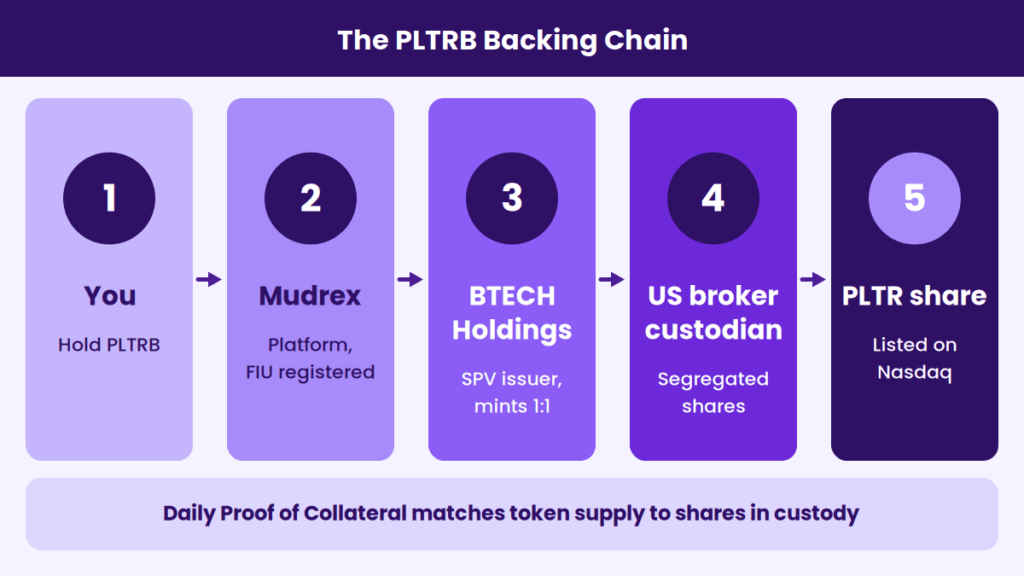
Five parties sit in the chain:
Smart contracts on BNB Smart Chain mint one token for each share held in custody.
This is the first question to ask of any tokenized stock. Some tokens are synthetic, meaning they track a price through a contract with no shares behind them. This is not the case here.
Each tokenized stock on Mudrex is issued against a real share, and the issuer publishes a Proof of Collateral that reconciles custodian holdings against total token supply every day. Anyone can check it. The smart contracts have also passed formal verification by security firms, per the issuer.
What this protects: the risk that more tokens exist than shares.
What it doesn’t: the risk that the attestation process itself fails. The Network Firm, an audit firm, points out that tokenized stock backing is only as good as the reporting behind it.
The underlying shares are bought and held by a special purpose vehicle (SPV). This entity is bankruptcy-remote and keeps the shares at a regulated US broker-custodian, ring-fenced and segregated from other assets.
Bankruptcy-remote means the SPV is set up so that trouble elsewhere in the wider group shouldn’t reach the shares it holds.
Daily reconciliation between the custodian’s records and token supply adds a second layer here, since a shortfall in custody would show up as a mismatch.
What this protects: your exposure if a related company runs into financial trouble.
What it doesn’t: your legal position is still a claim on the issuer through a certificate, not a direct claim on the company’s shares.
Counterparty risk is the chance that someone in the chain fails to do their job. With PLTRB, several parties matter:
| Party | Role | Risk to watch |
| Mudrex | Platform and account holder | Operational or platform risk |
| BTECH Holdings | Token issuer | Issuer risk |
| Broker | Buys the underlying share | Broker and execution risk |
| Custodian | Holds the share | Custody risk |
| Smart contract | Mints and tracks tokens | Technology risk |
Real-world allocation matters too. Earlier in 2026, several platforms had to cancel tokenized SpaceX offerings and refund over $1 billion after their shared intermediary couldn’t secure actual shares, as covered in our comparison of tokenized and traditional US stocks.
That is why check 1 comes first.
The underlying tokenized stock is classified as certificates representing financial instruments under Abu Dhabi Global Market (ADGM) rules, and the issuer’s prospectuses were approved by the ADGM’s Financial Services Regulatory Authority. The certificate gives you an interest in shares held by the issuer. It does not make you a shareholder of the company.
That means:
Mudrex is registered with FIU-IND for anti-money laundering compliance. That covers KYC and reporting, not investor protection of the kind SEBI brokers offer.
It helps to see PLTRB next to the other ways of holding Palantir exposure.
| Structure | Real share behind it? | Your legal position | Can you verify backing? |
| Synthetic token | No | Contract with the token provider | Not applicable |
| PLTRB | Yes, 1:1 | Certificate issued by an SPV | Yes, daily Proof of Collateral |
| GIFT City receipt | Yes, via custodian | Beneficial interest through a depository receipt | Through the custodian and exchange |
| Share through an LRS broker | Yes | Direct owner in a brokerage account | Through your broker statement |
The further down the table you go, the fewer intermediaries sit between you and the Palantir share, and the more paperwork you take on.
Structurally, PLTRB is a backed product with daily, public reconciliation. That puts it well ahead of synthetic tokens. It is not the same as owning the share, though, and it adds issuer, platform and regulatory layers that a direct PLTR holding avoids.
A practical way to use it: treat PLTRB as a convenient, low-ticket way to get price exposure, size it accordingly, and check the Proof of Collateral from time to time. If you want legal ownership for a large, long-term position, actual shares through LRS may suit you better.
READ MORE: Our comparison of tokenized spot, LRS brokers and GIFT City sets the routes side by side.
Our step-by-step guide to buying Palantir stock in India covers the process, and our Palantir (PLTR) stock price prediction for 2026 to 2030 looks at where the price could head.
Yes. Each bStock is issued against a real share held by a regulated US broker-custodian, and the backing is reconciled daily.
Yes. bStocks publishes its Proof of Collateral on its website, comparing custodian holdings against token supply.
No. You get price exposure through a certificate, not direct ownership or voting rights.
There is no dedicated SEBI framework yet. The issuer operates under ADGM rules, Mudrex is FIU-IND registered, and gains are taxed as virtual digital assets.
bStocks use a built-in rebase mechanism that adjusts token balances automatically for splits and dividends, so your holding stays in line with the underlying share.
They carry different risks/challenges. An LRS purchase gives you legal ownership through a broker but blocks a huge chunk of money (USD 250,000). PLTRB adds issuer and platform layers in exchange for rupee access, ₹100 tickets and no remittance.
This article is for information only and is not investment, tax or legal advice. Figures are as of 24 September 2026.