
Finding the best growth stocks in India requires more than spotting companies with rising share prices. It means identifying businesses that can grow revenue, improve profitability, and strengthen their competitive position over time. From India’s defence and technology sectors to consumer businesses, growth opportunities can emerge across industries. However, rapid expansion does not always translate into attractive stock returns, particularly when valuations are high.
This guide explores selected growth stocks for 2026, comparing their financial performance, earnings growth, and valuation metrics while highlighting the risks investors should consider before investing. It also examines how investors in India can access global growth opportunities through tokenized stocks and the key differences between tokenized assets and conventional share ownership.

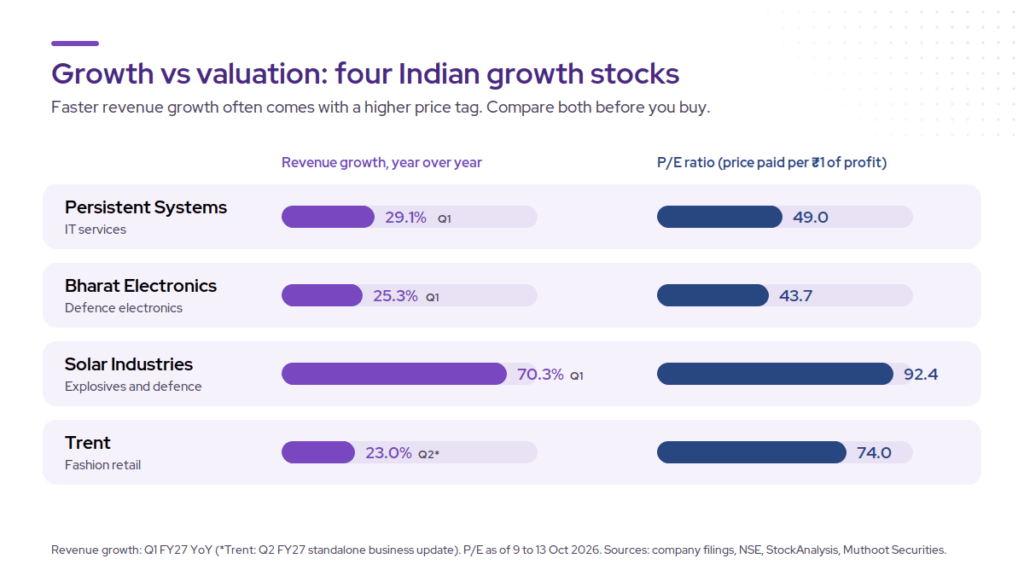
Persistent Systems is an IT services and digital engineering company specialising in cloud computing, data analytics, software engineering, and AI-led solutions. Its exposure to enterprise technology spending makes it a growth stock candidate for investors tracking India’s technology sector.
In Q1 FY2026–27, revenue increased 29.1% year over year to ₹4,303.23 crore, while earnings before interest and tax (EBIT) rose 32.7% to ₹686.88 crore. Profit after tax grew 13.7% to ₹483.04 crore. The company also reported quarterly total contract value of $1.146 billion, indicating strong deal wins, although contract value does not translate directly into immediate revenue.
Valuation and risks: As of October 13, 2026, Persistent Systems had a P/E ratio of approximately 49.0 and a market capitalisation of around ₹89,371 crore, according to StockAnalysis.com. Investors should also consider enterprise technology spending cycles, AI-driven competition, and fluctuations in quarterly profitability.
| Financial metric | Q1 FY27 (ended June 30, 2026) | Year-over-year growth |
|---|---|---|
| Revenue | ₹4,303.23 crore | +29.1% |
| EBIT | ₹686.88 crore | +32.7% |
| Profit after tax (PAT) | ₹483.04 crore | +13.7% |
| EBIT margin | 16.0% | N/A |
| Total contract value (TCV) | US$1.146 billion | Record quarterly TCV |
Bharat Electronics Limited (BEL) is a Navratna public-sector defence electronics company that supplies radar systems, communication equipment, electronic warfare systems, and other technologies to India’s armed forces. Its exposure to domestic defence procurement and indigenisation makes it a company worth examining among India’s growth stock candidates.
In Q1 FY2026–27, revenue from operations rose 25.27% year over year to ₹5,533.06 crore, while profit after tax increased 8.17% to ₹1,048.33 crore. BEL’s order book stood at ₹72,258 crore as of July 1, 2026, providing visibility into its execution pipeline. However, an order book is not guaranteed future profit; delivery schedules, costs, and contract execution matter.
Valuation and risks: On October 9, 2026, BEL traded at a P/E ratio of approximately 43.7, according to the NSE India market snapshot. Its premium valuation, slower profit growth relative to revenue, rising material costs, and working-capital requirements are important considerations. Investors should assess whether order-book conversion and earnings growth can justify the price.
| Financial metric | Q1 FY27 (ended June 30, 2026) | Year-over-year growth |
|---|---|---|
| Revenue from operations | ₹5,533.06 crore | +25.27% |
| Profit before tax (PBT) | ₹1,402.83 crore | +8.81% |
| Profit after tax (PAT) | ₹1,048.33 crore | +8.17% |
| Earnings per share (EPS) | ₹1.43 | From ₹1.33 |
| Order book | ₹72,258 crore | As of July 1, 2026 |
Solar Industries India manufactures industrial explosives, initiating systems, and defence products, serving mining, infrastructure, and defence customers. Its expanding defence business and international operations make it a growth-stock candidate worth examining.
n Q1 FY2026–27, consolidated revenue increased 70.26% year over year to ₹3,668.20 crore, while net profit rose 88.98% to ₹666.37 crore. The results reflect strong business momentum, although one quarter alone cannot establish a sustainable growth rate.
Valuation and risks: On October 13, 2026, Solar Industries traded at a P/E ratio of approximately 92.4, according to StockAnalysis.com. Its growth prospects must be weighed against this premium valuation, raw-material costs, mining-sector demand, project execution, and the timing of defence orders. Investors should also examine operating cash flow and debt before drawing conclusions from headline profit growth.
| Financial metric | Q1 FY27 (ended June 30, 2026) | Year-over-year growth |
|---|---|---|
| Revenue | ₹3,668.20 crore | +70.26% |
| Operating profit (EBIT) | ₹1,015.19 crore | +89.81% |
| Profit before tax (PBT) | ₹911.46 crore | +89.59% |
| Net profit (PAT) | ₹666.37 crore | +88.98% |
Trent Limited, part of the Tata Group, operates fashion and lifestyle retail brands including Westside and Zudio. Its expansion across value fashion and lifestyle retail makes it a useful candidate for investors exploring growth stocks in India, particularly those interested in consumer spending and organised retail.
In its Q2 FY2026–27 business update, Trent reported standalone revenue from operations, excluding GST, of ₹5,788 crore, up 23% year over year. Revenue for H1 FY27 reached ₹11,454 crore, a 21% increase. The company also crossed the 1,000-store milestone for Zudio during the quarter.
Valuation and risks: On October 13, 2026, Trent’s P/E ratio was approximately 74.0, with a market capitalisation of around ₹1.55 lakh crore, according to Muthoot Securities’ market data.
This premium valuation makes sustained store growth, sales productivity and profitability important to the investment case. Competition, discretionary-spending trends and the cost of opening new stores are also key risks. Trent’s Q2 FY27 business update provides revenue and store-expansion figures, but investors should review the company’s full quarterly results when published to assess profit growth and margins.
| Financial metric | Q2 FY27 (ended September 30, 2026) | Year-over-year growth |
|---|---|---|
| Standalone revenue (excluding GST) | ₹5,788 crore | +23% |
| H1 FY27 revenue (excluding GST) | ₹11,454 crore | +21% |
| Zudio store milestone | 1,000th store opened | As of Q2 FY27 |
| Total retail portfolio | 1,342 stores | As of September 30, 2026 |
Tesla is a US-based electric vehicle and clean energy company whose growth prospects are linked to electric vehicle demand, autonomous driving, energy storage, and AI-related initiatives. Its expansion opportunities are balanced by intense competition, execution challenges, and valuation sensitivity to future growth expectations.
| Financial metric | Q2 2026 (ended June 30, 2026) | Year-over-year growth |
|---|---|---|
| Revenue | US$28.24 billion | +25.5% |
| Operating income | US$398 million | -56.9% |
| Net income attributable to common stockholders | US$1.114 billion | -5.0% |
| Diluted earnings per share (EPS) | US$0.32 | -3.0% |
| Vehicle deliveries | 480,126 units | +25.0% |
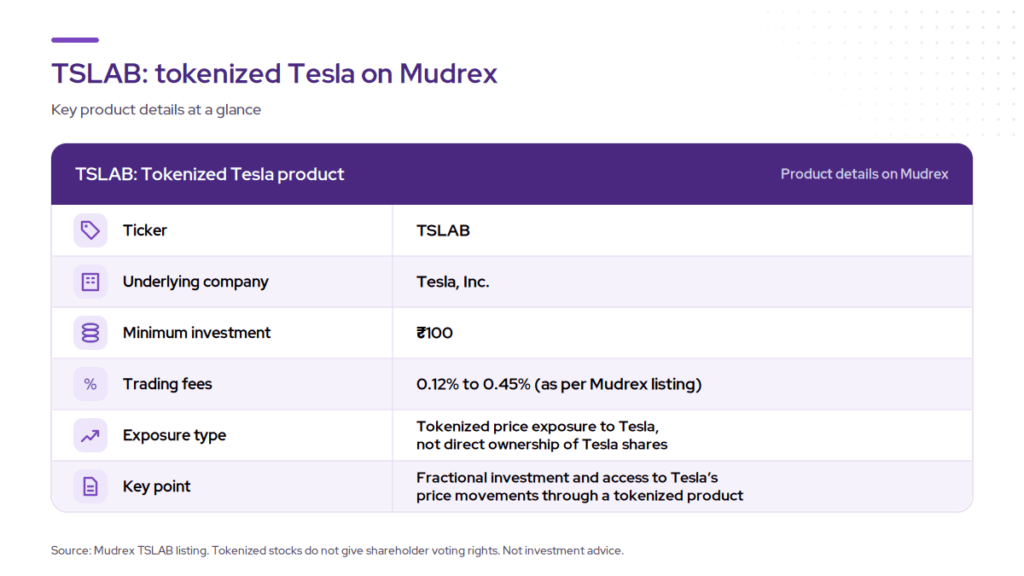
For Indian investors, Tesla can be accessed through traditional international investing routes or through tokenized products. Mudrex offers TSLAB, which tracks Tesla’s price and allows fractional exposure without requiring a separate US brokerage account. However, TSLAB does not provide direct Tesla share ownership or shareholder voting rights. Investors should review the product structure, fees, liquidity, and applicable Indian tax treatment before investing.
Indian investors can access US-listed companies through international brokerage accounts, overseas investments under the Reserve Bank of India’s Liberalised Remittance Scheme (LRS), and other investment products. However, traditional routes may involve currency-conversion charges, remittance paperwork, additional account requirements, and overseas market timings.
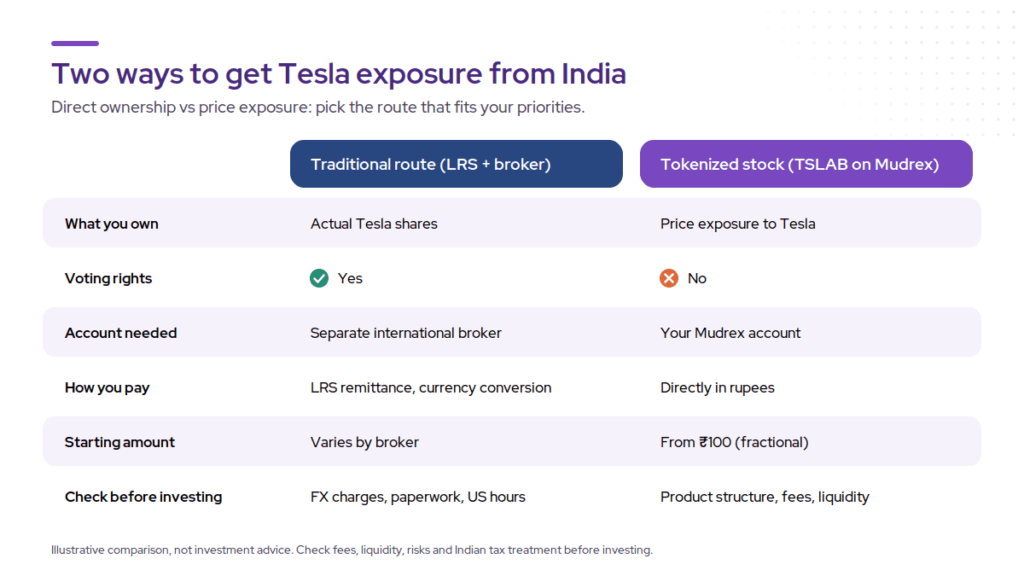
Tokenized stocks offer an alternative for investors seeking exposure to the price movements of selected US companies. On Mudrex, investors can buy TSLAB, a tokenized product tracking Tesla’s share price, directly through the platform. Purchases can be made in rupees, with fractional exposure available from ₹100, according to Mudrex’s TSLAB listing.
However, tokenized stocks are not equivalent to owning conventional shares. TSLAB provides price exposure rather than direct Tesla share ownership or shareholder voting rights. Investors should understand the product’s structure, trading fees, liquidity, risks, and applicable tax treatment before investing.
For investors interested in Tesla’s growth potential without opening a separate international brokerage account, TSLAB is an alternative worth evaluating. The choice ultimately depends on whether the priority is direct share ownership or exposure to price movements.
Crypto markets and tokenized stock products offer different ways to access digital-asset markets and selected traditional financial assets. Crypto provides exposure to digital assets, while tokenized stocks such as TSLAB offer price exposure to selected companies without necessarily providing direct share ownership.
For investors, these products can offer convenient digital access, fractional exposure, and opportunities to diversify beyond conventional markets. However, they also carry risks, including price volatility, liquidity constraints, regulatory uncertainty, and product-specific risks. Crypto futures add another layer of risk through leverage, which can magnify both gains and losses.
Before investing, understand how each product works, assess your risk tolerance, and choose an option that aligns with your financial goals.
The best growth stocks in India are not necessarily those with the fastest recent share-price gains, but companies capable of sustaining revenue growth, improving profitability, and maintaining strong business fundamentals. Persistent Systems, Bharat Electronics, Solar Industries India, and Trent offer exposure to different growth drivers, while each carries distinct valuation and execution risks.
For investors exploring opportunities beyond Indian equities, tokenized products such as Tesla-linked TSLAB on Mudrex offer an alternative route to price exposure. However, they are not substitutes for direct share ownership and come with their own risks.
Ultimately, disciplined research, reasonable valuation expectations, and diversification remain essential when building a long-term growth portfolio.
Yes. Indian investors can explore international investing routes and eligible investment products offering exposure to US companies. Tokenized products such as TSLAB on Mudrex provide Tesla price exposure but do not confer direct ownership of Tesla shares. Investors should review product risks, fees, and applicable regulations before investing
Persistent Systems, Bharat Electronics, Solar Industries India, and Trent are growth-stock candidates across technology, defence, industrial products, and retail. Their growth potential should be evaluated alongside valuations, financial performance, and business risks.
Look for businesses with sustainable revenue growth, improving profitability, competitive advantages, and sound financial management. Consider valuation, management quality, industry outlook, and the risks that could affect future earnings.
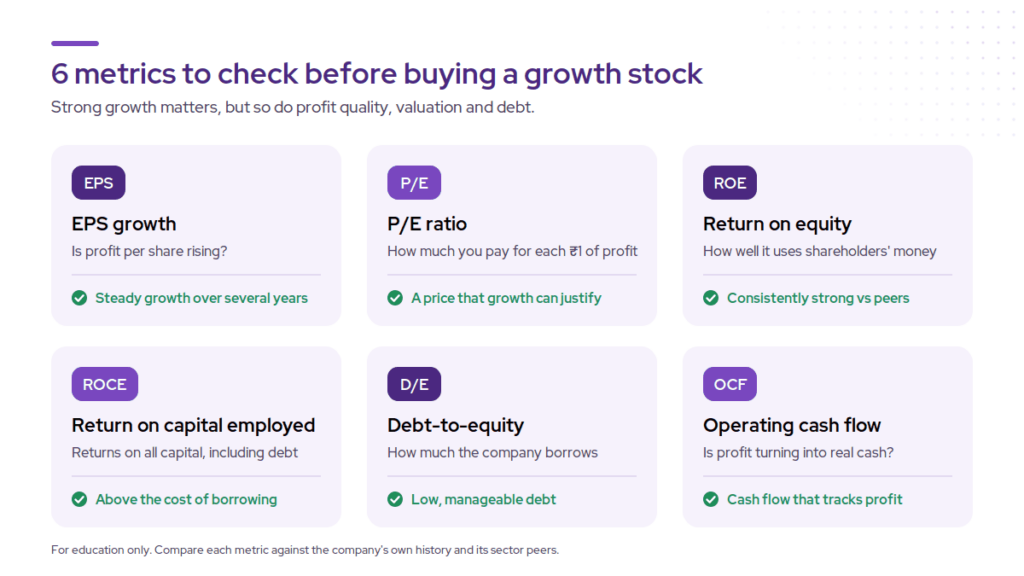
Compare revenue and earnings growth, earnings per share (EPS), price-to-earnings (P/E) ratio, return on equity (ROE), return on capital employed (ROCE), and debt-to-equity. Cash flow and valuation relative to growth are also important.
They can be suitable for long-term investors who can tolerate volatility and have researched the underlying businesses. However, strong business growth does not guarantee positive stock returns, particularly when valuations are high.
Key risks include expensive valuations, slowing earnings, competition, rising costs, execution challenges, and broader market downturns. Investors should also consider sector-specific risks and avoid concentrating their portfolios in a few stocks.
This article is for informational and educational purposes only and should not be considered investment advice or a recommendation to buy or sell any security or digital asset. Stock prices and tokenized products can be volatile, and investors may lose some or all of their invested capital. Tokenized stocks may not confer ownership rights in the underlying shares. Readers should conduct independent research and consult a qualified financial adviser before making investment decisions.