As of February 3, 2025, Bittensor (TAO) is priced at approximately $356 (around ₹30,765). The cryptocurrency market is currently experiencing significant fluctuations, driven by recent geopolitical events and market dynamics. This article provides a comprehensive price prediction for Bittensor from 2025 to 2030, analyzing recent developments, technical indicators, and long-term fundamentals.

Bittensor is a decentralized network that aims to create a new form of artificial intelligence (AI) by incentivizing participants to contribute their computational resources. The project has gained attention for its innovative approach to merging blockchain technology with AI capabilities. Recent news highlights the growing adoption of Real World Assets (RWA) within the Bittensor ecosystem, which could enhance its utility and attract more users.
Meanwhile, the market has been affected by President Trump’s imposition of tariffs on China and Canada, causing a temporary dip in prices across various cryptocurrencies. Despite this, TAO has shown resilience by quickly recovering from the dip and maintaining support along its trendline.

The gradual release of the remaining supply is designed to ensure stability while balancing inflation with increasing demand.
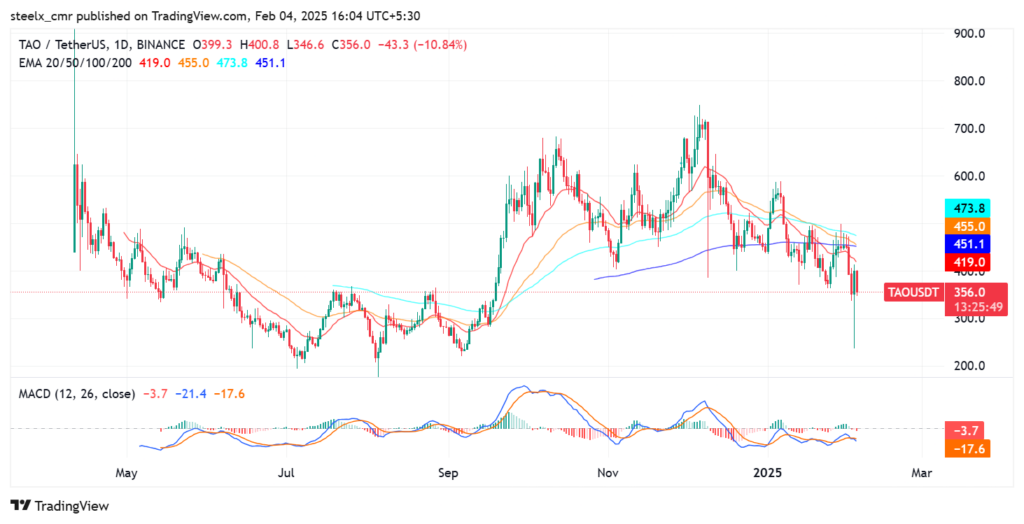
As of February 3, 2025, TAO is trading at $356 USD (approximately ₹30,765). Despite recent market fluctuations, the coin has demonstrated consistent growth, signaling strong market interest.
Bittensor (TAO) has recently achieved significant milestones in both technological advancements and strategic collaborations.
Technological Developments:
• Dynamic TAO Implementation: The introduction of Dynamic TAO represents a pivotal evolution in Bittensor’s tokenomics and governance. This upgrade aims to enhance decentralization by allowing the network to autonomously determine the value of its subnets, reducing reliance on centralized oversight.
• Subnet Expansion: Bittensor has experienced substantial growth in its subnet infrastructure, with over 50 subnets now operational. Notably, eight new subnets were launched in the past month alone, reflecting the network’s rapid expansion and increased developer engagement.
Strategic Partnerships:
• Collaboration with Innerworks: Bittensor has partnered with Innerworks to launch “RedTeam,” a decentralized initiative focused on enhancing cybersecurity. This platform incentivizes white-hat hackers to tackle programmable challenges, thereby strengthening the security framework of decentralized AI applications.
• Launch of Yuma by DCG: Digital Currency Group (DCG), under the leadership of Barry Silbert, announced the creation of Yuma, a decentralized AI company. Yuma aims to develop applications on the Bittensor network, highlighting the platform’s growing influence in the decentralized AI sector.
These developments underscore Bittensor’s commitment to advancing decentralized AI through continuous technological innovation and strategic alliances.
| Aspect | Details | Evaluation |
|---|---|---|
| Founders | Rhett Mankind | Digital artist and NFT veteran |
| Utility | AI-driven decentralized network | Strong community backing |
| Max Supply | 21 million TAO | Limited inflation risk |
| Circulating Supply | Approximately 8.22 million | Balanced supply dynamics |
| Adoption | Growing in multiple sectors | Expanding user base |
| Volume | Moderate, with spikes | Indicates rising interest |
| Roadmap | Focus on scalability and adoption | Clear long-term goals |
| Year | Bearish Case (USD) | Bullish Case (USD) | Remarks |
|---|---|---|---|
| 2025 | $300 | $600 | Increased usage of AI applications |
| 2026 | $400 | $800 | Expansion into new markets |
| 2027 | $700 | $1,200 | Strong institutional interest |
| 2028 | $1,000 | $1,800 | Widespread adoption |
| 2029 | $1,500 | $2,500 | Mass adoption of web3 |
| 2030 | $2,000 | $3,500 | Establishes itself as a leader in AI crypto |
Bittensor (TAO) has garnered attention for its innovative approach to decentralized artificial intelligence, positioning it as a compelling investment opportunity. The network’s recent technological advancements, such as the implementation of Dynamic TAO, aim to enhance decentralization and autonomy, potentially increasing the platform’s value proposition. Additionally, the expansion of its subnet infrastructure indicates a growing developer interest and a robust ecosystem, which are positive indicators for long-term growth.
Strategic partnerships further bolster TAO’s investment appeal. Collaborations with entities like Innerworks to launch the “RedTeam” cybersecurity initiative and the establishment of Yuma by Digital Currency Group to develop applications on the Bittensor network highlight the platform’s expanding influence and real-world applicability. These alliances not only validate Bittensor’s technology but also suggest a promising trajectory for TAO in the coming months and years.