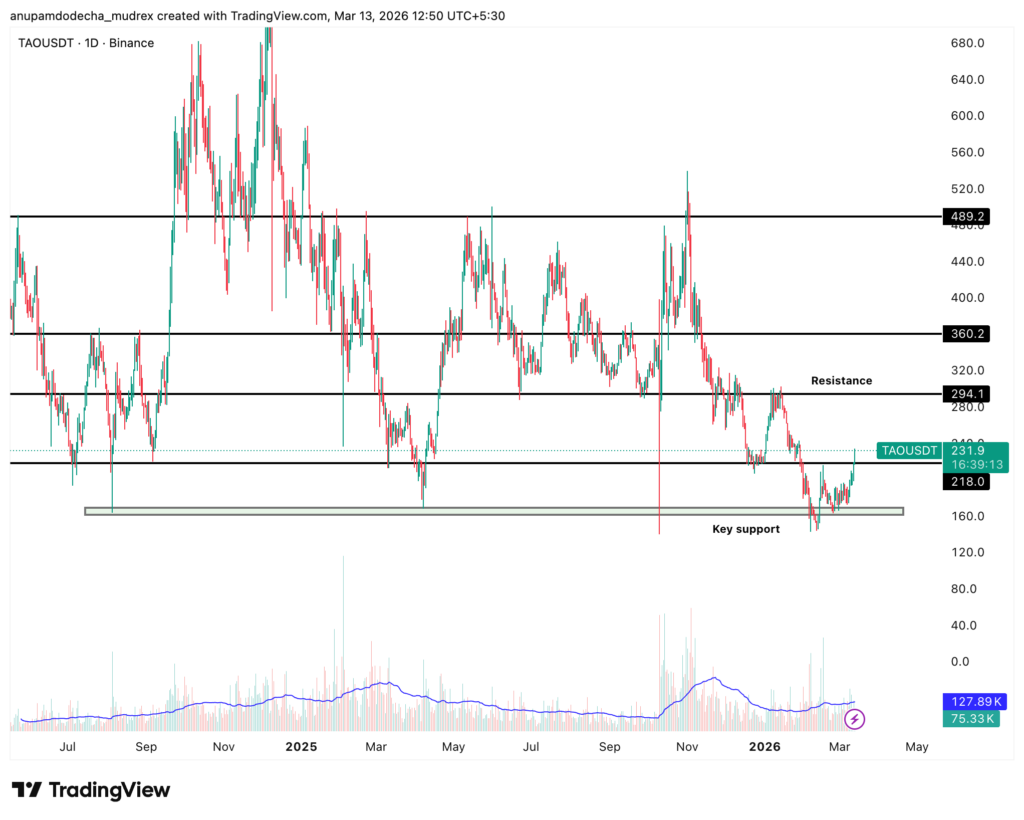
As of March 13, 2026, Bittensor (TAO) is priced at approximately $231 (around ₹21,252). The cryptocurrency market is currently experiencing significant fluctuations, driven by recent geopolitical events and market dynamics. This article provides a comprehensive price prediction for Bittensor from 2026 to 2030, analyzing recent developments, technical indicators, and long-term fundamentals.
Introduction
Bittensor is a decentralized network that aims to create a new form of artificial intelligence (AI) by incentivizing participants to contribute their computational resources. The project has gained attention for its innovative approach to merging blockchain technology with AI capabilities. Recent news highlights the growing adoption of Real World Assets (RWA) within the Bittensor ecosystem, which could enhance its utility and attract more users.
TAO Supply Details
Total Supply: 21 million TAO
Circulating Supply: 10.76 million TAO
Max Supply: 21 million TAO
The gradual release of the remaining supply is designed to ensure stability while balancing inflation with increasing demand.
Current Market Overview and Technical Analysis
Bittensor (TAO) Price Prediction for 2026 to 2030
TAO has bounced from a key support level and is showing bullish momentum as the AI category in crypto continues to gain attention. The overall market also looks relatively stable, which is supporting the current move.
The price has recently broken above the $218 level, which is a positive sign and could now act as support if the trend continues. Holding above this level keeps the bullish structure intact.
Key levels to watch:
Support: $160
S/R Flip: $218
Resistance: $294 and $360
If TAO continues to hold above $218 and the broader market remains supportive, the price could see further upside toward the next resistance levels.
Recent Developments
Bittensor (TAO) maintains strong momentum in the decentralized AI landscape as of mid-March 2026, driven by post-halving supply dynamics, institutional deepening, and explosive subnet ecosystem growth.Technological Developments:
Dynamic TAO (dTAO) Implementation: The Dynamic TAO upgrade, rolled out in early 2025, is fully operational on mainnet. It has transformed subnet economics by introducing subnet-specific alpha tokens, direct investibility, validator liquidity pools, and market-driven emissions that reward top-performing subnets. This has boosted decentralization, with subnet token market caps reaching record highs (27% of TAO’s total market cap per recent Yuma reports), enhancing efficiency and aligning incentives more closely with real AI utility.
Subnet Expansion: The network has scaled dramatically, now hosting over 120 active subnets (with ongoing efforts to reach 128–256 in the near term). Recent highlights include innovative subnets like Ridges (advanced code generation akin to Claude), Score (raw video computer vision processing), Targon (confidential H200 GPU compute at competitive rates like $2/hour), BEAM (SN105, recently launched), Chutes (SN64 AI search tool), and Almanac (SN41, bridging decentralized AI with live prediction markets like Polymarket). This growth fuels new AI commodity markets in NLP, vision, cybersecurity, agents, and more, reflecting heightened developer activity and adoption.
Strategic Partnerships and Institutional Momentum:
Collaboration with Innerworks on RedTeam: The RedTeam subnet (SN61), launched in partnership with Innerworks, remains a key player in decentralized cybersecurity. It continues to incentivize white-hat hackers and miners via competitive programming challenges focused on bot detection, threat intelligence, and protocol security. Recent updates (as of March 2026) include version 4.3.0 releases, expanded validator frameworks (e.g., botasaurus & pydoll), and active integrations like protecting platforms such as 1inch against synthetic attacks and fraud—driving real-world security R&D for decentralized AI.
Yuma by DCG: Digital Currency Group (DCG) subsidiary Yuma has solidified its role as a major accelerator for Bittensor. Recent milestones include the March 2026 launch of the Yuma Composite Index (YCX), a market-cap-weighted benchmark for the subnet economy; expanded Yuma Asset Management offerings for institutional/subnet token strategies; investments in ecosystem infrastructure (e.g., backing General Tensor’s $5M oversubscribed raise alongside Good Morning Holdings); and the second “State of Bittensor” report highlighting subnet valuation records and ecosystem progress. Leadership additions (e.g., Greg and Jeff Schvey in late 2025) continue to fuel adoption and scaling.
Additional Key Milestones:
The first halving in December 2025 reduced daily TAO emissions by 50% (from ~7,200 to ~3,600), creating ongoing supply scarcity and supporting long-term value amid reduced inflation.
Institutional traction accelerates with Grayscale’s Bittensor Trust advancing toward potential spot ETF approval (S-1 filing from late 2025), Europe’s staked TAO ETPs (e.g., STAO on SIX Swiss Exchange), Upbit’s February 2026 listing with KRW/BTC/USDT pairs boosting accessibility, and corporate accumulations (e.g., xTAO and TAO Synergies holdings).
Governance upgrades are in progress, transitioning toward Nominated Proof of Stake and enabling community voting on protocol changes in H1 2026.
These advancements position Bittensor as a premier decentralized AI infrastructure layer, with rapid ecosystem maturation, innovative tokenomics, and robust institutional support driving its sector leadership into the rest of 2026.
TAO Fundamentals for Long-Term Growth
Aspect
Details
Evaluation
Founders
Rhett Mankind
Digital artist and NFT veteran
Utility
AI-driven decentralized network
Strong community backing
Max Supply
21 million TAO
Limited inflation risk
Circulating Supply
Approximately 8.22 million
Balanced supply dynamics
Adoption
Growing in multiple sectors
Expanding user base
Volume
Moderate, with spikes
Indicates rising interest
Roadmap
Focus on scalability and adoption
Clear long-term goals
TAO Price Targets from 2026 to 2030
Year
Bearish Case (USD)
Bullish Case (USD)
Remarks
2026
$160
$300
Expansion into new markets
2027
$220
$360
Strong institutional interest
2028
$500
$1000
Widespread adoption
2029
$800
$2000
Mass adoption of Web3
2030
$1800
$3,500
Establishes itself as a leader in AI crypto
Year-by-Year Breakdown
2026: The rise in AI-driven applications could push TAO’s price between $160–$300, as the ecosystem continues expanding and adoption gradually increases.
2027: With stronger institutional interest and growing participation in AI infrastructure networks, TAO could trade between $220–$360.
2028: Wider adoption of decentralized AI platforms may drive TAO into the $500–$1,000 range as the network gains more developers and use cases.
2029: Increased demand for AI compute and broader Web3 integration could lift TAO between $800–$2,000 if the ecosystem continues scaling.
2030: With full ecosystem maturity and enterprise-level adoption, TAO may reach $1,800–$3,500, potentially establishing itself as a leading AI-focused crypto network.
Conclusion
Bittensor is emerging as a unique project combining artificial intelligence with decentralized blockchain infrastructure. With developments like Dynamic TAO, growing subnet expansion, and increasing developer activity, the ecosystem continues to evolve and strengthen its long-term potential.
Support from industry players such as Digital Currency Group and collaborations like the RedTeam cybersecurity initiative highlight growing real-world interest in the network. While future prices will depend on market conditions and adoption, continued innovation and ecosystem growth could play a key role in shaping TAO’s long-term outlook.
Anupam has over 3 years of experience in the crypto industry, having worked with top indian crypto exchanges. He writes about Bitcoin, altcoins, AI, and emerging tech, helping readers understand what’s driving markets and where the digital asset ecosystem is headed.