Circle stock vs tokenized stock looks like a simple price-tracking question on the surface, both move with the same underlying company, so what’s actually different? The honest answer is: quite a lot, once you get past the shared ticker symbol and look at what you actually hold, how it’s taxed, and what happens behind the scenes to keep the two prices aligned.
This piece breaks down the real CRCL share and its tokenized counterpart, CRCLB, side by side.
What Is Real Circle (CRCL) Stock?
Real CRCL stock is equity in Circle Internet Group, listed on the New York Stock Exchange since its June 2025 IPO. It trades under standard SEC oversight, with price discovery happening on the NYSE’s own order book during US market hours, the same regulatory and market structure that governs any other US-listed company.
Buying it, whether through a US brokerage account, an LRS-based remittance, or a GIFT City receipt, makes you a shareholder with a direct legal claim on the company, subject to whatever rights come with that specific access route. The share sits in a demat or brokerage account in your name (or your custodian’s, depending on the route), and its price is set entirely by supply and demand for the actual security on a regulated exchange, not by a separate token market tracking it.
What Is Circle Tokenized Stock (Spot)?
Circle tokenized stock, available on Mudrex Spot as CRCLB, is a blockchain-based token designed to track CRCL’s price. The “Spot” naming matters here: it distinguishes this from derivative products like perpetual futures, which also reference a stock’s price but work through entirely different contract structures. CRCLB is a straightforward buy-and-hold position, not a leveraged or expiring contract.
It’s issued through a custodial model: a custodian holds a real share (or a claim on one) as backing, and new tokens are minted against that backing as demand requires. The token you hold represents an entitlement tied to that share, not a direct legal shareholding in Circle Internet Group itself. Because it lives on blockchain rails rather than a traditional exchange’s order book, it can be bought, sold, and settled independently of NYSE trading hours entirely.
Do Circle Stock and Circle Tokenized Stock Track the Same Price?
They’re designed to, and the mechanism that keeps them aligned is worth understanding rather than taking on faith.
Circle Stock vs Tokenized Circle Stock (Spot): Key Differences
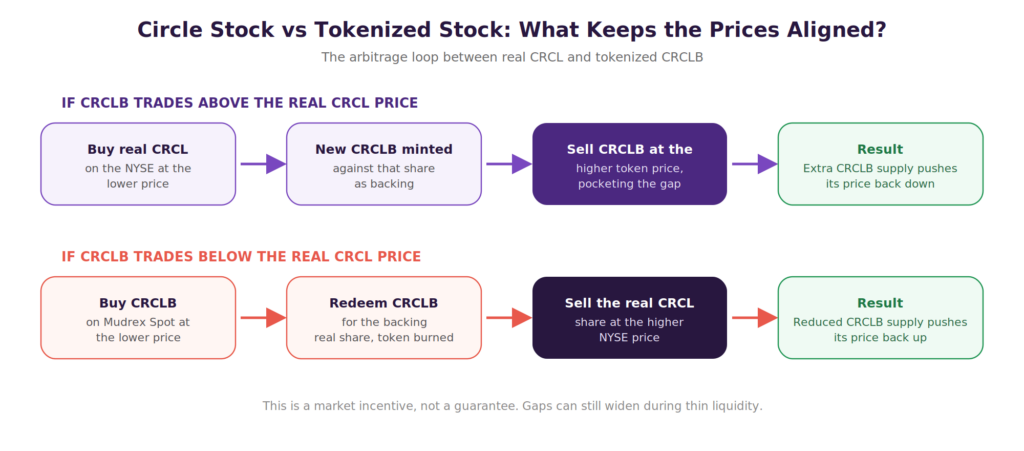
Tokenized stock issuers generally rely on an arbitrage relationship to keep the token’s price close to the real share’s price. If CRCLB traded meaningfully above the real CRCL price, an arbitrageur could buy real shares, have new tokens minted against them, and sell the tokens at the higher price, a trade that pushes the token price back down. The reverse works if the token trades below the real price. This mint-and-redeem mechanism is what’s supposed to keep the two prices in line, not a guarantee, but a market incentive.
In practice, this means tokenized stock prices can still drift from the real share, particularly during periods of thin liquidity or when the underlying US market is closed but the token is still trading. A gap between the two isn’t necessarily a red flag, but a persistent, large gap is worth investigating before trading around it.
What’s the Difference in Ownership Rights Between CRCL and CRCLB?
This is the difference that matters most and surprises people most often. Owning real CRCL makes you a shareholder with whatever voting and dividend rights come attached to the stock. Owning CRCLB generally does not; you have price exposure through a custodial entitlement, not the underlying legal rights of a shareholder.
The reason comes down to who’s actually on the company’s shareholder register. In a custodial tokenization model, the custodian holding the backing share is the legal shareholder of record, not you. Your token represents a claim against the custodian, not a direct relationship with Circle Internet Group. This isn’t unique to Circle; it’s how most tokenized stock products work across the category, and it’s worth understanding as a structural feature of the model rather than something specific to this one stock.
Circle doesn’t currently pay a dividend, so that specific gap isn’t costing CRCLB holders anything today, but the voting-rights gap exists regardless. We cover dividends and voting rights on tokenized Circle stock in full detail separately, including what would change if Circle ever started paying one.
How Do Trading Hours and Settlement Differ?
Real CRCL trades during NYSE hours and settles on the standard US equity T+1 cycle. CRCLB, trading on a crypto platform, is generally available 24/7 and settles in minutes rather than days, since there’s no exchange clearing cycle involved. This is possible because a blockchain network doesn’t have “opening hours” the way a stock exchange does; settlement depends on the network confirming a transaction, not on a market operator’s trading calendar.
This has real practical implications for active traders specifically. If stablecoin-related news breaks over a weekend, when the real CRCL market is closed but crypto markets aren’t, CRCLB holders can react immediately, while direct CRCL holders have to wait for Monday’s open. That timing gap cuts both ways, of course; it also means you can be reacting to a price move the underlying market hasn’t even confirmed yet. We go deeper on 24/7 trading access for Circle stock in a dedicated piece.
How Does Taxation Differ Between CRCL and CRCLB in India?
This is where the two routes diverge most sharply for an Indian investor, and it’s worth seeing side by side with the same numbers run both ways.
Say you invest ₹1,00,000 and later sell for ₹1,30,000, a ₹30,000 gain, held for 18 months.
Via LRS (real CRCL, taxed as unlisted equity): Since the holding period is under 24 months, this is a short-term gain, taxed at your income slab rate. At a 30% slab rate, that’s ₹9,000 in tax, the same headline rate as the VDA route in this example, but only because this particular holding period happens to fall in the highest slab; a lower-income investor would pay less. Hold past 24 months instead, and the same gain would qualify for the 12.5% long-term rate, just ₹3,750.
Via tokenized CRCLB (taxed as a virtual digital asset): Regardless of holding period, the flat 30% VDA rate applies: ₹9,000 in tax, plus 1% TDS (₹1,300) deducted at transfer and adjusted against your final liability. Holding for 5 years instead of 5 months changes nothing about the rate.
Real CRCL (via LRS)
Tokenized CRCLB
Tax basis
Capital gains (unlisted equity rules)
Flat 30% VDA tax
Short-term rate (<24 months)
Income slab rate
30% flat
Long-term rate (>24 months)
12.5%
30% flat, no long-term benefit
Loss offset
Allowed against other capital gains
Not allowed
TDS
Not applicable
1% on transfers
The practical takeaway: the tax gap between the two routes widens the longer you plan to hold, since only the LRS route rewards patience with a lower rate.
Which One Should You Choose?
Neither route is universally better; they suit different intentions. If you’re planning to hold for years and want the long-term capital gains benefit plus full shareholder rights, the LRS or GIFT City route is built for that. If you’re trading shorter-term price moves and value speed, low minimums, and 24/7 access more than long-term tax efficiency or shareholder rights, tokenized CRCLB fits that use case better. Your own time horizon and goals should drive the decision, not which route happens to be more convenient to set up.
They track the same company, Circle Internet Group, but CRCLB is a tokenized entitlement issued by a crypto platform, not the real share itself.
Can the price of tokenized Circle stock differ from the real stock?
Yes, though an arbitrage mechanism generally keeps them close. Gaps can widen during thin liquidity or when the token trades while the real market is closed.
Which is cheaper after tax, CRCL or CRCLB, in India?
It depends on your holding period. CRCLB’s flat 30% VDA tax doesn’t reward longer holding periods, while real CRCL bought via LRS qualifies for a lower 12.5% long-term rate after 24 months.
Risk Disclaimer
Trading tokenized stocks and other virtual digital assets carries risk of capital loss. Tokenized stocks currently sit outside SEBI’s regulatory framework in India. The tax example above uses illustrative figures, not real return projections, and is not tax advice; consult a qualified advisor for your specific situation.
Siri is a writer venturing into the exciting realms of blockchain technology, cryptocurrency, and decentralized finance (DeFi), eager to explore the transformative potential of these innovations. She brings a unique perspective that bridges traditional industries and cutting-edge technology, often infused with a touch of humor through memes. She has a rich background in real estate and interior design, having previously contributed to NoBroker, where she crafted blogs and assets on these topics.