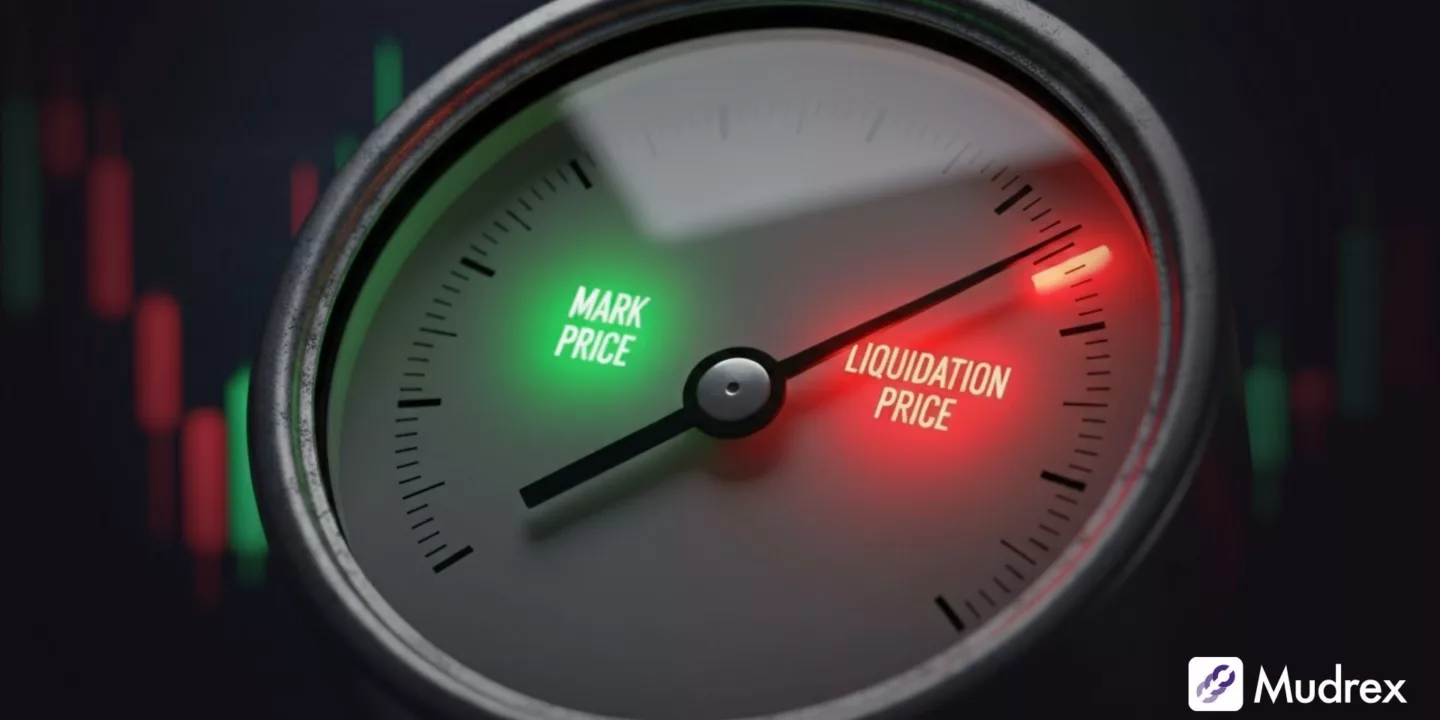
When a Crypto Futures Mark Price: If Position Is Liquidated, What Price Is It Based On?
Crypto futures let you bet on price moves without owning coins. But if things go wrong, your position might get liquidated, i.e. closed by force.
Ever wonder what price decides this? Here’s where Mark Price comes in. Let’s break down Crypto futures Mark Price and liquidation simply, step by step, to help you trade smarter.
Understanding Liquidation in Crypto Futures
Liquidation is when the exchange closes your position by force because your deposit (margin) is too low to cover losses. It’s like a bank taking your house if you can’t pay the loan. This stops you from owing more than you have.
In crypto, this happens a lot because prices swing wildly.
If losses grow too big, the exchange might have to pay from its own pocket. So, exchanges set rules: you need an initial margin to open a position and a maintenance margin to keep it open.
When your account falls below the maintenance margin, liquidation starts.
For example, if maintenance is 1% of your position, and losses eat into that, it’s over.
Margin is your skin in the game: real money you put up. Leverage multiplies it. High leverage means small price moves can wipe you out.
Say you long Bitcoin at $50,000 with 20x leverage and $1,000 margin. A 5% drop to $47,500 could liquidate you, as your margin vanishes. Low leverage gives more room for price swings.
The Key Prices: Mark Price vs. Last Price
Now, the big question: what price decides if you’re liquidated? It’s the mark price, not the last price. Why? To keep things fair and stop tricks.
What Is Mark Price?
Mark price is like a fair guess of the coin’s true value.
It’s not from one trade but an average from many big exchanges. For Bitcoin, it might mix prices from Binance, Coinbase, and others.
Exchanges calculate it with formulas, adding things like funding rates (fees between long and short traders). This makes it steady, even if one exchange has a weird spike.
Mark price is used for unrealized profits/losses (paper gains) and to check margins. It’s the boss for liquidation triggers.
What is the Last Price?
Last price is the price of the most recent trade on that exchange. It’s real-time but can jump around due to low trades or big orders.
It’s used for realized profits:when you close a position.
But for liquidation, it’s too shaky. Imagine a fake low trade forcing you out: that’s unfair.
Why Exchanges Use Mark Price for Liquidation
Mark price stops manipulation. If someone dumps coins to crash the last price, your position might liquidate wrongly. Mark price ignores that, looking at the big picture.
In volatile times, like a flash crash, mark price stays calm. This protects you from quick, fake drops. Binance and Bybit use mark price for this reason. It’s all about trust and fair play.
Liquidation price is the point where mark price hits a level that drops your margin below maintenance. It’s not fixed; it changes with your leverage, entry price, and account balance.
Just saw your comment, Just so you know, futures liquidations are based on the mark price, which can be a bit different from the last traded price you see on the chart. That’s probably why your position closed before hitting your set level. Hope that helps!
Bankruptcy Price vs. Liquidation Price: What’s the Difference?
Liquidation in crypto futures is a protocol to prevent bankruptcy. And so as a retail trader chances are less that you can go bankrupt within the trading environment.
Bankruptcy price is worse: where your position hits zero value, and you might owe money. Liquidation happens before that, at a buffer point.
For long positions: Bankruptcy Price = Entry Price / (1 + Maintenance Margin Rate).
Exchanges have insurance funds to cover if liquidation doesn’t fully pay. This keeps the system safe.
Tips to Avoid Getting Liquidated
No one wants forced closes. Here are ways to stay safe.
Choose Leverage Wisely: Start low, like 3-5x. It gives breathing room for price swings. Pros use high leverage only for short trades.
Set Stop-Loss Orders: These auto-close positions at a set price, before liquidation. If you long at $50,000, set stop at $48,000 to limit losses.
Keep an Eye on Margins and Markets: Check your margin ratio often. Use apps for alerts. Watch news—big events like Fed rates can swing crypto.
Diversify and Use Risk Tools: Don’t put all in one position. Some exchanges offer “liquidation buffers” or auto-add margin. Learn from past trades.
Liquidation in crypto futures is based on mark price. A fair, average value to prevent tricks and unfair closes. By knowing mark vs. last price, calculating your risks, and using smart tips, you can avoid pitfalls.
Trading crypto futures is exciting but demands caution and knowledge.
This is where Mudrex comes in. Mudrex gives you the easiest and simplest interface and mobile phone apps, stacked with tools to track margins, set alerts, and learn with clear guides.
Start small, practice with demos, and build your skills for steady gains. Ready to trade smarter? Explore Mudrex’s resources to stay ahead in the crypto game.
FAQs
1. What is the difference between the mark price and the last price in crypto futures?
Mark price is a fair average of a coin’s value, taken from multiple big exchanges to avoid manipulation. Last price is just the latest trade on one exchange, which can be shaky. Mark price decides liquidation to keep things fair.
2. Why does my crypto futures position get liquidated?
Your position gets liquidated when your margin (deposit) falls below the maintenance level due to price moves against you. It’s like running out of money to cover losses. Using high leverage makes this happen faster.
3. How can I calculate my liquidation price?
Liquidation price depends on your entry price, leverage, margin, and maintenance rate. Use this formula: Liquidation Price = Entry Price – (Margin / (Position Size * Maintenance Rate)). Most exchanges have calculators to help.
4. Can I avoid liquidation in crypto futures trading?
Yes! Use low leverage (3-5x), set stop-loss orders to close trades early, and watch your margin. Diversify your trades and stay updated on market news.
5. What happens after my position is liquidated?
After liquidation, your position closes, and you lose your margin. You can start again with a new trade, but use less leverage and learn from mistakes. It’s not the end, but just a lesson in your crypto trading learning journey.
Krishnan is a Bangalore-based crypto writer dedicated to simplifying complex crypto concepts. He covers blockchain, DeFi, and NFTs, with a focus on real-world asset tokenization and digital trust. Previously he has written on Real Estate related assets for NoBroker. Krishnan holds a B.Tech degree from the College of Engineering Trivandrum.