

Bitcoin entered the second half of 2026 under significant pressure. As of July 24, it traded near $65,000, roughly 48% below its October 2025 peak of about $126,000. The Crypto Fear & Greed Index stood at 28, indicating “Fear,” compared with an “Extreme Fear” reading of 17 one month earlier.
Institutional demand has weakened at points, but the picture is not a straight institutional exit. US spot Bitcoin ETF flows had recorded approximately $51.7 billion in cumulative net inflows through July 23, while recent daily flows remained mixed, according to Farside Investors.

If you are wondering whether the worst is over, no indicator can answer that conclusively. This article examines what drove the first-half decline and five developments that could influence the market before 2026 ends.
The decline reflected weaker marginal demand, restrictive monetary conditions and the unwinding of leveraged positions.
Bitcoin ETF flows became less consistent during the sell-off, although cumulative US spot ETF inflows remained approximately $51.7 billion through July 23. The distinction matters: slower or negative short-term flows do not mean institutions have withdrawn all the capital accumulated since launch.
Federal Reserve policy also remained restrictive. At its June meeting, the FOMC maintained the federal funds target range at 3.50-3.75%. That range had been in place since December 2025; not for more than a year. The next scheduled meetings are July 28-29, September 15-16, October 27-28 and December 8-9. See the Federal Reserve’s June statement and official meeting calendar.
The Bitcoin halving cycle does not provide a reliable late-2026 bottom date. Twelve to 18 months after the April 2024 halving falls between April and October 2025, broadly around the period in which Bitcoin reached its latest peak. Any Q4 2026 bottom scenario therefore needs a separate model and should not be presented as simple halving arithmetic.
Leverage, dollar strength, bond yields and reduced appetite for speculative assets also contributed to the decline. These factors explain market pressure, but none can establish how far prices will fall or when they will recover.
While prices declined, parts of the industry continued to become more specialized. Asset managers increasingly focus on product issuance, custodians on asset safekeeping, infrastructure providers on settlement, and exchanges on distribution and liquidity.
Definition: Tokenization
Tokenization is the process of representing ownership or contractual rights in an asset (such as a bond, fund or commodity) using a blockchain-based token.
Asset managers are focusing on issuing tokenized products, banks and custodians are handling collateral safekeeping, and exchanges are focusing on distribution and liquidity. Stablecoins are following a similar path, splitting into issuance, reserve management, and distribution roles as regulatory clarity around reserves improves.
Stablecoin and tokenization markets also involve separate issuers, reserve managers, custodians, distributors and settlement providers. This division of roles may indicate greater operational maturity, but it does not guarantee demand for crypto assets or higher token prices.
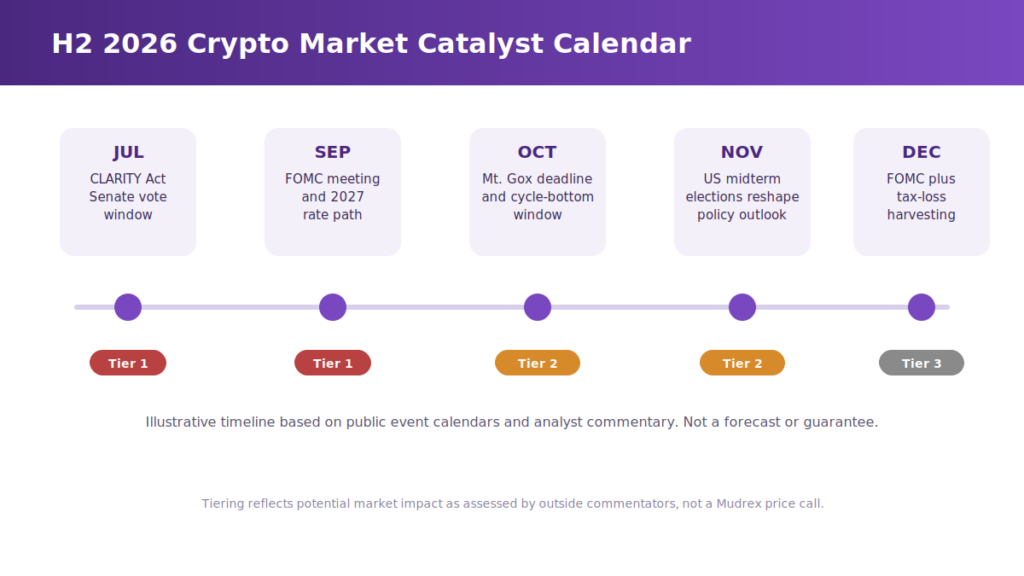
Five developments stand out as the clearest crypto market catalysts left this year. Each carries a different kind of risk, and none of them are guaranteed to play out as expected.
| Period | Development | What to monitor |
|---|---|---|
| July–December | US market-structure legislation | H.R. 3633 passed the House in 2025 but remains referred to the Senate Banking Committee; no July floor vote is guaranteed |
| July–December | FOMC meetings | Changes in rates, economic projections and language on inflation and future policy |
| By October 31 | Mt. Gox repayment deadline | Transfers to creditors and whether distributed Bitcoin is held, moved or sold |
| November 3 | US midterm elections | Possible changes in congressional control and the 2027 legislative environment |
| December | Year-end liquidity and US tax positioning | Lower holiday liquidity, portfolio rebalancing and jurisdiction-specific tax selling |
The CLARITY Act should not be described as having a confirmed July Senate vote. Congress.gov shows that the House bill was referred to the Senate Banking Committee, but no official floor-vote date is listed.
Mt. Gox’s trustee extended the repayment deadline to October 31, 2026. That deadline does not mean all remaining Bitcoin will be released or sold simultaneously. Cite the official Mt. Gox notice.
The US midterm elections are scheduled for November 3, 2026. The winning members generally take office in January 2027, so any regulatory effect may be delayed. See the Congressional Research Service election-date guidance.
Tax-loss harvesting must be framed as a US-market consideration. For Indian investors, Section 115BBH generally does not permit VDA losses to be set off against other income or gains. Cite the Income Tax Department’s VDA guidance and advise readers to consult a tax professional.
A market bottom cannot be confirmed while it is forming. Current data shows depressed valuations and improving behaviour among some holders, but not universal confirmation.
Glassnode’s MVRV Z-Score was approximately 0.315 on July 24. A lower reading can indicate that market value is approaching realized value, but the metric has no fixed level that guarantees a reversal.
Glassnode also reported in June that more than 95% of short-term-holder supply was underwater and that demand remained fragile despite historically discounted valuations. Its conclusion was that the market was moving deeper into capitulation, not that a durable bottom had already been confirmed. See Glassnode’s “Finding a Floor” report.
Some investors use dollar-cost averaging to avoid relying on one entry price. This approach spreads purchases over time, but it does not prevent losses in a prolonged decline.
The first half of 2026 was difficult for crypto, but price weakness alone does not show whether the industry is recovering or deteriorating. ETF demand, monetary conditions, regulation, creditor distributions and market liquidity are sending different signals.
The most useful approach is to follow dated evidence rather than rely on a single cycle model or indicator. Track the Fed’s official decisions, verified fund flows, legislative status and on-chain demand as each development unfolds.
Want to follow these events as they happen? Use the Mudrex app to monitor crypto prices and market indicators, or subscribe to the Mudrex YouTube channel for regular market updates.
No one can confirm whether a sustained recovery will occur in 2026. Regulation, monetary policy, institutional demand, liquidity and leverage can all influence prices, but none provides a guaranteed recovery date.
The decline reflected weaker marginal demand, restrictive interest rates, deleveraging and lower appetite for speculative assets. The exact contribution of each factor changed throughout the period.
Important dates include the FOMC meetings on July 28-29, September 15-16, October 27-28 and December 8-9; the October 31 Mt. Gox repayment deadline; and the November 3 US midterm elections.
No. A low reading can indicate depressed valuation relative to realized value, but Bitcoin can remain undervalued or fall further. Demand, liquidity and holder behaviour should be assessed alongside it.
Crypto assets are highly volatile, and trading them carries a risk of loss, including loss of principal. Where leverage is involved, it can magnify both gains and losses. All figures, price levels, and scenarios in this article are illustrative and drawn from public market data as of mid-2026; they are for informational purposes only and do not constitute financial advice. Please consult a qualified financial advisor before making investment decisions.