

You open a short Bitcoin futures position to protect your spot holdings. Two days later, you are not sure if you protected anything or just placed a new bet with borrowed money. That mix-up is common, and it is expensive.
Hedging vs speculation: They use the exact same tool in crypto futures; long and short positions, often with leverage. The instrument never tells you which one you are doing. Only your intent, your position size, and your exit plan do.

Get this wrong and a “safe” hedge can turn into an open-ended speculative bet, or a speculative trade can bleed money through funding fees you never accounted for. So here’s what you need to know.
Hedging is a defensive move. Speculation is an offensive one. That single distinction explains almost every other difference between them.
Definition: Hedging Taking an offsetting position to reduce, not eliminate, the risk of loss on an asset you already own.
Definition: Speculation Taking on new market risk, with no existing position to protect, purely to try to profit from an expected price move.
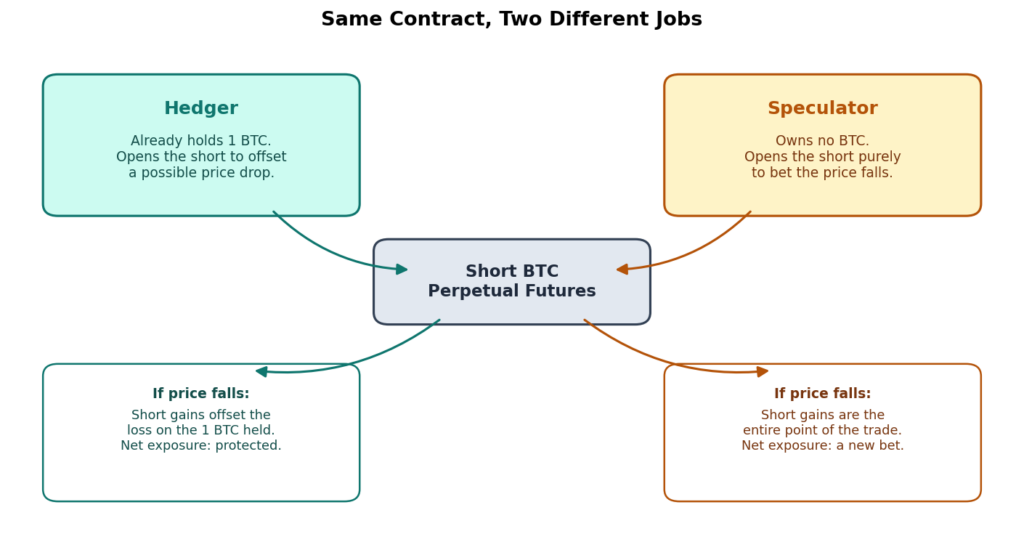
A hedger already owns the asset and is trying to protect its value. A speculator owns nothing yet and is trying to create profit from a view on price. Both might open the exact same short Bitcoin futures position. Their goals for that position are opposites.
| Term | What It Means |
|---|---|
| Long Position | A bet that price will rise. |
| Short Position | A bet that price will fall. |
| Leverage | Borrowed exposure that lets a small deposit control a larger position. |
| Perpetual Futures | A crypto futures contract with no expiry date, common on most exchanges. |
| Funding Rate | A recurring fee exchanged between longs and shorts every 8 hours to keep the contract price near spot. |
| Basis | The gap between the futures price and the spot price. |
| Open Interest | The total number of futures contracts still open across the market. |
| Hedge Ratio | The share of your spot holding that your futures position actually covers. |
| Liquidation Price | The price at which your position is force-closed because margin can no longer cover losses. |
| Margin Ratio | Account equity divided by required margin; a falling ratio signals rising liquidation risk. |
| Portfolio Beta | How much your holdings tend to move relative to a benchmark like Bitcoin. |
| Correlation | How closely two assets move together; low correlation raises basis risk in a hedge. |
| Risk-Reward Ratio | Potential loss on a trade compared with potential gain. |
Crypto futures exchanges do not offer a separate “hedge mode” and “speculate mode.” A short position is a short position. What separates the two is whether you already hold the underlying asset.
If you hold 1 BTC and open a short BTC perpetual futures position of similar size, a price drop that hurts your spot holding helps your futures position by about the same amount. That is hedging. If you hold no BTC and open that same short purely because you expect the price to fall, that is speculation.
This is also why speculation is not automatically reckless and hedging is not automatically safe. A hedger who oversizes their short past their actual holding has become a speculator on the extra amount. A speculator with tight stop-losses and small position sizing can manage risk carefully.
The clearest difference shows up in how risk is capped, or not capped, on each side.
| Factor | Hedging | Speculation |
|---|---|---|
| Goal | Protect an existing position | Profit from a price view |
| Underlying exposure | Already owns the asset | Often owns nothing |
| Risk profile | Capped, known cost (fees, funding) | Open-ended profit or loss |
| Ideal leverage | Low, just enough to size the hedge | Varies with strategy and risk appetite |
| Time horizon | Tied to a specific risk window | Can range from minutes to months |
| What “success” looks like | Losses on the hedge, gains on spot, net near flat | Futures position itself ends in profit |
Notice that hedging is not about winning on the futures trade. A hedge “wins” when it loses a little money on fees while spot losses are avoided. Speculation only wins if the trade itself is profitable, since there is no offsetting position picking up the slack.
Funding rates are periodic payments exchanged between long and short traders in perpetual futures, usually every 8 hours, to keep the contract price close to spot. Both hedgers and speculators pay or receive this fee. It affects them differently because of how long each side typically holds a position.
A speculator often holds a directional trade for hours or days. The funding cost is a small, contained part of the trade’s overall risk. A hedger, by contrast, may need to keep a protective short open for weeks around a slow-moving risk, and funding compounds every single interval it stays open.
For a deeper look at how this fee is calculated and how to manage it, see this breakdown of crypto funding rates.
Numbers make the difference concrete. Here is a worked example using the same position size for both.
Scenario: You hold $12,000 worth of Bitcoin and a volatile event is 3 days away. Funding rate averages 0.03% every 8 hours.
| Trade Type | Position | Outcome If BTC Drops 12% | Outcome If BTC Rises 10% |
|---|---|---|---|
| Hedge (short $12,000 of BTC futures against spot) | Fees + funding: ~$46 total (~0.38% of position) | Spot loses ~$1,440; short gains ~$1,400. Net loss ≈ cost of the hedge (~$46) | Spot gains ~$1,200; short loses ~$1,200. Net gain ≈ minus the hedge cost |
| Speculation (short $12,000 of BTC futures, no spot holding) | Fees + funding: ~$46 total | Gains ~$1,400 on the short, minus ~$46 in costs | Loses ~$1,200 on the short, plus ~$46 in costs |
The chart below shows the hedge scenario over time. The unhedged spot line swings hard with the market. The hedged line stays close to flat while the hedge is open, then rejoins the market once it is closed.
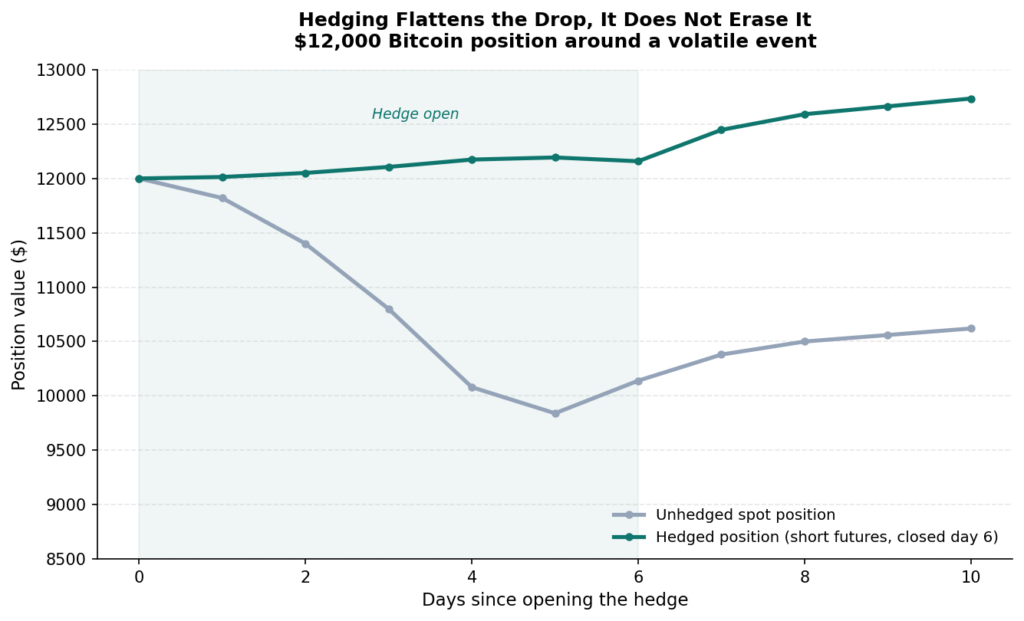
The small gap on the hedged line is the funding and fee cost of running the hedge. That cost is the price of protection, whether or not the crash actually happens.
The hedge ratio is the number that separates the two in practice. It is the size of your futures position compared with the size of the spot holding it is meant to protect.
Cross-asset hedges add another wrinkle. If you hedge one coin using futures on a different, but correlated, asset, check that correlation first. Low correlation raises basis risk, meaning the hedge may not move in step with the position it is supposed to protect.
For a full framework on timing a hedge, including when the cost outweighs the protection, this guide on when to hedge with crypto futures walks through it step by step. If your goal leans toward the speculative side instead, this roundup of crypto futures trading strategies covers approaches from trend following to breakout trading.
Whichever side you are trading, keep an eye on your liquidation price. Leverage brings that price closer to the market on both hedges and speculative trades, and a big move in either direction can force-close a position before it has done its job.
Hedging vs speculation – not different, being for the same tool: a long or short position in crypto futures trading. A hedger already owns the asset and pays a small, capped cost to protect it. A speculator owns nothing yet and takes on open-ended risk in exchange for a shot at profit.
Before your next trade, ask one question: am I protecting something I already hold, or am I creating a brand-new bet? The answer decides your position size, your leverage, and how closely you need to watch funding costs.
Ready to put this into practice? Download the Mudrex app for Android or Apple and trade crypto futures with real-time INR P&L and built-in risk tools, or subscribe to the Mudrex YouTube channel for more beginner-friendly breakdowns.
Hedging takes an offsetting position to protect an asset you already hold. Speculation takes on new risk with no existing position, purely to try to profit from a price move.
Both. The same long or short futures contract can serve either purpose, depending on whether the trader already holds the underlying asset.
Traders hedge to reduce the risk of a price drop on holdings they want to keep, without having to sell and trigger taxes or slippage.
Speculation in crypto means opening a position, often with leverage, based purely on an expected price move, with no existing holding to protect.
Speculation carries open-ended risk since there is no offsetting position. Hedging caps risk to a known cost, though oversizing a hedge can add unintended risk.
Yes. The exact same contract type, such as a short BTC perpetual future, can be a hedge for one trader and a speculative bet for another, based on intent and existing holdings.
Crypto futures trading involves substantial risk of loss, and leverage magnifies both gains and losses. The figures and scenarios in this article are illustrative examples only, not financial advice or a guarantee of any outcome. Consult a qualified financial advisor before trading crypto futures, and never trade with funds you cannot afford to lose.