Every tokenized stock claims to be “backed” by a real share. But that word gets used loosely. If you don’t know what backing actually means on the platform you’re using, you might assume protection that isn’t really there. You usually find that out at the worst time, mid-crisis, when a redemption process turns out to be unclear.
Is Circle tokenized stock safe? Here’s a straight answer: how CRCLB is backed, what custody really means, and where the real gaps are, so you know what you’re holding before you commit money, not after.
How Is Tokenized Circle (CRCL) Stock Backed?
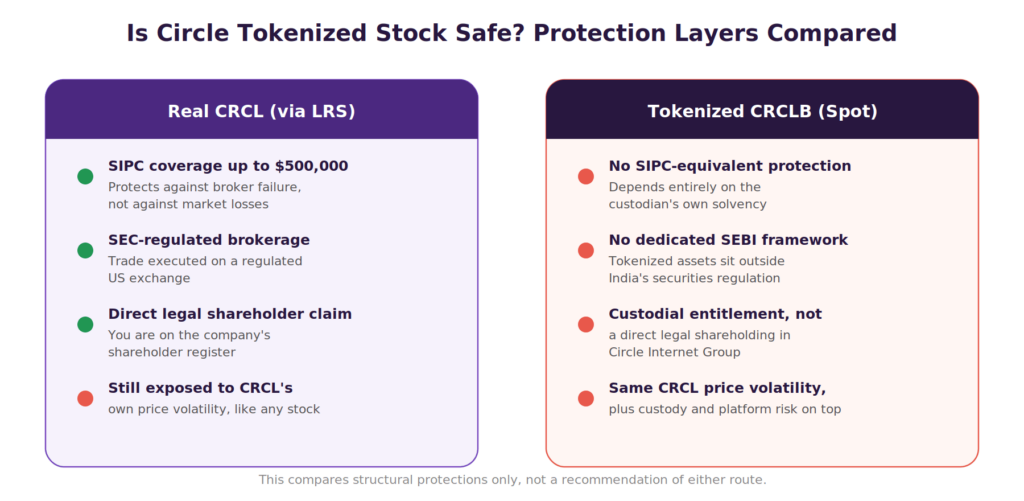
CRCLB runs on a custodial model. A custodian holds a real Circle Internet Group share, or a claim on one, and your token gives you fast, liquid price exposure to that backing. It’s not a direct legal shareholding in the company. Mudrex is upfront about this on its own tokenized stock offerings, confirming that these tokens don’t represent actual ownership of the underlying shares. That clarity is what lets you use CRCLB for what it’s actually good at: quick, flexible exposure to Circle without opening a US brokerage account.
Here’s what “custody” is actually supposed to mean in practice: new tokens get minted only when a matching real share is bought and put into custody, and tokens get burned when someone redeems out of the position, keeping token supply tied to actual shares held.
That’s the theory behind the 1:1 backing claim you’ll see on most tokenized stock products.
In practice, how well that holds up depends on the specific custodian’s disclosure habits, things like how often they publish proof of what they’re holding, so it’s worth checking a platform’s disclosures directly if that level of detail matters to you.
This isn’t unique to Circle or Mudrex. Most tokenized stocks work this way. The backing is real, but it’s an indirect claim, not the same legal position as being the shareholder of record. Knowing that distinction means you’re using the product with clear eyes, not false assumptions.
Is Tokenized Circle Stock Regulated?
Not yet, no. India’s securities regulator, the Securities and Exchange Board of India (SEBI), doesn’t have rules built specifically for tokenized assets on crypto platforms. LRS-based brokerage investing and GIFT City’s IFSCA-regulated receipts do have that kind of dedicated framework; tokenized stocks currently sit outside it.
What that actually means in practice: no access to SEBI’s SCORES grievance system if a dispute comes up, no mandated disclosure standards specific to tokenized products, and no exchange-level circuit breakers or surveillance the way SEBI-regulated brokerages have. That doesn’t mean there’s no recourse at all, Mudrex still operates under its own FIU-IND registration and standard consumer protection law applies, but it’s a narrower set of protections than what a SEBI-regulated brokerage account carries.
That gap isn’t frozen in place, though. In its Q2 2026 earnings, Circle disclosed that it received final approval from the US Office of the Comptroller of the Currency to establish a national trust bank, Circle National Trust, making it one of the first stablecoin issuers to hold a federal bank charter. It also received approval from the New York Department of Financial Services to open Circle New York Trust. Worth being precise here: these approvals are about Circle’s own corporate infrastructure and its custody of USDC’s reserves, not a statement about who holds the CRCL shares backing Mudrex’s tokenized stock product specifically. But they do signal that Circle as a company is accumulating real, federally-regulated custody credentials, which matters for overall confidence in the ecosystem it operates in.
On the derivatives side, the CFTC’s December 2025 Digital Assets Pilot Program isn’t just theoretical anymore either. In that same Q2 2026 update, Circle disclosed that Marex completed the first stablecoin-powered initial margin transaction in regulated derivatives clearing, letting institutional clients post USDC as collateral for CFTC-regulated derivatives under that pilot. That’s a real transaction, not a hypothetical, though it’s still a US derivatives-market development rather than a change to SEBI’s stance on tokenized equities in India.
What Other Risks Come With Circle (CRCL) Specifically?
Some risk here has nothing to do with tokenization at all, it’s just about CRCL being CRCL. The stock has been volatile since its June 2025 IPO: priced at $31, closed day one at $83.23, later hit a high in the high-$200s, then corrected sharply. Analysts are genuinely split too. Aggregate consensus leans “Buy,” but that headline hides real disagreement underneath.
There’s a specific business reason Circle swings as hard as it does. Nearly all of its revenue, Circle’s own IPO filing put the figure at 95-99%, comes from interest earned on the reserves backing USDC, not from fees or software subscriptions. That makes Circle’s earnings unusually sensitive to interest rates. In its own S-1 filing, Circle estimated that just a 1% drop in interest rates could cut reserve income by roughly $441 million. When the market reprices interest rate expectations, CRCL tends to move on that alone, regardless of anything else happening at the company.
That sensitivity shows up in the actual numbers, not just the filing’s hypotheticals. In its Q2 2026 earnings, Circle reported its reserve return rate declined 66 basis points year-over-year to 3.5%, even as USDC in circulation grew 19%. Growth in the underlying business and a declining rate environment were pulling in opposite directions at the same time, exactly the kind of push-pull that makes a stock like this harder to price than a more conventional business.
Competition and regulation add to that. The GENIUS Act, US legislation creating a formal path for regulated stablecoin issuers, opens the door for banks and other fintechs to launch competing products, which could pressure Circle’s market share over time. And a large chunk of Circle’s reserve income gets paid out to distribution partners like Coinbase under a revenue-sharing agreement, so the terms of that arrangement matter directly to Circle’s margins, not just USDC’s overall growth.
Putting a big chunk of money into any single, newly-listed, volatile stock carries concentration risk that diversifying would reduce. That’s true of CRCL no matter which route you use to get exposure to it.
What Happens If the Custodian or Platform Fails?
Is Circle (CRCL) Stock Safe? Tokenized CRCL Stock Backing & Risks
Here’s the gap – real CRCL bought through a US brokerage usually carries Securities Investor Protection Corporation (SIPC) coverage, up to $500,000, if the brokerage itself fails. That protects you against the broker going under, not against market losses. Tokenized CRCLB doesn’t have an equivalent standing scheme. If a custodian or platform ever fails, what happens to your position comes down to that platform’s specific redemption process and the custodian’s own solvency and disclosure.
That’s not a reason to assume the worst. Platforms operate under real regulatory registrations and disclosed processes. It is a reason to actually know what those processes are, rather than assuming a safety net exists by default.
It helps to be clear about what this tradeoff is really for. The protections you give up, SIPC coverage, a seat on the shareholder register, are built for long-term shareholders. If you’re trading price moves rather than parking capital for years, those specific protections were never really what you were buying exposure for. That doesn’t erase the gap above. It just means the real comparison isn’t “safer vs. less safe,” it’s “built for different things.”
How Can You Tell If a Tokenized Stock Platform Is Trustworthy?
A few concrete things are worth checking on any platform, not just for Circle:
Is the platform itself regulated? Mudrex, for example, is registered with India’s Financial Intelligence Unit (FIU-IND) and runs standard KYC/AML checks.
Does it say plainly what the token represents? A platform that states clearly that its tokens don’t confer direct ownership is being more honest than one that stays vague.
Does it name its custodian? And does it publish anything showing what backs the tokens?
Is the redemption process clear? What happens if you want out, and how is that different from just selling on the open market?
None of this erases risk. No disclosure practice does. But a platform that’s upfront about these points gives you what you need to decide for yourself, which beats being left to guess.
Trading Circle Stock With Clear Eyes
If you’ve weighed the tradeoffs above and they fit what you’re looking for, fast, flexible exposure to CRCL rather than long-term shareholder status, you can buy CRCLB directly through Mudrex.
Is Circle (CRCL) tokenized stock backed by a real share?
Generally yes, through a custodial model where a custodian holds the real share or a claim on it, and the token represents an entitlement to that backing rather than direct legal ownership.
Does tokenized Circle stock have the same protection as a US brokerage account?
No. Real CRCL bought through a US brokerage typically carries SIPC coverage up to $500,000 against broker failure. Tokenized CRCLB doesn’t have an equivalent standing protection scheme.
Is tokenized Circle stock regulated in India?
Not under a dedicated framework. SEBI doesn’t currently regulate tokenized assets on crypto platforms the way it regulates brokerage-based investing or GIFT City receipts.
Risk Disclaimer
Trading tokenized stocks and other virtual digital assets carries real risk of capital loss. Circle Internet Group (CRCL) has shown significant price volatility since its IPO, and concentrated single-stock positions carry additional risk. Tokenized stocks currently sit outside SEBI’s regulatory framework in India, and regulations may change. This article is illustrative only and not financial advice; consult a qualified advisor before investing.
Siri is a writer venturing into the exciting realms of blockchain technology, cryptocurrency, and decentralized finance (DeFi), eager to explore the transformative potential of these innovations. She brings a unique perspective that bridges traditional industries and cutting-edge technology, often infused with a touch of humor through memes. She has a rich background in real estate and interior design, having previously contributed to NoBroker, where she crafted blogs and assets on these topics.