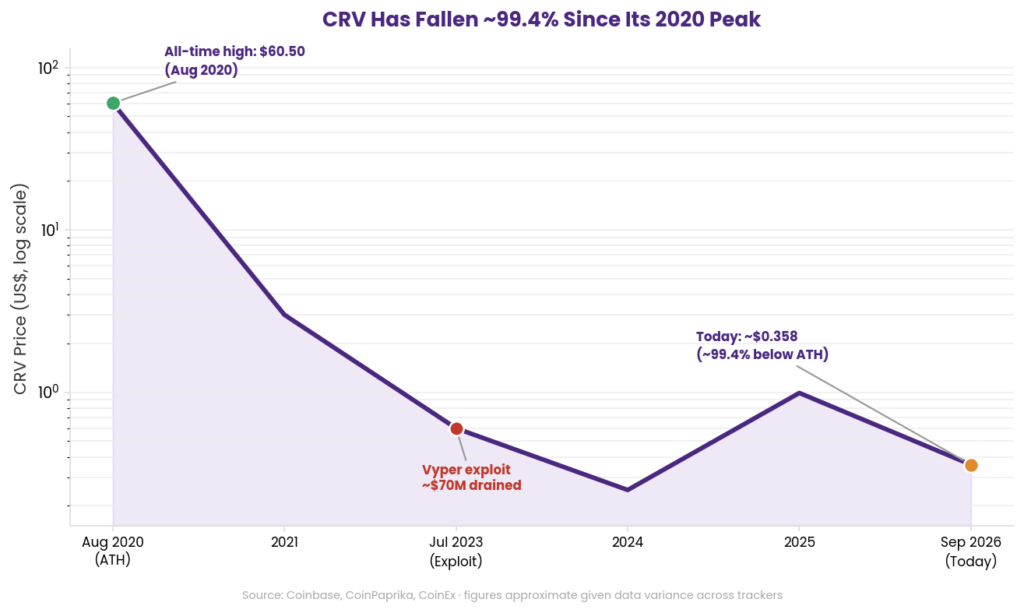
Is Curve DAO Token a good investment right now depends on which part of its six-year history you weigh most heavily. CRV is down roughly 99.4% from its August 2020 all-time high. Curve Finance, meanwhile, remains one of the most battle-tested decentralized exchanges in DeFi, generating real, measurable protocol revenue. A severe price decline and a genuinely durable business can both be true about the same token at once. Here is what CRV actually is, what the data shows, and an honest read on both sides before you decide.
Key Takeaways
CRV trades around $0.36 today, down roughly 99.4% from its all-time high of $60.50, reached in August 2020 shortly after launch.
Curve Finance generates real protocol revenue, with annualized fees estimated around $63.1 million and roughly $1.37 billion in total value locked across its pools.
CRV’s fully diluted valuation sits nearly double its current market cap. Roughly half of the 3.03 billion max supply has yet to enter circulation.
Curve suffered a major exploit in July 2023, when a Vyper compiler vulnerability led to roughly $70 million being drained from several pools.
Founder Michael Egorov has repeatedly used large CRV-backed loans, creating recurring liquidation risk that has affected the token’s price more than once.
What Is Curve DAO Token (CRV)?
Curve DAO Token is the governance and utility token of Curve Finance, a decentralized exchange built specifically for low-slippage trading between stablecoins and other similarly priced assets. Curve Finance launched in January 2020, founded by Michael Egorov, with the CRV token following in August 2020 as the protocol transitioned to a decentralized autonomous organization.
CRV is an ERC-20 token issued on Ethereum, meaning it works with standard Ethereum wallets and infrastructure. Its core innovation is the “StableSwap” pricing formula. This automated market maker design is optimized specifically for assets expected to trade near the same value, allowing tighter pricing and lower slippage than general-purpose exchanges offer.
Is Curve DAO Token a Good Investment?
Curve Finance is a genuinely established DeFi protocol with real revenue and a battle-tested product, but CRV, the token, has performed extremely poorly since its 2020 launch. Whether it counts as a good investment depends heavily on whether you are evaluating Curve’s business or CRV’s price chart, since the two have diverged sharply over time.
Curve Finance generates real, measurable protocol revenue, unlike many DeFi tokens with speculative-only value.
CRV is down roughly 99.4% from its all-time high, one of the steeper long-term declines among established DeFi tokens.
Founder-linked leverage has repeatedly created liquidation risk, a structural governance concern specific to CRV.
Nearly half of CRV’s max supply is still to be released, a real, ongoing dilution factor.
Definition: Vote-Escrowed Token (veCRV) A version of CRV created by locking regular tokens for a fixed period. It grants the holder voting power over protocol decisions and a boosted share of trading fee rewards, with longer lock periods generally producing greater voting weight and rewards.
What Are CRV’s Fundamentals?
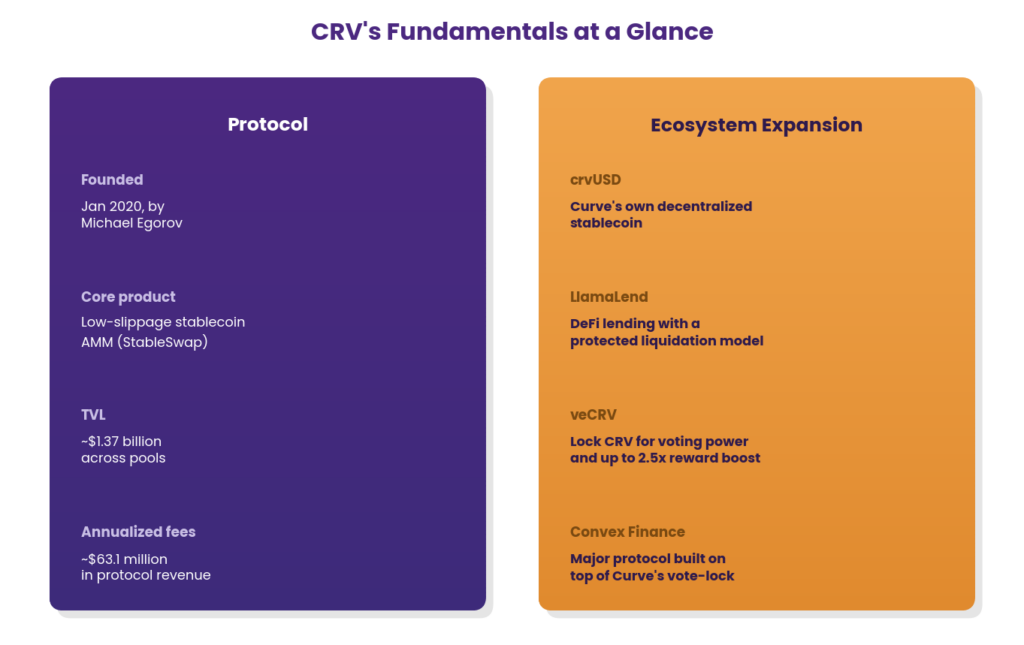
Curve’s core business is real and measurable: the protocol holds roughly $1.37 billion in total value locked across its pools. It generates an estimated $63.1 million in annualized protocol fees. This puts Curve in a different category from many DeFi tokens whose value depends almost entirely on speculation rather than actual usage.
Convex Finance as a major protocol built on top of Curve's system" class="wp-image-88810"/>Curve’s protocol fundamentals alongside its broader ecosystem.
Beyond its original stablecoin-swap function, Curve has expanded into a broader DeFi suite. crvUSD is Curve’s own decentralized stablecoin, competing directly with MakerDAO’s DAI. LlamaLend extends Curve into DeFi lending with a liquidation model designed to reduce cascading losses. Convex Finance, a separate but closely linked protocol, has grown into a major aggregator built specifically on top of Curve’s veCRV vote-locking system.
Curve DAO Token Price Performance: How Has CRV Done?
CRV’s price history is defined by an extremely fast 2020 launch rally followed by a long, uneven decline. The token reached an all-time high of $60.50 in August 2020, during the height of that year’s DeFi speculative boom. It lost the vast majority of that value over the following years.
CRV’s price since its 2020 peak, including the 2023 exploit.
Metric
Value
All-time high
$60.50 (Aug 2020)
Recent price levels
~$0.36
Approximate decline from ATH
~99.4%
Market capitalization
~$553 million
Fully diluted valuation
~$1.08 billion
Circulating supply
~1.6 billion CRV
Max supply
~3.03 billion CRV
A major inflection point came in July 2023, whena vulnerability in the Vyper programming language led to an exploit draining roughly $70 million from several Curve pools. CRV’s price fell sharply in the aftermath, compounded by fears that founder Michael Egorov’s large CRV-collateralized loans could face liquidation and trigger further selling.
What Affects the Price of Curve DAO Token?
CRV’s price responds to a mix of broader DeFi sentiment, protocol-specific developments, and factors tied specifically to its founder’s leveraged positions.
Founder-linked leverage: Michael Egorov has repeatedly used large CRV-backed loans across DeFi lending platforms, and price drops that approach his liquidation thresholds have historically triggered additional volatility.
Protocol revenue and TVL trends: growth or decline in Curve’s total value locked and trading volume directly affects the fee revenue the protocol generates.
veCRV lock-up dynamics: since a large share of CRV is locked for governance rather than freely tradable, changes in lock-up behavior can affect available liquidity.
Broader DeFi and stablecoin sentiment: as a stablecoin-focused DEX, CRV tends to track overall confidence in the DeFi and stablecoin sectors.
Token unlock schedule: continued release of CRV toward its 3.03 billion max supply adds ongoing potential sell pressure.
What Are the Risks of Buying CRV?
Severe historical drawdown: a roughly 99.4% decline from all-time high reflects one of the steeper long-term losses among established DeFi tokens.
Recurring founder-leverage risk: Egorov’s CRV-backed loans triggered liquidation scares in 2023 and an actual cascading liquidation in June 2024. The resulting bad debt was reportedly repaid within days.
Significant future dilution: with roughly half of CRV’s max supply still to be released, ongoing token unlocks remain a structural headwind.
Smart contract risk: the 2023 Vyper exploit demonstrated that even a mature, heavily audited protocol like Curve remains exposed to code-level vulnerabilities.
Uncertain value capture: some analysis has questioned whether enough of Curve’s protocol revenue flows to CRV holders specifically, versus liquidity providers, to justify current valuations.
Can CRV Reach a New All-Time High?
Reaching a new all-time high above $60.50 would require CRV’s market capitalization to grow to roughly $180 billion at current circulating supply. That scale is far beyond any DeFi token’s current valuation, and it is not supported by any current market conditions or realistic near-term scenario.
A more grounded question is whether CRV can meaningfully recover from current levels as Curve’s protocol revenue and TVL grow. Given the token’s history of tracking broader DeFi cycles, sustained sector-wide growth would likely need to occur before CRV could stage a significant, lasting recovery.
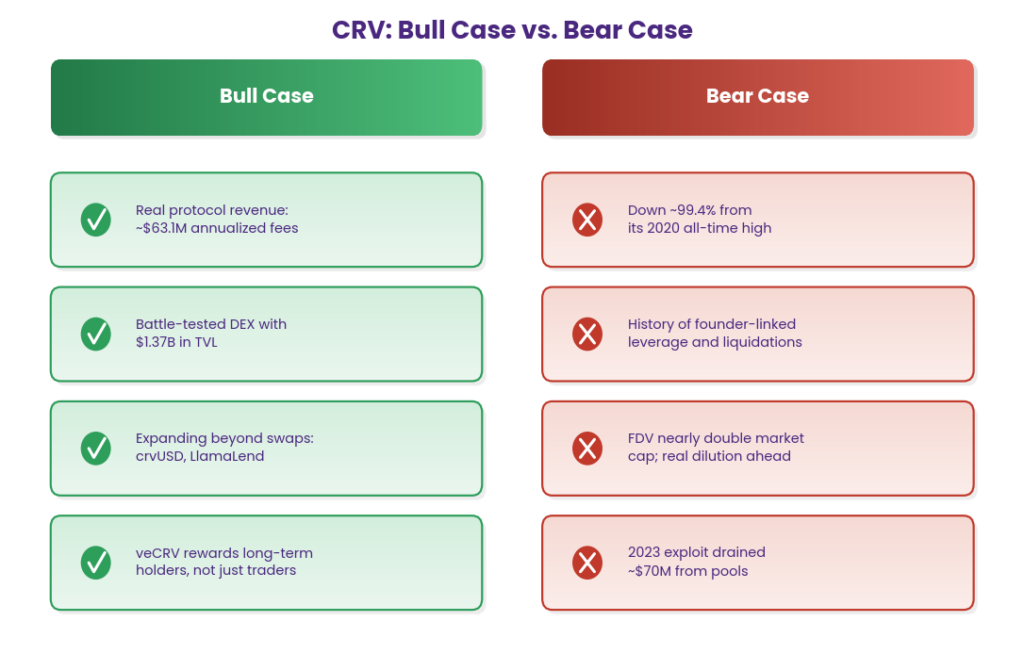
CRV: Bull Case vs. Bear Case
Weighing Curve’s real business against CRV’s real risks.
Weighing both sides fairly, Curve Finance has built something genuinely durable. It has real revenue, deep liquidity, and a product that has survived multiple market cycles and a major exploit without shutting down. CRV, the token, however, carries risks that go beyond typical crypto volatility, including a founder whose personal leverage has repeatedly become a market-moving event. Whether CRV re-rates meaningfully likely depends on whether that governance risk fades over time, not solely on Curve’s underlying business performing well.
Is CRV Suitable for Long-Term Investment, and What Is Its Future?
CRV’s long-term case rests on Curve Finance continuing to generate real fee revenue while gradually reducing the governance risk tied to concentrated founder leverage. The protocol’s expansion into crvUSD and LlamaLend suggests a genuine effort to diversify beyond its original swap-only function. That diversification could support demand for CRV over time if executed well.
Given the scale of CRV’s historical decline, the ongoing dilution from unreleased supply, and the token’s unusual founder-leverage history, CRV suits investors comfortable with DeFi-specific governance risk better than a purely passive, low-maintenance holding. Anyone considering a long-term position should watch Curve’s protocol revenue trends and any further developments tied to founder-held CRV collateral as the clearest signals to track.
CRV is available on Mudrex, a regulated Indian crypto platform, starting from as little as ₹100 using UPI or a direct bank transfer. Our piece on what Curve DAO Token is and its use cases covers the protocol’s mechanics in more depth.
Conclusion
Is Curve DAO Token a good investment? Curve Finance itself has proven durable, generating real revenue and surviving a major exploit without losing its position as a leading stablecoin DEX. CRV, the token, has still fallen roughly 99.4% from its 2020 peak, weighed down by ongoing dilution and a founder whose personal leverage has repeatedly created market-wide risk. Treat CRV as a DeFi-specific, governance-risk-aware position rather than a simple bet on Curve’s business alone. Watch both protocol revenue trends and founder-related on-chain activity as the real signals worth tracking.
This article is for informational and educational purposes. It is not financial advice, and you should do your own research and consult a qualified financial advisor before making investment decisions.
Curve Finance generates real protocol revenue and has proven durable through multiple cycles, but CRV trades roughly 99.4% below its all-time high with ongoing dilution and founder-leverage risk, making it a governance-risk-aware DeFi position rather than a simple bet.
What is the future of CRV, and is it suitable for long-term investment?
CRV’s future depends on Curve’s continued protocol revenue growth and reduced founder-leverage risk over time; it suits investors comfortable with DeFi-specific governance risk rather than a purely passive holding.
Can CRV reach a new all-time high?
Reaching $60.50 again would require a market capitalization of roughly $180 billion, a scale no current market conditions support as realistic.
What affects Curve DAO Token’s price?
Founder-linked leverage, protocol revenue and TVL trends, veCRV lock-up dynamics, broader DeFi sentiment, and the ongoing token unlock schedule all influence CRV’s price.
What are the risks of buying CRV?
A roughly 99.4% historical drawdown, recurring founder-leverage liquidation risk, significant future dilution, smart contract risk demonstrated by the 2023 exploit, and uncertain value capture for token holders are the main risks.
Where can I buy CRV in India?
Regulated Indian platforms like Mudrex support buying CRV with INR, starting from as little as ₹100.
How does Curve DAO Token compare with similar cryptocurrencies?
CRV generates more verifiable real revenue than many DeFi governance tokens, but its founder-leverage history and steep historical decline set it apart, for better and worse, from more passively governed DEX tokens.
Risk Disclaimer
Cryptocurrency investments carry a high risk of loss and are highly volatile, and DeFi tokens in particular carry smart contract and governance-specific risks beyond typical market volatility. The figures, comparisons, and scenarios in this article are illustrative and for educational purposes only; they are not financial advice or a guarantee of future performance. Please consult a qualified financial advisor before making any investment decisions.
Siri is a writer venturing into the exciting realms of blockchain technology, cryptocurrency, and decentralized finance (DeFi), eager to explore the transformative potential of these innovations. She brings a unique perspective that bridges traditional industries and cutting-edge technology, often infused with a touch of humor through memes. She has a rich background in real estate and interior design, having previously contributed to NoBroker, where she crafted blogs and assets on these topics.



 Convex Finance as a major protocol built on top of Curve's system" class="wp-image-88810"/>