The long/short ratio in crypto trading tells you something price alone can’t: whether the crowd is leaning bullish or bearish right now. It compares the number of traders (or trading volume) holding long positions against those holding short positions on futures exchanges. A long-short ratio above 1 means longs outnumber shorts; below 1, shorts are in control. This guide covers what the ratio means, how it’s calculated, how to read it for Bitcoin and major altcoins, where to check it live, and where it falls short as a signal.
However you search for it (long/short ratio, long-short ratio, long vs short ratio, or simply longs vs shorts) the underlying concept doesn’t change. Some traders look this up as crypto long short ratio or long short ratio crypto; others want the bitcoin long short ratio or bitcoin market sentiment long short ratio specifically, or a narrower bitcoin long to short ratio and BTC long to short ratio reading. Others come at it from the leverage side with crypto leverage long short ratio, or hope for one clean global long short ratio number… which, as covered below, rarely exists across every exchange at once.

The long/short ratio represents the proportion of traders or trading volume that is long versus short on a specific asset. A ratio of 2:1 means twice as many traders (or twice the volume) are positioned long compared to short. It’s a sentiment gauge, not a price predictor; it tells you where the crowd is standing, not where price is going next.
Before the ratio makes sense, the two building blocks need to be clear:
Every futures trade has a long side and a short side matched 1:1; one trader’s long is another’s short. The long/short ratio simply counts how that matching plays out in aggregate across the market.
Exchanges track open long and short positions on margin and perpetual futures contracts, then aggregate that data into a ratio. How this data is collected varies:
A global long/short ratio (one blended number across every exchange) rarely exists cleanly, because each platform calculates it slightly differently: some track ratios by number of accounts, others by position size or trading volume.
This is why the same asset can show a 1.3 long/short ratio on one exchange and a 0.9 on another, at the same moment. Aggregators that pull from multiple exchanges (covered below) exist specifically to smooth out this discrepancy.
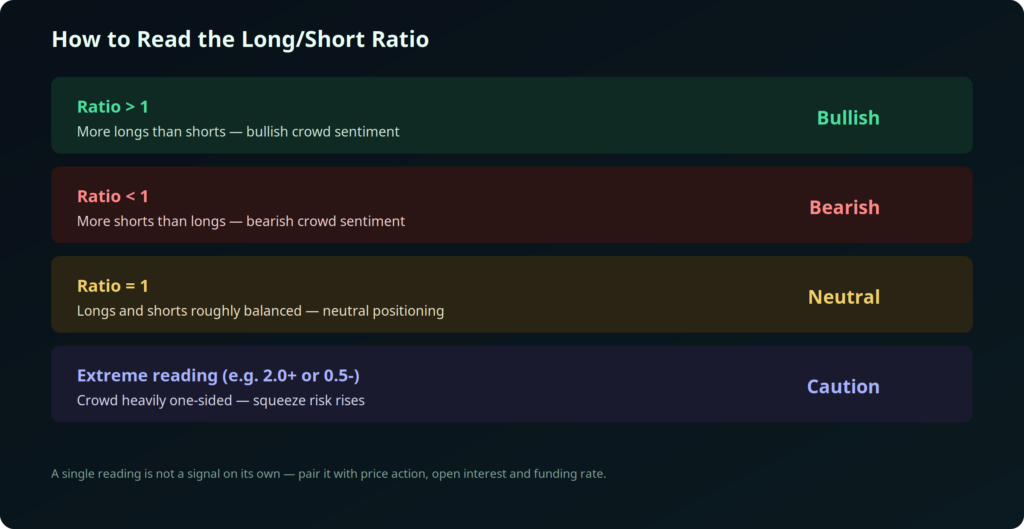
None of these readings work well in isolation. They’re most useful alongside open interest, funding rate, and price action.
The Bitcoin long/short ratio is the most closely watched version of this metric, given BTC’s deep liquidity and the volume of leveraged trading around it. Whether you frame it as the Bitcoin long vs short ratio or Bitcoin long vs short positions current ratio, checking Bitcoin long vs short positions today (rather than relying on a static number) matters because this reading can shift meaningfully within hours, especially around major news or macro events. It’s the same question whether you’re weighing crypto long vs short broadly or crypto long short for BTC specifically.
A few things to know about reading BTC long to short ratio data specifically:
For a deeper, BTC-specific breakdown of how to use this metric, Mudrex has a dedicated guide on the Bitcoin long-short ratio.
The long/short ratio isn’t a Bitcoin-only metric. ETH longs vs shorts data tends to move alongside BTC’s but with sharper swings, since Ethereum futures carry somewhat lower liquidity. The XRP long/short ratio and DOGE long and short positions ratio often show even more extreme readings; both assets attract a large share of retail, sentiment-driven trading, so their ratios can swing hard on social media momentum rather than fundamentals. Smaller-cap futures markets like TRX and ORDI coin see thinner order books, which means their long/short ratios can be more volatile and less reliable as a standalone signal; treat extreme readings on lower-liquidity coins with extra caution.
If you’re wondering where to check current long short ratio data (rather than relying on a number that goes stale the moment it’s published) a few sources are worth bookmarking:
Crypto futures markets run on high leverage, and that changes how much a shift in the long/short ratio actually matters:
The “leverage long short ratio” isn’t a separate metric; it’s the same ratio read through the lens of how much leverage the crowd is likely using. A 2.0 long/short ratio backed by 50x average leverage is a very different risk picture than the same ratio at 3x.
A short squeeze happens when a price rise forces short sellers to buy back their positions to limit losses, which pushes price up further. A long/short ratio well below 1 (lots of short positions relative to longs) is one of the conditions that makes a squeeze more likely, since there’s a large pool of short positions that could be forced to cover. The ratio doesn’t predict when a squeeze happens, but it flags where the fuel for one is sitting.
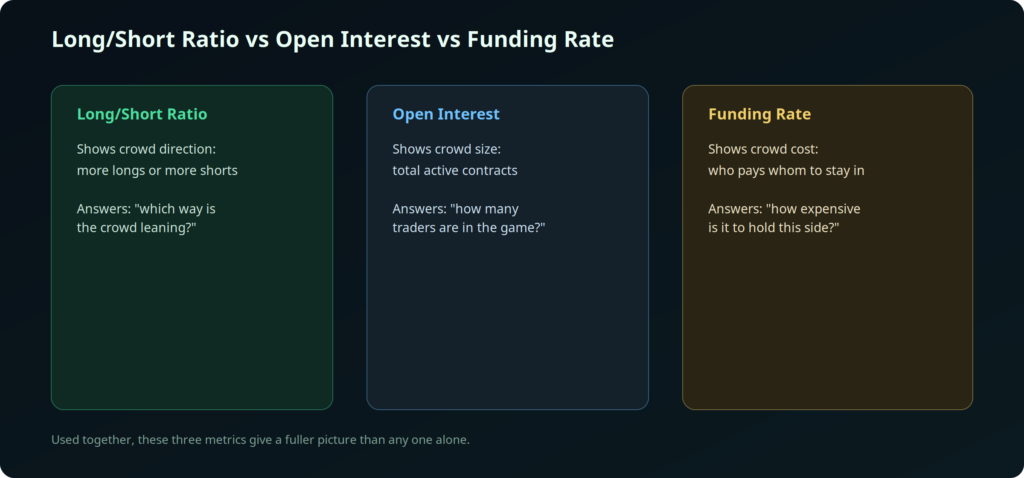
The ratio earns its place in a trading process alongside other tools, not instead of them:
Retail traders often use the ratio to spot overbought or oversold conditions. Institutional desks watch it to gauge retail sentiment and position against crowded trades. Either way, it works best as one input in a broader process, not a standalone trigger.
What is the long/short ratio in crypto? It’s the proportion of traders or trading volume positioned long versus short on a futures market, used as a gauge of crowd sentiment.
What does a long/short ratio above or below 1 mean? Above 1 means more traders are long (bullish tilt); below 1 means more are short (bearish tilt).
Is a high long/short ratio bullish or bearish? It reflects bullish positioning, but an extremely high ratio can also signal an overcrowded long trade at risk of a correction.
What is long and short in crypto trading? Long means buying an asset expecting its price to rise; short means selling a borrowed asset expecting its price to fall.
What does a 2.0 long/short ratio mean? There are twice as many long positions as short positions; a strongly bullish tilt, and a level worth watching for crowding risk.
Where can I check the current Bitcoin long/short ratio? Aggregators like CoinGlass, individual exchanges such as Binance’s futures data page, and the Mudrex app all show live long/short data.
Why does the long/short ratio differ by exchange? Each exchange calculates it differently (by account count, position size, or volume) and each has its own mix of traders, so readings rarely match exactly across platforms.
What is the leverage long/short ratio? It’s not a separate metric; it’s the standard long/short ratio interpreted alongside how much leverage traders are using, since higher leverage means the same ratio carries more liquidation risk.
What is a short squeeze? A short squeeze is a price rise that forces short sellers to buy back their positions, pushing price up further. A long/short ratio well below 1 signals a large pool of short positions that could fuel one.
Can the long/short ratio predict market movements? Not on its own. It’s a sentiment snapshot, best used alongside technical analysis, open interest, and funding rate rather than as a standalone predictor.
Trade BTC futures on Mudrex with live long/short data, open interest, and funding rate all in one place. For the fundamentals behind every position, start with what longing and shorting actually means in crypto, then read up on open interest and why funding rates spike during market stress to round out the picture.