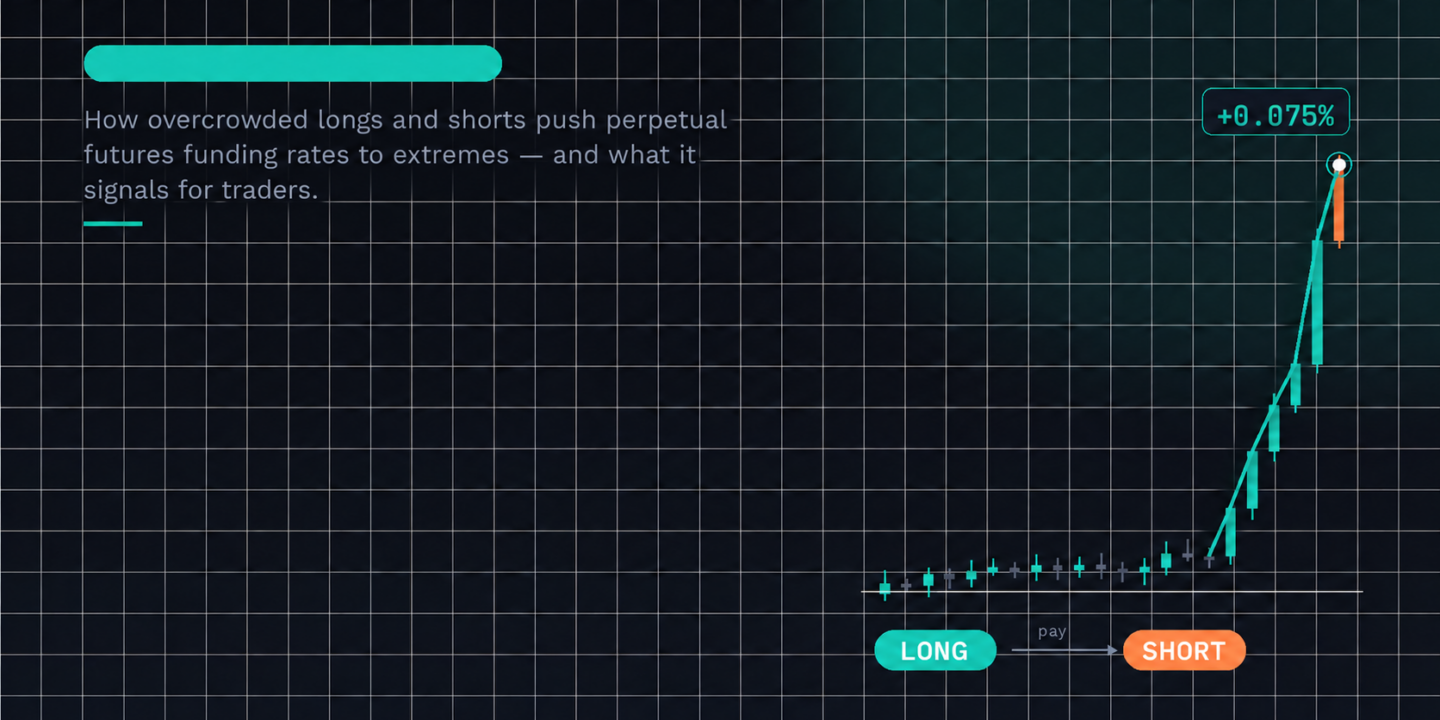

Periods of high market volatility often bring funding rates into the spotlight. Experienced traders monitor funding rates when Bitcoin or Ethereum rallies or sells off sharply. The metric helps them understand activity in the derivatives market. Ever wondered why funding rates spike during major Bitcoin rallies or market crashes? These spikes aren’t random. They reveal how traders are positioned and how much leverage they use. They also show whether sentiment has become overwhelmingly bullish or bearish.
In crypto, market stress refers to periods of heightened volatility. Rapid price swings, liquidations, macroeconomic events, regulatory announcements, or sentiment shifts can trigger it. During these periods, traders often increase their exposure using leverage. This creates an imbalance between buyers and sellers.

Understanding why funding rates spike is particularly important if you trade perpetual futures or use leverage. A sudden increase can raise the cost of holding a position. It may also indicate an overcrowded trade or reveal the strength of a market trend.
In this guide, you’ll learn what funding rates are, why they become more volatile during periods of market stress, what causes funding rate spikes, why these spikes can take longer to resolve than expected, and how to interpret them alongside other derivatives indicators.
Funding rates only apply to perpetual futures, so it’s important to understand how these contracts work before exploring why funding rates spike.
In spot trading, you buy and own a crypto asset. Perpetual futures let you speculate on price movements without owning the asset. You can profit from both upward and downward price movements, making perpetual futures one of the most widely used instruments in crypto derivatives trading.
Perpetual futures don’t have an expiry date, unlike traditional dated futures contracts. Positions can remain open indefinitely, provided traders maintain sufficient margin and continue paying any applicable funding payments.
Because these contracts never expire, exchanges need a mechanism to ensure their prices don’t drift too far away from the underlying spot market. That’s where funding rates come in.
Imagine Bitcoin is trading at ₹90 lakh in the spot market. As bullish sentiment grows, more market participants begin opening leveraged long positions in Bitcoin perpetual futures, expecting prices to continue rising. With increasing demand for perpetual contracts, the futures price starts trading above Bitcoin’s actual spot price.
Ideally, perpetual futures should closely track the spot market. If the gap becomes too large, the futures market no longer accurately reflects the underlying asset’s value. Funding rates exist to help correct this imbalance.
A funding rate is a periodic payment exchanged directly between participants holding long and short positions in perpetual futures. It’s not a fee charged by the exchange. Instead, it acts as a balancing mechanism that encourages perpetual futures prices to stay aligned with the spot market.
When perpetual futures trade above the spot price, the funding rate turns positive. Traders holding long positions pay those holding short positions. This increases the cost of maintaining bullish positions and discourages excessive buying.
When perpetual futures trade below the spot price, the funding rate turns negative. In this case, traders holding short positions pay those holding long positions, encouraging the market to move back towards equilibrium.
In simple terms, funding rates encourage balance between buyers and sellers while helping perpetual futures remain closely aligned with spot prices. Under normal, balanced conditions, this keeps funding rates small — typically in the range of 0.01% to 0.03% per 8-hour interval on most major exchanges. It’s only when the market becomes lopsided that funding rates start to move meaningfully.
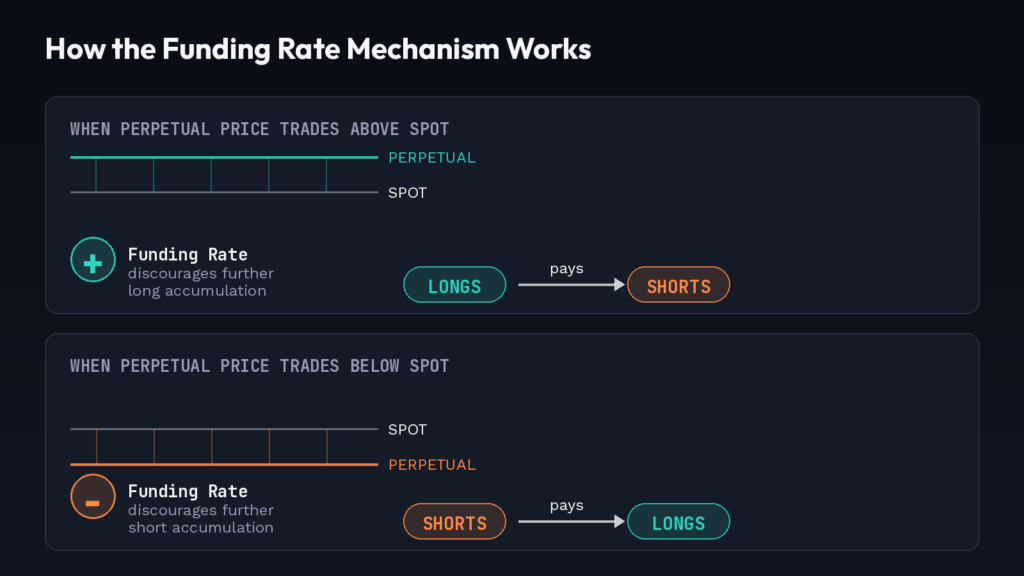
Funding rates become more volatile during periods of market stress because sharp price movements often lead to rapid changes in market sentiment and trader positioning. As more traders begin betting on the same direction using leverage, the imbalance between long and short positions grows. Funding rates adjust to encourage balance and keep perpetual futures prices aligned with the spot market.
Take a strong Bitcoin rally as an example. As optimism builds, more traders open leveraged long positions, pushing perpetual futures prices above the spot market. Funding rates turn positive, requiring long traders to compensate short traders. As the cost of holding long positions increases, some participants reduce their exposure, helping futures prices move closer to the spot market.
The opposite happens during market declines. When bearish sentiment strengthens, more traders open short positions, causing perpetual futures to trade below the spot price. Funding rates turn negative, requiring short traders to pay long traders.
The greater the imbalance between long and short positions, the larger the funding rate adjustment tends to be. This is why funding rates often spike during periods of heightened volatility and strong market trends.
For example, during the Bitcoin ETF-driven rally in early 2024, funding rates across several crypto exchanges climbed sharply — reaching annualised levels of roughly 75–85% on some exchanges around January and March 2024 — as traders opened aggressive leveraged long positions. The spike reflected increasingly bullish positioning rather than guaranteeing that Bitcoin would continue rising.
The reverse played out a few months later. In later 2024, a sudden Bank of Japan rate hike triggered a broad unwind of yen-funded carry trades across global markets, and Bitcoin fell from roughly $64,000 to $49,000 within 48 hours. As traders piled into short positions during the sell-off, funding rates on Bitcoin perpetuals swung sharply negative across major exchanges. That deeply negative funding reflected extremely crowded bearish positioning — and in the four months that followed, Bitcoin recovered by roughly 83% from that August low.
Read: When will bitcoin bottom
Leverage allows traders to control larger positions with less capital. During strong market trends, increased use of leverage can quickly create one-sided positioning, causing funding rates to rise. Our leverage guide breaks down how leverage magnifies both gains and this kind of funding-driven cost.
When most traders expect prices to move in the same direction, funding rates adjust to discourage further imbalance. Bull markets typically attract more long positions, while bear markets encourage more short selling.
Open Interest measures the total number of active perpetual futures contracts. When it rises alongside funding rates, it often indicates that fresh leveraged positions are entering the market. This can signal growing conviction but may also suggest increasingly crowded trades.
Optimism during rallies and fear during sell-offs — often reflected in tools like the Fear & Greed Index — encourage traders to use leverage. As positioning becomes increasingly one-sided, funding rates rise to reflect the growing imbalance between buyers and sellers.
Funding rates exist to keep perpetual futures prices aligned with the spot market. This price gap is known as the basis, and the wider it becomes, the larger the funding rate adjustment is likely to be.
Periods of high volatility often trigger waves of liquidations, increasing trading activity and amplifying market moves. As leverage builds across the market, funding rates may continue rising until conditions begin to stabilise.
A single factor rarely causes high funding rates.. They’re usually the result of rising leverage, increasing Open Interest, strong market sentiment, elevated trading activity, and a widening gap between perpetual futures and the spot market. Looking at these factors together provides a clearer understanding of what’s driving the crypto derivatives market.
It’s important to remember that funding rates don’t predict future price movements. Instead, they show how heavily the market is positioned in one direction, making them a useful indicator of sentiment rather than a standalone trading signal.
It’s tempting to assume that extreme funding rates should self-correct quickly: traders facing a high recurring cost should simply close their positions, the imbalance should ease, and rates should normalise. In practice, funding spikes often persist for longer than this logic suggests, for a few reasons.
New entrants keep the crowded side filled. During a strong trend, fresh positions on the popular side are frequently opened faster than the funding cost pressures existing traders into closing. The inflow of new leveraged positions can offset the outflow of traders exiting, keeping the imbalance — and the elevated funding rate — in place.
Leverage compounds the risk quietly. Every funding payment chips away at a trader’s margin, pulling their liquidation price closer even if the market price itself hasn’t moved. This risk builds in the background while most traders are focused on price direction rather than their shrinking margin buffer.
The unwind tends to happen abruptly rather than gradually. Rather than a slow, orderly resolution, an overextended funding imbalance often resolves through a liquidation cascade — forced selling (or buying) from one group of liquidated traders that pushes price far enough to trigger the next group, and so on. Funding rates can sit at extreme levels for an extended period and then reverse sharply within a single settlement window once this process begins.
In short: a high funding rate tells you pressure is building in the market. It doesn’t tell you exactly when — or how — that pressure will release.
Funding rates do more than keep perpetual futures aligned with the spot market. They also influence the cost of holding leveraged positions while offering valuable insight into market sentiment and positioning.
A high positive funding rate means traders holding long positions pay more to maintain those positions. While each individual funding payment may seem small, the cost compounds every 8 hours and can add up meaningfully over time — separate from any price movement against the position.
To see how this adds up, consider a sustained funding rate of around 0.075% per 8-hour interval — close to the level Bitcoin perpetuals briefly touched on some exchanges during the March 2024 rally:
| Holding Period | Funding Cost (at 0.075% per 8h) |
|---|---|
| 1 day (3 intervals) | ~0.225% of notional value |
| 1 week | ~1.575% of notional value |
| 1 month | ~6.75% of notional value |
Illustrative example only. Actual funding rates vary by exchange, asset, and market conditions, and can move well beyond this level during extreme stress.
For context, a trader holding a ₹5,00,000 notional Bitcoin perpetual position at this rate would pay roughly ₹375 per 8-hour settlement, or around ₹1,125 per day — paid entirely to the opposite side of the trade, regardless of whether the position is otherwise profitable.
Funding rates can also reveal when trades have become overcrowded. Exceptionally high positive funding often signals excessive bullish positioning, while deeply negative funding reflects strong bearish sentiment. If market sentiment shifts unexpectedly, these crowded positions can unwind quickly, triggering long squeezes or short squeezes that accelerate price movements.
However, funding rates should never be analysed in isolation. Professional traders typically combine them with indicators such as Open Interest, Trading Volume, Liquidations, the Long-Short Ratio, the Premium Index, Mark Price, the basis, and even broader sentiment tools like the Fear & Greed Index to build a more complete picture of market conditions.
Reading funding rate direction alongside Open Interest direction is one of the most useful combinations:
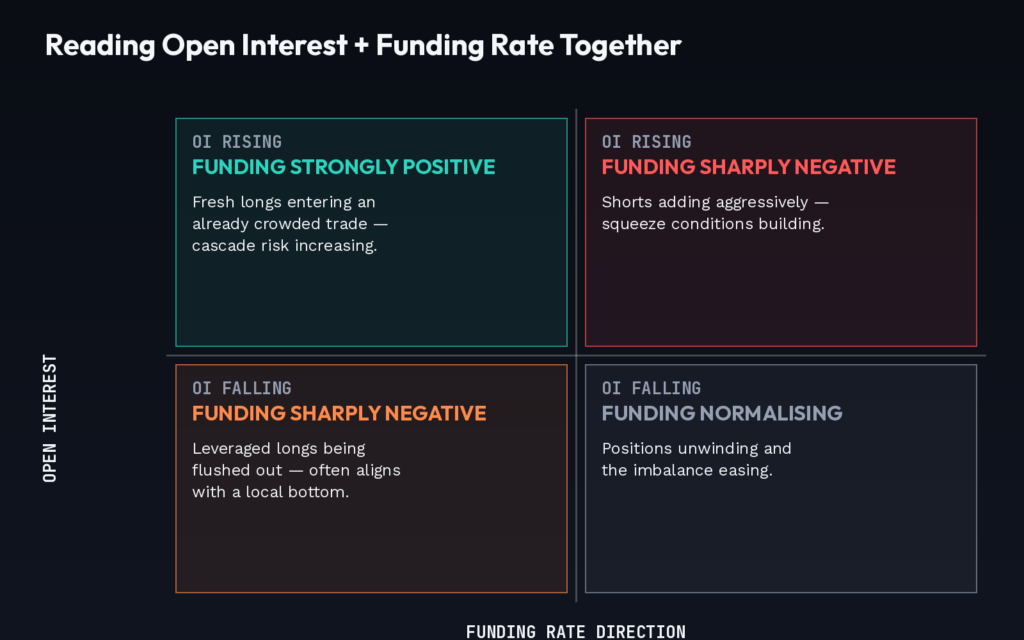
| Open Interest | Funding Rate | What It Often Signals |
|---|---|---|
| Rising | Strongly positive | Fresh longs entering an already crowded trade — cascade risk increasing |
| Falling | Sharply negative | Leveraged longs being flushed out — often aligns with a local bottom |
| Rising | Sharply negative | Shorts adding aggressively — squeeze conditions building |
| Falling | Normalising toward zero | Positions unwinding and the imbalance easing |
For example, rising funding rates alongside increasing Open Interest may indicate that fresh leveraged positions are entering the market. On the other hand, elevated funding rates with declining Open Interest can suggest that positions are being unwound rather than new ones being opened.
Traders should not treat funding as a standalone buy or sell signal. Instead, they can use it to understand sentiment, leverage, and positioning.
This explains why funding rates spike during volatile and strongly trending markets.
Funding rates don’t predict where Bitcoin or any other cryptocurrency will move next. Instead, they reveal how the market is positioned and how leverage is shaping sentiment. Traders should analyse funding with Open Interest, Liquidations, Trading Volume, and the Long-Short Ratio. Together, these indicators provide useful context during market stress..
Explore Mudrex Learn or the Mudrex YouTube channel for more guides on Bitcoin market cycles, risk management, and execution basics.
Funding rates spike when there’s a significant imbalance between long and short positions in the perpetual futures market. As more market participants position themselves on one side, funding rates adjust to encourage balance and keep perpetual futures prices aligned with the spot market.
On most major exchanges, funding rates typically sit between roughly 0.01% and 0.03% per 8-hour interval during calm, balanced market conditions — a small cost or credit that most traders barely notice. Rates that climb toward 0.05–0.08% per interval (roughly 40–85% annualised) are generally considered elevated, and sustained readings beyond that usually reflect the kind of crowded, one-sided positioning covered in this guide.
High funding rates are usually driven by a combination of rising leverage, increasing Open Interest, strong market sentiment, elevated trading activity, and widening price differences between perpetual futures and the spot market.
High funding rates generally reflect strong bullish positioning because more traders are willing to pay to maintain long positions. However, they don’t guarantee that prices will continue rising and may also indicate that the market has become overcrowded.
Negative funding rates mean traders holding short positions pay traders holding long positions. This usually occurs when bearish sentiment dominates and perpetual futures trade below the spot market.
Yes. During strong market trends, funding rates can remain elevated across multiple funding intervals if traders continue opening positions in the same direction. Persistent high funding typically reflects sustained bullish or bearish sentiment rather than a temporary market imbalance.
Funding rates influence the cost of holding leveraged positions while offering insight into market positioning and sentiment. They’re most valuable when analysed alongside indicators such as Open Interest, Liquidations, Trading Volume, and the Long-Short Ratio rather than being used in isolation.
Disclaimer: This content is for educational purposes only and is not financial advice. Crypto futures trading involves significant risk, including the loss of your entire margin. Do your own research and never trade more than you can afford to lose.