Bitcoin Long-Short Ratio: What Is It and How to Use It?
Bitcoin can look calm on the price chart while the futures market underneath is stacked heavily on one side. That hidden imbalance is often what triggers the next sharp move, and most traders never check it before placing a trade.
The Bitcoin long-short ratio fixes that blind spot. It tells you whether traders are piling into long positions or short positions right now, using real exchange data instead of guesswork. Ignore it, and you risk entering right before a squeeze wipes out the crowded side.
This guide breaks down what the ratio means, how to calculate it, and how to use it without treating it as a magic buy or sell signal.
Key Takeaways
The long-short ratio compares total open long positions to total open short positions on Bitcoin futures.
A ratio above 1 means longs outnumber shorts, showing bullish crowd sentiment.
A ratio below 1 means shorts outnumber longs, showing bearish crowd sentiment.
Retail and whale ratios often diverge, and the whale (top trader) side tends to be more reliable.
How Is the Long-Short Ratio Different From Open Interest and Funding Rate?
The long-short ratio, open interest, and funding rate all describe Bitcoin futures activity, but each answers a different question. Mixing them up is one of the most common beginner mistakes.
The long-short ratio tells you which direction traders are leaning: long or short. Open interest tells you how much money is committed to perpetual futures positions overall, regardless of direction. Funding rate tells you who is paying whom to keep a position open, which is itself a side effect of one-sided positioning.
In short: open interest shows crowd size, the ratio shows crowd direction, and funding rate shows how expensive that crowd is to stay in.
Key Terms and Metrics to Know
Term
What It Means
Long position
An open contract betting that Bitcoin’s price will rise
Short position
An open contract betting that Bitcoin’s price will fall
Open interest
The total value of all futures contracts still open in the market
Funding rate
A periodic payment between long and short traders that keeps futures prices close to spot
Perpetual futures
A futures contract with no expiry date, common in crypto derivatives
Leverage
Borrowed capital that lets a trader control a bigger position than their own money alone
Liquidation
When an exchange force-closes a position because margin can no longer cover losses
Basis
The gap between the futures price and the spot price
Taker buy/sell ratio
The split between aggressive market buy orders and market sell orders
CVD (Cumulative Volume Delta)
A running total of buy volume minus sell volume, used to spot real buying or selling pressure
Fear and Greed Index
A separate 0-100 sentiment score based on volatility, momentum, surveys, and social data
What Is the Bitcoin Long-Short Ratio?
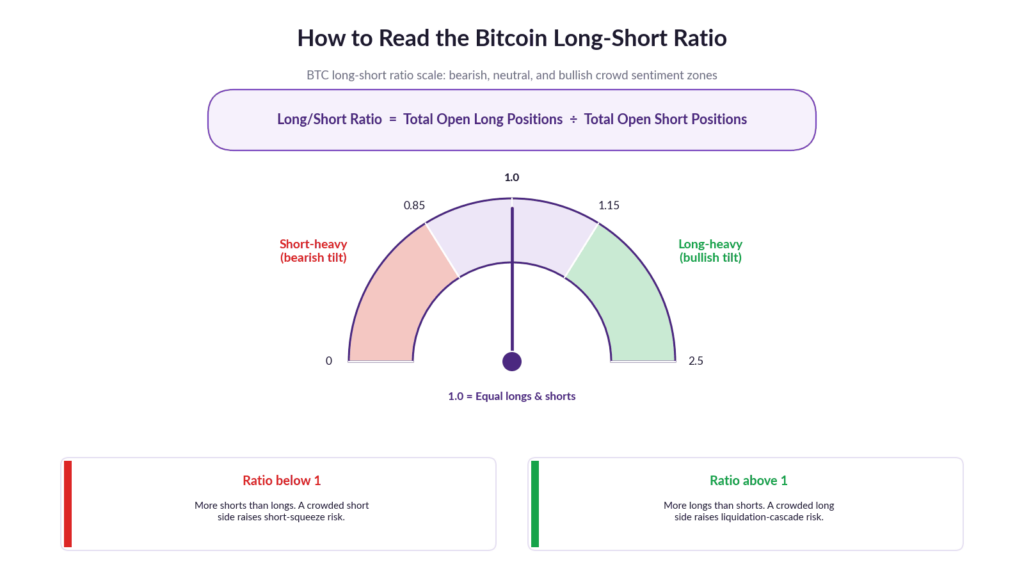
The Bitcoin long-short ratio is a sentiment metric that divides total open long positions by total open short positions on Bitcoin futures exchanges. It shows which side of the market, buyers or sellers, currently holds more open contracts.
A ratio of 1.0 means longs and shorts are perfectly balanced.
A ratio above 1.0 means more traders hold long positions, a bullish tilt.
A ratio below 1.0 means more traders hold short positions, a bearish tilt.
The ratio updates constantly as traders open and close positions throughout the day.
This is a crowd sentiment gauge, not a price predictor. It tells you what traders are doing, not what will happen next.
How Is the Bitcoin Long-Short Ratio Calculated?
The Bitcoin long-short ratio is calculated with one simple formula: total open long positions divided by total open short positions. Data providers pull this from exchange APIs and update it every few minutes.
Long-Short Ratio = Total Open Long Positions ÷ Total Open Short Positions
Some platforms calculate this by account count (how many traders are long versus short), while others calculate it by position size (how much money is long versus short). The two can tell very different stories, which is why the next section matters.
Bitcoin Long-Short Ratio: What is it and How to Use It?
The image above shows how to translate a raw ratio number into a sentiment read. Anything meaningfully above 1 leans bullish, anything meaningfully below 1 leans bearish, and readings close to 1 mean the market is roughly split.
Ratio Value
What It Signals
0.5
Shorts heavily outnumber longs; bearish crowd
0.8
Mild short bias
1.0
Balanced; no clear crowd lean
1.3
Mild long bias
2.0
Longs heavily outnumber shorts; bullish crowd
What’s the Difference Between the Retail Ratio and the Top Trader Ratio?
The retail (all-accounts) ratio and the top trader ratio often move in opposite directions, and that gap is more useful than either number alone. The all-accounts ratio counts every active account equally, so it mostly reflects retail trader behavior.
The top trader ratio only counts accounts in roughly the top 20% by margin balance, so it reflects institutional and whale positioning instead. Total long value always equals total short value in any futures market, so a high account ratio just means more accounts are long, usually with smaller positions each.
Definition: Top Trader Ratio The top trader ratio is the long-to-short ratio calculated only from the accounts holding the largest positions on an exchange, typically the top 20% by margin.
When retail leans one way, and whales lean the other, the whale side has historically been the more reliable signal, since large accounts tend to have more experience and risk discipline.
Is a High Bitcoin Long-Short Ratio Always Bullish?
No, a high long-short ratio is not automatically bullish. A high ratio means the crowd is leaning long right now, but an overcrowded long side is alsomore fragile, not less.
When too many traders hold long positions with leverage, a small drop in price can force liquidations. Those forced sells then push price down further, a chain reaction known as a liquidation cascade. The same logic works in reverse: an extremely low ratio (crowded shorts) sets up conditions for a short squeeze if price ticks up.
This is why experienced traders treat extreme ratio readings as a caution flag on the crowded side, not confirmation to join it.
How Do You Use the Bitcoin Long-Short Ratio in a Trading Strategy?
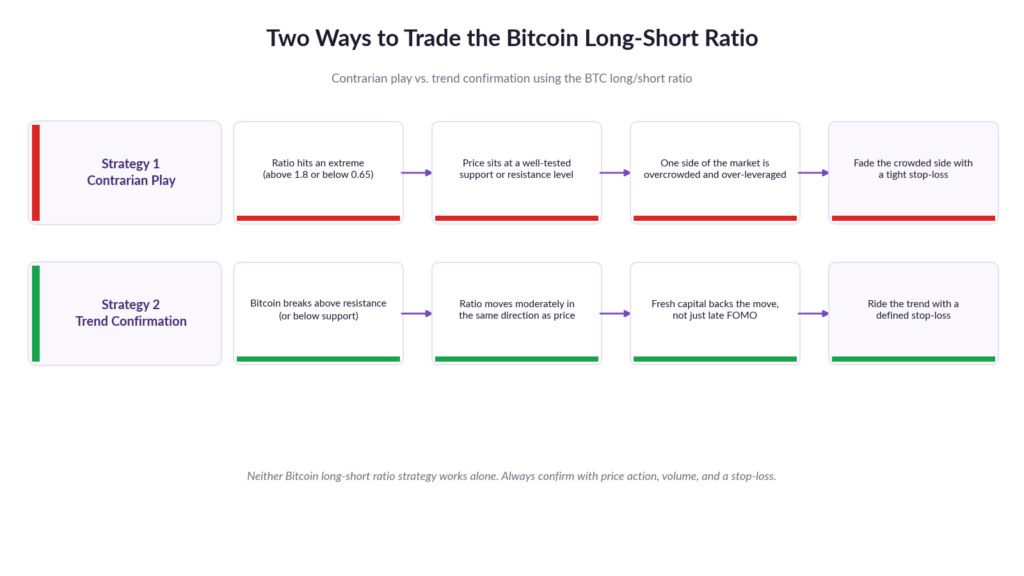
You can use the Bitcoin long-short ratio two main ways: as a contrarian signal at extremes, or as trend confirmation during a breakout. Both approaches use the same data but read it in opposite contexts.
Bitcoin Long-Short Ratio: What is it and How to Use It?
Strategy 1: The contrarian play. When the ratio hits an extreme (very high or very low) right at a well-tested support or resistance level, it signals the market is over-leveraged on one side. Traders watch for a squeeze in the opposite direction rather than chasing the crowd.
Strategy 2: Trend confirmation. When Bitcoin breaks a key level and the ratio moves moderately in the same direction, it suggests fresh capital is backing the move rather than late FOMO. This adds confidence that the breakout has real support behind it.
What Does a Ratio Divergence at Support Look Like in Practice?
Say Bitcoin drops toward a strong, well-tested support level. Retail traders panic and pile into shorts, while data shows large accounts are doing the opposite.
Metric
Value
What It Suggests
All-accounts ratio
0.62
Retail is heavily short at support
Top trader ratio
1.55
Whales are net long at the same level
Leverage used (illustrative)
3x
Kept conservative given the divergence
Stop-loss placement
Below support
Protects against a genuine breakdown
The divergence between a low retail ratio and a high top-trader ratio at support is a classic contrarian setup. It does not guarantee a bounce, but it does tell you which side of the trade the more experienced money is on. This is an illustrative example only, not a trade recommendation.
Where Can You Check the Bitcoin Long-Short Ratio Today?
You can check the Bitcoin long-short ratio on data aggregator platforms and directly on major derivatives exchanges, most of which update the figure every few minutes. Look for a breakdown by account count, position size, and by individual exchange, since the numbers can vary between platforms.
When you’re ready to act on what the ratio and price action are telling you, you can open a position directly through Mudrex Futures.
What Mistakes Should You Avoid When Reading the Long-Short Ratio?
The most common mistake is trading the ratio alone, without checking price levels, volume, or leverage risk first.
Chasing the crowd. A high ratio can mean buying right before a long squeeze.
Ignoring account vs. position data. A high account ratio doesn’t mean more capital is long.
Skipping the stop-loss. Any ratio-based trade still needs a defined exit.
Reading it in isolation. Pair the ratio with the Fear and Greed Index or open interest.
Conclusion
The Bitcoin long-short ratio is a simple but powerful window into how traders are positioned right now. Above 1 means longs lead, below 1 means shorts lead, and extreme readings near key levels often warn of a squeeze rather than confirm a trend.
Use it alongside price action, open interest, and funding rate, and treat crowded extremes with caution instead of chasing them. To track live positioning and trade Bitcoin futures with built-in risk tools, download the Mudrex app on Android or Apple, or subscribe to the Mudrex YouTube channel for more beginner-friendly futures trading guides.
FAQs
What is Bitcoin long-short ratio?
It’s a sentiment metric that divides total open long positions by total open short positions on Bitcoin futures exchanges.
How is Bitcoin long-short ratio calculated?
It’s calculated by dividing total open long positions by total open short positions, tracked by account count or position size.
What is a good long-short ratio?
There’s no fixed “good” number. A ratio near 1 shows balance, while readings far from 1 show one-sided positioning worth watching.
Is a high long-short ratio bullish?
It shows bullish crowd sentiment, but an extremely high ratio also raises the risk of a long liquidation cascade.
Can you trade using the long-short ratio?
Yes, traders use it for contrarian setups at extremes or as trend confirmation during breakouts, always alongside price action and risk management.
What does a low long-short ratio mean?
A ratio below 1 means more traders hold short positions, showing bearish crowd sentiment and possible short squeeze risk if it gets too crowded.z
Where can I check the Bitcoin long-short ratio today?
You can check it on crypto data aggregator platforms and on the trading interfaces of major derivatives exchanges.
Disclaimer: Crypto futures trading carries a high risk of loss, and leverage magnifies both gains and losses. The ratios, numbers, and examples in this article are illustrative only, meant for education, not financial advice or a guarantee of any outcome. Always assess your own risk tolerance before trading with leverage.
Siri is a writer venturing into the exciting realms of blockchain technology, cryptocurrency, and decentralized finance (DeFi), eager to explore the transformative potential of these innovations. She brings a unique perspective that bridges traditional industries and cutting-edge technology, often infused with a touch of humor through memes. She has a rich background in real estate and interior design, having previously contributed to NoBroker, where she crafted blogs and assets on these topics.