
Bitcoin can fall sharply even when there is no obvious crypto-specific headline. Sometimes stress begins in US equities, changes global risk appetite and then spreads to digital assets.
Wall Street’s best-known volatility gauge is the VIX, often called the fear index. The VIX fear index does not track Bitcoin directly; it uses S&P 500 options prices to estimate expected 30-day equity volatility. The VIX and crypto signal should therefore be treated as macro context, not as a direct price prediction.

You do not need a finance degree to compare the VIX with crypto price action. You need to understand what it measures, when cross-market stress matters and when the signal is only noise. This guide explains the five checks worth using alongside crypto-native indicators.
The VIX and crypto sentiment indicators measure different things using different markets and inputs. The VIX is calculated from S&P 500 options and measures expected volatility, while the Crypto Fear and Greed Index combines crypto-native inputs such as volatility, momentum, volume and sentiment.
Both tools provide context about risk conditions, but they do not measure exactly the same thing. The VIX measures expected volatility, whereas fear-and-greed tools attempt to summarise sentiment.
Neither one predicts the future. They just summarize the present mood using data that is already public.
For crypto traders, the smart move is not choosing one over the other. It is watching both, since equity fear and crypto fear do not always move together.
These are the terms and metrics that show up most often when traders talk about the VIX and crypto in the same breath.
| Term or Metric | What It Means |
|---|---|
| VIX | Expected annualised 30-day volatility of the S&P 500, derived from SPX options prices |
| Implied Volatility (IV) | The options market’s forward-looking estimate of the magnitude of future price movement |
| Historical Volatility (HV) | A backward-looking measure calculated from actual past price changes |
| Crypto Fear & Greed Index | A periodic payment between long and short perpetual-futures positions that can indicate positioning pressure |
| Open Interest | The total number of outstanding futures or options contracts not yet settled |
| Funding Rate | A periodic payment between long and short perpetual-futures positions that can indicate positioning pressure |
| Average True Range (ATR) | A volatility measure based on the average size of an asset’s price range over time |
| Options Skew | The difference in implied volatility across calls and puts or across strike prices |
| Put-Call Ratio | The ratio of puts to calls, calculated using either trading volume or open interest depending on the data source |
| MOVE Index | A measure of expected volatility in the US Treasury market |
To understand how VIX affects crypto markets, remember that the connection is indirect. The VIX impact on crypto usually becomes visible when the same macroeconomic shock affects equities, liquidity and digital assets. The VIX does not mechanically control Bitcoin’s price, and the relationship can weaken during crypto-specific events.
Here is roughly how that chain reaction tends to play out.
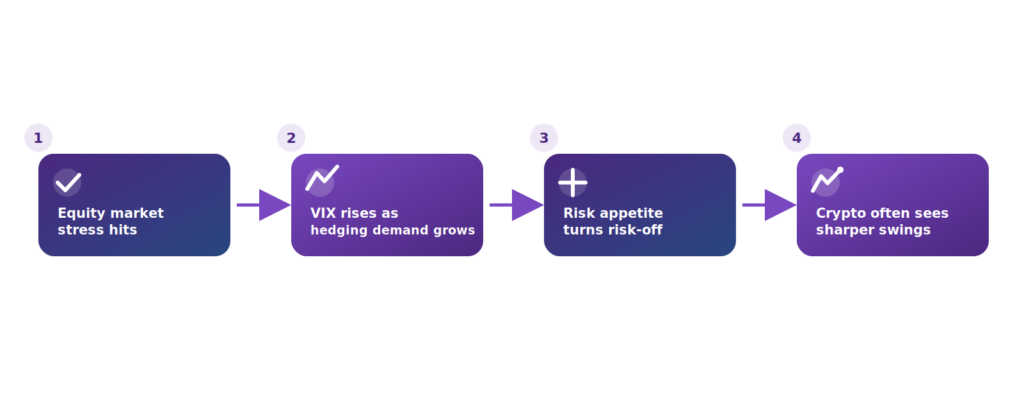
During periods of extreme stock market stress, this pattern has shown up before. Equity investors rush to hedge, the VIX jumps, and leveraged crypto positions get caught in the same wave of selling.
| Event | VIX reading | Bitcoin reaction | What it shows |
|---|---|---|---|
| COVID-19 sell-off, 12 March 2020 | 75.47 at the US close | Bitcoin fell nearly 40% during the crypto trading day | A macro liquidity shock affected equities and crypto together |
| FTX crisis, 8 November 2022 | 25.54 at the US close | Bitcoin fell approximately 16% during the FTX-driven sell-off | A crypto-specific event can cause a major Bitcoin decline without an extreme VIX reading |
The VIX Bitcoin relationship was strong during the broad March 2020 liquidity crisis but much weaker during the FTX collapse. These examples show correlation, not proof that the VIX caused either Bitcoin move.
Crypto traders watch the VIX because it provides context about global risk appetite. During periods of stress, changes in institutional flows can affect equities, currencies, commodities and crypto at the same time.
A rising VIX, a sign of building macro volatility, can flag a few practical things for a crypto trader:
None of these signals work in isolation. They are context for a decision, not the decision itself.
A useful framework combines the VIX with crypto-native indicators. Using VIX for risk management means treating it as context for position sizing, leverage and liquidity—not as an automatic buy or sell signal. The following five checks can provide a more complete view of portfolio risk.
| Signal | What to check | Interpretation |
|---|---|---|
| 1. VIX level | Whether the VIX is in a low, normal, elevated or extreme range | Identifies the broader equity-volatility regime |
| 2. Speed of change | How quickly the VIX is rising rather than only its absolute level | A fast increase may matter more than a small move within the same range |
| 3. VIX with DVOL or BVX | Whether equity and Bitcoin implied volatility are rising together | Simultaneous increases suggest broader risk repricing |
| 4. VIX with Fear and Greed | Whether macro stress and crypto sentiment confirm each other | Agreement gives stronger context; divergence suggests a market-specific driver |
| 5. VIX with funding and open interest | Whether leverage remains crowded while volatility rises | Elevated leverage can increase liquidation sensitivity |
| VIX level | General interpretation | Crypto takeaway |
|---|---|---|
| Below 15 | Low expected equity volatility | Crypto may still move on token- or exchange-specific news |
| 15–20 | Relatively normal conditions | Use crypto-native indicators for confirmation |
| 20–30 | Elevated uncertainty | Review liquidity, leverage and position concentration |
| 30–40 | High market stress | Expect wider price swings and potentially weaker liquidity |
| Above 40 | Extreme equity-market stress | Use greater caution; do not assume Bitcoin will move in a fixed direction |
No. The VIX measures expected S&P 500 volatility, not Bitcoin’s future direction. It can provide context about broader market stress, but it cannot reliably predict Bitcoin’s price or identify the timing of a crash.
The VIX also has real blind spots when applied to crypto. It says nothing about exchange-specific risk, token unlocks, smart contract exploits, or sudden regulatory headlines, all of which can crash crypto prices with the VIX sitting calmly at low levels.
Crypto-specific shocks routinely hit while the VIX stays flat, since it has no visibility into that market at all. Treat it as one input among several, not a standalone warning system.
VIX and crypto markets can react to the same macro conditions, but their relationship is loose and changes over time. A low VIX does not guarantee a calm crypto market, while a sharp VIX increase does not automatically mean Bitcoin will fall.
The VIX becomes more useful when it is compared with Bitcoin implied volatility, Fear and Greed, funding rates and open interest. Together, these indicators help distinguish broad macro stress from a crypto-specific event.
Want to follow market conditions more closely? Download the Mudrex app to track live market sentiment and start investing with a clearer view of risk, or subscribe to the Mudrex YouTube channel for regular market breakdowns.
The VIX is an index calculated by Cboe using S&P 500 options prices. It represents the market’s expected annualised volatility over the next 30 days and does not predict market direction.
Indirectly, it can. Ethereum may decline during broad risk-off events that also push the VIX higher, but the VIX does not directly determine ETH’s price. Network upgrades, DeFi activity, liquidations and crypto-specific news can move Ethereum even when the VIX remains stable.
There is no single universally accepted equivalent. Deribit’s DVOL and CME’s BVX provide forward-looking measures of Bitcoin implied volatility.
No. It measures expected S&P 500 volatility and cannot see crypto-specific risks such as exchange failures, exploits, token unlocks or liquidation cascades.
It provides context about global risk appetite and broader market stress that may spill over into Bitcoin and other risk assets.
Their relationship is situational. It can strengthen during a macro liquidity shock and weaken during an event affecting only the crypto market.
It is a 0–100 sentiment score built from crypto-native inputs such as volatility, momentum, volume and social signals. It measures something different from the VIX.
Crypto assets are highly volatile, and trading or investing in them carries a real risk of loss. Leverage, where available, magnifies both gains and losses and can lead to losses beyond your initial investment. The examples and scenarios in this article are illustrative only and are not financial advice. Please consult a qualified financial advisor before making investment decisions.