Maker Fee vs Taker Fee: What’s the Difference in Crypto Trading?
Every crypto trade you place gets charged one of two ways: as a maker or as a taker. Most new traders never check which one applies to them, and it quietly eats into their profits.
The gap between the two fees looks small on a single trade. Over a month of active trading, it can add up to a real amount of money. Knowing which fee you are paying, and why, is one of the easiest ways to trade smarter without changing your strategy.
This guide breaks down the maker fee vs taker fee split in plain terms, shows you exactly how each one gets calculated, and gives you practical ways to pay less on every trade.
Maker Fee vs Taker Fee: Key Takeaways
A maker fee applies when your order adds liquidity to the order book by resting there before it fills.
A taker fee applies when your order removes liquidity by matching an existing order right away.
Maker fees are usually lower than taker fees, because exchanges want traders to keep the order book full.
What Is the Difference Between Maker Fee and Taker Fee?
The maker fee vs taker fee difference comes down to one thing: whether your order adds liquidity to the market or removes it. A maker fee is charged when your order rests in the order book and waits to be filled. A taker fee is charged when your order matches an existing order and fills right away.
Definition: Liquidity How easily an asset can be bought or sold without moving its price much. More resting orders in the book means more liquidity.
Exchanges reward the orders that add liquidity with a lower fee, because a full order book makes trading smoother and cheaper for everyone. Orders that remove liquidity pay more, since they consume the depth that makers built up.
Maker
Taker
Adds or removes liquidity
Adds
Removes
Typical order type
Limit order (resting)
Market order, or a limit order that fills instantly
Typical fee
Lower
Higher
Fill speed
Not guaranteed; waits for price
Instant
Key Terms and Metrics to Know
Term / Metric
What It Means
Maker Fee
Fee charged when your order adds liquidity to the book
Taker Fee
Fee charged when your order removes liquidity from the book
Maker Order
An order that rests in the book before it fills
Taker Order
An order that fills immediately against a resting order
Market Maker
A trader or firm that regularly places maker orders
Market Taker
A trader who regularly places taker orders
Order Book
The live list of buy and sell orders, ranked by price
Limit Order
An order that only fills at your chosen price or better
Market Order
An order that fills instantly at the best available price
Post-Only Order
A limit order setting that cancels instead of filling as a taker
Bid Price / Ask Price
The highest buy offer / the lowest sell offer in the book
Bid-Ask Spread
The gap between the best bid and the best ask
Maker Rebate
A small payment some exchanges give makers instead of charging a fee
Fee Tier / VIP Tier
A fee level based on your monthly trading volume
Market Depth
The size of orders resting near the current price
Partial Fill
When only part of a large order matches immediately
What Is a Maker Order in Crypto Trading?
A maker order is a limit order placed away from the current market price. It joins the order book and waits for another trader to fill it, rather than executing right away.
Because this order sits in the book before it matches, it adds new depth for other traders to trade against. That is exactly why exchanges charge makers a lower fee, sometimes even a small rebate.
Rests in the book instead of filling on the spot.
Adds liquidity that other traders can match against.
Usually pays a lower fee, and sometimes earns a rebate.
Fill is not guaranteed. The price may never reach your order.
What Is a Taker Order in Crypto Trading?
A taker order is any order that matches an existing order the moment you place it. Market orders always work this way, and limit orders can too if they are priced at or through the current market.
This order consumes liquidity that a maker already placed in the book. In exchange for that instant fill, exchanges charge takers a higher fee than makers.
Fills immediately against a resting order.
Removes liquidity from the order book.
Usually pays a higher fee than a maker order.
Fill is guaranteed, but the price is not.
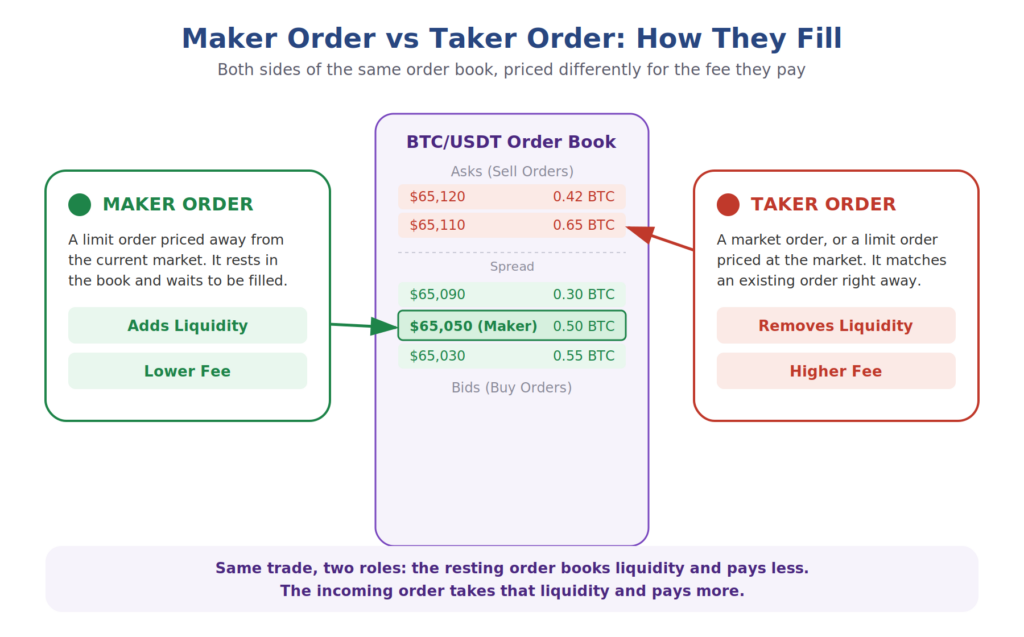
The highlighted maker order sits and waits, while the taker order on the right matches the best ask the instant it arrives.
Why Are Maker Fees Lower Than Taker Fees?
Maker fees are lower because makers do the exchange a favor: they add the liquidity that makes the whole market work. A crypto exchange with a thin, empty order book is hard to trade on, since prices swing more and orders take longer to fill.
By charging lower fees to makers, exchanges encourage traders to keep placing resting orders. This keeps the bid-ask spread tight and makes the market attractive to everyone, including the takers who eventually pay more.
Takers pay more for the opposite reason. A taker order consumes liquidity instead of contributing it, and it demands instant execution, which costs the exchange more to guarantee. Some platforms even reward high-volume makers with a small rebate on top of the discount, since their constant liquidity is that valuable to the exchange.
Does a Limit Order Always Pay a Maker Fee?
No. A limit order only earns the maker fee if it rests in the book before it fills. If your limit price matches an order already sitting on the other side, it executes immediately and pays the taker fee instead.
This is a common mix-up for new traders. Placing a “buy” limit order at the current best ask price does not guarantee a maker fee, since it fills the moment it is placed, just like a market order would.
What Is a Post-Only Order and How Does It Cut Your Fees?
A post-only order is the most reliable way to guarantee the maker fee on every trade. It is a setting on a limit order that tells the exchange to cancel the order instead of letting it fill immediately.
Definition: Post-Only Order A limit order setting that rejects the order rather than filling it right away, so it only ever executes as a maker order.
Guarantees maker status. The order either rests in the book or gets cancelled.
No accidental taker fees. You never pay the higher rate by mistake.
Best for patient traders who can wait for their price instead of chasing the market.
Not ideal for urgent trades, since the order will not fill instantly.
How Do Maker vs Taker Fees Work for Crypto Futures?
The maker vs taker fee split works the same way on crypto futures as it does on spot trading. The bigger difference is impact: futures fees apply to your full leveraged position size, not just the margin you put down.
Here is a worked example on a leveraged futures position, assuming a maker fee of 0.02% and a taker fee of 0.05%:
Position Size
Fee Rate
Fee Paid
Maker (resting limit order)
₹50,000
0.02%
₹10
Taker (market order)
₹50,000
0.05%
₹25
Difference per trade
₹15
That ₹15 gap looks small on one trade. Run 40 trades a month at that size, and the difference between trading as a maker versus a taker adds up to ₹600, before any funding fees or slippage. If you want to see how these fees fit into the full cost of a leveraged position, our guide to how crypto order matching works walks through exactly how the matching engine decides your maker or taker status on every fill.
How Can You Avoid Paying Extra Taker Fees?
You cannot avoid taker fees completely if you need instant execution. You can, however, reduce how often you pay them by changing a few habits in how you place orders.
Use post-only orders whenever you are not in a rush to fill.
Set your limit price slightly away from the current market, not at it.
Avoid market orders for entries and exits you can plan ahead of time.
Check your fee tier, since higher monthly volume usually unlocks lower rates on both sides.
Batch smaller trades into fewer, larger ones where your strategy allows it, since each trade carries its own fee.
Traders running crypto futures strategies through an API or a bot face this same choice on every order the system places. Mudrex’s API trading guide covers how to configure order types programmatically so a strategy defaults to maker orders instead of taker orders wherever possible.
Conclusion
The maker fee vs taker fee difference is simple once you see it: makers add liquidity and pay less, takers remove liquidity and pay more. Knowing which one applies to your order type, and using post-only orders when you can, is one of the easiest ways to keep more of your profit on every trade.
If fee efficiency matters to your strategy, it is worth comparing platforms directly. Mudrex’s breakdown of the best crypto exchange for low fees is a good next read before you pick where to trade.
Ready to put this into practice? Download the Mudrex app for Android or iOS and see transparent maker and taker rates for yourself on every order. You can also subscribe to the Mudrex YouTube channel for more walkthroughs on order types and trading costs.
Frequently Asked Questions
What is a maker rebate?
A maker rebate is a small payment some exchanges give makers instead of charging them a fee, as a reward for adding liquidity.
Why do exchanges reward market makers?
Market makers keep the order book full and the bid-ask spread tight, which makes the exchange easier and cheaper for everyone to trade on.
Do maker and taker fees change with trading volume?
Yes. Most exchanges use fee tiers, where higher 30-day trading volume unlocks lower maker and taker rates.
Can one trade get charged both a maker fee and a taker fee?
Yes, if a large order partially fills instantly and partially rests in the book, the two portions can be charged differently.
Is the maker-taker model the same on every crypto exchange?
The core idea is the same everywhere, but the exact fee percentages, tiers, and rebates vary from platform to platform.
Do maker and taker fees apply to crypto grid trading bots?
Yes. A grid bot places many limit orders automatically, and each one is still charged as a maker or a taker based on how it fills.
Does a bigger trade always mean a bigger fee?
Fees are usually a percentage of trade size, so a bigger trade does mean a bigger fee in rupee or dollar terms, even if the rate stays the same.
Disclaimer: Crypto futures trading involves leverage, and leverage can magnify both gains and losses. All prices, fee rates, and worked examples in this article are illustrative only and do not reflect live market data or guaranteed outcomes. Nothing in this article is financial advice. Please consult a qualified financial advisor before trading crypto futures or using leverage.
Siri is a writer venturing into the exciting realms of blockchain technology, cryptocurrency, and decentralized finance (DeFi), eager to explore the transformative potential of these innovations. She brings a unique perspective that bridges traditional industries and cutting-edge technology, often infused with a touch of humor through memes. She has a rich background in real estate and interior design, having previously contributed to NoBroker, where she crafted blogs and assets on these topics.