
Polygon (formerly MATIC) has long been recognized as one of the leading layer-2 scaling solutions for Ethereum, focusing on improving transaction speeds and reducing costs while maintaining high security.
With a strong market position, Polygon has consistently attracted attention from investors and developers alike. The latest buzz around Polygon centers on its ambitious transition from MATIC to POL, a move that is part of its larger Polygon 2.0 strategy. This upgrade is not just a token swap but a complete overhaul designed to expand the network’s functionality, enhance scalability, and unify liquidity across its blockchain ecosystem.
Recent announcements, such as Coinbase and Binance supporting the POL migration, have stirred market sentiment. The upgrade introduces POL as the primary staking and gas token, and its utility is expected to grow as the Polygon ecosystem expands. These developments are sparking curiosity among investors, prompting many to question what lies ahead for Polygon’s price in the near and distant future. This article dives deep into technical analysis, expert predictions, and the potential impact of these changes on Polygon’s price trajectory through 2024, 2025, and beyond.
We will explore month-by-month forecasts for 2024, highlight key technical indicators, and discuss factors that will influence price movements in the coming years, including the aggressive implementation of Polygon 2.0. If you’re looking to understand how Polygon’s latest developments could shape its market position, read on to discover expert insights and detailed predictions.
Polygon, initially known as MATIC, is a layer-2 scaling solution for Ethereum designed to enhance blockchain speed and reduce transaction costs while maintaining security. Launched in 2017 by Jaynti Kanani, Sandeep Nailwal, and Anurag Arjun, Polygon’s purpose is to tackle Ethereum’s scalability issues through a network of interconnected blockchains. The native token, POL, is used for governance, staking, and transaction fees within the network.
Polygon’s price has exhibited significant volatility since its inception. From trading at fractions of a cent, POL surged during the 2021 bull market, reaching an all-time high near $2.92 in December 2021. Following this peak, the price experienced a notable downturn alongside broader market corrections. Despite these fluctuations, Polygon’s ongoing development and growing ecosystem have helped maintain its relevance and investor interest.
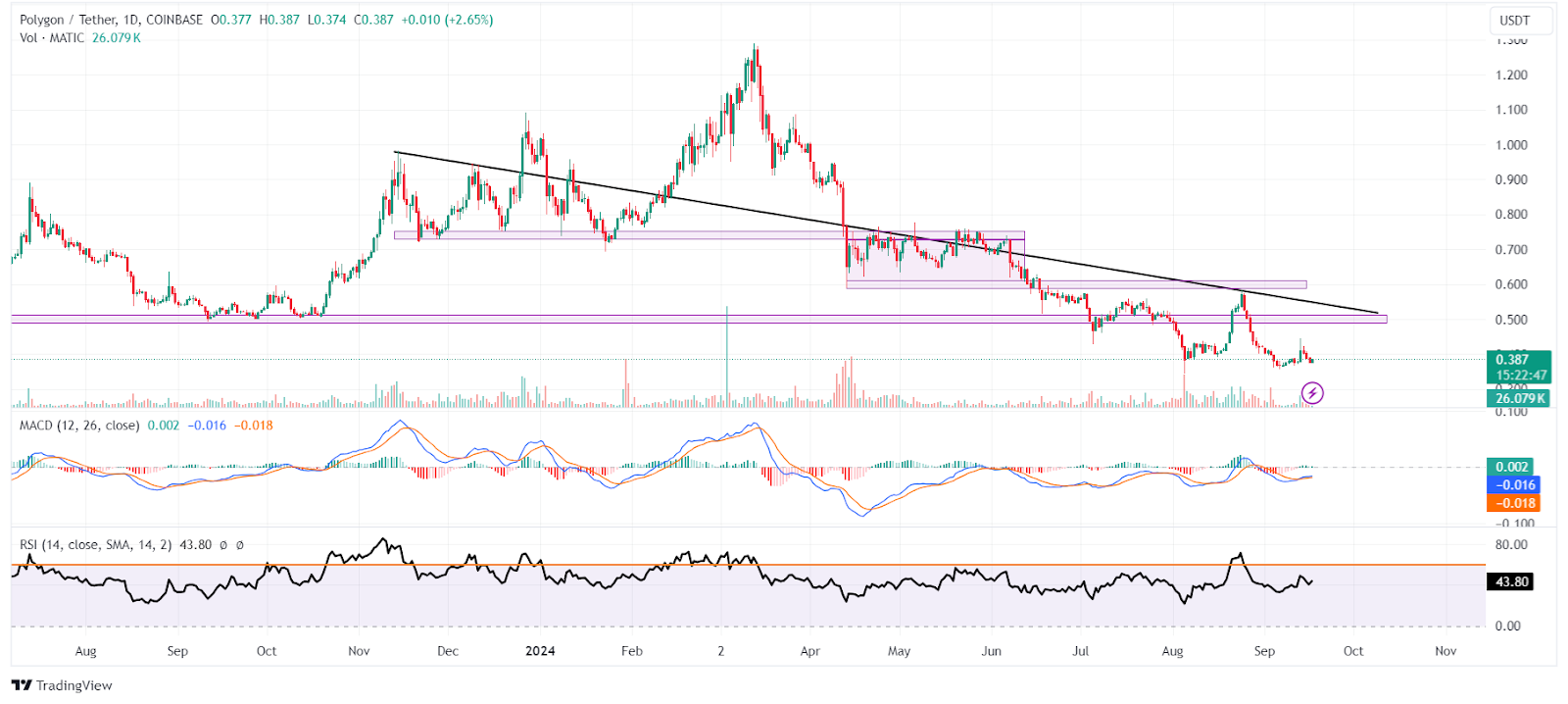
The first quarter was characterized by a lack of positive momentum, with price movement constrained by repeated rejections at key resistance levels and ongoing regulatory concerns.
The second quarter was marked by low volatility and range-bound trading, reflecting market uncertainty and cautious investor behavior.
The third quarter faced intensified selling pressure, driven by negative sentiment and ongoing technical weaknesses.
The fourth quarter’s outlook depends heavily on the success of the POL migration and overall market conditions, with potential for a rebound if positive sentiment gains traction.
| Month | Price Prediction ($) | Commentary |
| September | 0.30 – 0.40 | POL continues to face selling pressure, testing key support levels near $0.30 as market adjusts to POL migration impacts. |
| October | 0.32 – 0.45 | Potential bottoming pattern could emerge with POL integration gaining traction; minor bullish attempts might surface. |
| November | 0.33 – 0.48 | Increased adoption of POL features may drive slight upward movement, though resistance remains strong near $0.45-$0.50. |
| December | 0.35 – 0.50 | End-of-year market stabilization expected; POL’s broader ecosystem utility could begin to influence positive price actions. |
Market analysts highlight that POL’s near-term performance will be closely tied to the POL migration’s success and Polygon’s ability to scale effectively. While some foresee potential for a rebound if new use cases emerge, others remain cautious due to macroeconomic headwinds and regulatory challenges.
| Year | Price Prediction ($) | Commentary |
| 2024 | 0.30 – 0.50 | The transition from MATIC to POL is the primary focus. Market sentiment remains cautious due to technical and adoption challenges. |
| 2025 | 0.60 – 1.00 | Full integration of POL into staking and governance roles could drive demand. Success of staking hubs and growing DeFi adoption is critical. |
| 2026 | 0.80 – 1.20 | Expansion of Polygon’s ecosystem, including zero-knowledge proofs and increased utility of POL, likely to enhance investor confidence. |
| 2027 | 1.00 – 1.50 | Growing interoperability with other blockchains through the AggLayer could lead to increased demand for POL as a multi-chain utility. |
| 2028 | 1.20 – 2.00 | Continued network growth and institutional adoption expected as Polygon solidifies its position as a leader in layer-2 scaling solutions. |
| 2029 | 1.50 – 2.50 | POL’s expanded use in governance and data availability could further strengthen its market position, driving steady price appreciation. |
| 2030 | 2.50 – 5.00 | Long-term growth fueled by widespread adoption, advanced scalability solutions, and increased integration into global blockchain networks. |
| Beyond 2030 | 5.00+ | As blockchain technology matures, Polygon’s continuous innovation could position POL as a critical asset in decentralized finance ecosystems. |
In 2025, the full implementation of POL and additional staking opportunities could enhance the token’s utility. The launch of staking hubs and increased governance roles for POL are expected to drive demand.
Price Range Prediction for 2025: $0.60 – $1.00, contingent on adoption rates and network growth.
2026 could see continued expansion of the Polygon ecosystem, especially with the integration of zero-knowledge proofs and new scalability solutions. Polygon’s success in attracting more projects will be pivotal.
Price Range Prediction for 2026: $0.80 – $1.20, assuming continued development and positive market conditions.
By 2027, Polygon’s enhanced scalability and interoperability features could significantly boost its market position, driving POL’s value.
Price Range Prediction for 2027: $1.00 – $1.50, reflecting growing utility and adoption.
As adoption continues, Polygon could solidify its role as a leading blockchain solution, pushing POL’s value higher as demand for scalable and interoperable blockchains grows.
Price Range Prediction for 2028: $1.20 – $2.00, driven by technological advancements and market dynamics.
The network’s maturity by 2029 could attract more institutional investors and solidify its market presence, further supporting price appreciation.
Price Range Prediction for 2029: $1.50 – $2.50, based on continued ecosystem development and strategic partnerships.
In the long term, Polygon’s focus on innovation and broader market adoption positions it for potential significant gains. POL’s role in governance, staking, and cross-chain operations will be crucial.
Price Range Prediction for 2030: $2.50 – $5.00, depending on overall market trends, technological adoption, and regulatory factors.
Polygon’s future holds promise, but the path forward will hinge on executing its strategic initiatives and navigating the broader market challenges successfully.
Polygon’s transition from MATIC to POL marks a pivotal moment in its journey toward becoming a comprehensive multi-chain ecosystem. This evolution is poised to significantly impact the network’s utility, with POL expected to play a crucial role in staking, governance, and interoperability among various blockchain layers. The migration has already generated substantial interest, as seen with major exchanges like Coinbase and Binance offering support, signaling confidence in Polygon’s future.
However, as with any significant upgrade, there are inherent risks, including technical challenges and market adaptation. The short-term price outlook remains cautious, but the long-term prospects are promising, with potential for substantial growth driven by increased utility, adoption, and continuous network upgrades.
As the cryptocurrency landscape evolves, Polygon’s commitment to scalability and innovation positions it well for the future. Investors should keep a close eye on key developments and market responses to better navigate the price movements of POL in the coming years. Whether you are a short-term trader or a long-term investor, understanding these dynamics will be crucial in making informed decisions about Polygon’s potential as a leading blockchain solution.