Position Sizing Strategies: 3 Methods Every Futures Trader Should Know
Meera doubled her account in three weeks. Then she lost it all in a single afternoon. Same skill, same charts, same instincts. What changed? On that last trade she bet far too big, the market went against her, and one bad move erased everything the good ones had built.
Her problem was never picking trades. It was position sizing. And that is exactly what these position sizing strategies fix. Position sizing is simply deciding how much money to put into a single trade so that no one loss can wreck you. Get it right and you survive long enough to let your edge play out. Get it wrong and even a great strategy goes to zero.
So let’s fix it. You get three position sizing strategies, the exact math behind each, and clear rules for how much to risk per trade.
Crypto 2026
What Position Sizing in Futures Trading Actually Means
Think of your trading capital as oxygen. Every trade uses some. Bet too much on one and you can suffocate before the next good setup arrives.
Position sizing in futures trading is the process of deciding how large each trade should be, based on your account balance and how much you are willing to lose if the trade fails. It is the bridge between a trade idea and actual risk management.
Here is the part beginners miss. Your entry and your stop loss decide your risk per contract. Your position size decides your risk in rupees. Two traders can take the identical setup, yet one risks 500 and the other risks 50,000, purely because of size.
Notice what position sizing is not. It is not about predicting the market. It is about controlling the damage when you are wrong, which in trading is often.
Why Position Sizing Beats Picking Winners
You’re here because you want consistency. Consistency does not come from being right more often. It comes from making sure your losses stay small and survivable.
Consider two traders. Both win 50 percent of their trades. The first risks 2 percent per trade and grinds steadily upward. The second risks 20 percent per trade, hits a normal losing streak of five, and is down more than half the account. Same win rate. Wildly different outcomes.
That gap is created entirely by position sizing. This is why professionals obsess over it while beginners obsess over entries.
The 3 Position Sizing Strategies You Can Use Today
Each method below answers one question: how much do I put on this trade? Learn the first one properly before touching the others.
Strategy 1: Fixed Percentage Risk (the 1% Rule)
Position Sizing Strategies: 3 Methods for Futures Traders
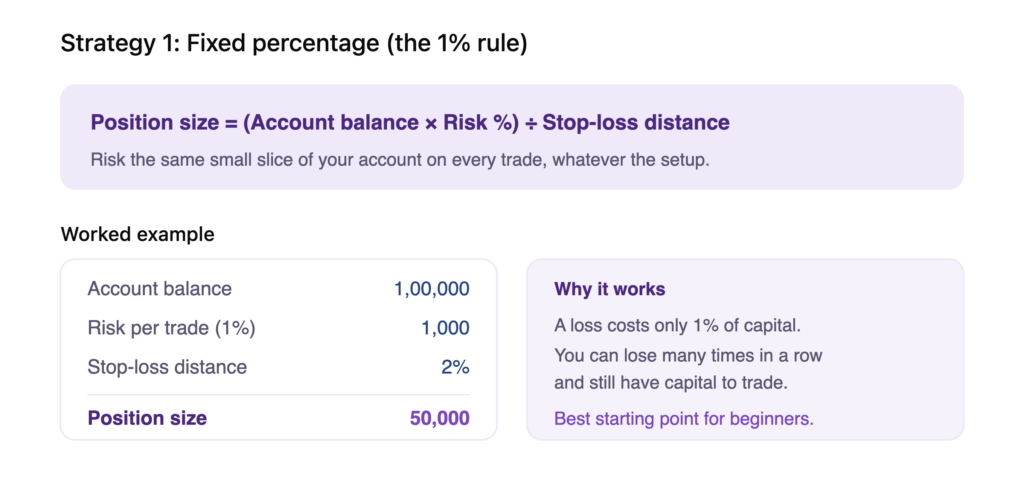
This is the foundation, and the one most professional traders start from. You risk the same small percentage of your account on every trade, usually 1 to 2 percent.
The formula is simple. Position size equals your account balance times your risk percentage, divided by your stop-loss distance. Say you have 1,00,000, you risk 1 percent, and your stop is 2 percent away from entry. You risk 1,000, which lets you take a 50,000 position.
The beauty is built-in protection. A loss costs only 1 percent of capital, so you can be wrong ten times in a row and still have most of your account intact. As your balance grows, your position size grows with it. As it shrinks, your size shrinks automatically, easing off the gas exactly when you should.
For beginners, this is the single best place to start.
Position Sizing Strategies: 3 Methods for Futures Traders
A calm market and a wild market should not get the same position size. This method uses volatility, measured by ATR (Average True Range), to adjust.
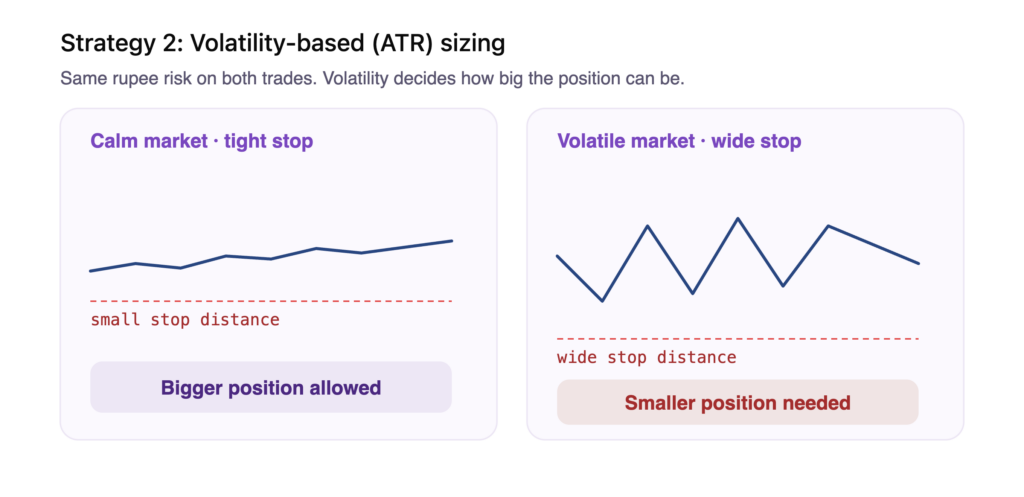
The idea is intuitive. When a market is volatile, prices swing wide, so your stop loss has to sit further away to avoid getting knocked out by noise. A wider stop means you must take a smaller position to keep your rupee risk the same. When the market is calm, your stop can sit closer, so the same risk allows a bigger position.
The diagram above shows both cases side by side, with identical risk but very different position sizes. You keep your dollar risk constant and let volatility decide the size. This is volatility-adjusted position sizing, and it stops you from over-betting in chaotic conditions.
It takes a little more work than the fixed percentage method, but it respects what the market is actually doing.
Position Sizing Strategies: 3 Methods for Futures Traders
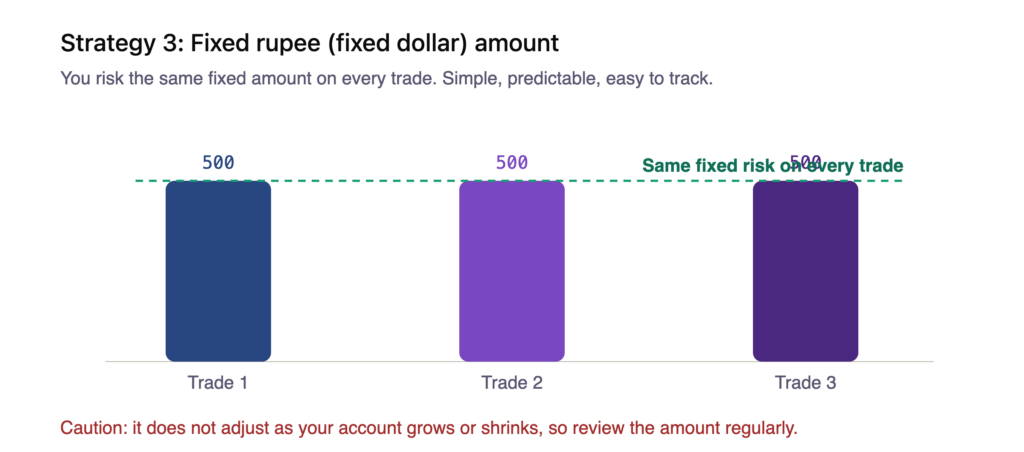
Sometimes the simplest approach is the most usable. Here you risk the exact same rupee amount on every single trade, say 500, regardless of the setup.
The appeal is clarity. Every trade carries identical risk, so your results are easy to track and your emotions stay flat. There is no formula to run mid-trade and no second-guessing.
The catch is that a fixed amount does not adapt as your account changes. Risk 500 on a 10,000 account and that is 5 percent, which is a lot. Risk the same 500 on a 5,00,000 account and it is a rounding error. So this method works best when you review and adjust the fixed amount regularly as your capital moves.
Many traders use this as a stepping stone, then graduate to the percentage method once they are comfortable.
Comparing the Three Position Sizing Strategies
Method
How size is set
Best for
Main trade-off
Fixed percentage (1% rule)
% of account per trade
Beginners; steady growth
Needs a stop distance to calculate
Volatility-based (ATR)
Adjusted to market swing
Choppy, changing markets
More effort per trade
Fixed rupee amount
Same amount every trade
Simplicity; easy tracking
Doesn’t adapt as account changes
Comparison of strategies
Notice they solve slightly different problems. Fixed percentage scales with your account. Volatility-based respects market conditions. Fixed rupee wins on pure simplicity. None is universally best, and many traders blend them.
The Rules That Make Any Method Work
A sizing method only helps if you pair it with discipline. These rules are non-negotiable:
Decide risk per trade before you enter. Fix the percentage or amount in advance, never in the heat of the moment.
Always use a stop loss. Position sizing math falls apart without a defined exit, because your risk becomes unlimited.
Respect leverage. Leverage lets you hold a large position with little margin, but it does not change how much you should risk. Size by risk, not by how much the platform lets you buy.
Never risk more than you can survive on a streak. Assume five losses in a row and check that your account survives comfortably.
Recalculate as your balance changes. Your position size should move with your account, not stay frozen.
Position sizing is not about winning every trade. It is about guaranteeing that no single trade can end your trading.
How a Beginner Should Start
Keep it boring on purpose. Start with the fixed percentage method at 1 percent risk per trade. Before every trade, calculate your size from your stop distance, write it down, and stick to it. Use a position size calculator so the math is instant. After thirty trades, look back: did you ever break your own rule? That honesty teaches you more than any indicator.
Capital preservation comes first. Profits are what happen while you are busy not blowing up.
Conclusion: Size Small, Survive Long
These three position sizing strategies, fixed percentage, volatility-based, and fixed rupee, all serve one master: keeping you in the game. The fixed percentage rule is your foundation, volatility-based sizing adapts to the market, and the fixed rupee method keeps things simple while you learn. Master position sizing and you turn trading from a gamble into a process where your edge finally has room to work.
Meera came back, by the way. Same charts, same instincts, but this time she sized every trade at 1 percent. Slower, yes. But she is still trading.
Ready to trade with real discipline? Pick one method, size your next trade by risk instead of guesswork, and protect your capital first.
Disclaimer: This content is for educational purposes only and is not financial advice. Futures trading involves significant risk, and leverage can amplify losses beyond your initial capital. Do your own research and never trade more than you can afford to lose.
FAQ (Frequently Asked Questions)
What is position sizing in trading?
Position sizing in trading is the process of deciding how much money to commit to a single trade based on your account balance and how much you are willing to lose if the trade fails. It controls your risk in rupees, separate from your entry and stop loss, and is a core part of risk management.
How do you calculate position size?
The most common formula is: position size equals account balance times your risk percentage, divided by your stop-loss distance. For example, on a 1,00,000 account risking 1 percent with a 2 percent stop, you risk 1,000 and can take a 50,000 position. A position size calculator makes this instant.
What is the best position sizing strategy?
There is no single best strategy, but the fixed percentage (1% rule) method is the most recommended starting point because it scales automatically with your account and caps every loss at a small, survivable amount. Volatility-based and fixed rupee methods suit different needs, and many traders blend them.
How much should you risk per futures trade?
A widely used guideline is to risk 1 to 2 percent of your account on any single trade. This keeps losses small enough that even a long losing streak leaves most of your capital intact, which is essential when trading leveraged futures.
How do professional traders size positions?
Most professionals size by risk, not by conviction. They fix a small percentage of capital to risk per trade, define a stop loss first, then calculate the position size that keeps the loss within that limit. Many also adjust for volatility using tools like ATR.
What is the 1% risk rule?
The 1% risk rule means you never risk more than 1 percent of your total account on a single trade. If a trade hits its stop loss, you lose only 1 percent of capital, so no single trade, or even a string of them, can seriously damage your account.
How does leverage affect position size?
Leverage lets you control a large position with a small amount of margin, but it does not change how much you should risk. Your position size should still be set by your risk per trade and stop-loss distance, not by the maximum the platform allows you to buy.
Anupam has over 3 years of experience in the crypto industry, having worked with top indian crypto exchanges. He writes about Bitcoin, altcoins, AI, and emerging tech, helping readers understand what’s driving markets and where the digital asset ecosystem is headed.