Range Trading Crypto Futures: Strategies, Tools, and Risk Rules
Priya kept losing money waiting for a trend that never came. Bitcoin had been stuck in the same band for three weeks, drifting up, drifting down, going nowhere. She kept buying breakouts that fizzled. Then a mentor told her one thing: stop fighting the sideways market and start trading it. She flipped her approach, sold near the top of the band, bought near the bottom, and for the first time the boring market started paying her.
That flip is the whole idea behind range trading crypto futures. Range trading crypto futures means buying near a support level and selling near a resistance level while price moves sideways between them, instead of betting on a big trend. When markets go quiet, this is how you keep earning. Get it right and a dead chart becomes your best friend.
Here is everything you need. You get the strategies, the tools that confirm your entries, and the risk rules that keep range trading crypto futures from turning against you.
What Range Trading in Crypto Actually Means
Picture a ball bouncing between a floor and a ceiling. It rises, hits the ceiling, falls, hits the floor, and repeats. A ranging market behaves the same way.
Range trading in crypto is a strategy for sideways, range-bound markets where price keeps bouncing between a clear support zone and a clear resistance zone. Rather than chasing a trend, you fade the edges: buy low near support, sell high near resistance, and repeat while the range holds. In crypto futures, you can trade both directions, going long at support and short at resistance.
Most of the time, markets are not trending. They chop sideways. That is exactly why range trading crypto futures is such a useful skill to have in your kit.
Range Trading Strategy Video
Why Ranges Are an Opportunity, Not a Waiting Room
You’re here because sideways markets feel frustrating. Trends get all the glory. But markets generally spend more time consolidating than trending, so ranges are where most of your screen time actually happens.
That is the reframe. A range is not dead time between trends. It is a repeatable, two-sided opportunity. The edges give you clear entries, clear stops, and a clear target on the opposite side. Few setups are as clean.
The trade-off is that ranges eventually end. When they do, a breakout can catch a lazy range trader offside. Managing that risk is the difference between range trading crypto futures working for you and blowing up on you.
How to Identify a Ranging Market
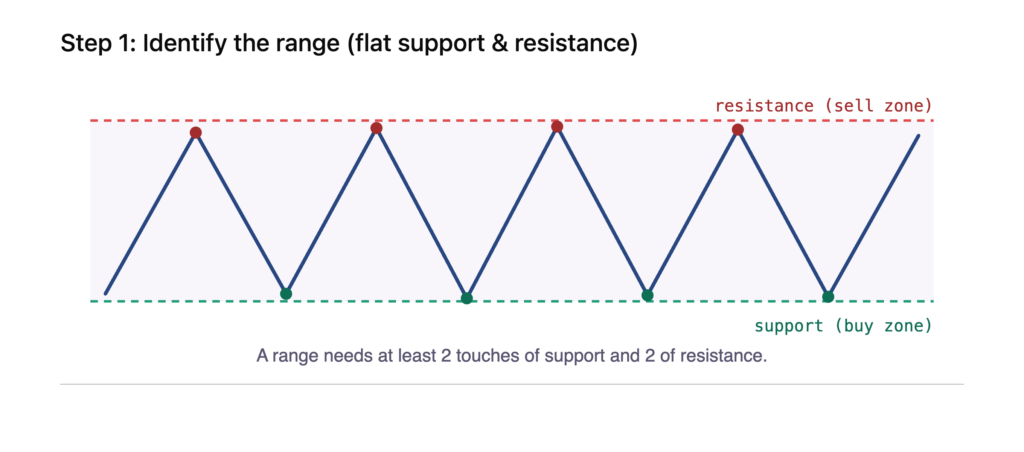
Before any strategy, you need a real range. The diagram above shows what to look for.
A valid range has a flat resistance level that price has rejected at least twice, and a flat support level that has held at least twice. The more touches, the more reliable the range. If the highs and lows are clearly rising or falling instead of staying flat, you are in a trend, not a range, and range trading crypto futures does not apply.
Range Trading Crypto Futures: Strategies & Risk Rules
A simple check: can you draw two roughly horizontal lines that contain most of the price action? If yes, you likely have a range.
Each method below is a different way to trade the same sideways structure. Learn the first before adding the rest.
Strategy 1: Buy Support, Sell Resistance
Range Trading Crypto Futures: Strategies & Risk Rules
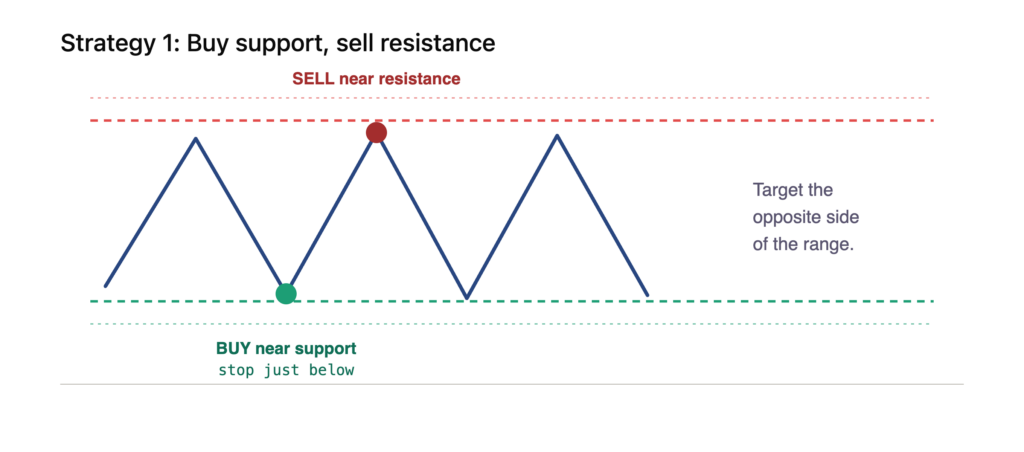
This is the heart of range trading crypto futures. When price falls to the support zone and shows signs of holding, you buy, with a stop just below support. When price rises to the resistance zone and stalls, you sell or go short, with a stop just above resistance.
Your target is the opposite edge of the range. The diagram above shows both entries and where the stops sit. The key is patience: you wait for price to reach an edge rather than trading in the muddy middle, where risk and reward are poor.
Range Trading Crypto Futures: Strategies & Risk Rules
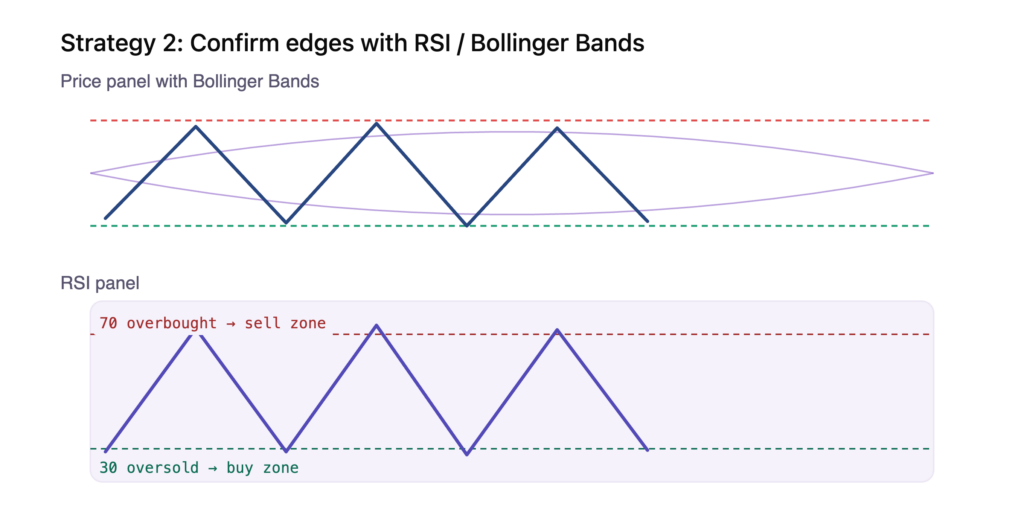
Buying support is stronger when an indicator agrees. This is where oscillators earn their keep in a crypto range trading strategy.
RSI and Stochastic RSI show momentum. When price hits support and RSI is oversold, near or below 30, the odds of a bounce improve. When price hits resistance and RSI is overbought, near or above 70, a rejection is more likely. Bollinger Bands work similarly: in a range, price tends to revert from the outer bands back toward the middle. The two-panel diagram above shows RSI hitting its extremes exactly as price reaches each edge.
Use these as confirmation, not as standalone signals. The level comes first; the indicator agrees second.
Strategy 3: Mean Reversion to the Middle
Range Trading Crypto Futures: Strategies & Risk Rules
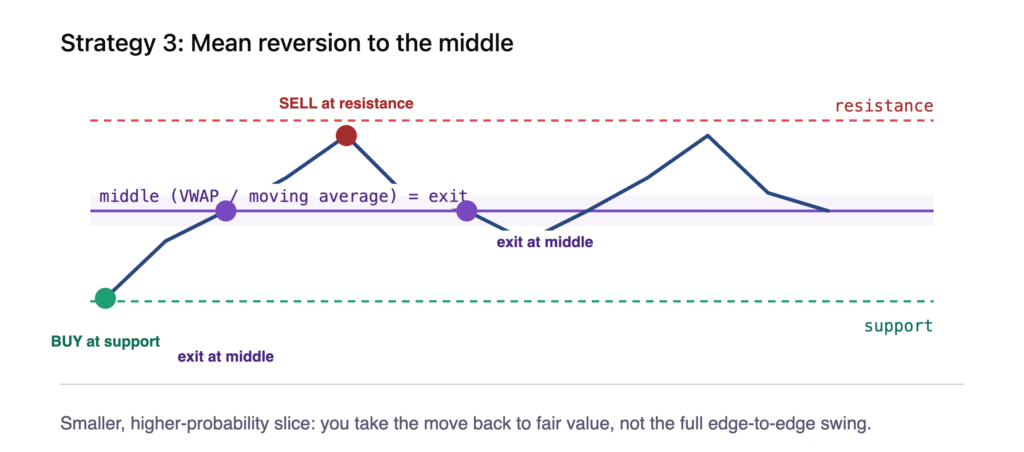
Sometimes you do not need to ride edge to edge. A mean reversion play takes a smaller, higher-probability slice: enter near an edge and exit at the middle of the range, often marked by VWAP or a moving average.
This books profit faster and avoids the risk of price stalling before it reaches the far side. It is a gentler way to practice range trading crypto futures while you build confidence.
The Tools That Make Range Trading Work
A few indicators do most of the heavy lifting in a sideways market:
Support and resistance. The foundation. Everything starts with clean levels.
RSI and Stochastic RSI. Flag overbought and oversold at the edges.
Bollinger Bands. Show when price is stretched and likely to revert.
None of these predicts the future. They stack the odds, and stacked odds are all any trader can ask for.
The Risk Rules for Range Trading Crypto Futures
Range Trading Crypto Futures: Strategies & Risk Rules
Ranges are clean until they break. These rules keep a broken range from breaking you:
Always stop just beyond the level. A long gets a stop below support; a short gets a stop above resistance. No exceptions.
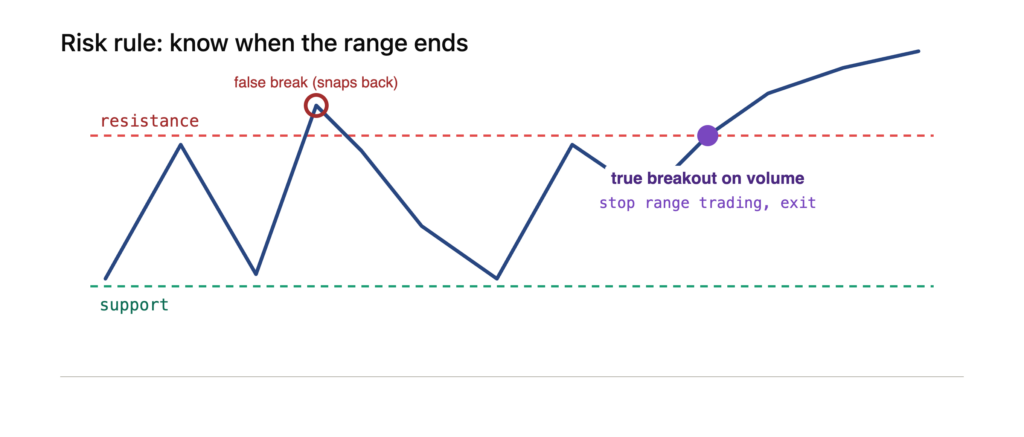
Respect the breakout. When price closes decisively outside the range on strong volume, the range is over. Stop range trading and step aside, or flip to a breakout plan.
Watch for false breakouts. A quick poke beyond the level that snaps back is a fakeout, and often a great range entry. The diagram above shows both a fakeout and a true breakout.
Keep leverage low. Ranges offer smaller moves than trends, so heavy leverage magnifies small mistakes fast.
Mind the funding rate. Holding crypto futures positions across funding times has a cost; factor it in on longer holds.
The single biggest danger in range trading crypto futures is refusing to admit the range has ended. Let the stop do its job.
How a Beginner Should Start
Keep it simple. Find one clean range on a higher timeframe like the 1-hour or 4-hour chart, where signals are less noisy. Mark support and resistance. Wait for price to reach an edge with RSI confirming, then take one small trade with a defined stop. Log it. Repeat. Thirty honest trades will teach you more about range trading crypto futures than any video.
Boring and consistent beats exciting and broke.
Conclusion: Trade the Chop, Respect the Break
Range trading crypto futures turns the market’s quietest phases into steady opportunity. Identify a clean range, buy support and sell resistance, confirm with RSI or Bollinger Bands, and above all respect the breakout when it finally comes. Done with discipline, range trading crypto futures is one of the most reliable ways for a beginner to trade a sideways market without waiting for a trend that may never arrive.
Priya still trades the same way. She stopped fighting the sideways market and started collecting from it. The chart is boring. Her results are not.
Ready to trade the range with real discipline? Mark your levels, wait for the edge, and place your next trade with a stop already set.
Disclaimer: This content is for educational purposes only and is not financial advice. Crypto futures trading involves significant risk, and leverage can amplify losses beyond your initial capital. Do your own research and never trade more than you can afford to lose.
FAQs
What is range trading in crypto?
Range trading in crypto is a strategy for sideways markets where price bounces between a clear support level and a clear resistance level. You buy near support and sell or short near resistance, aiming to profit from the repeated swings rather than from a big trend.
How do you identify a ranging market?
Look for a flat resistance level that price has rejected at least twice and a flat support level that has held at least twice. If you can draw two roughly horizontal lines that contain most of the price action, and the highs and lows are not clearly rising or falling, you likely have a range.
Is range trading profitable?
Range trading can be profitable because markets spend a large share of their time moving sideways, offering repeated two-sided entries with clear stops and targets. Profitability depends on entering near the edges, confirming with indicators, and cutting the trade quickly when the range breaks.
Which indicators are best for range trading?
The most useful tools are support and resistance levels, RSI and Stochastic RSI for overbought and oversold signals, Bollinger Bands for spotting stretched price, ATR for sizing stops, and VWAP as a mean-reversion target. Use indicators to confirm a level, not as standalone signals.
How do you avoid false breakouts in a range?
Wait for a candle to close decisively beyond the level rather than reacting to a wick, and require a volume spike to trust a breakout. A quick poke past support or resistance that snaps back into the range is often a false breakout and can even offer a strong range entry.
What is the best timeframe for range trading?
Higher timeframes like the 1-hour and 4-hour charts tend to produce cleaner, more reliable ranges with less noise, which suits beginners. Lower timeframes show more ranges but also more false signals, so they demand faster decisions and tighter risk control.
Can you use leverage in range trading?
Yes, but keep it low. Ranges produce smaller moves than trends, so high leverage magnifies the impact of small mistakes and false breakouts. Modest leverage combined with a tight stop just beyond the range edge is a safer approach for most traders.
Anupam has over 3 years of experience in the crypto industry, having worked with top indian crypto exchanges. He writes about Bitcoin, altcoins, AI, and emerging tech, helping readers understand what’s driving markets and where the digital asset ecosystem is headed.