How Does the RSI Indicator Work in Crypto Trading?
The Relative Strength Index is one of the most searched crypto technical analysis tools for a reason. It turns raw price changes into a readable momentum score. In this guide, you will learn the RSI formula, how to read overbought and oversold, practical RSI trading strategy ideas, and the pitfalls to avoid so you can apply RSI with confidence in crypto.
What Is the RSI Indicator in Crypto and Why It Matters
The relative strength index is an oscillator that ranges from 0 to 100. It measures how strong recent gains are relative to recent losses. When buyers dominate, RSI rises. When sellers dominate, RSI falls. Crypto trades nonstop and trends hard, so having a compact momentum gauge helps you quickly gauge if strength is building or fading.
RSI does not predict the future. It summarizes recent behavior so you can react with rules. That is its real edge for beginners.
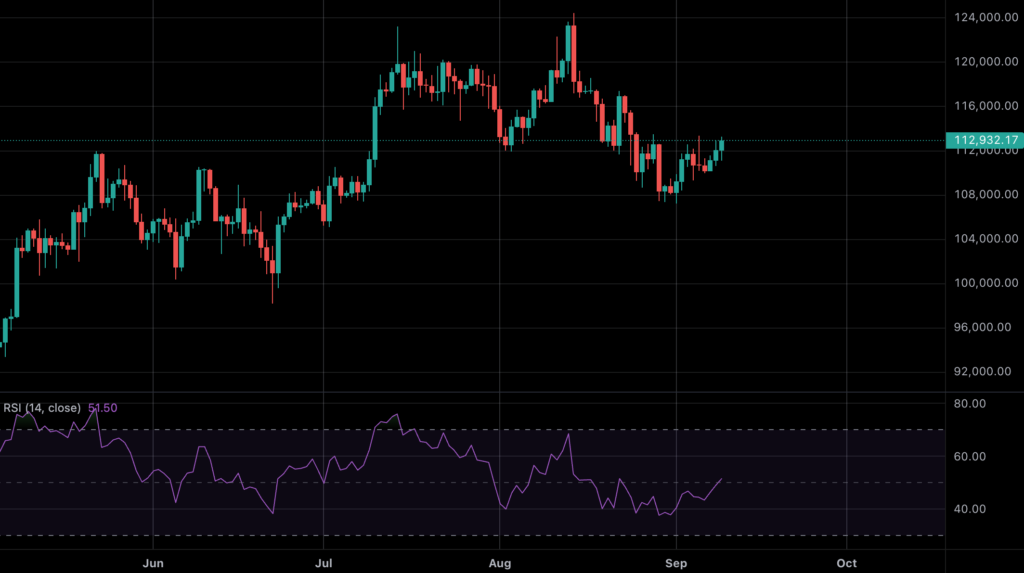
Bitcoin’s RSI is currently at 51.50, indicating a neutral momentum. It’s neither overbought nor oversold, suggesting that the market is in a consolidation phase and could move decisively in either direction depending on upcoming trends and volume.
How RSI Works in Crypto: The Formula Explained Simply
RSI is built from a few steps:
Compute average gain and average loss over a lookback, often 14 periods.
Calculate RS = Average Gain divided by Average Loss.
Convert to RSI = 100 − 100 ÷ (1 + RS).
Example walkthrough:
Pick a 14-candle lookback on a 4 hour BTC chart.
Sum all up closes, divide by 14 for average gain.
Sum all down closes (absolute values), divide by 14 for average loss.
RS = Avg Gain ÷ Avg Loss.
RSI = 100 − 100 ÷ (1 + RS).
A quick intuition: if average gains equal average losses, RS is 1 and RSI is 50. Above 50, bullish momentum is stronger. Below 50, bearish momentum dominates.
Wilder’s smoothing makes RSI responsive yet stable. You do not need to memorize the math. You just need to read where RSI sits and how it behaves around key zones.
Key RSI Settings for 24×7 Crypto Markets
Default: 14 periods on most charting platforms.
Useful variations:
7 to 9 periods: Faster and more sensitive. Good for scalping or volatile altcoins.
21 periods: Smoother and slower. Good for swing trades and trend confirmation.
Timeframes matter:
15 minute and 1 hour: Great for intraday timing, more noise.
4 hour and daily: Balanced signals for swing trades.
Weekly: Big-picture regime context.
Zone adjustments:
In strong uptrends, consider 80 overbought and 20 oversold because momentum can stretch.
In ranges, 70 and 30 often work well.
The 40 to 60 mid-zone helps you track when momentum flips sides.
For thin altcoins, widen your buffers. Liquidity gaps create spikes that can whipsaw tight RSI triggers.
Overbought and oversold: Above 70 suggests strength may be extended, below 30 suggests weakness may be extended. Extended does not mean reversal is guaranteed.
RSI ranges: In bull phases, RSI tends to live 40 to 80. In bear phases, it often lives 20 to 60. Where RSI spends time is as important as the spikes.
Bullish divergence: Price makes a lower low while RSI makes a higher low. Momentum loss hints at a possible turn up.
Bearish divergence: Price makes a higher high while RSI makes a lower high. Momentum loss hints at a possible turn down.
Hidden divergences: In trends, hidden setups can signal continuation rather than reversal.
A simple filter: trend up when RSI reclaims and holds above 50 to 55. Trend down when it fails and stalls below 45 to 50.
Seven Proven RSI Trading Strategy Approaches for Crypto
These are frameworks, not rigid rules. Combine them with risk management.
Buy-the-dip in uptrends (RSI 40 to 50 zone) Identify an uptrend using higher highs and higher lows. When RSI pulls back to 40 to 50 and turns up, enter with a stop under recent swing low. Exit on prior high or when RSI rolls over.
Range mean reversion (70 and 30 bands) In sideways markets, fade pushes into 70 to 75 and buy dips into 25 to 30. Use tight stops because ranges break without warning. Take profits near the middle of the range.
Divergence confirmation with volume or OBV Spot bullish or bearish divergence on RSI, then wait for supportive volume behavior. This adds conviction and cuts false positives during news spikes.
Breakout filter with RSI 60 and 40 For upside breakouts, require RSI to clear 60 and hold on retests. For downside breaks, require RSI to remain below 40. This filter avoids weak breaks.
RSI plus moving averages for confluence Trade in the direction of a rising 50 EMA when RSI stays above 50. Fade countertrend signals that do not align with the bigger moving average slope.
Support and resistance alignment Only act on RSI signals that occur at meaningful levels. Sell overbought near resistance. Buy oversold near support. This aligns momentum with structure.
Multi-timeframe alignment Use daily RSI for bias, 4 hour for entries. If daily is above 50 and rising, prioritize long setups on the 4 hour. If daily is below 50 and falling, prioritize shorts.
Limitations of the Relative Strength Index Indicator
Relative Strength Index can stay extended: In strong uptrends, RSI can hold above 70 while price keeps rising. Do not short just because it is overbought.
False divergences: Illiquid tokens and news spikes can print misleading divergences. Confirm with structure and volume.
Indicator lag: RSI summarizes what already happened. Combine it with trend context and risk rules.
Using RSI alone: RSI improves when paired with support and resistance, moving averages, and clean risk management.
A more reliable indicator is a disciplined process. RSI is one part of that process.
Conclusion
The relative strength index indicator crypto setups work best when you read them in context. The formula converts average gains and losses into a clear momentum scale, but the real skill is judging regime, aligning with structure, and managing risk. Start with one setup, test it across coins and phases, then evolve with disciplined journaling. With that process, RSI becomes a practical tool you can trust.
FAQs
What is a good RSI for crypto trading? There is no perfect number. Readings above 50 suggest buyers control momentum, and readings below 50 suggest sellers control momentum. In strong trends, adjust thresholds to avoid early exits.
Is RSI 70 and 30 reliable for crypto or should I use 80 and 20? Both can work. Use 70 and 30 for range markets. In strong trends, many traders prefer 80 and 20 so they do not fade strength too early.
Which timeframe is best for RSI in crypto? It depends on your style. Intraday traders often use 15 minute or 1 hour. Swing traders prefer 4 hour or daily. Weekly charts help define the backdrop.
How accurate is RSI compared to Stochastic RSI? RSI and Stochastic RSI both measure momentum differently. Stochastic RSI is the RSI of RSI and is more sensitive. Many traders prefer standard RSI for clarity and fewer false signals.
Can you use RSI alone for crypto trading? You can, but it tends to be noisier. Most traders pair RSI with support and resistance, moving averages, or volume, and always with strict risk rules.