Supertrend Indicator: What It Is, How It Works, and How to Use It
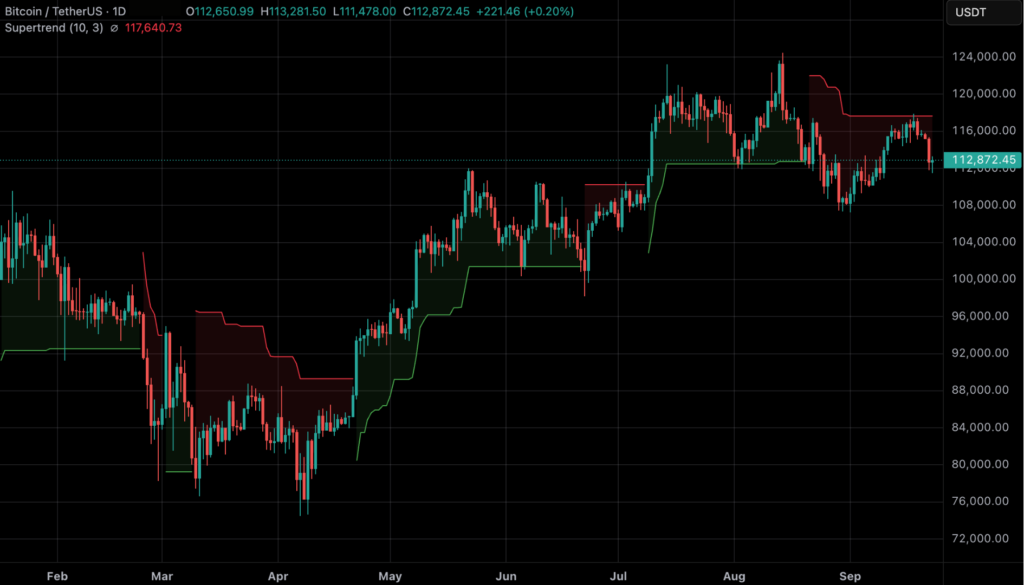
The Supertrend indicator is a popular trend-following overlay plotted on price charts. It was developed by Olivier Seban in 2009. The indicator uses the Average True Range (ATR) to set a dynamic band around price: a line turns green below price in uptrends and red above price in downtrends. Because it relies on past volatility and price, Supertrend is a lagging indicator (it reacts to price moves rather than predicting them).
It works best in strongly trending markets and can give false signals in choppy or sideways conditions. For this reason, traders often use Supertrend in conjunction with other indicators (ADX, moving averages, RSI, etc.) to confirm trends before acting.
Flips give signals (green = uptrend, red = downtrend).
How to Read the Supertrend Indicator (Step-by-Step)
Reading Supertrend in an Uptrend
When the Supertrend flips green and appears below the price, it signals that buyers are in control. The distance between the price and the green Supertrend line shows how strong the trend is. A wide gap suggests momentum. A narrowing gap indicates weakening strength and potential reversals. Price making higher highs while staying above the green Supertrend line typically confirms a healthy uptrend.
Reading Supertrend in a Downtrend
When the Supertrend flips red and plots above the price, it suggests sellers have the upper hand. The red line acts as a dynamic resistance that price often struggles to break. Consistent lower lows while staying below the red Supertrend line confirm a strong downtrend. If the price starts closing near the red line frequently, the trend may be losing momentum.
Common Traps When Reading Supertrend in Sideways Markets
In range-bound conditions, the Supertrend may flip colors multiple times and give misleading signals. These are traps caused by low volatility and choppy price action. The safest approach is to ignore signals when the price moves sideways, especially when candles remain close to the Supertrend line. Using moving averages or ADX as filters helps avoid these whipsaws.
Best Supertrend Indicator Settings
The Supertrend has two knobs you can adjust:
ATR length → how many candles you use to measure volatility.
Multiplier → how wide the bands are around price.
Smaller numbers (like ATR=7, Mult=2) make the line react faster, giving more signals but also more false ones.
Bigger numbers (like ATR=14, Mult=4) make the line slower, filtering noise but sometimes missing quick moves.
There isn’t a one-size-fits-all. Traders change settings depending on timeframe, market, and style.
Common Settings by Style
Trading Style
Chart Timeframe
Typical Setting
Why
Scalping
1–5 min
(7,2)
Fast response for quick trades
Intraday
5–15 min
(7–10, 2–3)
Balanced; catches most moves
Swing
Daily
(10–14, 3–4)
Smoother, less noise over days
Position
Weekly
(14,4)
Very stable, long-term trends
Crypto (high volatility)
Any
(7–10, 2–3)
Reacts to sharp swings
Forex (range-bound)
Any
(10–14, 3–4)
Filters out choppy moves
Best Supertrend Indicator Settings for Intraday, Swing, and Long-Term Trading
Best Supertrend Settings for Intraday Trading
Intraday traders need a balanced setup that reacts quickly without creating excessive noise. Settings like (7–10, 2–3) work well on 5–15 min charts because they adapt to rapid intraday volatility. Most intraday traders also filter Supertrend flips by checking whether the price is above or below a short-term moving average.
Best Supertrend Settings for Scalping
Scalpers rely on fast-moving signals on 1–5 min charts. Settings such as (7,2) or (5,1) make the indicator highly sensitive. This produces more entries but requires strict stop-loss discipline. Scalpers typically combine Supertrend with VWAP or a short EMA to confirm micro-trends and avoid noise-based flips.
Best Supertrend Settings for Swing and Position Trades
Swing traders prefer smoother settings that filter intraday noise. (10–14, 3–4) is common on daily charts, while weekly traders often use (14,4) for long-term trend following. These settings avoid frequent flips and allow trends to mature. They work best when aligned with broader market direction.
How to Use the Supertrend Indicator on TradingView, MT5, and Other Platforms
Supertrend Indicator on TradingView: How to Add and Change Settings
On TradingView, search for “Supertrend” in the Indicators menu and add the built-in version by TradingView. You can modify ATR length, multiplier, and styling from the Settings panel. The chart updates instantly as you adjust values. Many traders also save customized templates for different assets or strategies.
Supertrend Indicator on MT5 / MT4: Install, Download and Setup
MT5 or MT4 does not include Supertrend by default. Users must download a Supertrend indicator file (MQ5 or MQ4) from the platform’s marketplace or community library. After downloading, place the file in the Indicators folder, refresh the Navigator window, and drag it onto a chart. Settings can be adjusted from the Inputs tab.
Using Supertrend on Crypto Charting Platforms
Crypto platforms such as Binance, Bybit, KuCoin, and others often include Supertrend in their “Indicators” or “Trend” sections. Most platforms allow users to change ATR length and multiplier similarly to TradingView. The logic remains identical across platforms.
What does “7 and 3” mean?
The 7 means we calculate ATR from the last 7 candles.
The 3 means we multiply that ATR by 3 to set the bands.
So Supertrend (7,3) is just ATR length = 7, Multiplier = 3.
How to choose?
Start with the default (10,3) – it’s a good middle ground.
If you want faster signals, lower the numbers (like 7,2).
If you want safer, smoother signals, raise them (like 14,4).
👉 The golden rule: backtest first. Test different settings on past data for your chosen coin or market to see what works best.
Supertrend Indicator Buy–Sell Signals and Trailing Stop Rules
Buy signal: When price closes above the Supertrend line, the indicator flips below price and turns green. This signals an uptrend, so traders may enter long.
Sell (short) signal: When price closes below the Supertrend line, it flips above price and turns red, indicating a downtrend (short signal).
You can trail stops with the Supertrend line itself. For a long position, place the stop-loss at (or just below) the green line; for a short, place it at (or just above) the red line. Because the line adjusts each bar, it acts as a running stop. (Some traders add a small buffer, e.g. 0.1×ATR beyond the line, to avoid getting stopped on minor noise.) In practice, whenever the Supertrend line flips color, that often triggers closing the old trade and reversing into the new trend.
Confirmation & Avoiding False Signals
The Supertrend indicator gives a signal every time the trend flips, but not all of them are reliable. Some flips happen in sideways or choppy markets and can trick you into bad trades. To reduce these “fake signals,” traders use a few extra checks:
Check if the market is trending
Supertrend works best when price is clearly moving up or down.
A quick way: only take long trades if price is above a moving average (like the 50- or 200-period MA), and only short if it’s below.
Some traders also use an indicator called ADX (above 20 = decent trend).
Check momentum
Use RSI (Relative Strength Index).
If RSI just came out of oversold (<30) and Supertrend flips green, that’s stronger confirmation.
If RSI just dropped from overbought (>70) and Supertrend flips red, that strengthens a short signal.
Look for confluence
A signal is more powerful if it lines up with support/resistance, trendlines, or VWAP (an average price line used by pros).
Example: a Supertrend buy is stronger if price also breaks above a resistance level.
Wait for candle close
Don’t react to just a quick spike. Wait until the candle actually closes above/below the Supertrend line. This filters out a lot of fakeouts.
Follow higher timeframes
If the daily chart is showing an uptrend, it’s safer to only take buy signals on the 15-min chart.
Going against the bigger trend increases risk.
Be mindful of news
News events can break technical signals. Avoid trading right around big announcements.
Strategies (from simple to advanced)
The simplest way to use the Supertrend indicator is to follow the flips: buy when it turns green and sell when it turns red. Some traders add filters, like only taking green flips if price is above a moving average, or confirming signals with RSI. Others wait for a pullback to the Supertrend line before entering, which can give better risk-to-reward.
More advanced methods use two or three Supertrend lines with different settings, only trading when most agree. Day traders may also use Supertrend for quick scalps, focusing on one direction and trailing stops tightly. In crypto, traders often tighten settings to handle high volatility, while in Forex, they adjust based on session activity.
In short, the Supertrend indicator can be used alone or in combination, but the idea is always to filter out bad signals and ride the stronger trends.
Supertrend vs Other Indicators
The Supertrend indicator is often compared to other popular tools. While they all help with trends or volatility, they work a bit differently.
The Chandelier Stop also uses ATR, but it anchors from the highest or lowest price since entry. This means it can hold longer through pullbacks, while Supertrend may flip earlier on smaller moves.
A moving average crossover (like 50 vs 200 SMA) gives trend signals too, but it usually lags more and can whipsaw in sideways markets. Supertrend reacts quicker and also provides clear stop levels, something moving averages don’t.
Bollinger Bands plot volatility bands around a moving average and are mostly used for spotting overbought or oversold zones. Supertrend is different—it’s one directional line that flips with the trend, making it better for trend-following.
VWAP shows the average price weighted by volume and is popular for intraday trading. It reflects where most trading happened, while Supertrend is purely price and volatility-based. Using both together can give stronger signals.
RSI and MACD measure momentum. RSI shows overbought/oversold levels, and MACD shows momentum and trend shifts. They aren’t replacements but are often used alongside Supertrend to confirm entries and exits.
In short, the Supertrend indicator focuses on trend direction and trailing stops, while other indicators highlight momentum, volume, or volatility in different ways. They often work best in combination rather than alone.
Pros & Cons
Pros: The Supertrend indicator is easy to read—one line that turns green in uptrends and red in downtrends. It adjusts automatically to volatility using ATR, doubles as a trailing stop for exits, and works across all markets and timeframes. Beginners like it because it overlays directly on the price chart and gives clear signals.
Cons: It is a lagging tool, so signals appear after a move has already started. In sideways markets, it can flip back and forth and cause false entries. The results also depend heavily on the settings you choose; wrong parameters can create noise. Unlike other tools, it only shows direction, not trend strength, so it’s best used with confirmation from other indicators.
Does the Supertrend Indicator Really Work?
The Supertrend indicator works well in strong trending markets where price moves cleanly and volatility is consistent. In these conditions, the trailing logic helps capture large portions of directional moves. It performs poorly in sideways or choppy markets, where noise causes rapid color changes and false entries. Supertrend works best when paired with other tools such as moving averages, RSI, or ADX. These filters help confirm momentum and avoid low-quality setups. Like all technical indicators, Supertrend improves results only when combined with disciplined risk management.
Bottom Line & Risk Note
The Supertrend is a clear and useful way to follow trends, but it isn’t perfect. It can give late or false signals, so never rely on it alone. Always combine it with other tools like moving averages, RSI, or support and resistance to confirm trades.
Before using it with real money, test your strategy on past data and practice with paper trading. Manage risk carefully by sizing positions wisely and setting stop-losses (often just beyond the Supertrend line).
Think of the Supertrend indicator as one part of your toolkit, not a magic solution. Good results come from using it alongside proper risk management and confirmation signals.
FAQs
Which is the best Supertrend indicator?
There’s no universal best — start with the default (10,3) and adjust based on your asset and timeframe.
What is 7 and 3 in Supertrend?
It means ATR is calculated over 7 candles and multiplied by 3 to set the bands.
Does the Supertrend indicator work?
Yes, the Supertrend indicator works well in strong trending markets because it follows price direction using volatility-based bands. It performs poorly in sideways or choppy markets, where frequent flips can create false signals. It works best when combined with confirmation tools such as moving averages, RSI, or ADX, and with proper risk management.
How do you read the Supertrend indicator?
You read the Supertrend by watching where the line appears: – A green line below the price means an uptrend and potential buy conditions. – Red line above price means a downtrend and potential sell conditions. – If the price stays on one side of the line while making higher highs or lower lows, the trend is strong. Frequent flips usually indicate consolidation or noise.
What are the best Supertrend settings for intraday trading?
The most commonly used intraday settings are (7–10, 2–3) on 5–15 minute charts. These settings offer fast reactions without too many false signals.
How do I use the Supertrend indicator on TradingView?
Open TradingView, click Indicators, search for “Supertrend”, and select the built-in version. You can adjust ATR length and multiplier in the Settings panel and customize colors or line thickness.
How do I add the Supertrend indicator to MT5?
MT5 does not include Supertrend by default, so you must download an MQ5 Supertrend file from the Marketplace or CodeBase.
Is the Supertrend indicator leading or lagging?
It is a lagging indicator, since it reacts after price moves.
Which timeframe is best for the Supertrend indicator?
It works on all, but shorter settings fit intraday/scalping and longer ones suit swing or position trading.
How accurate is Supertrend / success rate?
Accuracy depends on asset, settings, and filters — backtesting is essential.
How to confirm a Supertrend?
Use other tools like moving averages, RSI, ADX, or support/resistance for stronger confirmation.
Best indicator with Supertrend (ADX/RSI/MAs)?
ADX for trend strength, RSI for momentum, and MAs for overall direction — they all work well with Supertrend.
Who invented the Supertrend indicator?
French trader Olivier Seban introduced it in 2009.
How is the Supertrend indicator calculated?
It uses the midpoint of price plus/minus ATR × multiplier, then flips when price closes beyond the band.
Difference between Supertrend & ATR?
ATR measures volatility, while Supertrend uses ATR to plot a trend-following line.
Anush is a crypto researcher dedicated to making blockchain insights clear and accessible. A proud Solana maxi who still appreciates a good Layer 2 debate, he dives deep into market trends so others don’t have to (but really should). Passionate about simplifying crypto, he strives to make the space less intimidating and a lot more relatable, one report at a time.