Circle stock (CRCL) has been one of the most talked-about listings on the NYSE since its 2025 debut, and one of the most volatile. If you’ve heard the name and want to understand what the company actually does, why the stock moves the way it does, and how to get exposure to it from India, including through tokenized spot trading, this guide covers all of it.
We’ll go through what Circle Internet Group actually is, why CRCL has swung so hard since listing, what a tokenized version of the stock is and isn’t, and the actual steps to buy tokenized Circle stock on Mudrex Spot.
Key Takeaways
Circle Internet Group (NYSE: CRCL) is the company behind USDC, one of the largest dollar-backed stablecoins, along with EURC, USYC, and the Arc blockchain.
CRCL has been extremely volatile since its June 2025 IPO: it priced at $31, closed its first day up sharply, later ran to a multi-hundred-dollar high, and has since corrected significantly.
A tokenized version of CRCL, available on Mudrex Spot as CRCLB, gives you price exposure to the stock through a crypto platform, without opening a US brokerage account.
Tokenized CRCL is not the same as owning the real share: you generally don’t get shareholder rights, and it’s taxed under India’s virtual digital asset rules rather than capital gains rules.
Buying tokenized CRCL on Mudrex follows the same steps as any other Spot purchase on the platform.
What Is Circle Internet Group (CRCL) Stock?
Circle Internet Group is the company behind USDC, one of the world’s largest dollar-backed stablecoins. It listed on the New York Stock Exchange in June 2025 under the ticker CRCL, after an earlier attempt to go public via SPAC fell through in 2021.
Founded in 2013 by Jeremy Allaire and Sean Neville, Circle is headquartered in New York and reported roughly $1.7 billion in revenue for 2024. Jeremy Allaire remains CEO, and the company’s president, Heath Tarbert, previously chaired the US Commodity Futures Trading Commission (CFTC), a detail worth knowing given how central regulatory credibility is to Circle’s business.
What Does Circle Actually Do?
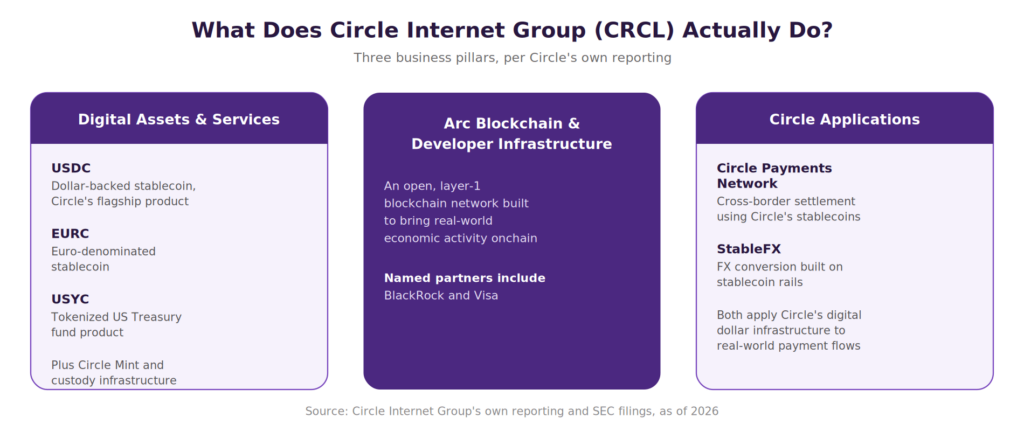
Circle’s business runs across three areas, per its own reporting.
Digital Assets and Services is the core of the business: USDC (its dollar stablecoin), EURC (a euro-denominated stablecoin), and USYC, a tokenized US Treasury fund product. Circle also runs Circle Mint and custody infrastructure that businesses use to issue and redeem these assets.
Arc Blockchain and Developer Infrastructure is Circle’s own layer-1 blockchain, built to bring real-world economic activity onchain. Circle has named BlackRock and Visa as initial partners on this network.
Circle Applications includes the Circle Payments Network, used for cross-border settlement using Circle’s stablecoins, and StableFX, a foreign exchange conversion product built on stablecoin rails.
In short: Circle makes money from the infrastructure around digital dollars, not from trading them, which is worth understanding before looking at why the stock behaves the way it does.
Why Has Circle (CRCL) Stock Been So Volatile Since Its IPO?
CRCL’s price history is a useful case study in how a genuinely new, hard-to-value category of company gets priced by the market.
Circle priced its IPO at $31 per share in June 2025, above its originally planned $27-28 range. The stock opened trading well above that at $69, and closed its first day at $83.23, one of the strongest single-day IPO pops of the year. It kept climbing over the following weeks, reaching a high in the high-$200s, before a sharp correction set in. By mid-2026, the stock had given back the vast majority of those gains, trading well below its post-IPO highs.
This kind of swing isn’t unusual for a newly listed company in a category investors are still trying to price correctly. Circle sits at the intersection of “regulated fintech” and “crypto infrastructure,” and analysts have been genuinely split on how to value that combination. Aggregate analyst consensus currently leans “Buy,” but that headline hides real disagreement underneath it; some major firms like Morgan Stanley have held Underweight ratings even as the average tilts bullish. That kind of dispersion is itself a signal that this is a stock without an established, agreed-upon valuation framework yet, which tends to produce exactly this kind of volatility.
What Is a Tokenized Version of Circle (CRCL) Stock?
A tokenized version of CRCL is a blockchain-based token designed to track the price of the real Circle Internet Group share, issued through a crypto platform rather than a stock exchange.
On Mudrex Spot, this is listed as CRCLB.
Most tokenized stock products, including this category generally, work on a custodial model: a custodian holds a real share (or a claim on one), and the token you hold represents an entitlement tied to that share, not direct legal ownership of it. That distinction matters more than it might first appear, and it’s the subject of its own detailed piece: Is Circle (CRCL) Tokenized Stock Safe? Backing, Custody, and Key Risks Explained.
How Is Tokenized Circle Stock Different From Buying CRCL Directly?
The core difference is what you actually end up holding, and the mechanics that follow from that.
Direct CRCL Stock
Tokenized CRCL (CRCLB)
What you own
Direct shareholder claim
Custodial token entitlement
Access route
US or India-based brokerage account
Crypto platform (e.g., Mudrex Spot)
Voting/dividend rights
Full shareholder rights
Generally none
Trading hours
US market hours
Often 24/7
Minimum investment
Often one full share or fractional, broker-dependent
How Can Indian Investors Get Exposure to Circle (CRCL) Stock?
Indian investors have the same broad set of options for CRCL as for any other US stock: remit funds under the RBI’s Liberalised Remittance Scheme (LRS) to a US or India-partnered broker, use GIFT City’s fractionalized receipts, or buy a tokenized version through a crypto platform.
The LRS route gives direct ownership but comes with a $250,000 annual cap and 20% Tax Collected at Source (TCS) above ₹10 lakh remitted in a year. The tokenized route skips that remittance process entirely, since it’s a domestic crypto transaction rather than a foreign exchange remittance, but trades LRS’s costs and limits for a different set of tradeoffs: the flat VDA tax rate and the absence of shareholder rights. Neither route is objectively better; they suit different goals.
Yes, this is one of the more practically useful differences for active traders specifically. Because CRCLB trades on a crypto platform rather than the NYSE directly, it isn’t bound to US market hours the way the real share is. That means you can react to news or price moves outside the 9:30 am-4 pm ET window the actual stock is confined to. This is covered in more depth in Can Indians Buy Circle (CRCL) Stock 24/7 Through Tokenized Spot Trading?
How to Buy Tokenized Circle (CRCL) Stock on Mudrex Spot
Buying CRCLB follows the same steps as any other Spot purchase on Mudrex; there’s no separate process for tokenized stocks specifically.
Download the Mudrex app and sign up using your phone number and email address, verifying both with the OTPs sent to you.
Complete KYC verification with your PAN and Aadhaar. This is mandatory before you can deposit funds or buy any asset, since Mudrex is an FIU-IND registered platform.
Add INR to your account via UPI or bank transfer from the home screen.
Search for “Circle” or CRCLB using the search bar.
Tap Buy, enter the amount you want to invest, and confirm the order.
What Are the Risks of Buying Tokenized Circle Stock?
A few risks are worth naming plainly, beyond the general volatility already covered above.
Single-stock concentration risk is real here specifically: CRCL’s post-IPO price history shows just how sharply a single, newly listed stock can move in both directions.
Custodial and counterparty risk applies to the tokenized route: your exposure depends on the custody and disclosure practices of whichever platform issues the token.
Regulatory risk cuts both ways, since Circle’s own business is exposed to how stablecoin regulation evolves, and tokenized stock products themselves currently sit outside SEBI’s regulatory framework in India.
Tax treatment for the tokenized route is a flat 30% on gains with no loss offset, which can be more expensive than capital gains treatment for a long-term holder.
See our dedicated piece, Does Circle (CRCL) Tokenized Stock Pay Dividends or Give Voting Rights?, for the ownership-rights side of this in full.
FAQs
What is Circle (CRCL) stock?
Circle Internet Group (NYSE: CRCL) is the fintech company behind USDC, EURC, and the Arc blockchain. It listed on the NYSE in June 2025.
Is Circle (CRCL) stock a good investment?
It depends on your goals and risk tolerance. CRCL has been highly volatile since its IPO, and Wall Street analysts are genuinely split; some maintain buy ratings on stablecoin-adoption grounds, others have moved to sell ratings on valuation. That split itself suggests there’s no settled consensus yet. Do your own research or speak with a financial advisor before deciding.
Does Circle (CRCL) stock pay a dividend?
No. As of this writing, Circle Internet Group does not pay a dividend, and management hasn’t indicated plans to start one.
How do tokenized stocks work?
Most tokenized stocks work on a custodial model: an issuer or custodian holds the real share, and mints a blockchain token that tracks its price and represents an entitlement to it. You get price exposure and typically 24/7 tradability, but usually not the full legal ownership or shareholder rights that come with holding the real share directly.
Is tokenized Circle stock the same as owning real CRCL shares?
No. Tokenized CRCL is generally a custodial entitlement tracking the stock’s price, not a direct legal shareholding, so you typically don’t get voting rights or dividends the way a direct shareholder would.
Can I buy Circle stock from India?
Yes, through LRS-based direct investing, GIFT City receipts, or a tokenized version like CRCLB on a crypto platform such as Mudrex Spot.
Risk Disclaimer
Trading tokenized stocks and other virtual digital assets carries the risk of capital loss. Tokenized products may involve custodial structures that differ from direct stock ownership. Tokenized stocks currently sit outside SEBI’s regulatory framework in India, and regulations may change. Please consult a qualified financial advisor or do your own research before making investment decisions.
Siri is a writer venturing into the exciting realms of blockchain technology, cryptocurrency, and decentralized finance (DeFi), eager to explore the transformative potential of these innovations. She brings a unique perspective that bridges traditional industries and cutting-edge technology, often infused with a touch of humor through memes. She has a rich background in real estate and interior design, having previously contributed to NoBroker, where she crafted blogs and assets on these topics.