

Colour trading is a short-duration online prediction game in which users stake money on a colour outcome, usually red, green or violet. Despite the word “trading,” no share, cryptocurrency or commodity is bought or sold. The result comes from the game’s own mechanism rather than an open financial market. This guide explains how colour trading works, its legality in India, major risks, common AI and chart claims, and legitimate alternatives.
Colour trading, also called colour prediction trading, is commonly presented as an easy way to make money by predicting which colour will appear next.

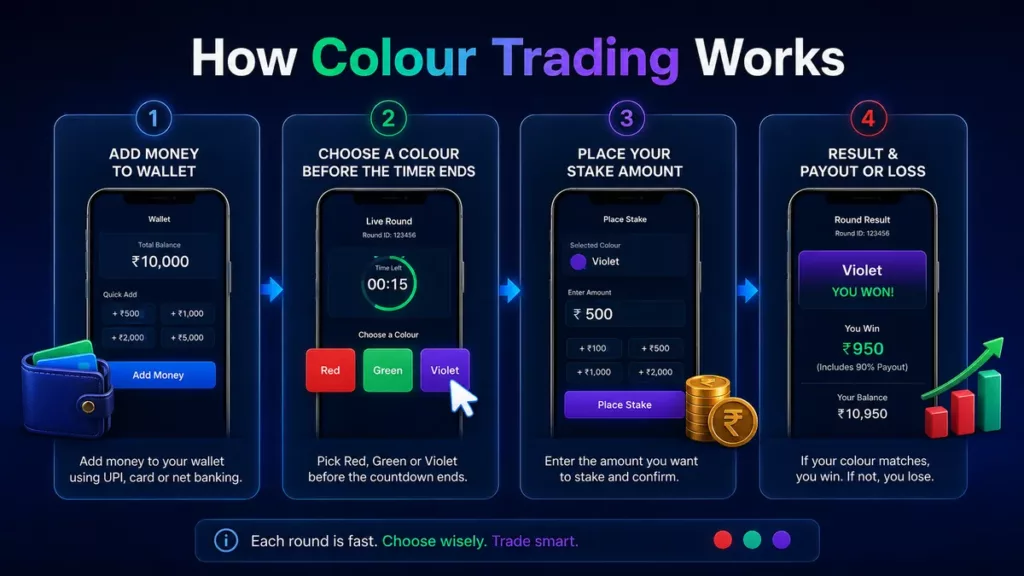
A colour trading app or website may show red, green and violet options, a countdown timer, previous outcomes and a wallet balance. You choose a colour, enter an amount and wait for the round to finish.
If your selected colour matches the announced result, the platform pays according to its stated payout rules. If it does not, you lose the stake.
The crucial difference from real trading is that there is no underlying financial asset. You are not buying Bitcoin, a share, gold or another instrument whose price is determined by market participants.
Do not confuse colour trading with the red and green candles used on genuine financial charts. In stock and crypto markets, candle colours represent real price movements. In a colour prediction game, the colour itself is the outcome on which money is being wagered.
The exact interface differs across colour trading apps, but the basic process usually looks like this:
Some platforms describe their results as being generated through an RNG, or Random Number Generator, while others refer more broadly to an algorithm or internal system.
However, simply claiming that an RNG is used does not prove fairness. Unless the mechanism and probabilities are independently audited in a verifiable way, users cannot know whether the advertised odds match the actual system.
Even a genuinely random game can be mathematically unfavorable.
Imagine a hypothetical game with a true 50-50 chance. You stake ₹100. A correct prediction returns ₹190 in total; an incorrect one returns ₹0.
Your expected return would be:
50% × ₹190 = ₹95
That means the mathematical expectation is a ₹5 loss for every ₹100 staked over many rounds.
That gap is commonly called the house edge.
This is only an illustration—the odds and payouts vary between platforms. The point is that if a platform pays less than the fair mathematical odds, repeated play creates a negative expected value even without manipulating the result.
Searches for colour trading chart patterns, prediction AI, AI panels and colour trading hacks are common because the interface often makes the activity look analytical.
But a colour-result chart is fundamentally different from a financial market chart.
A genuine Bitcoin or stock chart reflects actual transactions, prices, volume and supply-demand behaviour. A chart showing previous red, green or violet results only tells you what appeared in previous rounds.
If each result is genuinely independent, earlier colours do not predict the next one. If an internal platform system controls the outcome, outsiders still do not gain reliable access to that system by analysing previous colours.
Therefore, claims such as “100% accurate AI prediction,” “secret colour trading panel,” “sure-shot chart pattern,” or “guaranteed hack” should be treated as major red flags.
A colour trading demo account can show you what the interface looks like and how the buttons, timer and displayed balance work.
It cannot prove that:
A demo should therefore be viewed as an interface preview, not proof that colour trading can be learned profitably.
The word “trading” creates the biggest misunderstanding.
| Feature | Colour Trading | Stock Trading | Crypto Spot Trading |
|---|---|---|---|
| What you do | Stake money on a game outcome | Buy or sell securities | Buy or sell crypto assets |
| Underlying asset | None | Shares/securities | Digital assets |
| Result/price | Game mechanism | Market buyers and sellers | Global market buyers and sellers |
| Research | Does not create an asset-level analytical edge | Fundamental/technical analysis can inform decisions | Fundamental/technical analysis can inform decisions |
| India framework | Online gaming laws | SEBI/exchange framework | FIU/PMLA framework for VDA service providers |
| Returns guaranteed? | No | No | No |
| Main risk | Wager, fairness and platform risk | Market/business/liquidity risk | Volatility, custody and market risk |
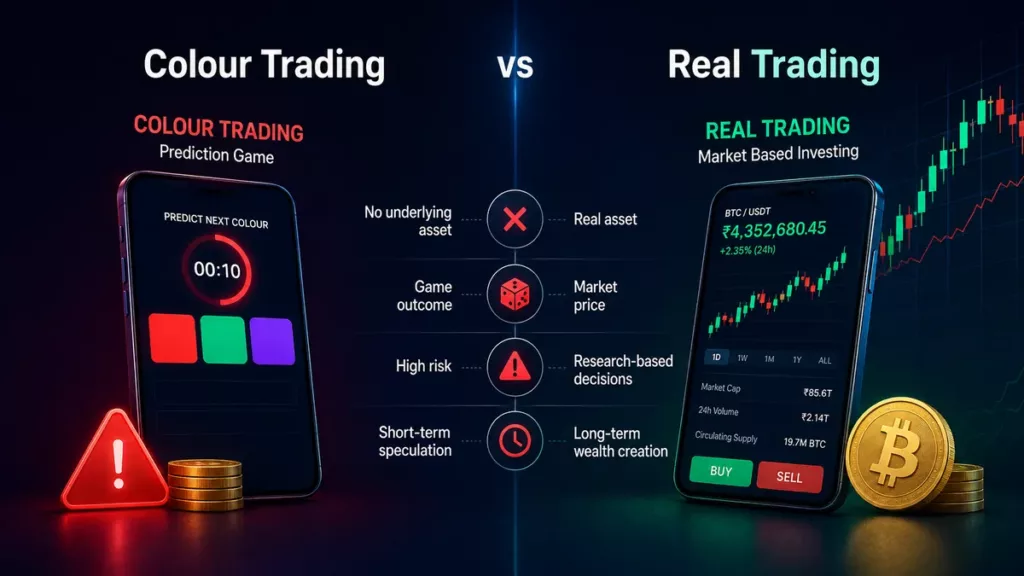
Real trading is not guaranteed to be profitable. Stocks can decline, and crypto can experience severe drawdowns.
The difference is that genuine markets involve identifiable financial or digital assets and observable market prices. Colour trading involves predicting the result of a game round rather than taking exposure to an asset.
For real-money colour prediction, the legal position is considerably clearer in 2026.
India’s Promotion and Regulation of Online Gaming Act, 2025 prohibits online money games, advertisements relating to online money games, and transfers of funds for such games. India Code lists these prohibitions under Sections 5, 6 and 7 of the Act.
The Promotion and Regulation of Online Gaming Rules, 2026 came into force on 1 May 2026. They also established a framework through the Online Gaming Authority of India for determining whether a particular game constitutes an online money game.
The Rules consider factors such as whether users pay fees or stakes, expect monetary winnings, how the revenue model works, and whether rewards can be redeemed or monetised.
A real-money colour prediction game that requires a stake in expectation of monetary winnings therefore has the characteristics used to identify an online money game.
The government has also stated that the Act prohibits all forms of online money games, including their advertising, promotion, facilitation and associated financial transactions.
That does not mean every free colour-themed game is illegal. The relevant issue is whether real money is being staked for monetary or monetisable winnings.
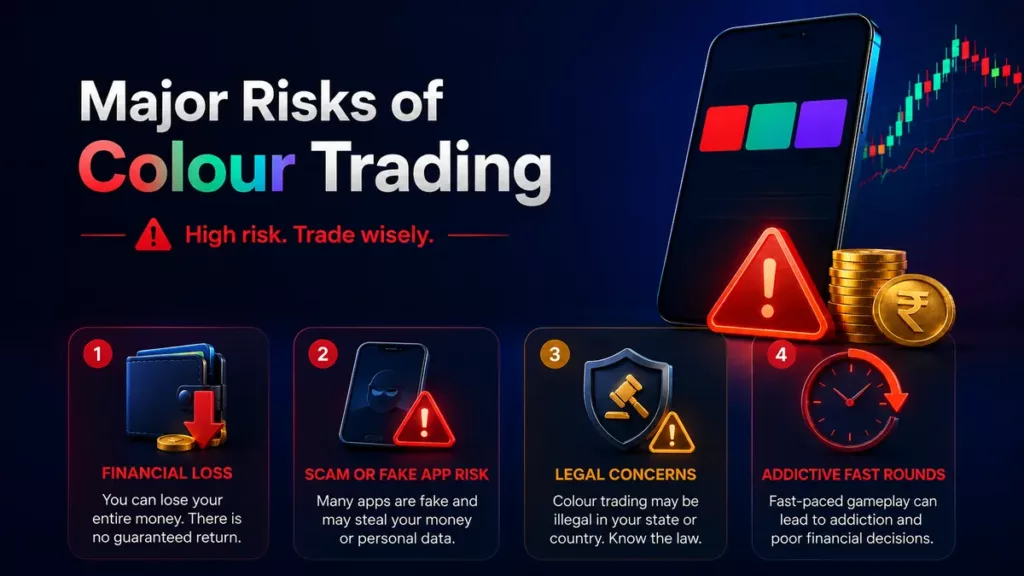
Short rounds allow users to place many wagers in a small amount of time. Even individually small stakes can accumulate into substantial losses.
If the result-generation mechanism is not independently auditable, users cannot verify whether published probabilities actually match the system producing the outcomes.
Suspicious platforms may make deposits easy but create new conditions when users attempt large withdrawals.
Warning signs include demands for additional “unlock”, “verification” or “processing” payments before funds are released.
Be especially cautious with a colour trading app download or APK distributed through WhatsApp, Telegram or an unofficial website.
Unknown apps may create privacy, malware and financial risks in addition to the money being wagered.
Guaranteed-return screenshots, Telegram prediction groups, paid colour signals and referral-heavy promotions can create the illusion that other users consistently make money.
Fast outcomes can encourage a user who loses ₹500 to stake ₹1,000 next time in an attempt to recover the loss. Repeating this behaviour can cause losses to escalate quickly.
Do not send more money because a platform claims another deposit will release your balance.
Save screenshots, transaction IDs, chats, phone numbers, payment details and any website or app information. Contact your bank or payment provider promptly.
For suspected online financial fraud, India’s National Cyber Crime Reporting Portal directs users to report through the 1930 cybercrime helpline and the national cybercrime reporting system.
Also be cautious of “recovery agents” demanding an upfront payment to retrieve lost funds.
If your goal is to save, invest or learn about markets, choose an instrument based on your objective rather than the excitement of short-term outcomes.
| Goal | Possible option | Main trade-off |
|---|---|---|
| Preserve capital | Fixed deposits or recurring deposits | Lower return potential and possible inflation risk |
| Long-term diversified investing | Mutual fund SIPs | Market risk remains; returns are not guaranteed |
| Research and own businesses | Direct stocks through a registered broker | Equity, business and liquidity risk |
| Higher-risk digital market exposure | Crypto spot trading | High volatility, custody and regulatory risk |
| Build an additional income stream | Freelancing, tutoring or other skill-based work | Requires time, skills and consistent effort |
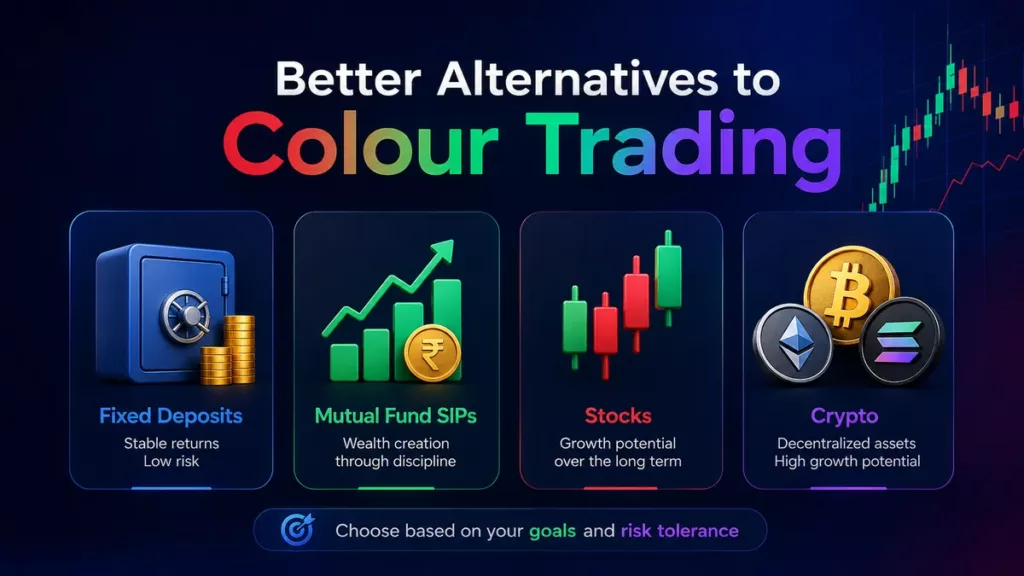
None of these options guarantees returns. The important difference is that they involve identifiable assets, financial products or genuine economic activity rather than wagering on a colour result.
Crypto trading is not risk-free and should not be presented as a guaranteed-income alternative. However, crypto spot trading and colour prediction games work in fundamentally different ways.
| Feature | Colour trading | Crypto spot trading |
| What you do | Stake money on a game outcome | Buy or sell a digital asset |
| Underlying value | No underlying financial asset | An identifiable crypto asset, subject to the platform’s custody and terms |
| How the result or price is formed | Internal game mechanism or announced result | Market prices formed through buyers and sellers |
| Role of research | Previous colours do not create a reliable analytical edge | Market data, liquidity, fundamentals and technical analysis can inform decisions, but cannot guarantee profit |
| Risk management | A single round may lose the amount staked, while repeated bets and platform-related risks can increase total losses | Position sizing, portfolio limits and order controls may help manage market risk, but cannot prevent lossesgement |
| Compliance context in India | Real-money versions may fall within the prohibited online money game framework | VDA service providers operating in India may have FIU-IND registration and AML/CFT obligations under the PMLA framework |
| Long-term outcome | No asset is accumulated | The asset may gain or lose value; returns are uncertain |
Crypto assets can be highly volatile. Users should understand the product, fees, custody arrangements, tax obligations and risk disclosures before trading.
For users who want to learn about crypto markets instead of participating in colour-prediction rounds, Mudrex provides a market-based platform and educational resources.
Mudrex supports an INR-focused experience for Indian users, including crypto prices and conversion tools such as the BTC-to-INR converter. Users can review market values in rupees and use supported INR deposit and withdrawal options, subject to KYC, product terms and applicable checks.
The Mudrex Learn library explains crypto concepts, market behaviour, trading approaches and risk-related topics. Beginners can use educational content to understand an asset and a product before deciding whether it is suitable for them.
Crypto markets provide observable prices, charts, market information and other tools that users can study. These tools do not predict the future or eliminate losses, but they allow users to make decisions using market data rather than a colour-result sequece.
Mudrex offers low trading fees on Spot and Futures, tight spreads and deep liquidity to help users execute trades efficiently with potentially lower slippage. Actual costs may vary by asset, order size and market conditions.
Mudrex is registered with FIU-India and the platform operates with ISO 27001:2022 and SOC 2 Type 2 security standards. These registrations and certifications support compliance and security processes, but they do not remove crypto-market volatility or guarantee investment performance.
Colour trading may appear simple and attractive because it relies on quick rounds, bright colours and instant results. However, the underlying activity is a prediction game based on chance, not the buying or selling of a real asset. Users cannot apply ordinary market research or technical analysis to create a reliable edge, and repeated participation can increase the risk of financial loss.
Crypto trading follows a different structure because it involves identifiable digital assets and prices formed through market activity. It is still volatile and risky, so users should learn the basics, understand the product and avoid promises of guaranteed returns.
Understanding the difference between colour trading and real market activity helps users choose more informed financial paths.
Colour trading borrows the language and visual appearance of financial markets, but the underlying activity is different. Users stake money on a game outcome rather than buying or selling an asset, and real-money versions face India’s current prohibition on online money games.
If your goal is to invest or learn real trading, choose markets and products where you understand what you own, how prices are formed, and what risks you are taking.
To make better crypto decisions, focus on learning fundamentals, managing risk and avoiding promises of guaranteed returns. Start with Mudrex Learn for detailed guides and follow the Mudrex YouTube channel for practical market education.
Real-money colour prediction games that involve staking money for monetary winnings can fall within India’s prohibited online money game framework. The 2026 Rules implementing the 2025 Act took effect on 1 May 2026.
Previous colour outcomes are not equivalent to financial-market price data. A visual sequence alone does not establish a reliable predictive trading signal.
Ranking real-money colour trading apps as “best” would be misleading. Users should focus on legality, transparency and financial risk rather than bonuses, downloads or payout promises.
Be cautious with APKs distributed through messaging apps or unofficial websites. They may expose users to device-security, data and financial risks.
A demo may demonstrate the interface, but it does not prove real-money profitability, fairness or reliable withdrawals.
Depending on your objective, alternatives include deposits, mutual funds, direct equities and crypto. Each has different levels of market risk, regulation, liquidity and suitable investment horizons.
There is no reliable basis to assume an AI can predict the next colour merely from previous outcome sequences. Claims of guaranteed AI accuracy should be treated with caution.
No. Colour trading involves wagering on a game outcome. Crypto spot trading involves buying or selling digital assets whose prices are formed through global markets.